A U.S. Navy G-1 Leather Flight Jacket from the fiscal year 1968.
The U.S. Navy (United States Navy) traces its origins to the Continental Navy, established in 1775 during the American Revolutionary War, and stands as one of six military branches of the United States Armed Forces.
Anchored by eleven nuclear-powered aircraft carriers, thirty-one amphibious assault ships, and seventy-one nuclear-powered submarines, the Navy maintains approximately 270 major surface combat vessels—including over 80 cruisers and destroyers, all equipped with the Aegis Combat System—alongside roughly 2,640 operational aircraft such as combat jets and anti-submarine patrol aircraft. With a total personnel strength of approximately 430,000 active and reserve personnel, it remains the world's largest naval force.
We present a specimen of the G-1 Leather Flight Jacket—a timeless standard that has been worn within the U.S. Navy since World War II.
The G-1 was developed specifically for pilots of the U.S. Navy aviation corps who launched from aircraft carriers.
The lineage of the G-1 traces back to the M-422, standardized by the U.S. Navy Bureau of Aeronautics in the 1940s.
By 1941, it was refined into the M-422A with a pen holder added to the left exterior pocket. Then in 1947, it evolved into what was first designated as the G-1 (55-J-14).
The MIL-J-7823 (AER) introduced in 1952 became the predecessor of the G-1 as we know it today, and was the first model to feature the "USN" stamp on the wind flap.
By 1971, five additional variations through the MIL-J-7823E specification had been manufactured.
The G-1 was discontinued in 1976, but strong demand from pilots of that era led to its reintroduction in 1984, and it has enjoyed enduring popularity ever since.
This model gained further renown when worn by Tom Cruise in the 1986 film Top Gun.
The specimen at hand represents the MIL-J-7823D (WP) variant, which remained in production until the specification transition between 1966 and 1971.
The contractor is Brill Bros.
This maker was involved in G-1 production throughout the period from 1968 to 1987.
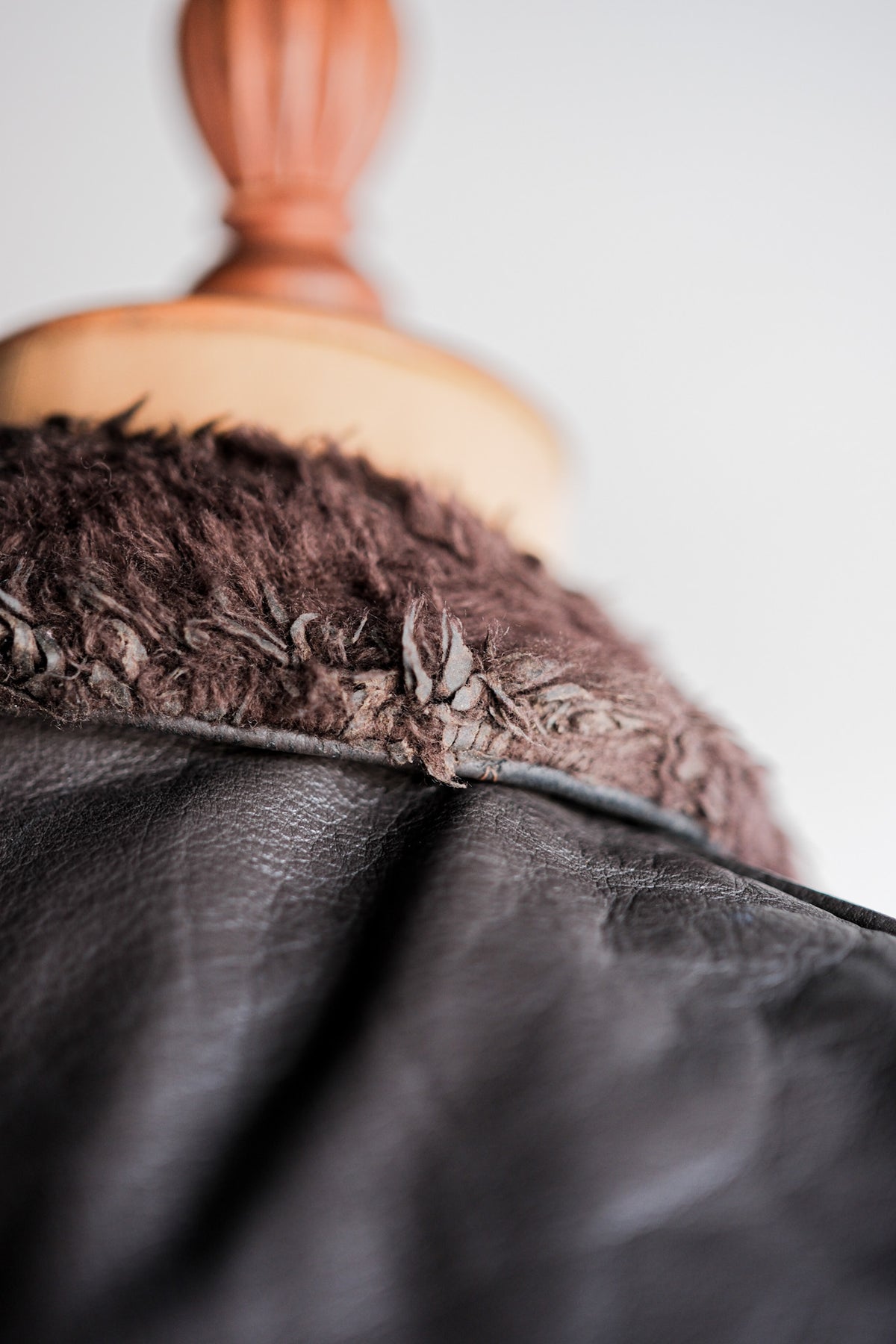
The MIL-J-7823D (WP) represents the final iteration before the collar transitioned from natural sheepskin shearling to synthetic alternatives. This particular piece retains the natural sheepskin collar that discerning collectors prize, making it precisely the specimen many seek.
In its details, the G-1 closely inherits the specifications of its predecessor, the M-422.
Designed for an era when aircraft cockpits were open to the elements, it features a chin strap and natural sheepskin shearling collar meant to be worn standing upright, complemented by functional action pleats across the back—a thoughtfully engineered piece bearing the hallmarks of military craftsmanship.
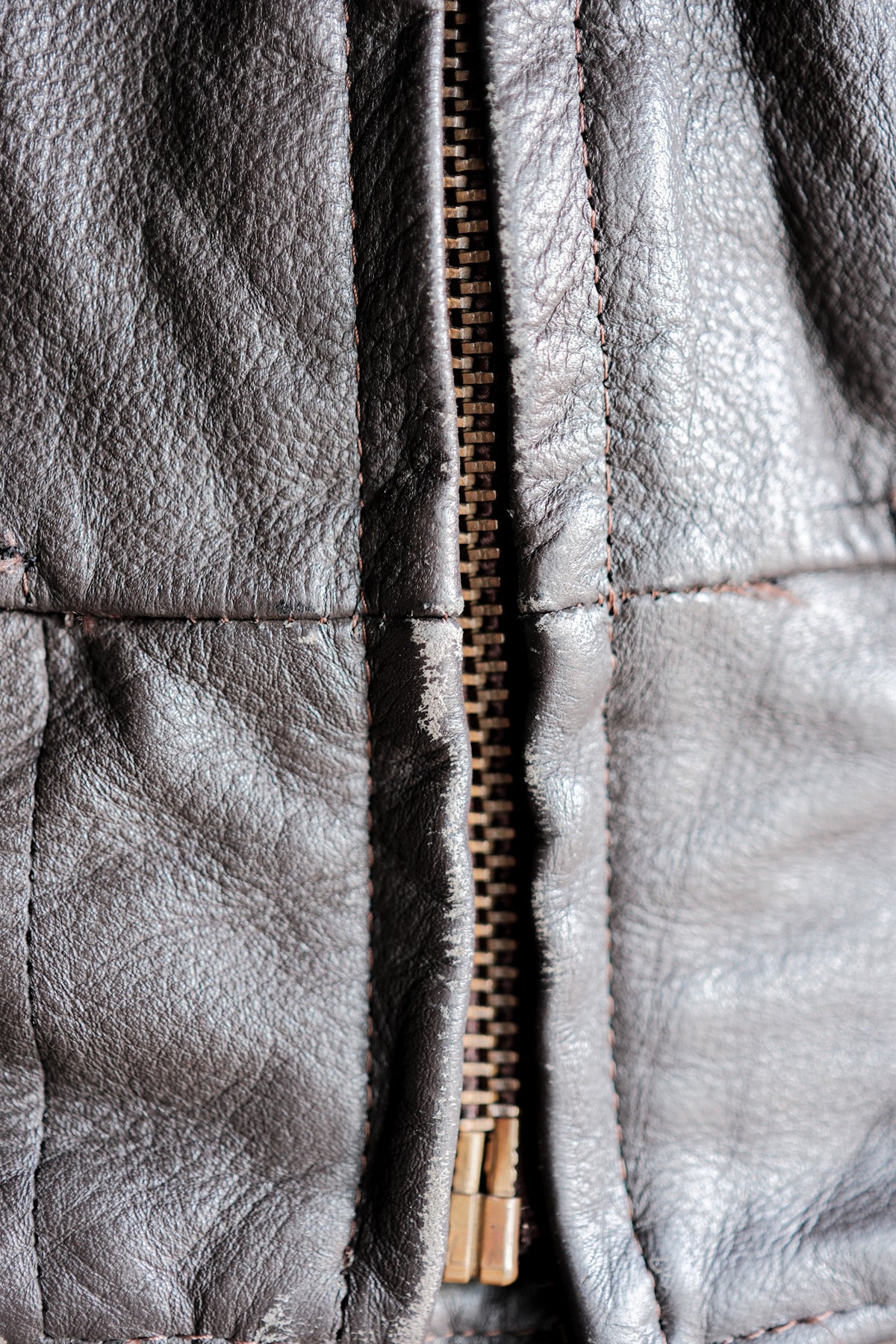
The front closure incorporates a wind flap to deflect drafts, and an official-issue punch-stamped "USN" mark attests to its military provenance.
The exterior is crafted from Goat Skin.
From 1975 onward, production transitioned from goat leather to Cowhide.
Goat Skin is leather made from the hides of mature goats.
Despite exceeding the tensile strength of cattle leather, it measures less than half the thickness, resulting in remarkable lightness while maintaining a dense fiber structure and durability.
It possesses considerable resilience while remaining supple to the hand, with excellent elasticity.
Many assume leather jackets to be rigid and uncomfortable to wear, yet the inherent qualities of this skin, combined with the softening that naturally occurs with time, make it accessible even to those typically averse to leather.
The lining employs Nylon Oxford.
Regulations stipulate that the lining should match the jacket body's color; in principle, it does. However, age and solar exposure typically result in fading.
Size marking is "36,"
which approximates a Japanese "S" size.
The actual measurements reflect a compact silhouette, suitable for those of smaller stature.
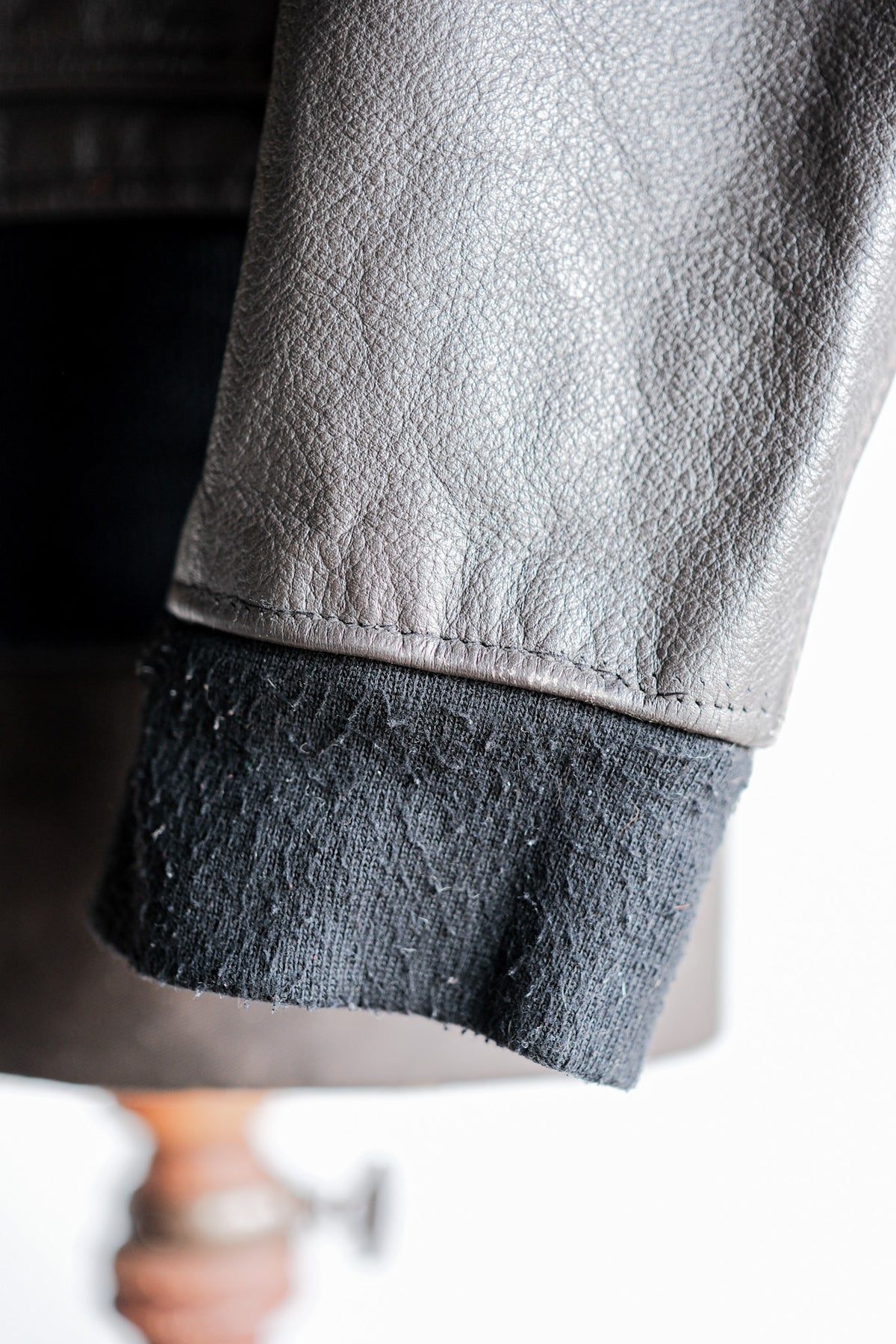
While wear is evident in soiling, fabric abrasion, minor pilling, and repair marks, no significant damage impairs wearability. This piece remains entirely serviceable.
Military pieces are inseparable from any discussion of American vintage.
Among them, the G-1 Leather Flight Jacket embodied here stands as an enduring classic, and its value will only appreciate.
Whether as a wardrobe staple or collection piece,it is beyond question a worthy addition.
Such rarities seldom pass through our hands. Should you have been seeking this particular jacket, consider this your opportunity.
![[~60's]U.S.NAVY G-1 Leather Flight Jacket Size.36](http://vieuxetnouveau-shop.com/cdn/shop/files/D6572AED-1647-46A2-B18A-6EC5FEDB4123-5718-00000443AE882C7A.jpg?v=1698146999&width=2400)
![[~60's]U.S.NAVY G-1 Leather Flight Jacket Size.36](http://vieuxetnouveau-shop.com/cdn/shop/files/73E5F0B6-480F-4897-A761-3200A0D498A6-5718-00000443A0CE5403.jpg?v=1698146999&width=2400)
![[~60's]U.S.NAVY G-1 Leather Flight Jacket Size.36](http://vieuxetnouveau-shop.com/cdn/shop/files/062D7E68-4379-44CE-A587-5F5281C9F3C1-5718-00000442291739E4.jpg?v=1698146999&width=2400)
![[~60's]U.S.NAVY G-1 Leather Flight Jacket Size.36](http://vieuxetnouveau-shop.com/cdn/shop/files/8973C02B-D417-46B5-975A-AE176422244B-5718-000004436E33B2B5.jpg?v=1698146999&width=2400)
![[~60's]U.S.NAVY G-1 Leather Flight Jacket Size.36](http://vieuxetnouveau-shop.com/cdn/shop/files/08C1391C-F7FB-4987-A2F9-31CDCCF45E82-5718-0000044355C3C93B.jpg?v=1698146999&width=2400)
![[~60's]U.S.NAVY G-1 Leather Flight Jacket Size.36](http://vieuxetnouveau-shop.com/cdn/shop/files/D00EB526-83AC-4156-A1E1-4B2E7600CE18-5718-000004434EEBFACD.jpg?v=1698146999&width=2400)
![[~60's]U.S.NAVY G-1 Leather Flight Jacket Size.36](http://vieuxetnouveau-shop.com/cdn/shop/files/6C4B386D-ED76-4451-9F44-01E27B359414-5718-00000442113B804E.jpg?v=1698146999&width=2400)
![[~60's]U.S.NAVY G-1 Leather Flight Jacket Size.36](http://vieuxetnouveau-shop.com/cdn/shop/files/487F905A-11A9-4590-A343-64D2E86CA24F-5718-00000443078C7704.jpg?v=1698146999&width=2400)
![[~60's]U.S.NAVY G-1 Leather Flight Jacket Size.36](http://vieuxetnouveau-shop.com/cdn/shop/files/BF403412-2B95-44E7-99C1-CD4C36172C02-5718-00000442F54CFA8E.jpg?v=1698146999&width=2400)
![[~60's]U.S.NAVY G-1 Leather Flight Jacket Size.36](http://vieuxetnouveau-shop.com/cdn/shop/files/C5448472-A273-4165-B8CA-3623143522E1-5718-00000442DAB6C15B.jpg?v=1698146999&width=2400)
![[~60's]U.S.NAVY G-1 Leather Flight Jacket Size.36](http://vieuxetnouveau-shop.com/cdn/shop/files/D2F1FF2D-B599-4D30-A366-801F17398D47-5718-000004438D52BF0D.jpg?v=1698146999&width=2400)
![[~60's]U.S.NAVY G-1 Leather Flight Jacket Size.36](http://vieuxetnouveau-shop.com/cdn/shop/files/F5AAF673-6788-49C8-AA75-C4B818F354F8-5718-000004437F0792AA.jpg?v=1698146999&width=2400)
![[~60's]U.S.NAVY G-1 Leather Flight Jacket Size.36](http://vieuxetnouveau-shop.com/cdn/shop/files/88116F4D-AC61-4BC7-947E-79E1E51536DE-5718-0000044376C5DC4E.jpg?v=1698146999&width=2400)
![[~60's]U.S.NAVY G-1 Leather Flight Jacket Size.36](http://vieuxetnouveau-shop.com/cdn/shop/files/1DF60C73-F5A9-471B-A8AB-34EA3EA080E6-5718-000004427620FB46.jpg?v=1698146999&width=2400)
![[~60's]U.S.NAVY G-1 Leather Flight Jacket Size.36](http://vieuxetnouveau-shop.com/cdn/shop/files/3E74CE09-249F-4497-B3ED-EEAB55451E4C-5718-00000442CD0CD37F.jpg?v=1698146999&width=2400)
![[~60's]U.S.NAVY G-1 Leather Flight Jacket Size.36](http://vieuxetnouveau-shop.com/cdn/shop/files/5F870550-0ECA-41F8-9B76-17F2547BC490-5718-0000044244CF439D.jpg?v=1698146999&width=2400)
![[~60's]U.S.NAVY G-1 Leather Flight Jacket Size.36](http://vieuxetnouveau-shop.com/cdn/shop/files/7D9F321B-D1BD-44A0-9C35-3F4B473B5A27-5718-00000442B4917C3A.jpg?v=1698146999&width=2400)
![[~60's]U.S.NAVY G-1 Leather Flight Jacket Size.36](http://vieuxetnouveau-shop.com/cdn/shop/files/A2BB72D7-FCF4-48A4-860A-BADC018B1971-5718-000004429E96B3F0.jpg?v=1698146999&width=2400)
![[~60's]U.S.NAVY G-1 Leather Flight Jacket Size.36](http://vieuxetnouveau-shop.com/cdn/shop/files/07A95EE7-BE2C-4EAB-A857-5980F0CBF382-5718-000004433AE5DAB3.jpg?v=1698146999&width=2400)
![[~60's]U.S.NAVY G-1 Leather Flight Jacket Size.36](http://vieuxetnouveau-shop.com/cdn/shop/files/E1EC54F2-3414-47BE-A9C9-19BD4E9117E1-5718-0000044317E0E94F.jpg?v=1698146999&width=2400)
![[~60's]U.S.NAVY G-1 Leather Flight Jacket Size.36](http://vieuxetnouveau-shop.com/cdn/shop/files/D2593F3B-3F81-403B-A7B6-6062D6679B25-5718-00000441FFC8B835.jpg?v=1698146999&width=2400)
![[~60's]U.S.NAVY G-1 Leather Flight Jacket Size.36](http://vieuxetnouveau-shop.com/cdn/shop/files/C7137D44-2729-41D0-BB41-5B4BBF8055F9-5718-00000441D6113A58.jpg?v=1698146999&width=2400)
![[~60's]U.S.NAVY G-1 Leather Flight Jacket Size.36](http://vieuxetnouveau-shop.com/cdn/shop/files/490C1B87-FA55-4083-B16F-170FB9C2075A-899-000002589257BBFF.jpg?v=1698146999&width=2400)
![[~60's]U.S.NAVY G-1 Leather Flight Jacket Size.36](http://vieuxetnouveau-shop.com/cdn/shop/files/7F9F4DBE-497A-4F55-A550-AC6DD8B3FBB8-899-0000025863A9EC31.jpg?v=1698146999&width=2400)
![[~60's]U.S.NAVY G-1 Leather Flight Jacket Size.36](http://vieuxetnouveau-shop.com/cdn/shop/files/9AD0CBE6-801F-49C0-B77E-459B6517B3DC-899-0000025849582A8D.jpg?v=1698146999&width=2400)
![[~60's]U.S.NAVY G-1 Leather Flight Jacket Size.36](http://vieuxetnouveau-shop.com/cdn/shop/files/A2701F68-3928-46D0-9B8F-A2B56B1A7CD4-899-00000258769C18DB.jpg?v=1698146999&width=2400)
![[~60's]U.S.NAVY G-1 Leather Flight Jacket Size.36](http://vieuxetnouveau-shop.com/cdn/shop/files/9B0CDA8D-A68E-4910-B86A-4E68F4700C32-1354-000003C17AAFA062.jpg?v=1698146999&width=2400)
![[~60's]U.S.NAVY G-1 Leather Flight Jacket Size.36](http://vieuxetnouveau-shop.com/cdn/shop/files/2BC69A0C-ADB6-4A84-A70E-4E37EBAA204A-1354-000003C0FBD7A0B7.jpg?v=1698146999&width=2400)
![[~60's]U.S.NAVY G-1 Leather Flight Jacket Size.36](http://vieuxetnouveau-shop.com/cdn/shop/files/C724551E-A74E-4011-A062-DFE93821AEB6-1354-000003C0C37A13A9.jpg?v=1698146999&width=2400)
![[~60's]U.S.NAVY G-1 Leather Flight Jacket Size.36](http://vieuxetnouveau-shop.com/cdn/shop/files/D2730986-6C68-43CA-8672-B275753218D3-1354-000003C0DEECEB68.jpg?v=1698146999&width=2400)
![[~60's]U.S.NAVY G-1 Leather Flight Jacket Size.36](http://vieuxetnouveau-shop.com/cdn/shop/files/1E1F1A3C-11D4-4882-A4D5-2588418F2C7D-1354-000003C16324D241.jpg?v=1698146999&width=2400)
![[~60's]U.S.NAVY G-1 Leather Flight Jacket Size.36](http://vieuxetnouveau-shop.com/cdn/shop/files/5336F375-EBF1-418B-95DF-B180542A4E85-1354-000003C12F48A8AD.jpg?v=1698146999&width=2400)
![[~60's]U.S.NAVY G-1 Leather Flight Jacket Size.36](http://vieuxetnouveau-shop.com/cdn/shop/files/38DFD6BB-AAF2-474E-AA47-3470F5F5BF90-1354-000003C11A24538E.jpg?v=1698146999&width=2400)
![[~60's]U.S.NAVY G-1 Leather Flight Jacket Size.36](http://vieuxetnouveau-shop.com/cdn/shop/files/8D4EC1BE-92E7-4328-9B12-C7C2F4A7780C-1354-000003C1502EE512.jpg?v=1698146999&width=2400)
![[~60's]U.S.NAVY G-1 Leather Flight Jacket Size.36](http://vieuxetnouveau-shop.com/cdn/shop/files/9D137ACF-4908-4AAB-8C96-49BA490884E9-1354-000003C0AE5F6CEF.jpg?v=1698146999&width=2400)
![[~60's]U.S.NAVY G-1 Leather Flight Jacket Size.36](http://vieuxetnouveau-shop.com/cdn/shop/files/525D4AE6-9493-4583-8AF2-8F73EEE9477C-1354-000003C19D194E66.jpg?v=1698146999&width=2400)
![[~60's]U.S.NAVY G-1 Leather Flight Jacket Size.36](http://vieuxetnouveau-shop.com/cdn/shop/files/926A5157-85BB-4C02-8D49-0743A5A00E79-1354-000003C1892CAD8B.jpg?v=1698146999&width=2400)
![[~60's]U.S.NAVY G-1 Leather Flight Jacket Size.36](http://vieuxetnouveau-shop.com/cdn/shop/files/670CD5D8-CC3A-4E08-92ED-94A722319C83-1354-000003C09EEDB612.jpg?v=1698146999&width=2400)
![[~60's]U.S.NAVY G-1 Leather Flight Jacket Size.36](http://vieuxetnouveau-shop.com/cdn/shop/files/34461701-9172-48D3-AF0A-CA4A5B570B8D-1354-000003C14574DF8E.jpg?v=1698146999&width=2400)
![[~60's]U.S.NAVY G-1 Leather Flight Jacket Size.36](http://vieuxetnouveau-shop.com/cdn/shop/files/AD0F5844-02EE-44D7-ACE3-3F613CB4C47C-1354-000003C1AFF36D1A.jpg?v=1698146999&width=2400)
![[~60's]U.S.NAVY G-1 Leather Flight Jacket Size.36](http://vieuxetnouveau-shop.com/cdn/shop/files/4B33D235-828C-41FF-8412-1C5006A60B9A-1354-000003C0834C5E8E.jpg?v=1698146999&width=2400)
![[~60's]U.S.NAVY G-1 Leather Flight Jacket Size.36](http://vieuxetnouveau-shop.com/cdn/shop/files/B2A73FA3-2E07-4AC2-9E1A-83E85DC5FC87-1354-000003C0761B9B5D.jpg?v=1698146999&width=2400)
![[~60's]U.S.NAVY G-1 Leather Flight Jacket Size.36](http://vieuxetnouveau-shop.com/cdn/shop/files/0EA81FE2-5D93-4057-8916-72B638BDA670-1354-000003BC850E1E15.jpg?v=1698146999&width=2400)