Dating to approximately the 1930s, this French Army indigo herringbone twill linen double breasted mechanic jacket represents a truly exceptional piece.
A superlative acquisition.
The Armée française constitutes the armed forces of the French Republic, comprising principally the Armée de Terre (Army), Marine nationale (Navy), Armée de l'Air et de l'Espace (Air and Space Force), and Gendarmerie nationale (National Gendarmerie).
Within this structure, the Armée de Terre in its strictest sense possesses the most venerable tradition, with origins traceable to the medieval Capetian period. Its establishment as a modern state military apparatus, however, crystallised following the French Revolution of 1789.
During the First World War, the Armée de Terre served as a principal Allied force, contributing to victory despite considerable sacrifice. The subsequent Second World War brought defeat through German blitzkrieg in 1940, with portions of the military placed under German administration under the Vichy regime. Concurrently, the Forces françaises libres (Free French Forces) under Charles de Gaulle continued operations alongside the Allies.
Following the Second World War, the establishment of the Fourth Republic in 1946 prompted military reorganisation, with the Armée française subsequently engaged in colonial conflicts—the Indochina and Algerian Wars among them. This experience profoundly shaped Cold War military doctrine.
Contemporary French military forces maintain their position as principal custodians of international security through frameworks of the European Union, NATO, and the United Nations. Global military operations are sustained through counter-terrorism operations in the Sahel region (Opération Barkhane) and external projection capabilities centred upon the aircraft carrier Charles de Gaulle.
We present herein a specimen issued and worn primarily by French Army communications personnel as regulation workshop dress—the Indigo HBT Linen Double Breasted Mechanic Jacket.
Among the considerable range of French military garments, this model occupies singular status as a consummate piece.
The distinction of this particular example emerges with clarity. First, the immediately striking double breasted front closure commands attention.
Upon this foundation lies indigo dyeing—itself a rarity among French vintage—further enriched by linen's characteristic fluid drape. The garment establishes its presence through material and dye rather than embellishment. Here, the cloth itself speaks.
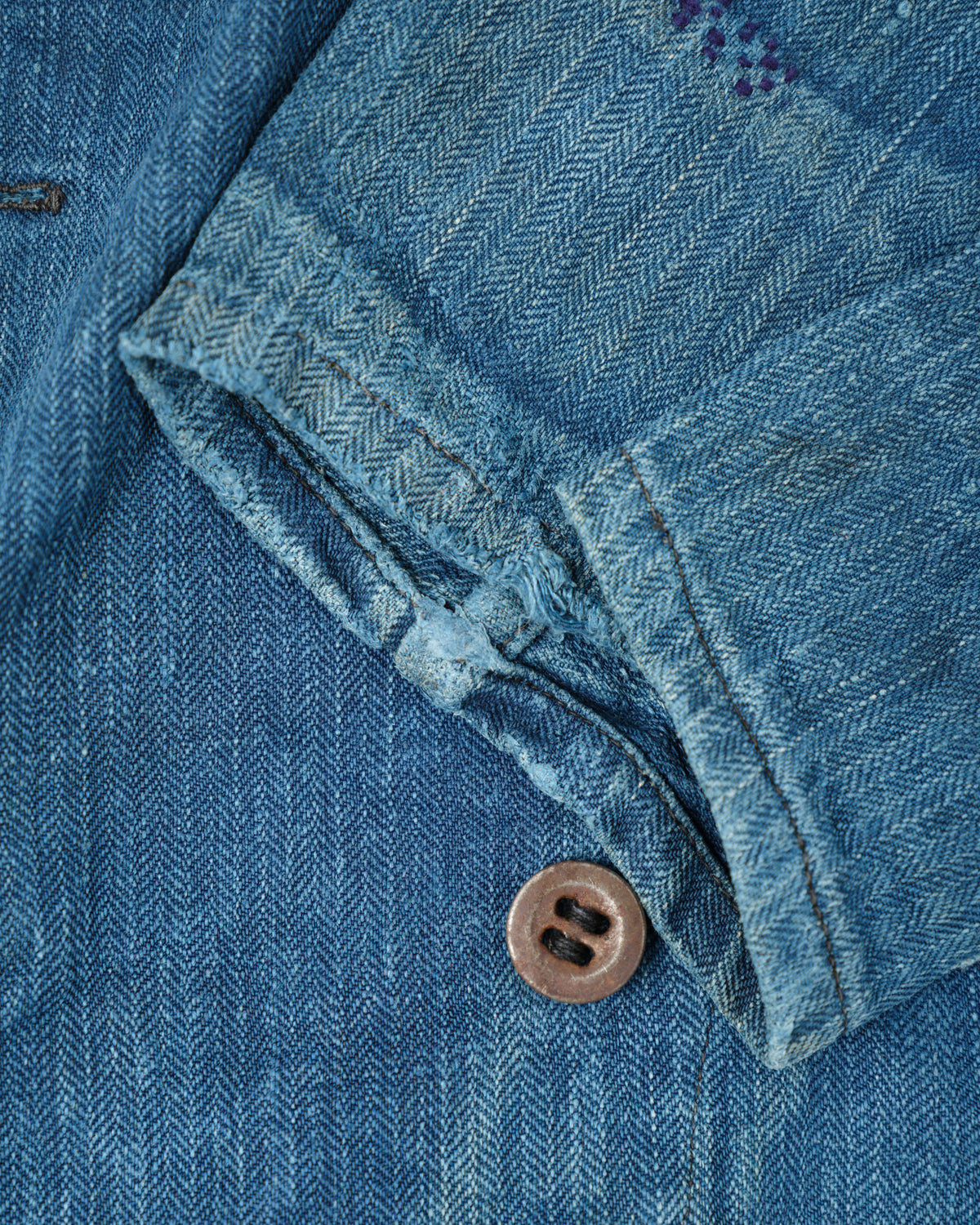
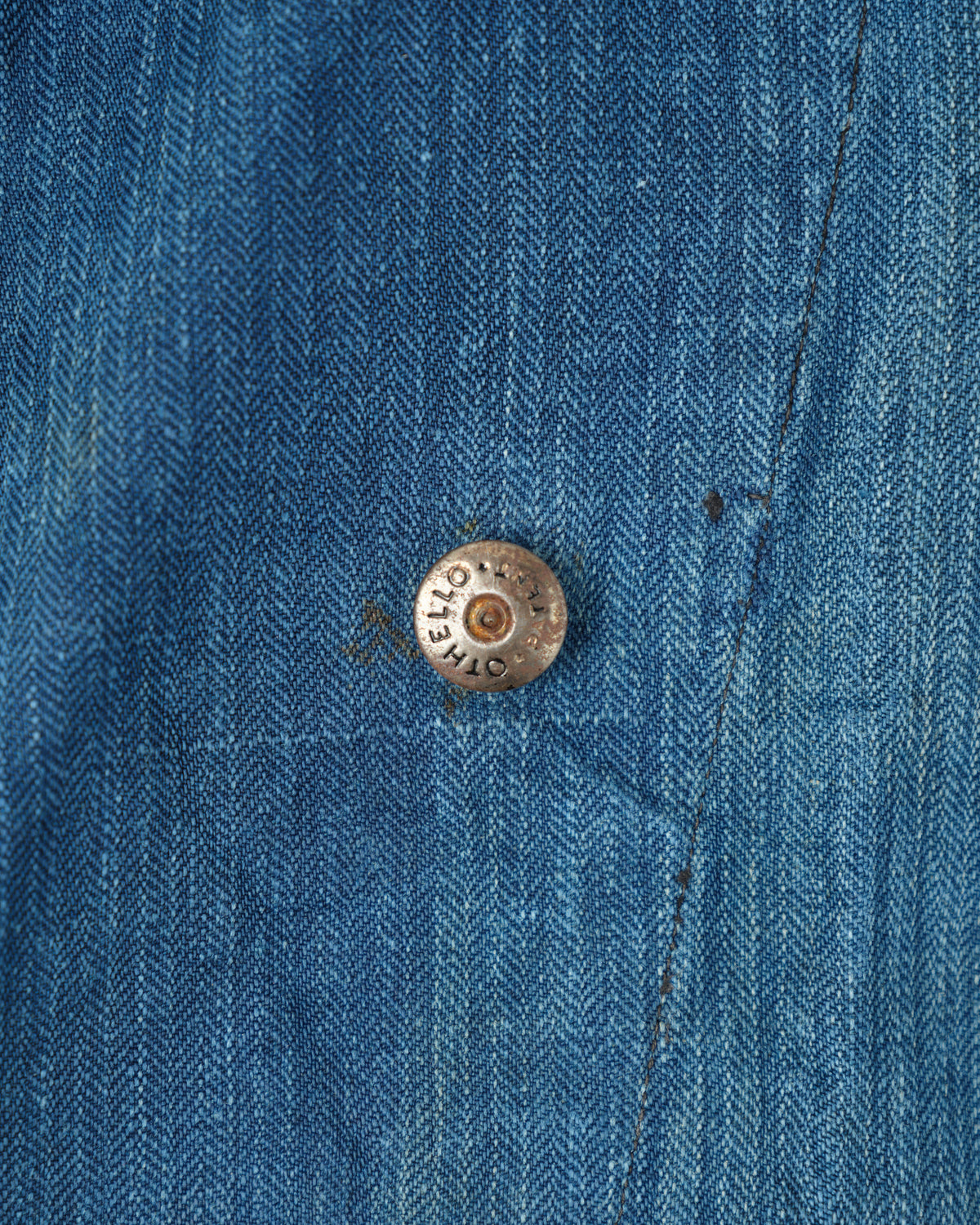
A significant detail warrants mention: the buttons on the men's closure are absent, rendering the jacket functional presently only in right-hand closure (women's style). Yet we might regard this less as deficiency than as productive absence. Naturally, should buttons be affixed, conventional men's closure function may be restored.
This specimen further bears evidence of modification—the patch pocket originally positioned at the lower right front has been removed. The consequence proves unexpectedly contemporary: a single pocket remains, creating asymmetry that carries a distinctly modern sensibility.
Against the pronounced double breast, the hem presents patch pocket alone. This restraint paradoxically strengthens the garment's visual authority.
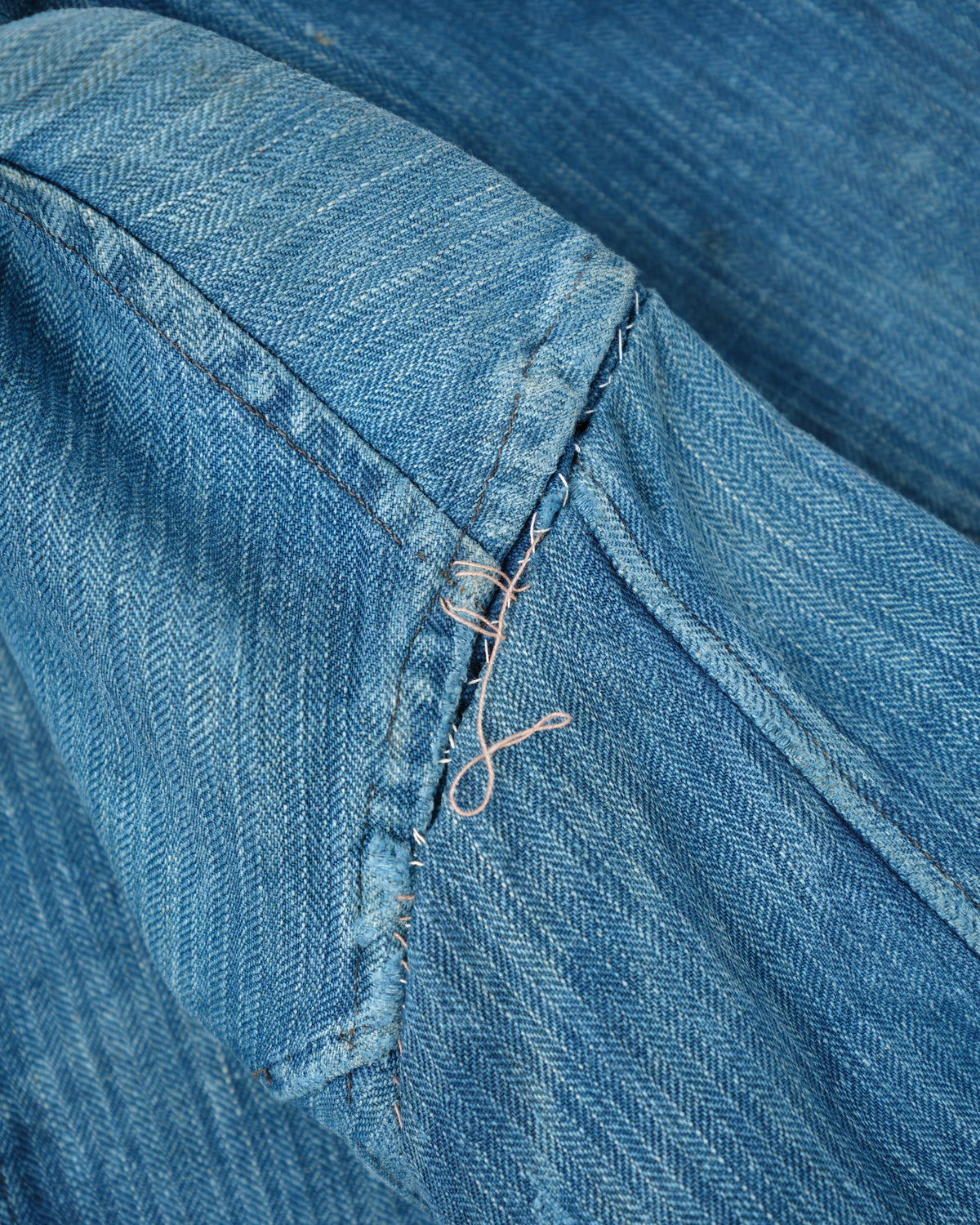
The back reveals the pronounced back yoke angle characteristic of earlier jackets, its geometry assuring dimensional construction. The centre back seam and shoulder-to-body line possess inherent three-dimensionality, a quality that prevents visual flatness.
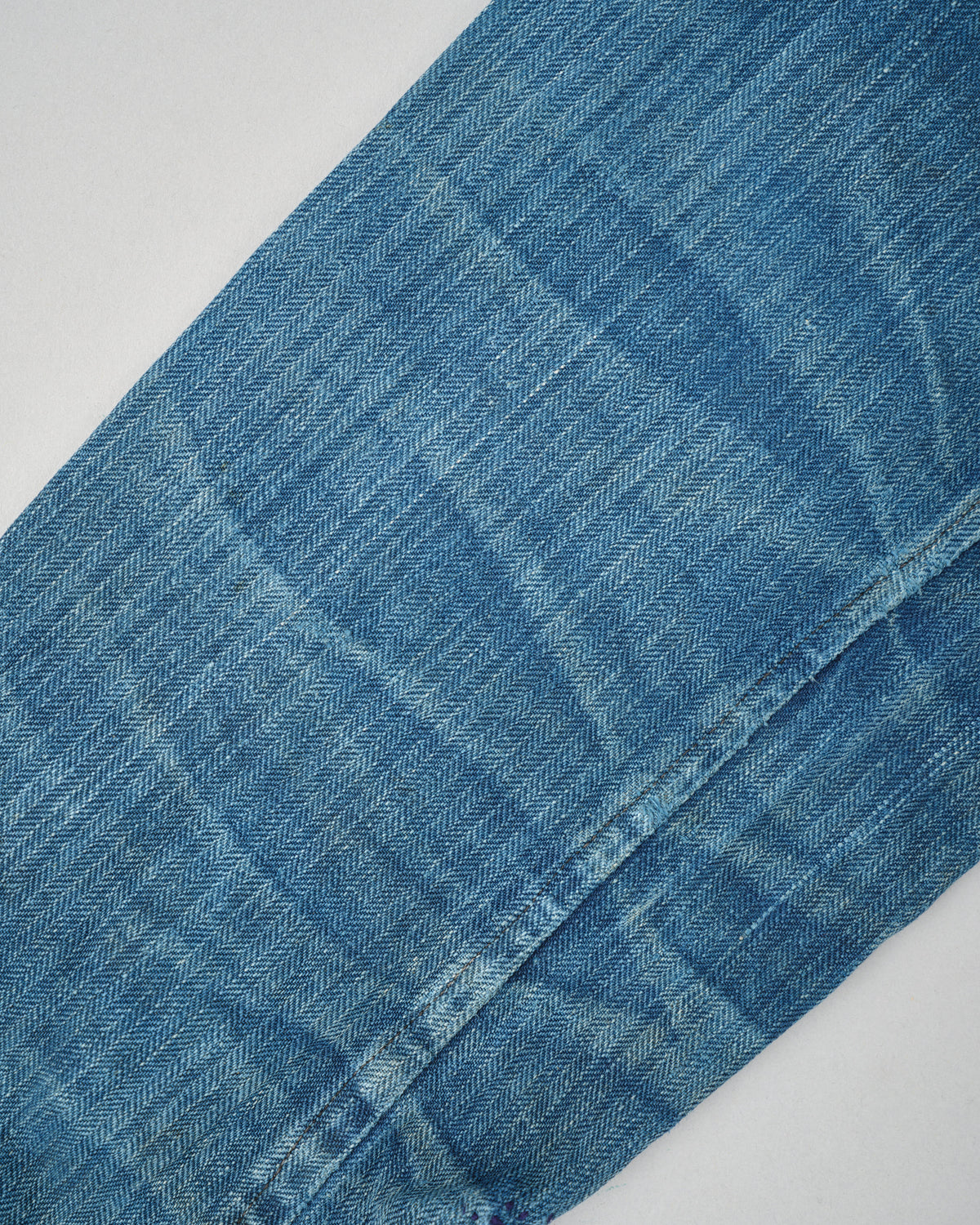
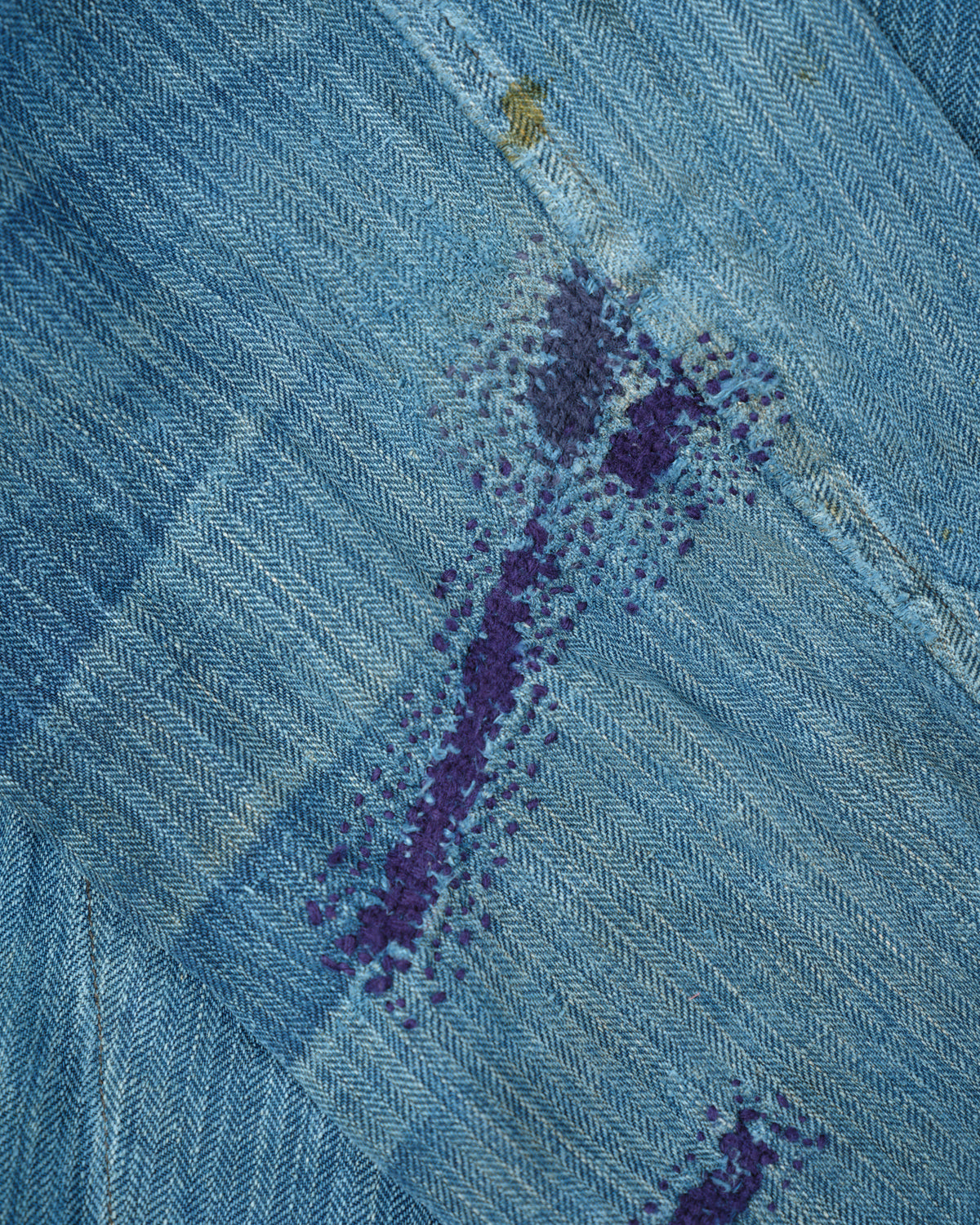
This example employs indigo-dyed herringbone twill linen.
Within French vintage, the conjunction of linen, HBT, and indigo represents an exceptional proposition. The labour and cost required to weave such pronounced herringbone in linen restricts production severely; specimens remain exceptionally limited.
That such refined fabric would be applied to the mechanic jacket—inherently a consumable utility garment subjected to rigorous use—stands as remarkable even by period standards.
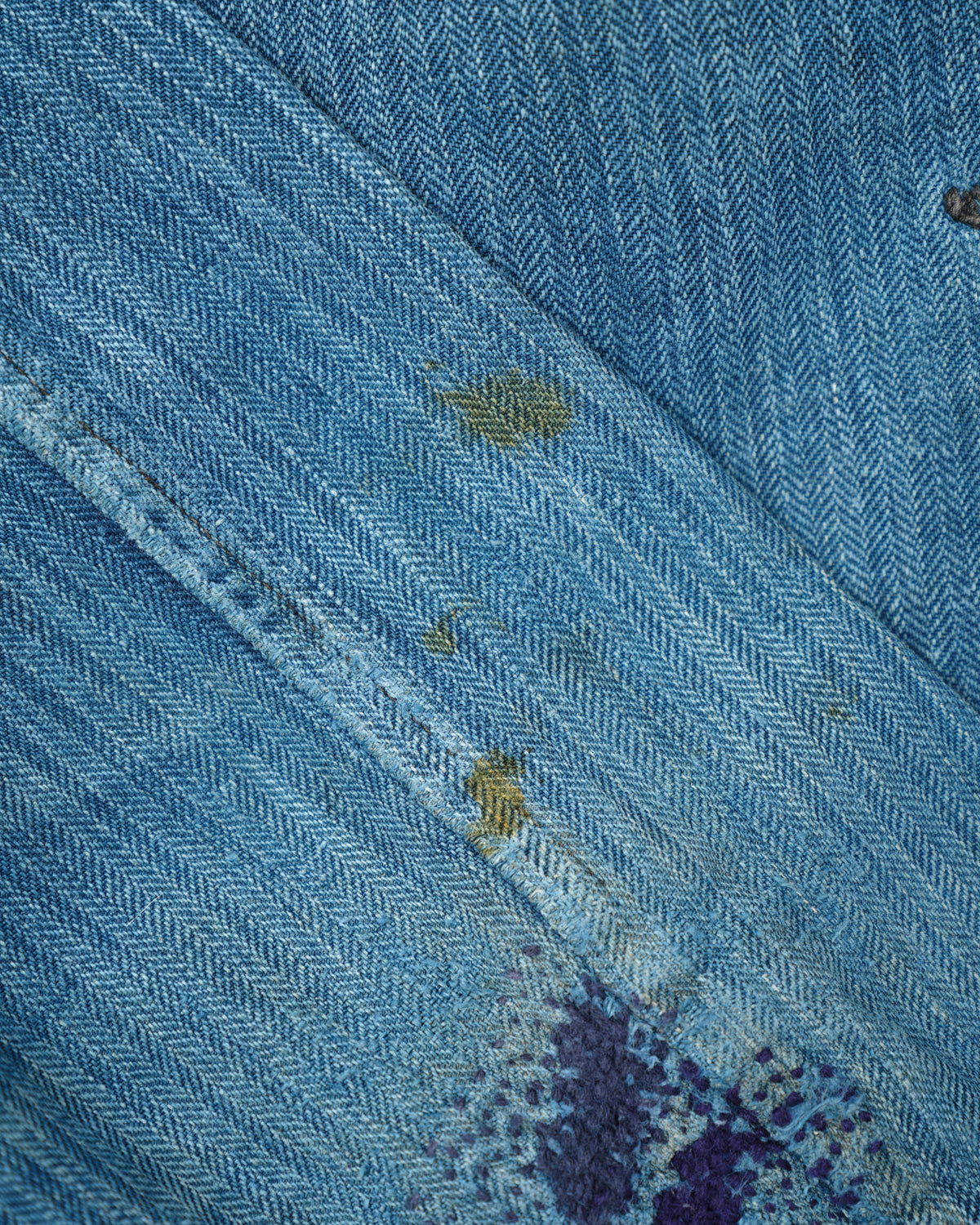
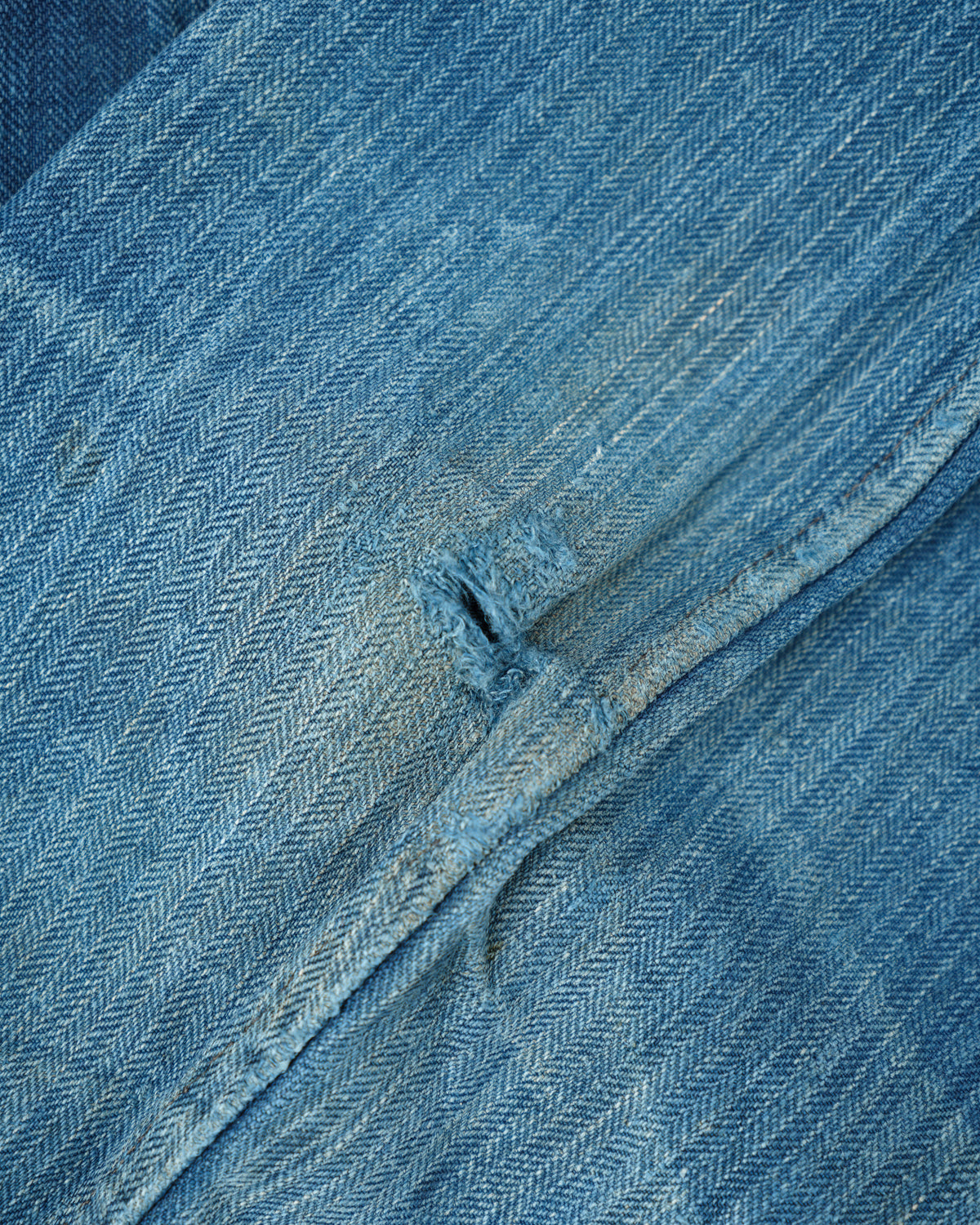
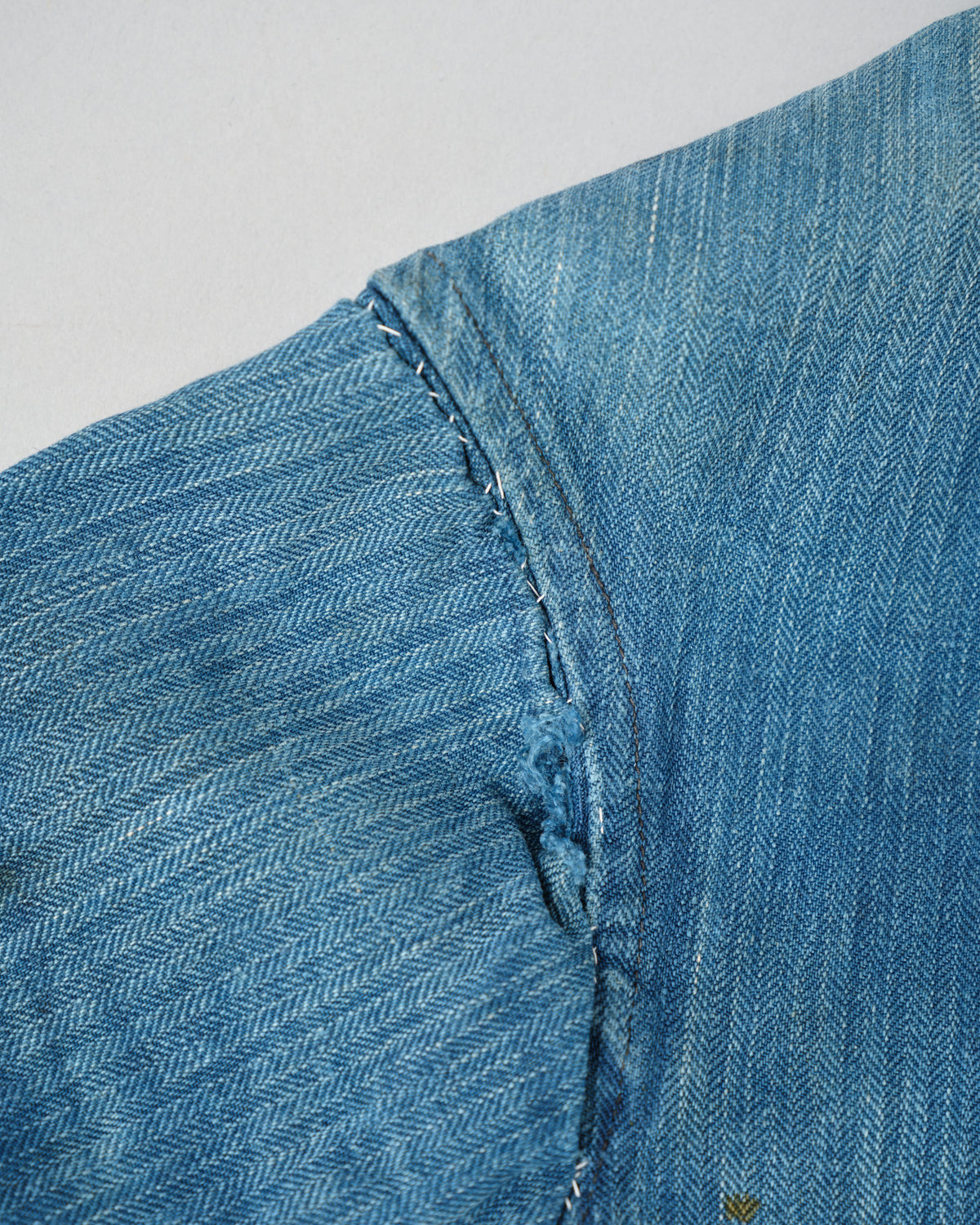
The fine diagonal weave generates visual depth, complemented by linen's characteristic slubs and dry handle. Robust in construction, yet responsive to movement with characteristic fluidity. Roughness and refinement coexist within the texture.
With wear, stiffness yields to suppleness and the cloth settles into the body's contours. Creases and contact marks become expression; patina transforms from deterioration into dignity.
The colour registers pronounced indigo fade.
Herein lies the secondary kernel of rarity. This is not merely blue; this is the particular fading intrinsic to indigo (藍) dyeing, present in this jacket distinctly.
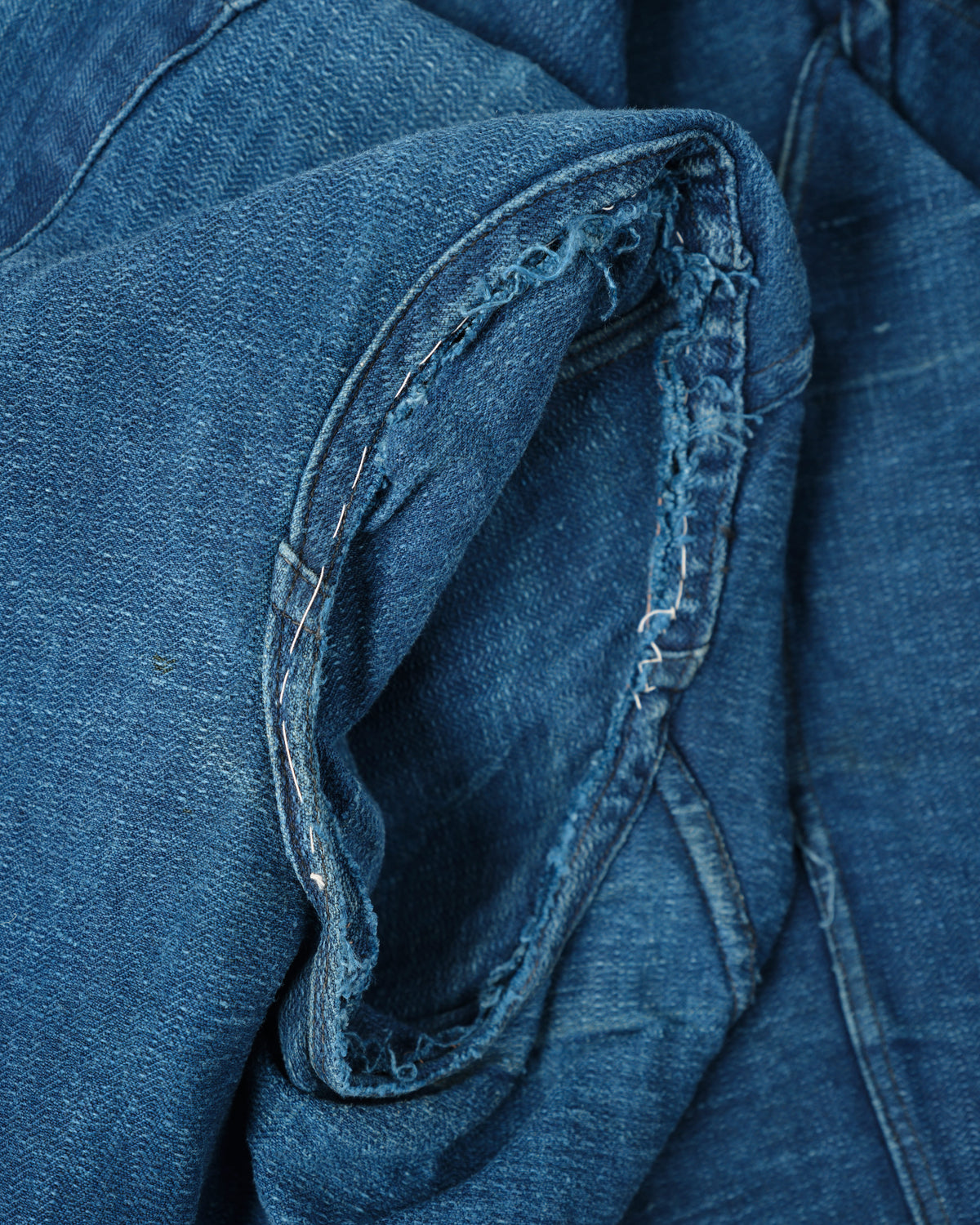
Unlike workwear uniformly dyed with synthetic blue pigment, the interplay of abrasion, sunlight, and laundering has generated tonal gradation—pale periwinkle through deep indigo coexist—creating chromatic depth. The front displays beautiful fade as protagonist, whilst indigo remains concentrated along seam allowances and interior, creating a dialogue through contrast. This interplay constitutes the true revelation of indigo dyeing.
No size marking is legible; estimation suggests Japanese proportions of XS to S.
Actual measurements reflect diminished scale, thus persons of petite frame should encounter no difficulty in wear.
Fabric-intrinsic contact marks, colour variation, soiling, abrasion, thread breaks, punctures, repair evidence, button replacement, button loss, and pocket absence characterise the piece throughout. Those drawn to such patina will recognise a natural selection.
Naturally, those pursuing pristine condition should look elsewhere.
Conversely, should the objective be shirt-weight layering that celebrates fabric and colour, the piece presents compelling value.
The Indigo HBT Linen Double Breasted Mechanic Jacket stands recognised among French military pieces as pre-eminent.
It announces its presence through material and dye alone, without rhetorical detail. A singular garment.
Worthy equally as functional wardrobe element or collection specimen. A piece encountered seldom, domestically or internationally. Those seeking such examples would be prudent not to overlook this opportunity.