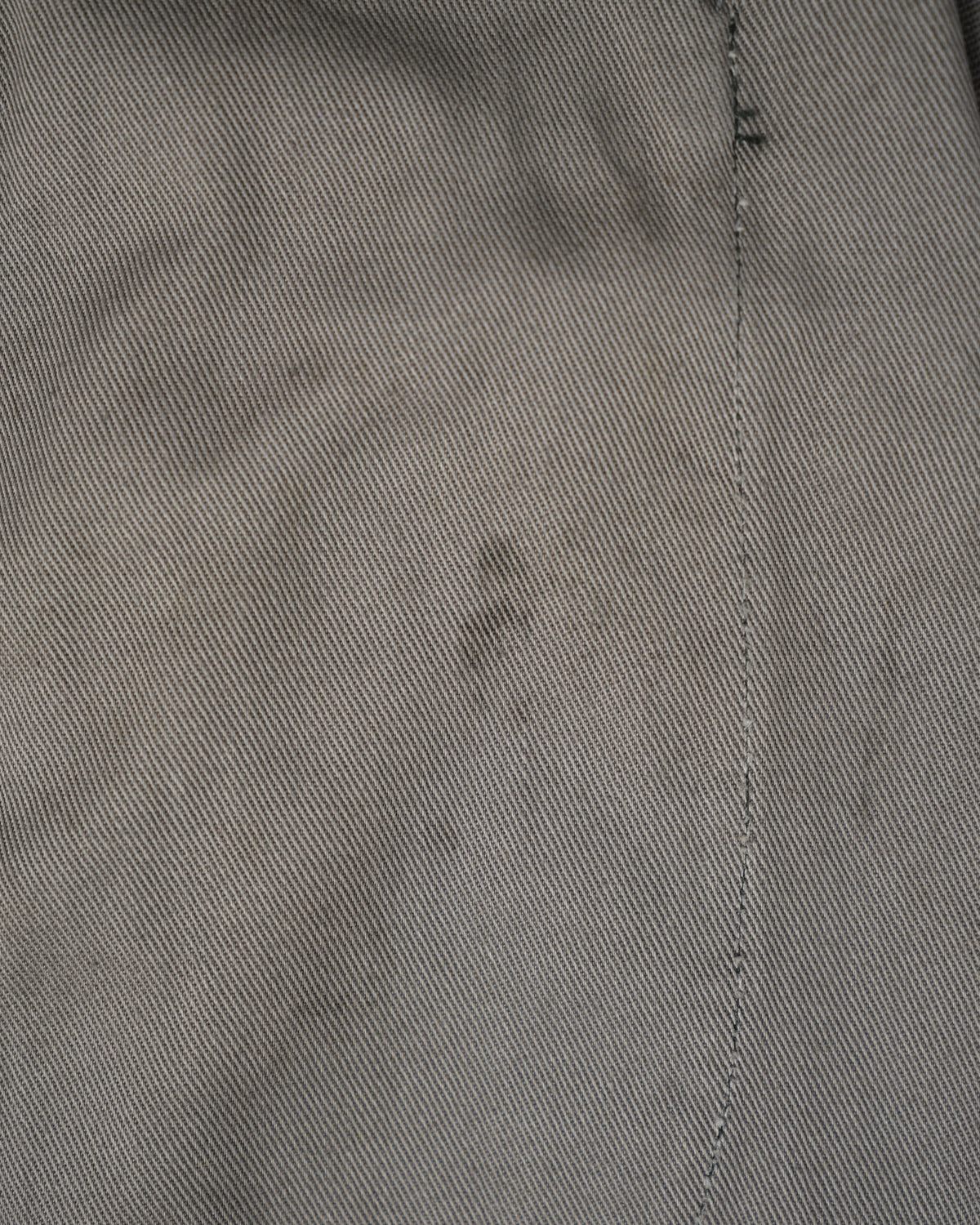
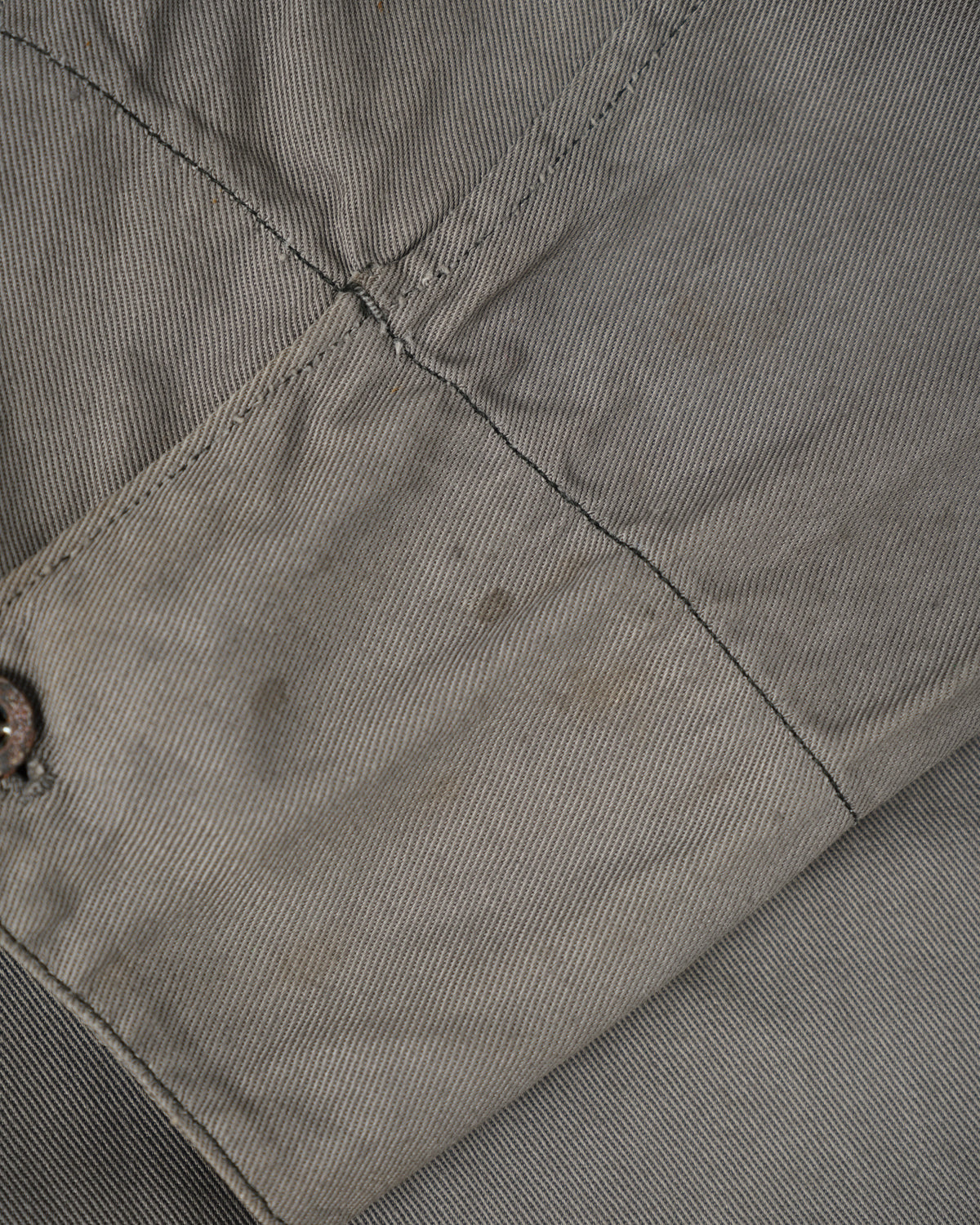
1935 issue, French Navy 'Gray Cotton Twill Sailor Work Smock'.
A special item arrival.
The Marine Nationale, or French Navy, is one of the principal military branches constituting the armed forces of the French Republic. It bears responsibility for the nation's maritime defense, overseas deployment, and nuclear deterrence—the very embodiment of French ocean-going capability.
Its institutional origins trace to the reign of Louis XIII, when Cardinal Richelieu established the 'Marine Royale' in 1626. Through the revolutionary period, this institution evolved into what we know today as the Marine Nationale.
The nineteenth century witnessed the Navy's role in maritime transformation through vessels of historic significance: the 'Gloire' (1859), the world's first ocean-going ironclad, and the 'Plongeur' (1863), a mechanically-propelled submarine. These ships embodied the nation's commitment to commanding the waters of the next era.
During the Second World War, following the 1940 defeat, the Free French Navy (FNFL) was established in July 1940. Yet the service also endured the catastrophic loss at Toulon in November 1942, when the fleet was scuttled—a defining moment in naval history.
In the postwar period, the Navy underwent restructuring and modernization. Since the establishment of FOST/ALFOST in 1972, submarine-based nuclear deterrence has formed the strategic pillar of French defense policy.
Today, the Marine Nationale remains organized into four principal operational commands, symbolized by the nuclear-powered aircraft carrier 'Charles de Gaulle,' continuing to demonstrate active capability across the world's oceans.
This is an account of the 'Gray Cotton Twill Sailor Work Smock'—a garment issued to and worn by deck crew of this historically significant navy.
Despite its utilitarian military origins and stripped-down design, this piece possesses a remarkable harmony of silhouette and detail—a subtle balance that reads as distinctly beautiful.
The defining element is this gray coloration. Likely a piece that was dyed in service, yet the dye did not fully penetrate the stitching thread itself. Black stitches remain clearly visible across the body—a detail that leaves open the romantic possibility that this may preserve an original color beneath. A garment with history written into its very fibers.
We have previously received a similar piece with original gray coloring in cotton piqué, yet this example employs cotton twill. The diagonal weave creates a refined surface texture, conveying a quiet strength distinct from piqué's character.
Among French military workwear, this model has grown particularly sought-after in recent seasons. While natural linen examples circulate with some regularity, the 'gray and cotton twill' combination offers broader stylistic range—a palette less restricted by preconception.
A modest, scaled shawl collar fastened with a single metal button. This restrained, minimal neckline yields a versatility of purpose: equally compelling as a statement or supporting piece, adapting rather than demanding.
The neckline can read spare on its own; a scarf or similar accent will draw out the depth of the gray and provide thoughtful balance.
Faint stitching lines visible on the right chest mark the seams of an interior patch pocket—functional detail held in reserve. The rational design philosophy is evident in this restraint: visual simplicity sheltering practical purpose.
The cuffs are cut deep and likewise secured with metal buttons.
Inside the collar, a faded stamp marks the year of issue. The marking '3 1935' suggests March 1935 as the date of formal military issue—a detail that anchors the piece firmly in history.
No size marking is legible, though the proportions suggest a fit equivalent to Japanese size S to M. The actual measurements run compact, so those of slighter build will find it accommodating. Whether worn true to size or oversized, it settles comfortably on the frame.
The piece shows the patina of wear—marks of service—yet sustains no damage that would prevent future wearing. It remains a functional garment.
The Marine Nationale, bearer of institutional duty across the nation's waters, produced workwear of uncommon conviction. Military garments shaped by such practical necessity carry authority beyond typical issue.
Regardless of the likelihood of post-issue dyeing, the 'gray and cotton twill' combination stands apart from the natural linen pieces more commonly encountered. Distribution remains limited; such a piece arrives at our shop infrequently. A rare offering.
Suited equally to active wardrobe or considered collection, this remains an exceptional acquisition. Given the scarcity of such pieces, those seeking a French Navy work smock of this caliber would be wise not to overlook this opportunity.