Circa 1940s, a British Army Camouflage Windproof Smock.
A particularly exceptional acquisition.
Originally issued primarily to infantry reconnaissance and snipers, this example was deployed within the British Army's elite Special Air Service (SAS).
The Special Air Service operated as a specialist sabotage unit, conducting deep penetration missions against enemy infrastructure—communications, logistics, and supply lines—within mechanized modern warfare.
The "Air" nomenclature invites assumptions of air force origins, yet the unit remained fundamentally an army formation, christened during the Second World War to reflect airborne insertion tactics into enemy territory.
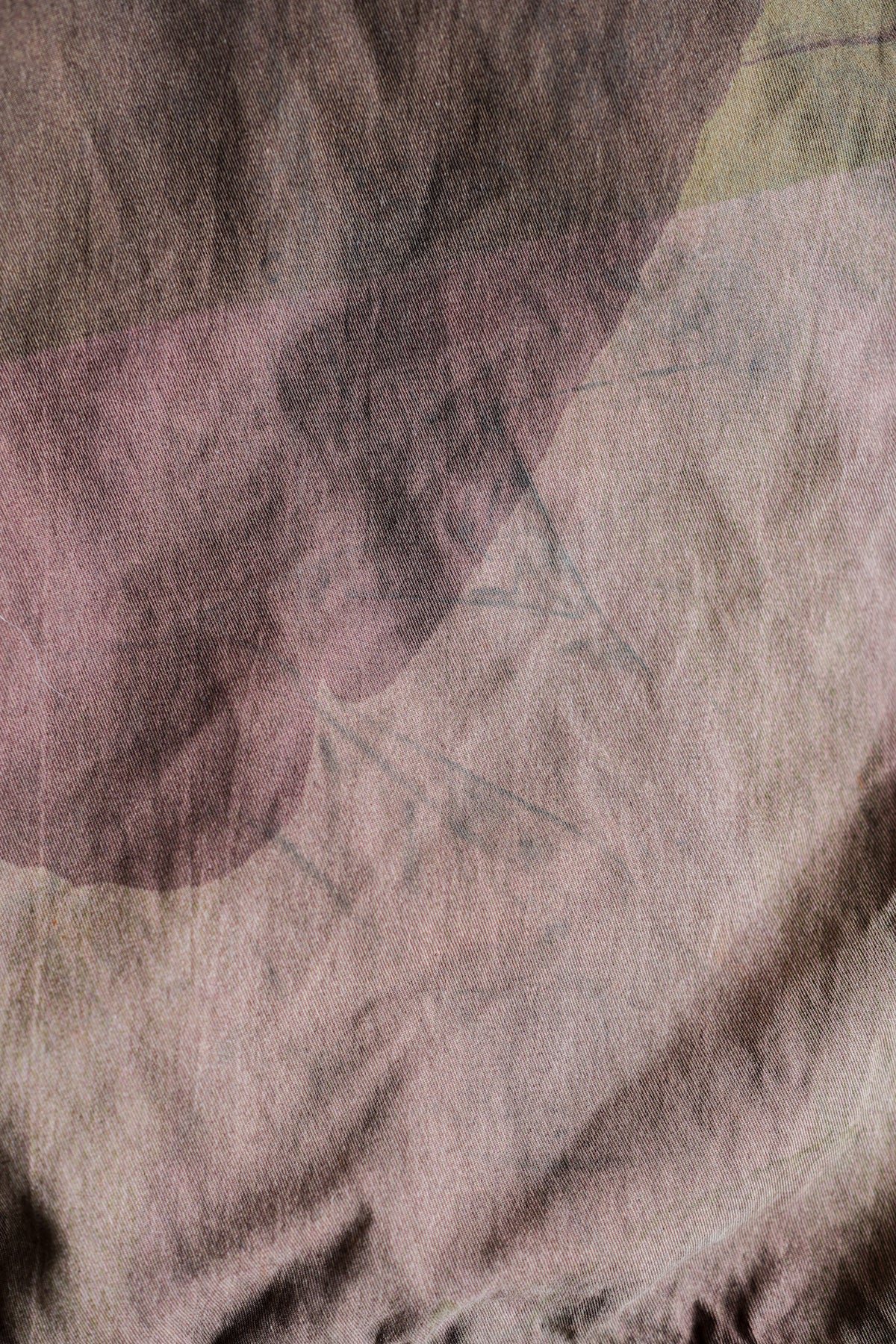
What distinguishes this piece above all is its singular camouflage pattern and an exceptionally refined fabric—one that evokes the densely woven characteristics of Ventile cotton.
First introduced to the British Army in 1942, the "Windproof" pattern emerged as a variation of the early Denison smock brushstroke camouflage.
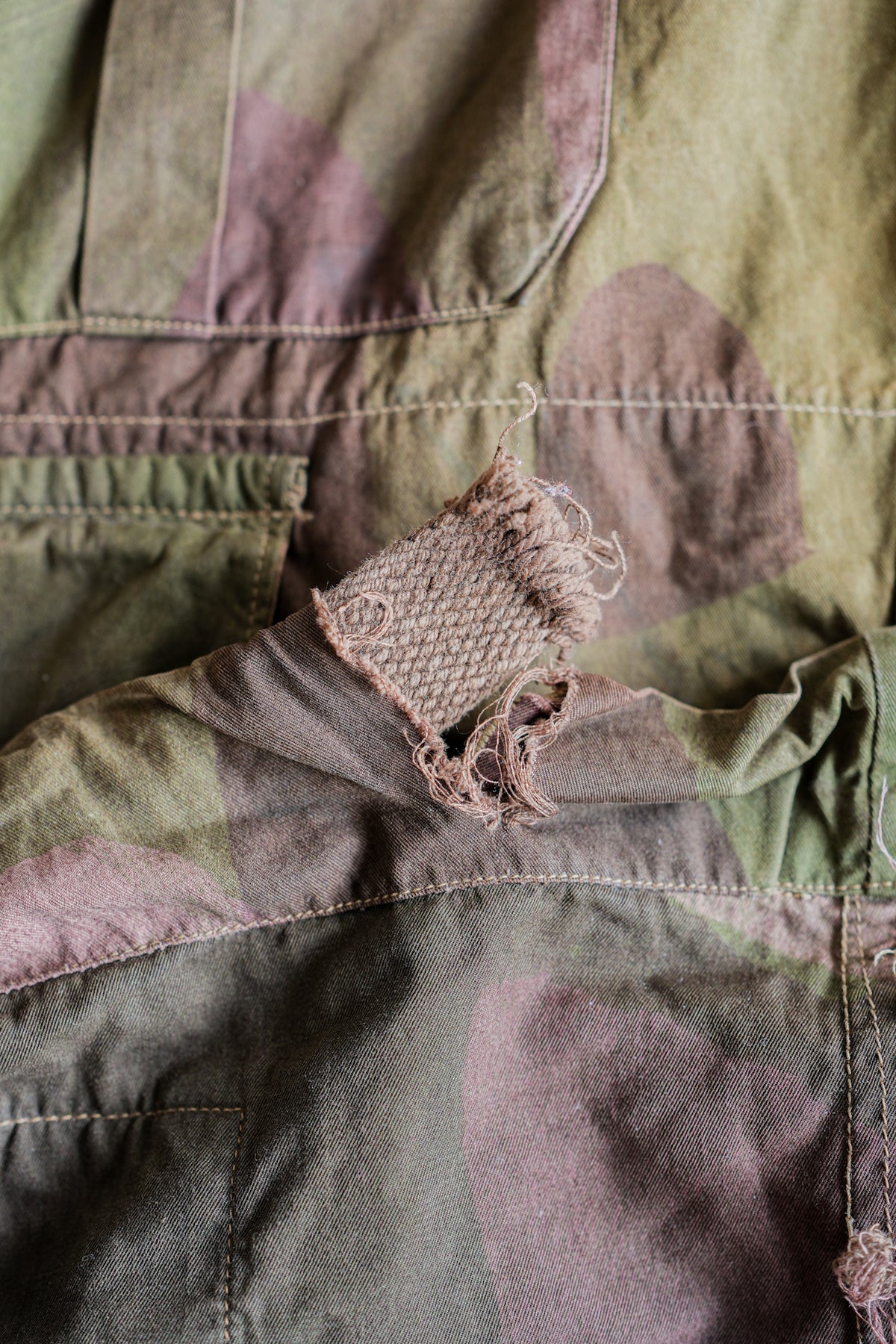
Designed specifically for Northern European deployment and manufactured using roller printing technology, this pattern is characterised by brushstroke compositions in dark brown, brown, pink tan, and olive green.
Issued as a lightweight two-piece infantry over-suit, it was allocated primarily to reconnaissance and sniper units during the Second World War, with particular deployment within the Special Air Service. This pattern remained in service through the 1970s.
Surplus stocks were also supplied to the French government, with units issued to combat forces during the First Indochina War.
Given its original specification as a wind and water-resistant outer garment, the fabric employed here is a high-density cotton gabardine—the character and construction reminiscent of Ventile cloth.
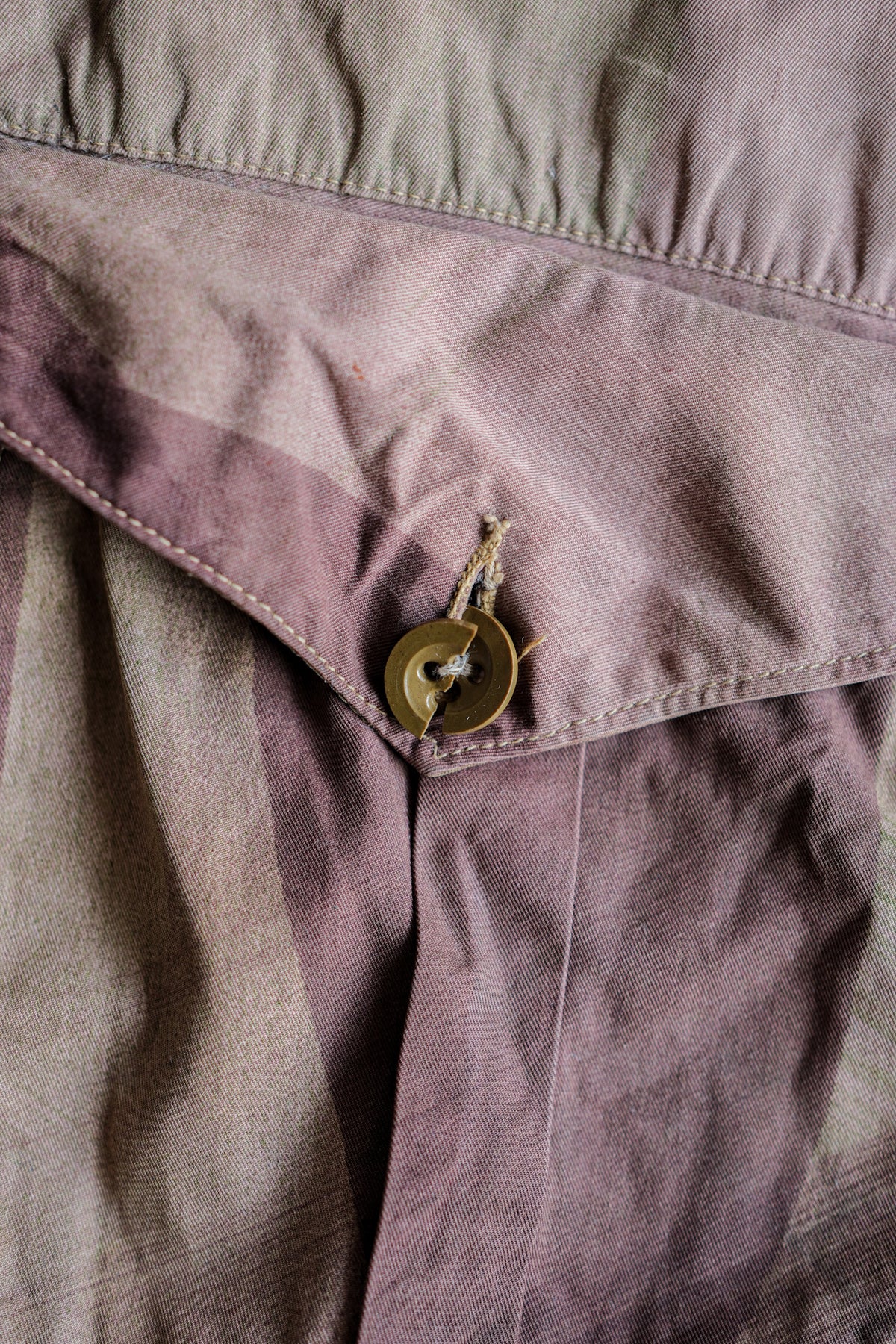
Four substantial flap patch pockets are positioned diagonally across the chest and hem, their exposed buttons lending considerable visual presence.
Reinforcement patches of matching fabric extend to the elbow on each sleeve, whilst cuff tabs with button closures permit sizing adjustment at each wrist.
Drawcords are incorporated at the neck and hem.
By cinching these cords, the silhouette transforms—a two-way versatility that invites a considered approach to wear, varying with circumstance and preference.
Within European military textiles, this piece occupies a singular position—a special camouflage in its own right.
Beyond its evident scarcity, when viewed as a garment for authentic wear, it possesses considerable visual authority. Wearing it should require no hesitation.
Marked size "2"
Equivalent to approximately Japanese medium.
The actual measurements suggest a golden proportion for the Japanese physique, accommodating a broad range of builds.
Such proportionate sizing has become increasingly scarce, as oversized examples dominate current stockings.
Conceived as an outer garment worn over clothing, all examples carry generous proportions by design.
Both the armhole and body width offer substantial ease, rendering this piece accessible to varied physiques.
Surface wear, abrasion, loose threads, small tears, creasing, and minor button damage are present—the natural patina of use. Yet no structural damage impedes wear, and the garment remains serviceable.
The Windproof Smock, bearing one of the British Army's most distinctive camouflage expressions, grows increasingly scarce and costly with each passing year.
Smaller examples in particular are rarely encountered, domestically or abroad—a genuine rarity.
This is not an item money alone reliably secures, nor can future availability be assured.
As a working wardrobe piece, a collection object, or a design reference, it warrants consideration.
Its scarcity within our inventory is evident. If sought, this occasion should not pass unmarked.