Circa 1940s Wehrmacht Drillich Herringbone Twill Cotton Linen Striped Hospital Trousers.
A particularly rare acquisition.
The Wehrmacht—the unified military force of Nazi Germany spanning 1935 to 1945—comprised three branches: the Heer (Army), Kriegsmarine (Navy), and Luftwaffe (Air Force).
The Wehrmacht designation replaced the earlier "Reichswehr," signifying the Nazi regime's efforts to rearm Germany beyond the limits permitted by the Treaty of Versailles.
Following Adolf Hitler's seizure of power in 1933, the establishment of the Wehrmacht was among his most deliberate and ambitious undertakings.
It represented the creation of a modern, offensively capable military force intended to achieve the Nazi regime's long-term objectives: reclaiming lost territory, acquiring new lands, and dominating neighboring nations.
This necessitated the reintroduction of conscription, substantial investment in military industry, and unprecedented defense expenditure.
Following Germany's unconditional surrender on May 8, 1945, the Allied occupation of Germany commenced, and the systematic dissolution of the Wehrmacht began.
On August 20, 1946, the Wehrmacht and all its subordinate branches were formally disbanded by the Allied High Command.
This encompassed the Heer (Army), Kriegsmarine (Navy), and Luftwaffe (Air Force).
In the aftermath of the Wehrmacht's dissolution, Germany became a nation without military force. The subsequent reconstruction of military capabilities for both West Germany (Federal Republic) and East Germany (German Democratic Republic) proceeded separately within the context of the Cold War.
West Germany established the Bundeswehr (Federal Armed Forces) in 1955, becoming part of NATO.
East Germany, conversely, established the Nationale Volksarmee (National People's Army) in 1956, joining the Warsaw Pact.
These new military organizations were expressly constituted as distinct from Wehrmacht tradition and structure.
We present here a specimen of the "Drillich Hospital Trousers"—issued and worn as hospital patient garments by the German military during the Second World War.
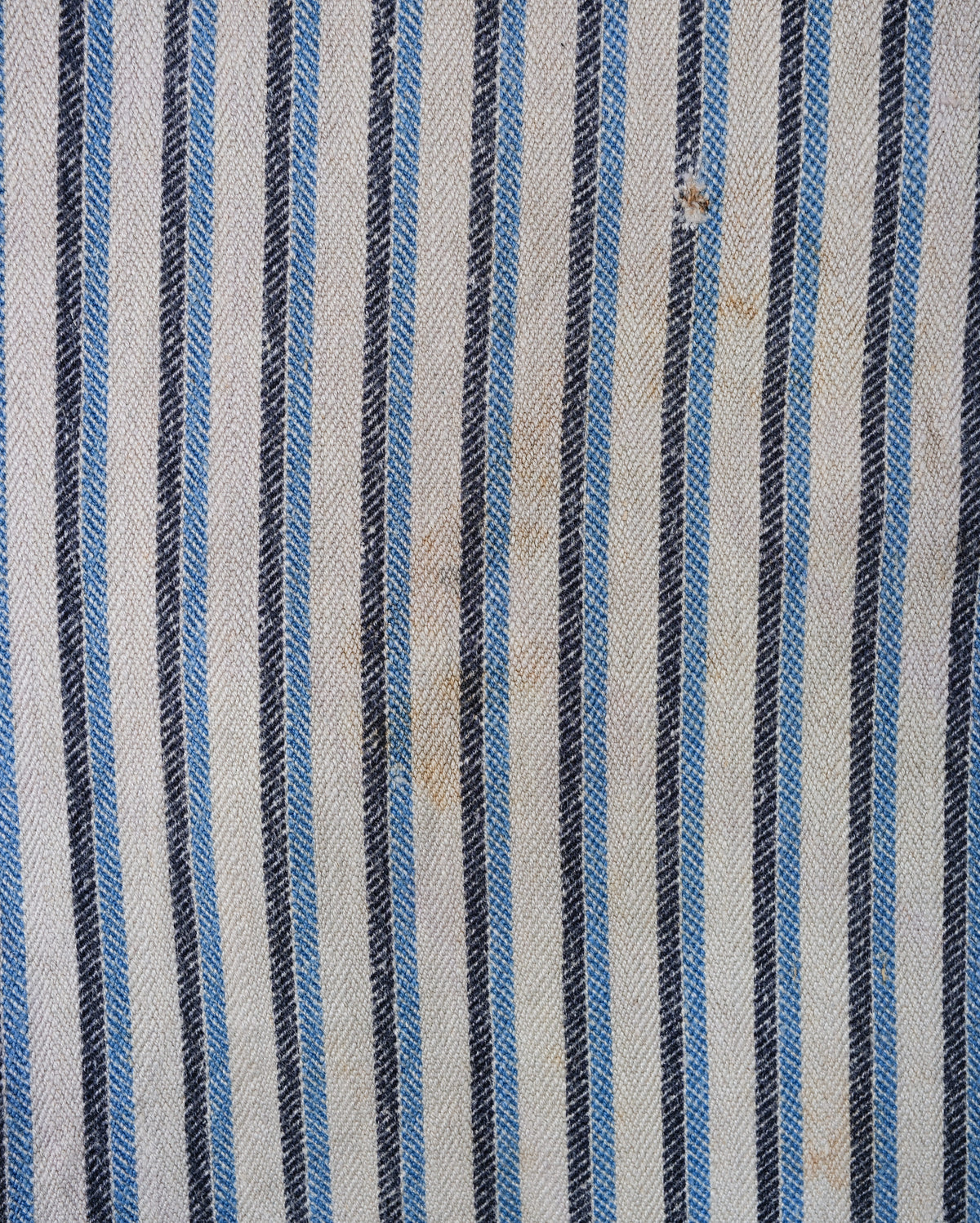
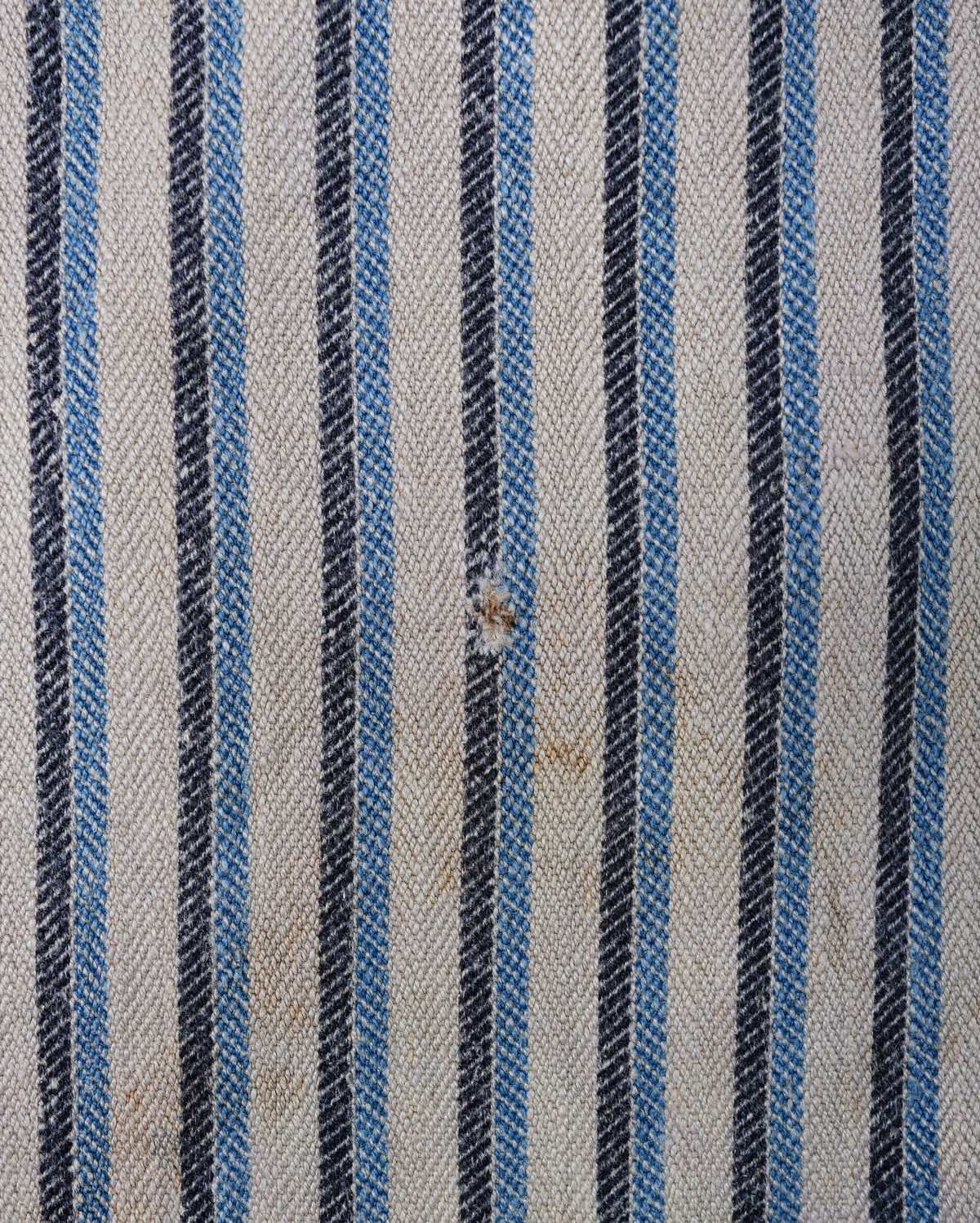
Drillich is a German term denoting a weave type, specifically herringbone twill fabric.
During the Second World War in particular, the Wehrmacht adopted this material extensively—from summer work wear to summer combat garments—owing to its exceptional durability.
Initially adopted as unbleached work and training wear, as hostilities escalated, the material's comfort and practicality led to its adoption for summer combat use in active theaters.
This underscores the breadth of its application across the German Army, Navy, and Air Force—employed not merely as work dress but across diverse purposes during summer months.
Although initially conceived for training and work purposes, the garment underwent continual refinement toward enhanced combat suitability, evolving in response to practical field requirements.
Executed in substantial German military cotton-linen blend fabric, the piece presents a restrained color palette of white, light blue, and navy in striped formation.
Vintage summer trousers of this caliber are exceedingly scarce, and their scarcity deepens considerably when design sensibility enters the equation.
Both front and back forgo superfluous ornamentation, the simplicity and austerity of detail being perhaps essential considerations for contemporary wear as a fashion item.
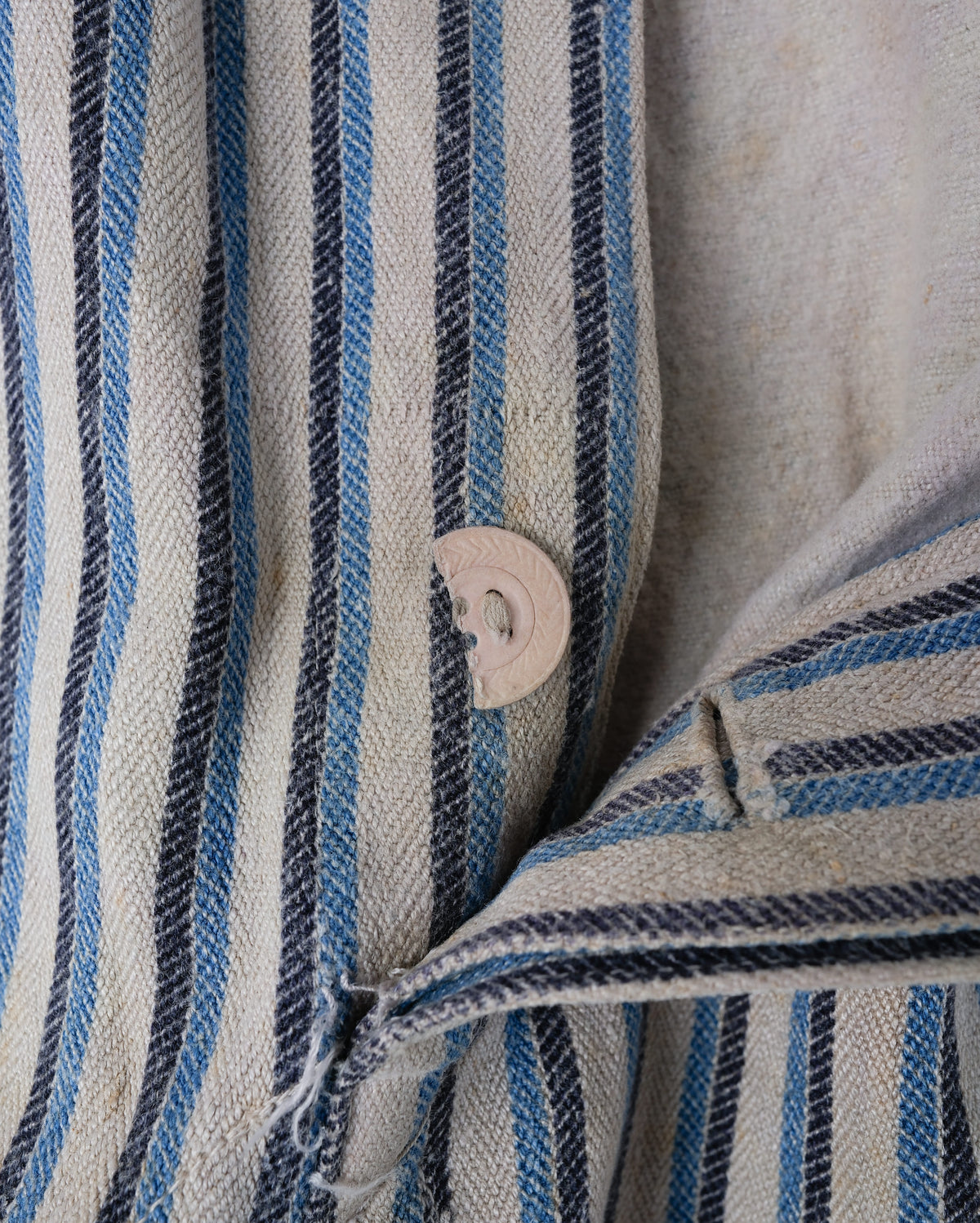
The front features button fly closure, with each button composed of paper—a characteristic detail of German military production.
This example lacks belt loops, necessitating either suspension wear via braces or adjustment through the rear cinch strap.
The silhouette exemplifies military straightforward proportions—a generous straight cut.
Such versatility permits pairing with virtually any garment, rendering it a genuinely adaptable silhouette.
The straight cut elongates and refines the leg line, creating an elegant form across varying physiques.
This silhouette harmonizes modern impression with classical character, extending its utility from formal occasions to casual contexts.
Among the considerable array of German military uniforms from the Second World War period, this piece is particularly notable for its fashion merit, and many seek such examples.
Beyond its rarity, viewed through the lens of fashion, this represents a genuinely compelling garment, and we encourage its active wear without hesitation.
While size marking is not visible, the piece appears to correspond to Japanese sizing M through L.
Examining actual measurements, this constitutes something of a golden size for Japanese physiques, accommodating a broad range of builds.
As befits military garments, a slightly generous fit remains decidedly handsome.
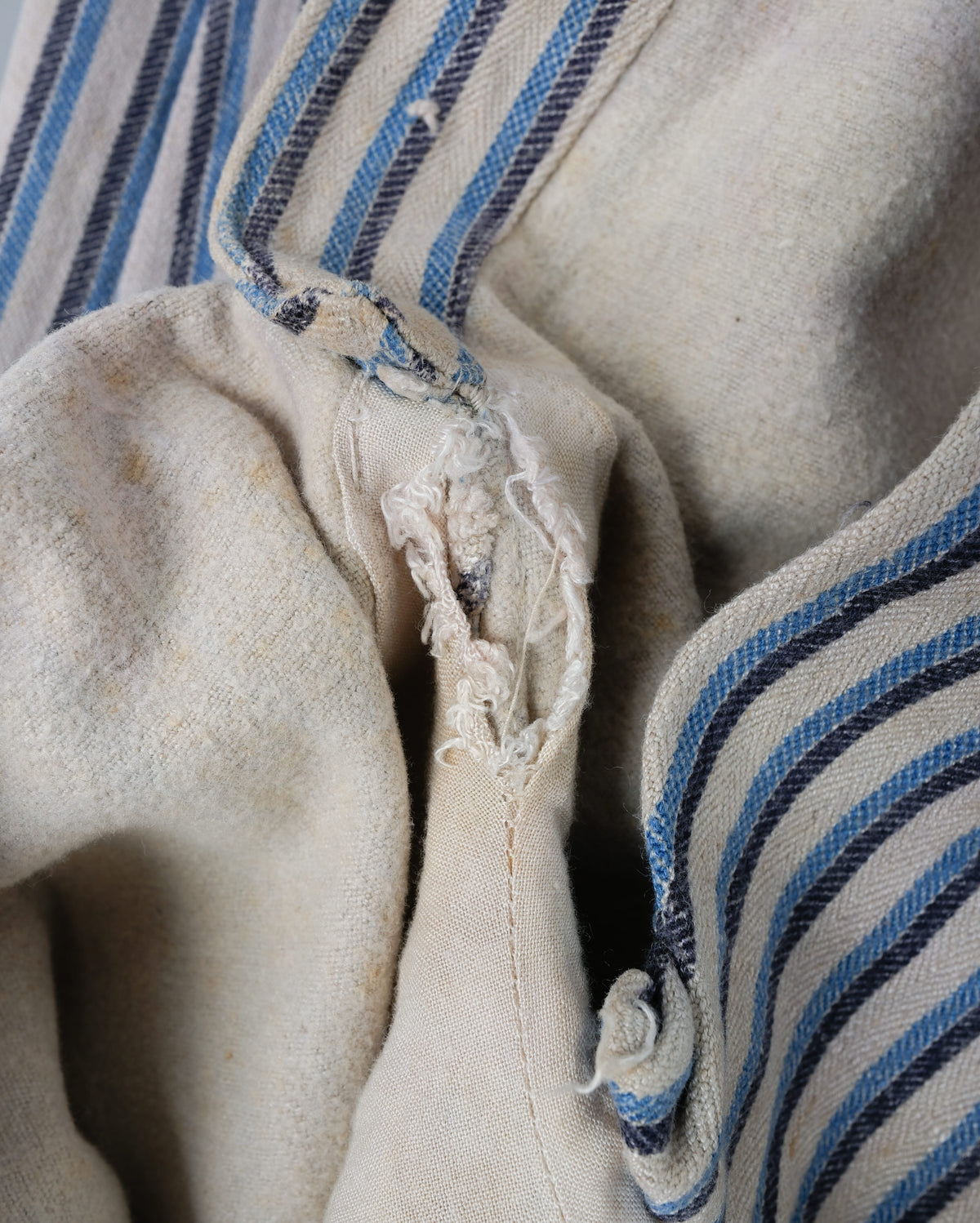
The piece exhibits expected patina—soiling, abrasion, loose stitching, minor tears, button wear, and minor loss—yet sustains no significant damage precluding wear, remaining entirely serviceable.
German military pieces have attracted particular attention in recent years, though items from this source are inherently scarce given their historical context and limited surviving examples. Demand substantially outpaces available supply.
With a devoted collector base, pieces of this provenance are understandably coveted archive acquisitions that seldom change hands.
This is not merchandise one merely procures through expenditure; future availability cannot be assured.
Whether as functional wardrobe component, collection artifact, or design source, this garment warrants consideration.
Rarely encountered domestically or internationally, those seeking such pieces or appreciating distinctive items would be wise to regard this opportunity carefully.
![[~40's]WWⅡ German Army Drillich HBT Cotton Linen Striped Hospital Trousers "Wehrmacht"](http://vieuxetnouveau-shop.com/cdn/shop/files/DSCF0595.jpg?v=1739524459&width=2400)
![[~40's]WWⅡ German Army Drillich HBT Cotton Linen Striped Hospital Trousers "Wehrmacht"](http://vieuxetnouveau-shop.com/cdn/shop/files/DSCF0606_24baea35-3f07-48bf-b093-ff44da06191d.jpg?v=1739524506&width=2400)
![[~40's]WWⅡ German Army Drillich HBT Cotton Linen Striped Hospital Trousers "Wehrmacht"](http://vieuxetnouveau-shop.com/cdn/shop/files/DSCF0609.jpg?v=1739524506&width=2400)
![[~40's]WWⅡ German Army Drillich HBT Cotton Linen Striped Hospital Trousers "Wehrmacht"](http://vieuxetnouveau-shop.com/cdn/shop/files/DSCF0596_0d149ef4-1577-4759-85fb-bb5cfcc890a7.jpg?v=1739524506&width=2400)
![[~40's]WWⅡ German Army Drillich HBT Cotton Linen Striped Hospital Trousers "Wehrmacht"](http://vieuxetnouveau-shop.com/cdn/shop/files/DSCF0607_09f3c440-d03d-4ca9-83cf-d53fbf1d0b8b.jpg?v=1739524506&width=2400)
![[~40's]WWⅡ German Army Drillich HBT Cotton Linen Striped Hospital Trousers "Wehrmacht"](http://vieuxetnouveau-shop.com/cdn/shop/files/DSCF0610_fd4c22ab-ba92-4bbc-93f2-73a91f8b8047.jpg?v=1739524506&width=2400)
![[~40's]WWⅡ German Army Drillich HBT Cotton Linen Striped Hospital Trousers "Wehrmacht"](http://vieuxetnouveau-shop.com/cdn/shop/files/DSCF0597_78ba4b8a-7454-4a96-94f5-06595fd76896.jpg?v=1739524506&width=2400)
![[~40's]WWⅡ German Army Drillich HBT Cotton Linen Striped Hospital Trousers "Wehrmacht"](http://vieuxetnouveau-shop.com/cdn/shop/files/DSCF0598_238e1b0a-491c-42f3-81a1-83bd0d032680.jpg?v=1739524506&width=2400)
![[~40's]WWⅡ German Army Drillich HBT Cotton Linen Striped Hospital Trousers "Wehrmacht"](http://vieuxetnouveau-shop.com/cdn/shop/files/DSCF0614_a2ff6d12-50e2-463b-b904-0a355d1b59f9.jpg?v=1739524506&width=2400)
![[~40's]WWⅡ German Army Drillich HBT Cotton Linen Striped Hospital Trousers "Wehrmacht"](http://vieuxetnouveau-shop.com/cdn/shop/files/DSCF0600_ccb101ec-75d4-4be5-b784-2de28eaa8645.jpg?v=1739524506&width=2400)
![[~40's]WWⅡ German Army Drillich HBT Cotton Linen Striped Hospital Trousers "Wehrmacht"](http://vieuxetnouveau-shop.com/cdn/shop/files/DSCF0601.jpg?v=1739524506&width=2400)
![[~40's]WWⅡ German Army Drillich HBT Cotton Linen Striped Hospital Trousers "Wehrmacht"](http://vieuxetnouveau-shop.com/cdn/shop/files/DSCF0612_ec4ad3d9-40aa-40fe-90cf-8e3f4abcf7e5.jpg?v=1739524506&width=2400)
![[~40's]WWⅡ German Army Drillich HBT Cotton Linen Striped Hospital Trousers "Wehrmacht"](http://vieuxetnouveau-shop.com/cdn/shop/files/DSCF0613_5f0db3d1-ed5d-4e0c-86de-16dbc90f4b97.jpg?v=1739524506&width=2400)
![[~40's]WWⅡ German Army Drillich HBT Cotton Linen Striped Hospital Trousers "Wehrmacht"](http://vieuxetnouveau-shop.com/cdn/shop/files/DSCF0616_71032d65-192a-4f4b-b097-0b754ac64d59.jpg?v=1739524506&width=2400)
![[~40's]WWⅡ German Army Drillich HBT Cotton Linen Striped Hospital Trousers "Wehrmacht"](http://vieuxetnouveau-shop.com/cdn/shop/files/DSCF0617_f498c9da-b670-43ad-8ab1-5dd56e06cd88.jpg?v=1739524459&width=2400)
![[~40's]WWⅡ German Army Drillich HBT Cotton Linen Striped Hospital Trousers "Wehrmacht"](http://vieuxetnouveau-shop.com/cdn/shop/files/DSCF0776.jpg?v=1739947686&width=2400)
![[~40's]WWⅡ German Army Drillich HBT Cotton Linen Striped Hospital Trousers "Wehrmacht"](http://vieuxetnouveau-shop.com/cdn/shop/files/DSCF0777.jpg?v=1739947686&width=2400)
![[~40's]WWⅡ German Army Drillich HBT Cotton Linen Striped Hospital Trousers "Wehrmacht"](http://vieuxetnouveau-shop.com/cdn/shop/files/DSCF0778.jpg?v=1739947686&width=2400)
![[~40's]WWⅡ German Army Drillich HBT Cotton Linen Striped Hospital Trousers "Wehrmacht"](http://vieuxetnouveau-shop.com/cdn/shop/files/DSCF0779_9cb01a3e-0798-4d2a-ace0-9f105c8af6af.jpg?v=1739947686&width=2400)
![[~40's]WWⅡ German Army Drillich HBT Cotton Linen Striped Hospital Trousers "Wehrmacht"](http://vieuxetnouveau-shop.com/cdn/shop/files/DSCF0780.jpg?v=1739947686&width=2400)
![[~40's]WWⅡ German Army Drillich HBT Cotton Linen Striped Hospital Trousers "Wehrmacht"](http://vieuxetnouveau-shop.com/cdn/shop/files/DSCF0781.jpg?v=1739947686&width=2400)
![[~40's]WWⅡ German Army Drillich HBT Cotton Linen Striped Hospital Trousers "Wehrmacht"](http://vieuxetnouveau-shop.com/cdn/shop/files/DSCF0783.jpg?v=1739947686&width=2400)