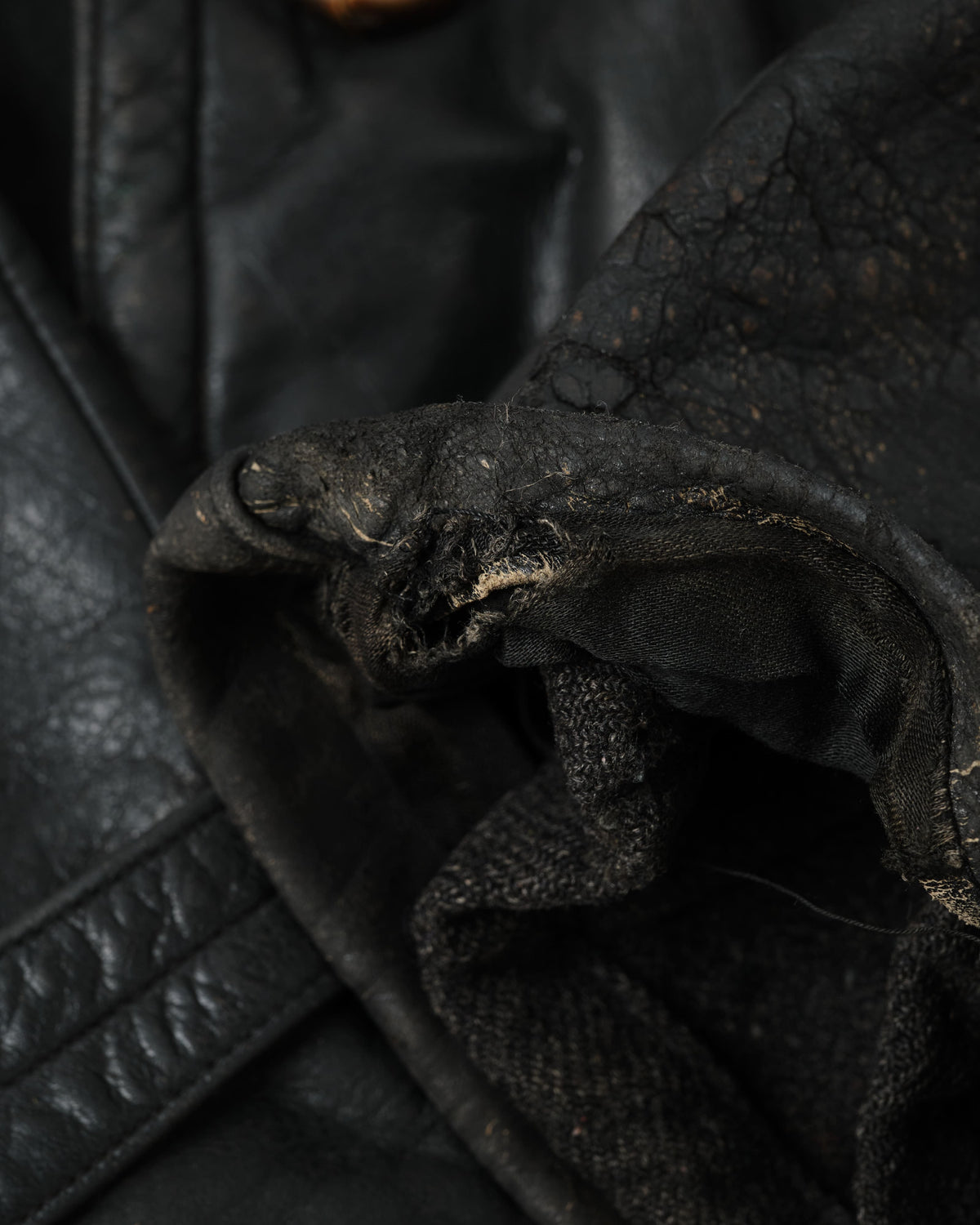
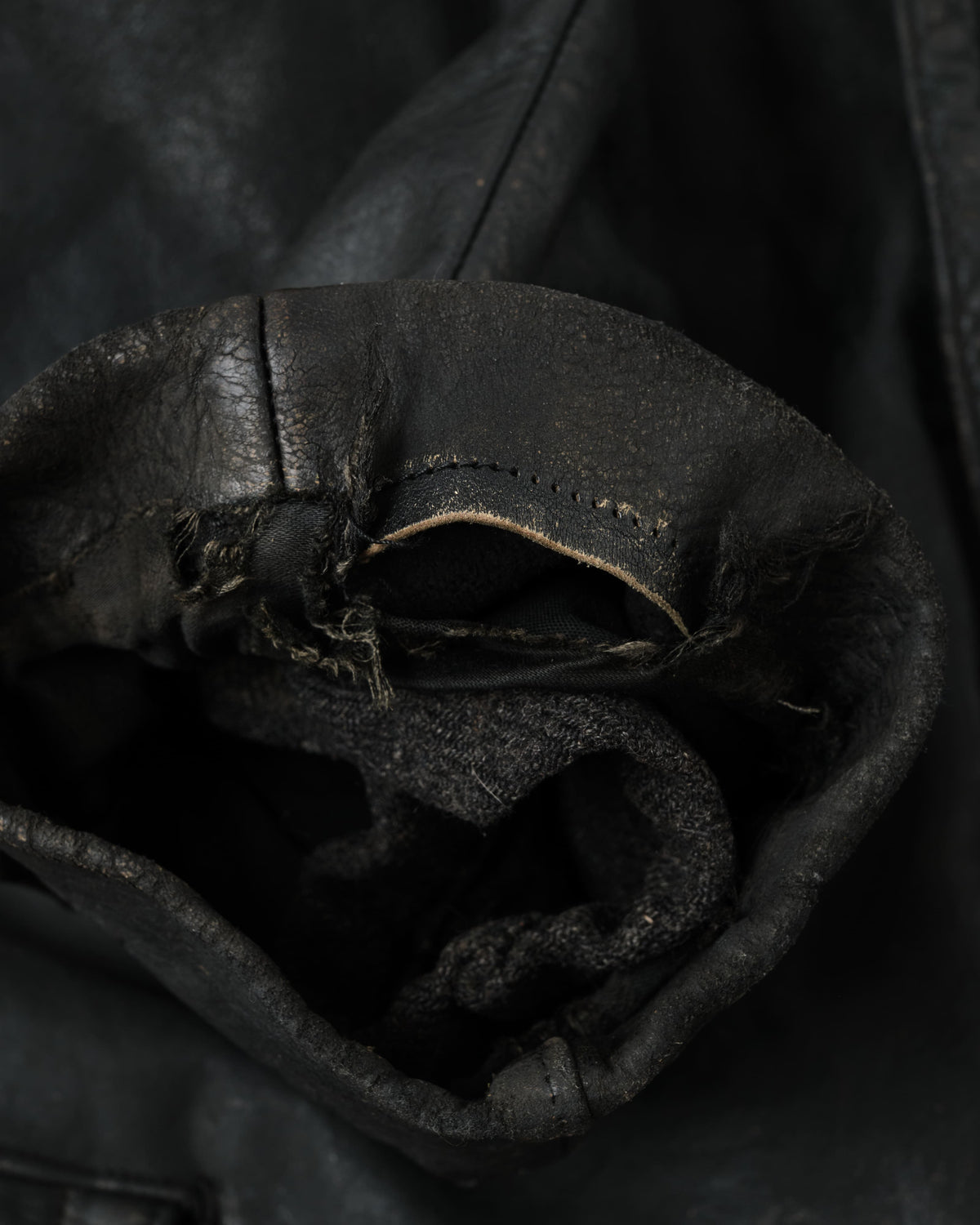
An estimated 1940s Kriegsmarine U-Boat Crew black leather jacket.
A special arrival.
The Kriegsmarine, or German Navy, was the official naval organization that existed from 1935 to 1945 during Nazi Germany. It served as one pillar of the Wehrmacht—the unified three-service military structure—alongside the Army (Heer) and the Air Force (Luftwaffe).
The designation "Kriegsmarine" (literally: War Navy) was established as the successor to the post-World War I German Navy, the Reichsmarine (National Defense Navy). It was formally established in 1935 as part of the Nazi regime's rearmament initiative.
Its founding reflected a clear political intention: to rebuild and expand naval power that had been severely restricted by the Treaty of Versailles. Through the construction of submarines (U-Boot), the deployment of capital ships, and coordination with air power, Germany sought to reestablish itself as a maritime nation.
During World War II, the Kriegsmarine primarily conducted "Atlantic Naval Blockade Operations" (commerce raiding against Britain).
The submarine campaign, known as the "U-Boot-Krieg" (U-Boat War), became a formidable threat to Allied supply lines.
Following Germany's defeat in May 1945, the Kriegsmarine was dissolved by the Allies along with other branches of the Wehrmacht, and was formally abolished in 1946.
With the subsequent division of Germany, West Germany established the Bundesmarine in 1956 and resumed operations as a NATO member.
Meanwhile, East Germany founded the Volksmarine and became integrated into the Warsaw Pact.
Both were deliberately designed to stand apart from the Kriegsmarine in name and ideology, positioned as naval organizations distinctly reflecting the political systems and historical contexts of their respective nations.
We are pleased to present a "U-Boat Crew Leather Jacket"—standard-issue wear for submariners serving aboard U-Boots through the end of World War II.
U-Boot is an abbreviation of the German term "Unterseeboot" (underwater vessel), and refers specifically to the submarine fleet of the German Navy during World War II.
Formal operations of U-Boots began during the First World War and evolved as a strategic weapon in the struggle for control of the Atlantic. By World War II, they became the mainstay of the commerce-raiding campaign known as the "U-Boot-Krieg."
The demands of the mission were severe. Crews endured narrow, humid compartments, extended submerged operations, and severely limited provisions and sanitation—conditions that imposed extraordinary physical and psychological strain.
As a result, equipment and uniforms designed for U-Boot personnel often featured specialized specifications that balanced functionality with comfort.
A minimal leather jacket that served as the standard deck uniform of the era.
Distilled to its essential elements, it embodies a beautiful military functional aesthetic.
The example shown—with its stand collar, hook closures, and single-breasted construction—represents the standard deck uniform worn by lower-ranking ratings during wartime.
In contrast, senior officers are said to have worn a similar garment in double-breasted configuration.
The unadorned single-breasted structure is a typical example of utilitarian design engineered to maintain maximum functionality in harsh conditions.
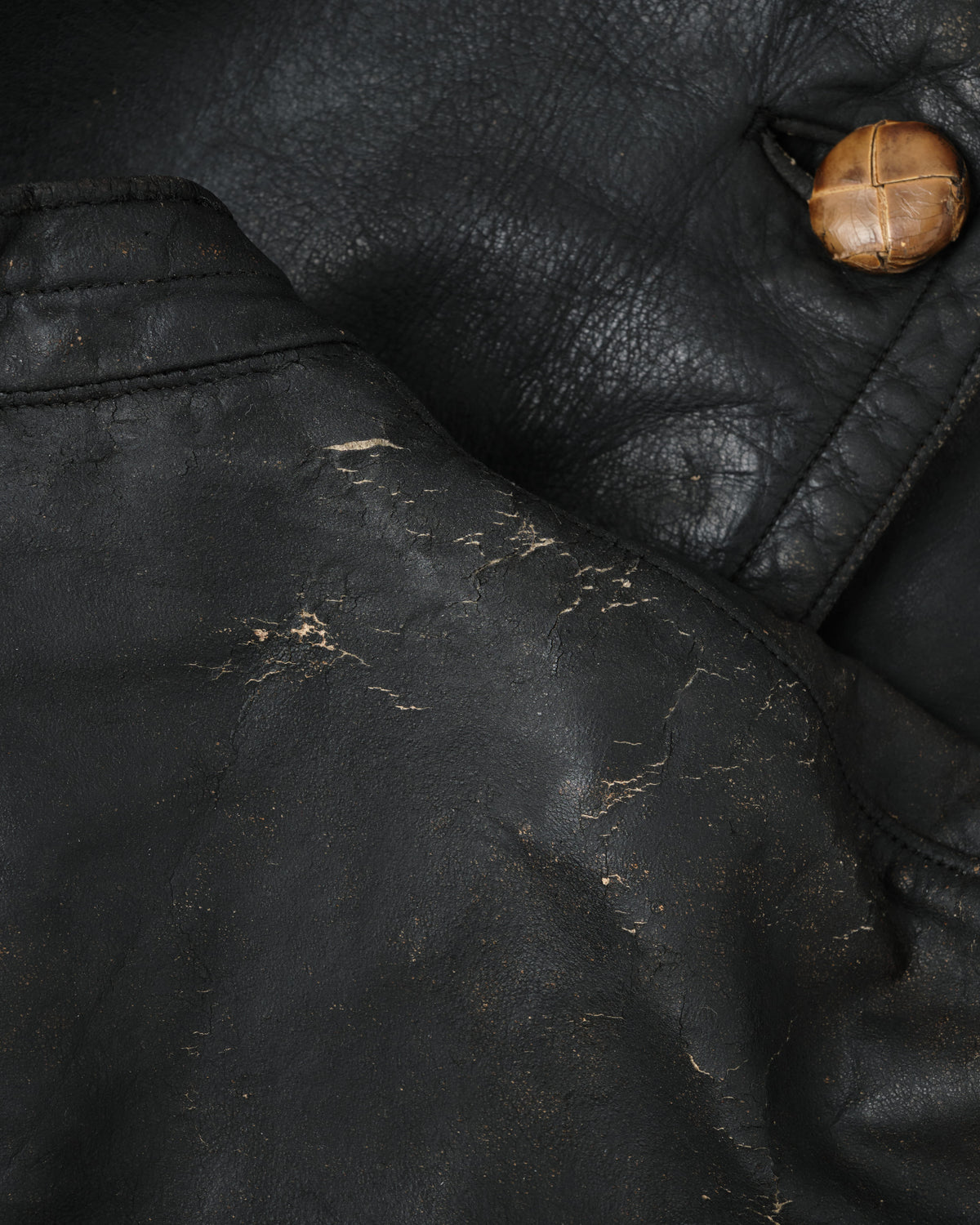
The collar is modest and compact—a stand collar in form.
Its low profile is designed to avoid obstructing vision or movement, while still blocking cold air infiltration. The balance achieves a sharp silhouette without compromise.
The left chest features a slant-cut flap pocket.
The angled construction enables easy access even when bending or operating single-handed—a rational design consideration.
At both side seams, large flap pockets are positioned to cover the back of the hand.
Beyond storage, these appear designed to serve a secondary purpose during actual deck work—hands could be inserted for warmth, functioning much like mittens.
Tab straps with button closures line the cuffs, providing an adjustable system to prevent wind infiltration.
Subtle three-dimensional piping in the stitchwork serves a structural reinforcement purpose, yet presents itself with an almost intentional aesthetic quality.
A faint trace remains where an official issue tag was once sewn into the inside neck—unfortunately now absent.
This example employs leather for the outer shell, with wool generously used as the lining.
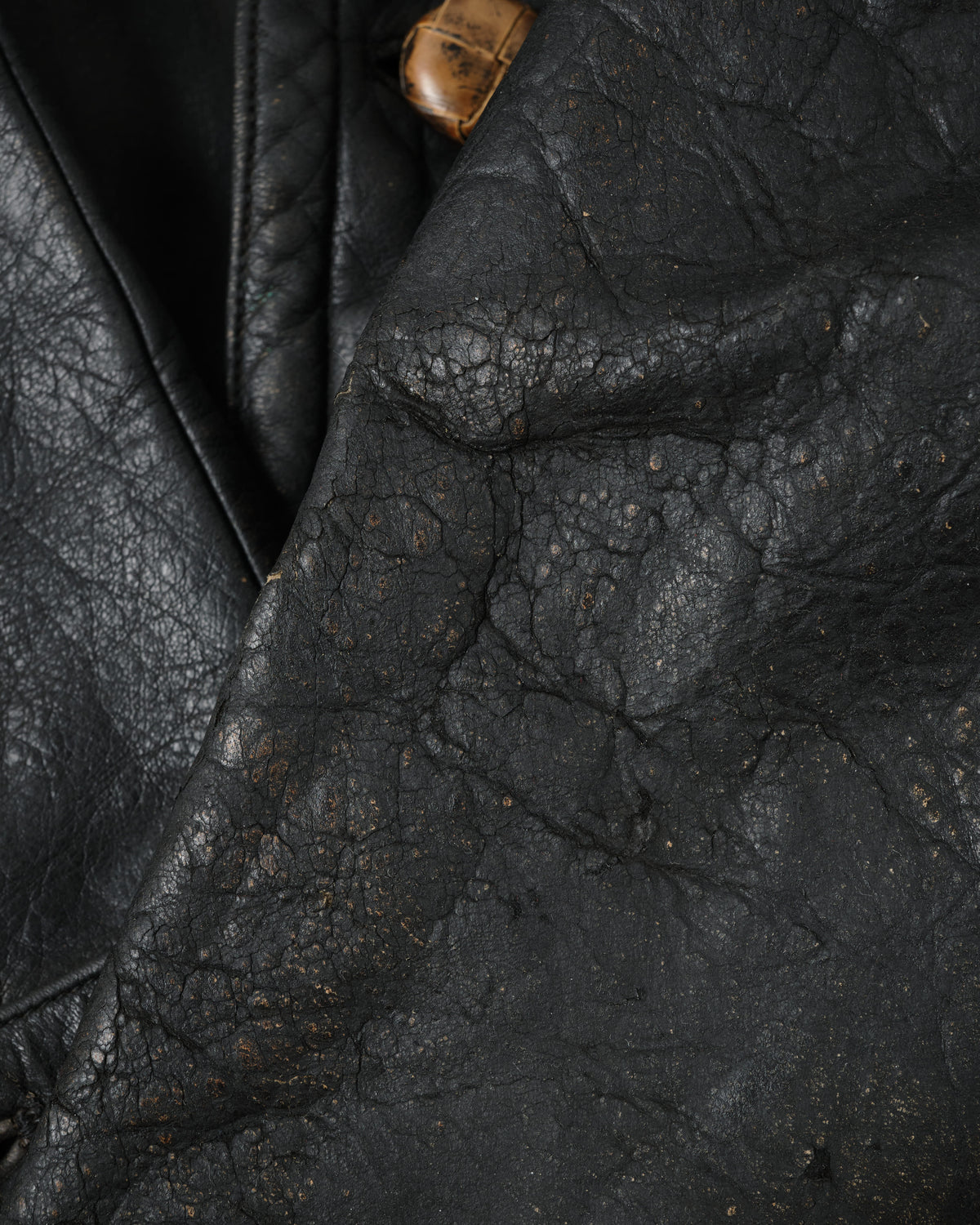
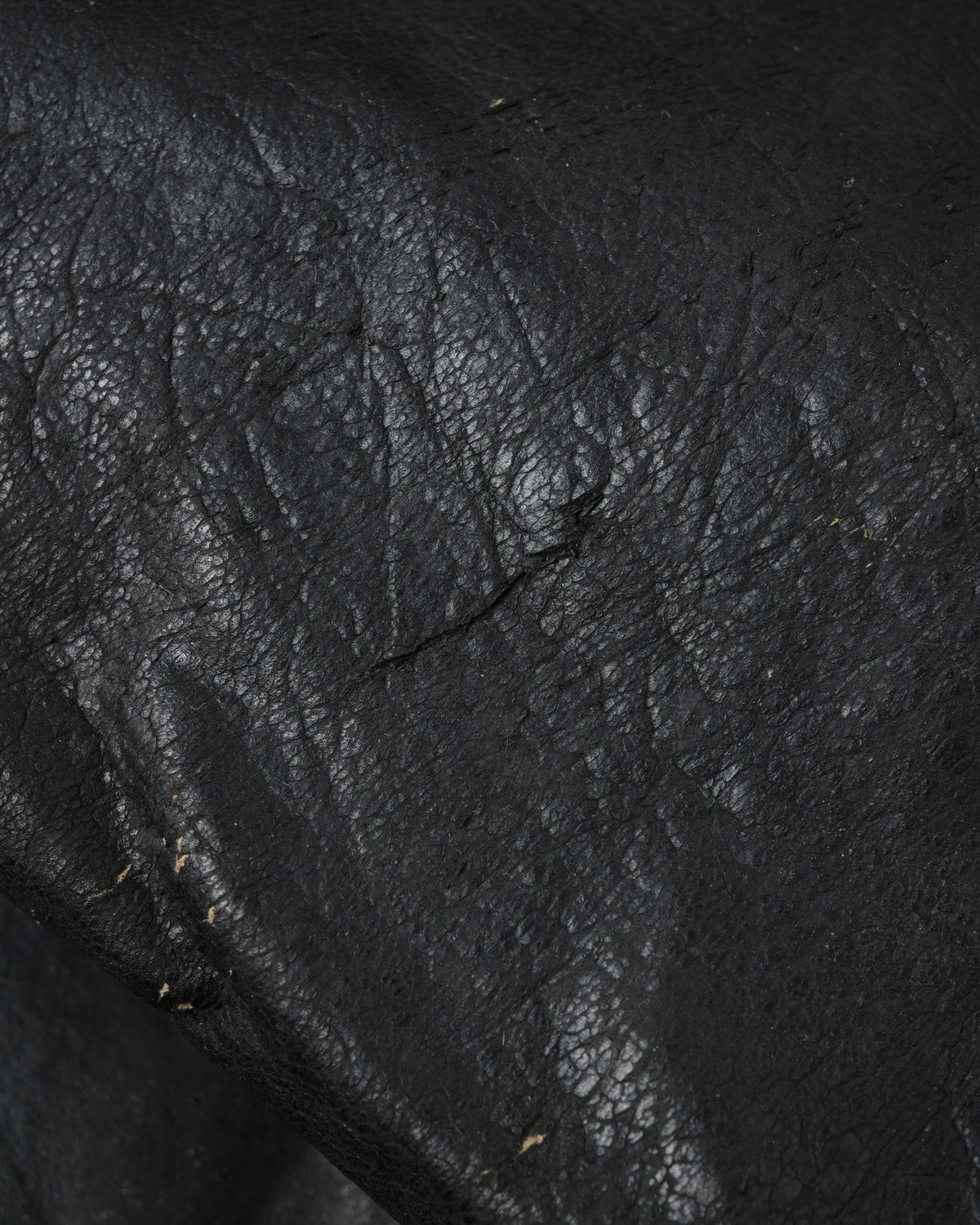
From the moment you hold it, one feels a supple, oil-laden quality.
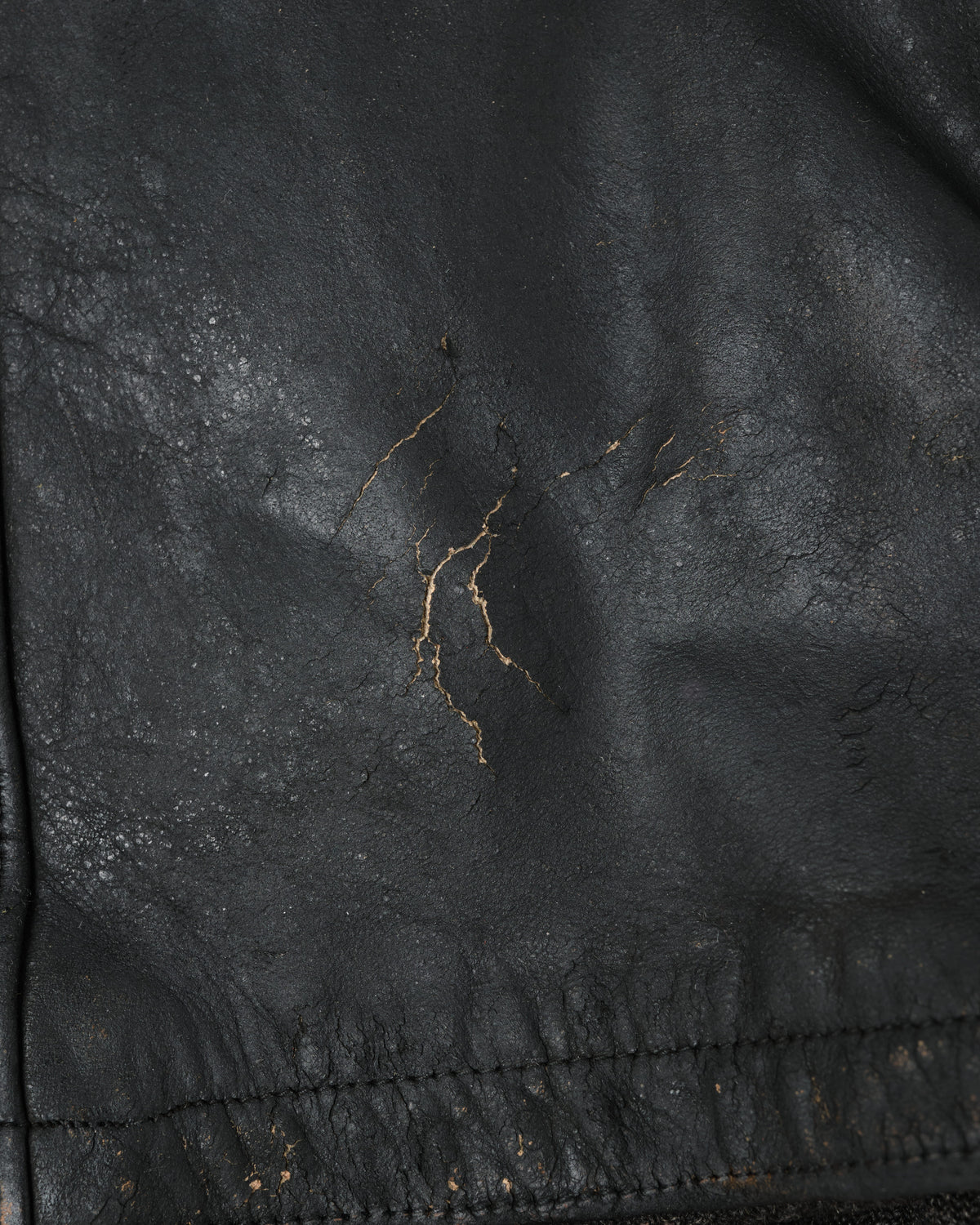
Countless creases and abrasions accumulated through years of wear transcend mere material condition to speak of history itself.
The leather exudes a quiet tension and a seasoned warmth—a strange magnetism that extends beyond ruggedness.
Equally noteworthy is the wool lining that backs the interior.
The moderately brushed, heavyweight wool fabric blocks cold wind while preventing moisture buildup, offering the superior insulation and breathability inherent to natural fiber.
The interplay between the weight of the leather and the softness of the wool is emblematic of military apparel's rational pursuit of functionality. The pairing significantly elevates comfort during wear.
The color is a deep, settled black.
This is not a uniform black, but rather shaped by natural fading over time.
Areas subject to friction display a greyish surface variation, which, depending on the angle of light, reveals gradations reminiscent of ink wash painting.
This "fluctuating black" is the essence of vintage leather—the hallmark of an object utterly singular, never to be duplicated.
The outer strength, the inner gentleness, and the patina of age converge as one unified garment.
No size marking is visible, though the piece appears to correspond to a Japanese L to XL.
Given the actual measurements, this runs large, accommodating even substantial frames without concern.
In the manner of military wear, the generous cut reads well even when worn oversized.
Evidence of use is present—scuffing, creasing, loose threads, small holes, tears, cracks, separation, replaced buttons, and missing tags. No damage severe enough to compromise wearability is evident, and the jacket remains serviceable.
German military items have garnered considerable attention in recent years, yet surviving examples remain exceptionally scarce—a reflection, in part, of historical circumstance. Demand outpaces supply.
With a dedicated following among collectors, this is unquestionably a coveted archive piece that rarely changes hands.
It merits consideration both as a wardrobe addition and as a collection piece—equally valuable as a design reference.
Items of this caliber arrive at our shop with limited frequency. Should you seek such a piece, this opportunity warrants attention.