Estimated 1940s Wehrmacht Splinter Camouflage Zip-Up Hooded Jacket.
A truly exceptional arrival.
The Wehrmacht—the unified armed forces of Nazi Germany from 1935 to 1945—comprised three branches: the Heer (Army), Kriegsmarine (Navy), and Luftwaffe (Air Force).
The name Wehrmacht replaced the earlier Reichswehr, embodying the Nazi regime's rearmament efforts that exceeded the limitations set by the Treaty of Versailles.
After Adolf Hitler seized power in 1933, the establishment of the Wehrmacht was among his most explicit and audacious undertakings.
It represented the creation of a modern, militarily capable force designed to achieve the Nazi regime's long-term objectives: reclaiming lost territories, acquiring new lands, and dominating neighbouring nations.
This required the reintroduction of conscription, coupled with massive investment in military industry and defence expenditure.
Following Germany's unconditional surrender on May 8, 1945, Allied occupation commenced and the Wehrmacht underwent systematic dissolution.
On August 20, 1946, the Wehrmacht and all of its branches were formally disbanded by the Allied Command.
This included the Heer (Army), Kriegsmarine (Navy), and Luftwaffe (Air Force).
After the Wehrmacht's dissolution, Germany became a nation without military power. The subsequent remilitarisation of West Germany (Federal Republic) and East Germany (German Democratic Republic) proceeded separately within the context of the Cold War.
West Germany established the Bundeswehr (Federal Armed Forces) in 1955, becoming part of NATO.
Meanwhile, East Germany established the Nationale Volksarmee (National People's Army) in 1956, joining the Warsaw Pact.
These new military organisations were considered distinct from Wehrmacht traditions and structures.
We present a Zip-Up Hooded Jacket, believed to have been privately tailored for an individual soldier during the Second World War.
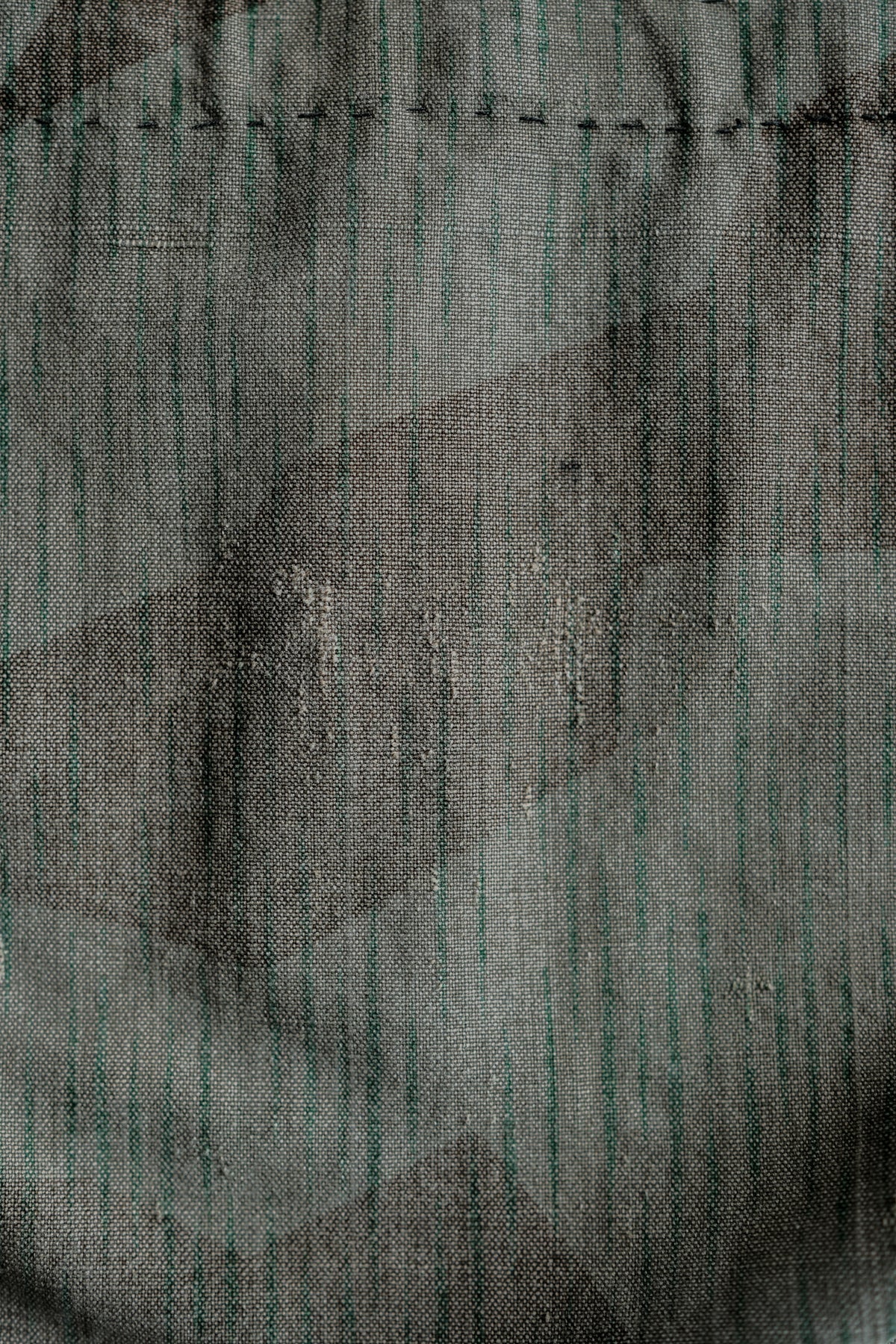
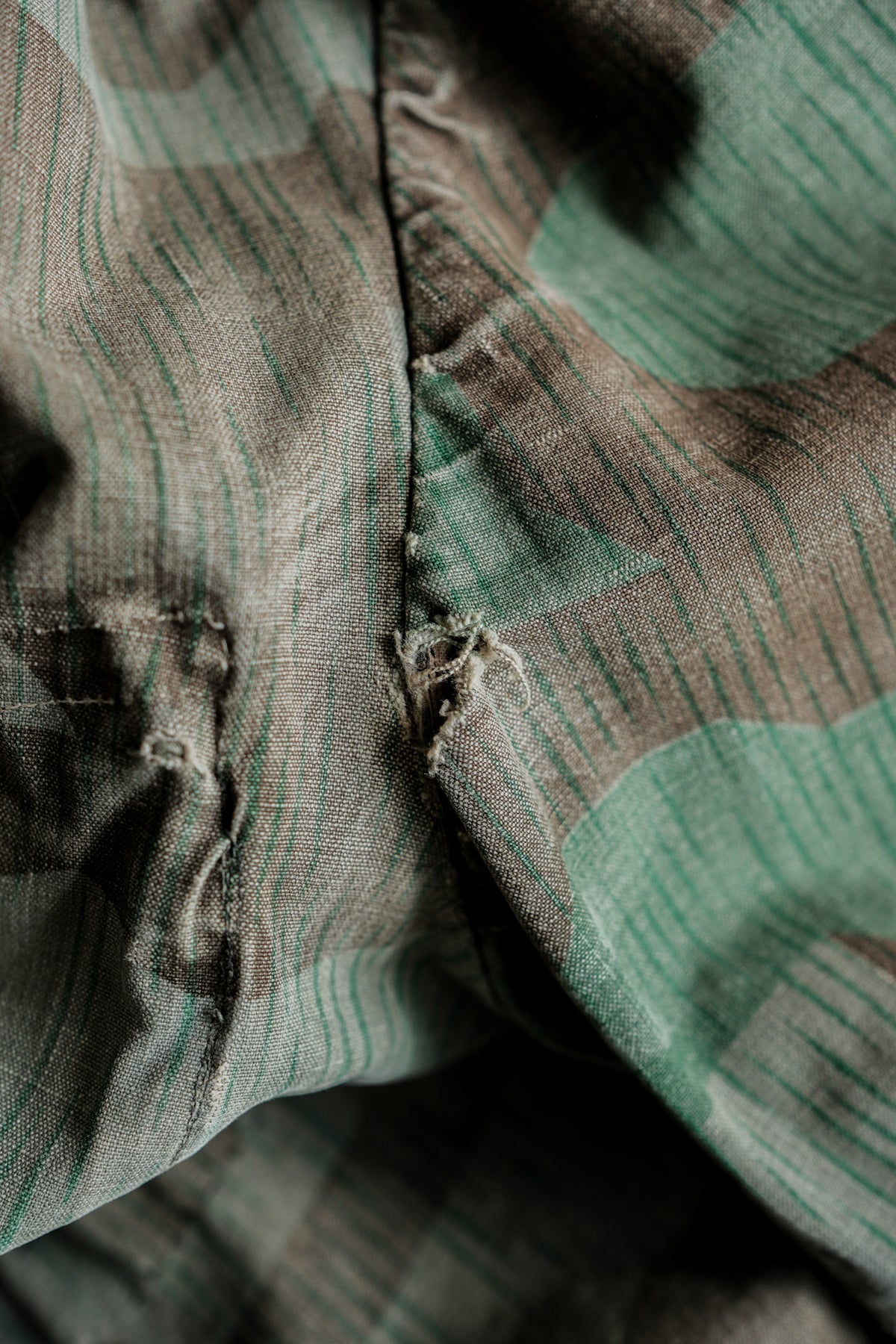
The defining characteristic of this piece is undoubtedly the camouflage pattern unique to the Wehrmacht.
The camouflage pattern known colloquially as Splinter Camouflage is a four-colour military pattern developed by Germany in the late 1920s and first adopted by the Reichswehr in 1931—the first camouflage pattern ever employed by German forces.
These patterns held the formal designation Buntfarbendruck 31, which was later renamed Splittermuster 31 in 1935.
This pattern saw primary use on the Zeltbahn and was widely adopted for uniforms throughout the Second World War.
This particular jacket employs the Splittermuster 31—a piece bearing such commanding presence and character that its colour palette and atmosphere differ markedly from post-1950s Splinter variations.
Notably, this example represents what is termed Localmade—not a factory mass-production piece, but rather a jacket where fabric, pattern, and tailoring were all sourced and produced privately by an individual.
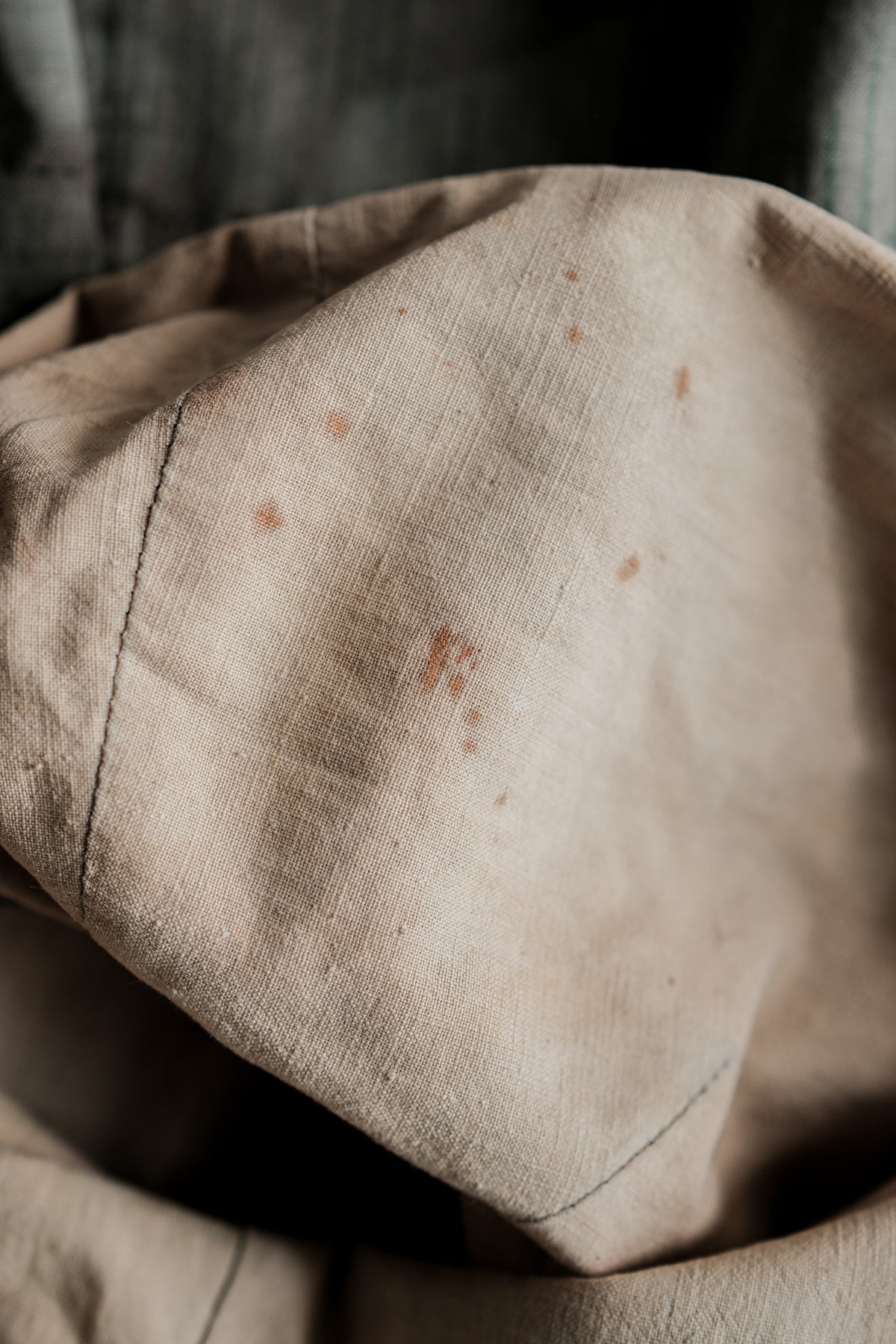
The differing colorways of the outer and lining fabrics suggest this was constructed from the Zeltbahn—the isosceles triangular personal shelter fabric—of that era.
Considering the zipper hardware and stitching employed, this piece was likely tailored during the early 1940s, well within the Second World War period.
Distinctive details abound: a collar engineered high to protect the neck, a substantial patch pocket positioned on the right chest only, a zip pocket at the right hem, and an adjuster belt with metal buckles enabling sleeve adjustment—all conceived for the wearer's comfort and practicality.
While documented Wehrmacht items certainly possess appeal, pieces like this localmade example carry their own distinct character and fascination.
The front closure employs a U-shaped retaining zip fastener with a single-prong slider from ORIG RITSCH—the same hardware seen on German jackets from the 1930s, testament to its vintage construction.
The hem zip pocket also features a U-shaped retaining fastener, unmarked.
The hood and waist feature thin cord drawstrings. By cinching the drawcords, the silhouette becomes adjustable—a two-way design suited to individual preference and occasion.
Beyond its rarity, this is a garment of genuine sartorial merit—one that demands to be worn, not merely preserved.
No size marking is visible, though the fit approximates a Japanese L to XL.
The actual measurements indicate a notably generous sizing, accommodating larger frames without concern.
In the spirit of military design, it wears beautifully oversized and relaxed.
The fabric exhibits expected signs of age and use—fading, worn areas, surface marks, loose threads, and small tears.
The piece remains wearable, though the zipper end shows some fraying; careful handling will allow for years of wear.
Wehrmacht pieces have garnered considerable attention in recent years, yet authentic examples remain exceptionally scarce. Demand far outpaces supply.
With a devoted following, Wehrmacht items are unquestionably coveted archive pieces that collectors rarely release.
This is not something money reliably procures, nor can future availability be assured.
Whether as an active wardrobe piece, a collection anchor, or a design reference, this jacket is exemplary.
A rarity seldom encountered domestically—for those who have searched for it or harbour an affinity for uncommon garments, this opportunity warrants serious consideration.
![[~40's]WWⅡ German Army Splinter Camouflage Zip Up Hooded Jacket "Localmade" "Wehrmacht"](http://vieuxetnouveau-shop.com/cdn/shop/files/DSCF2229.jpg?v=1728521361&width=2400)
![[~40's]WWⅡ German Army Splinter Camouflage Zip Up Hooded Jacket "Localmade" "Wehrmacht"](http://vieuxetnouveau-shop.com/cdn/shop/files/DSCF2230.jpg?v=1728521361&width=2400)
![[~40's]WWⅡ German Army Splinter Camouflage Zip Up Hooded Jacket "Localmade" "Wehrmacht"](http://vieuxetnouveau-shop.com/cdn/shop/files/DSCF2243_8cedc634-024f-4a78-94eb-e3168fb0dca3.jpg?v=1728521361&width=2400)
![[~40's]WWⅡ German Army Splinter Camouflage Zip Up Hooded Jacket "Localmade" "Wehrmacht"](http://vieuxetnouveau-shop.com/cdn/shop/files/DSCF2231_0c7b392c-83ea-4d24-b092-d828d8b11e52.jpg?v=1728521361&width=2400)
![[~40's]WWⅡ German Army Splinter Camouflage Zip Up Hooded Jacket "Localmade" "Wehrmacht"](http://vieuxetnouveau-shop.com/cdn/shop/files/DSCF2232_99b7a580-328d-4f6f-91ef-060b45171364.jpg?v=1728521361&width=2400)
![[~40's]WWⅡ German Army Splinter Camouflage Zip Up Hooded Jacket "Localmade" "Wehrmacht"](http://vieuxetnouveau-shop.com/cdn/shop/files/DSCF2233_b8f4cb4b-d78d-4342-8d1c-8238965b313f.jpg?v=1728521361&width=2400)
![[~40's]WWⅡ German Army Splinter Camouflage Zip Up Hooded Jacket "Localmade" "Wehrmacht"](http://vieuxetnouveau-shop.com/cdn/shop/files/DSCF2244_b76410c3-ce1c-4f31-a9aa-06d4b357f94e.jpg?v=1728521361&width=2400)
![[~40's]WWⅡ German Army Splinter Camouflage Zip Up Hooded Jacket "Localmade" "Wehrmacht"](http://vieuxetnouveau-shop.com/cdn/shop/files/DSCF2235_71741c86-4016-4aec-b9e6-9a9c3e7a888a.jpg?v=1728521361&width=2400)
![[~40's]WWⅡ German Army Splinter Camouflage Zip Up Hooded Jacket "Localmade" "Wehrmacht"](http://vieuxetnouveau-shop.com/cdn/shop/files/DSCF2236_7244365e-476b-43dc-9625-05db85793ee1.jpg?v=1728521361&width=2400)
![[~40's]WWⅡ German Army Splinter Camouflage Zip Up Hooded Jacket "Localmade" "Wehrmacht"](http://vieuxetnouveau-shop.com/cdn/shop/files/DSCF2242_f4c1da1a-d4c0-449e-bb51-667b8f84bb32.jpg?v=1728521361&width=2400)
![[~40's]WWⅡ German Army Splinter Camouflage Zip Up Hooded Jacket "Localmade" "Wehrmacht"](http://vieuxetnouveau-shop.com/cdn/shop/files/DSCF2254_a8c36f9b-bae4-439f-9471-6d83f53b54f1.jpg?v=1728521361&width=2400)
![[~40's]WWⅡ German Army Splinter Camouflage Zip Up Hooded Jacket "Localmade" "Wehrmacht"](http://vieuxetnouveau-shop.com/cdn/shop/files/DSCF2256_36e5c11f-bbc6-4315-a0c3-73875a5ab128.jpg?v=1728521361&width=2400)
![[~40's]WWⅡ German Army Splinter Camouflage Zip Up Hooded Jacket "Localmade" "Wehrmacht"](http://vieuxetnouveau-shop.com/cdn/shop/files/DSCF2262_aeea2ad2-cd8a-4e48-9708-2e1828256b21.jpg?v=1728521361&width=2400)
![[~40's]WWⅡ German Army Splinter Camouflage Zip Up Hooded Jacket "Localmade" "Wehrmacht"](http://vieuxetnouveau-shop.com/cdn/shop/files/DSCF2263_4a13f184-a7d1-423a-9007-71fee57314d8.jpg?v=1728521361&width=2400)
![[~40's]WWⅡ German Army Splinter Camouflage Zip Up Hooded Jacket "Localmade" "Wehrmacht"](http://vieuxetnouveau-shop.com/cdn/shop/files/DSCF2237_aea35067-8cc3-4ebd-94e6-f1f4680edeeb.jpg?v=1728521361&width=2400)
![[~40's]WWⅡ German Army Splinter Camouflage Zip Up Hooded Jacket "Localmade" "Wehrmacht"](http://vieuxetnouveau-shop.com/cdn/shop/files/DSCF2238_7f308ca1-dfa3-4882-97f2-ad615c09b7d6.jpg?v=1728521361&width=2400)
![[~40's]WWⅡ German Army Splinter Camouflage Zip Up Hooded Jacket "Localmade" "Wehrmacht"](http://vieuxetnouveau-shop.com/cdn/shop/files/DSCF2239_b24b7049-1d2e-485d-bbc4-27b25c8e53fb.jpg?v=1728521361&width=2400)
![[~40's]WWⅡ German Army Splinter Camouflage Zip Up Hooded Jacket "Localmade" "Wehrmacht"](http://vieuxetnouveau-shop.com/cdn/shop/files/DSCF2240_4a277c0a-2ffc-4023-a367-09be245aa7e8.jpg?v=1728521361&width=2400)
![[~40's]WWⅡ German Army Splinter Camouflage Zip Up Hooded Jacket "Localmade" "Wehrmacht"](http://vieuxetnouveau-shop.com/cdn/shop/files/DSCF2258_f33b800e-0a0c-4591-aea8-2db6647ff497.jpg?v=1728521361&width=2400)
![[~40's]WWⅡ German Army Splinter Camouflage Zip Up Hooded Jacket "Localmade" "Wehrmacht"](http://vieuxetnouveau-shop.com/cdn/shop/files/DSCF2260_a743c524-0667-4b31-9357-c4e0d92941a2.jpg?v=1728521361&width=2400)
![[~40's]WWⅡ German Army Splinter Camouflage Zip Up Hooded Jacket "Localmade" "Wehrmacht"](http://vieuxetnouveau-shop.com/cdn/shop/files/DSCF2241_a1c6ee58-ca06-4416-bb68-81dd91064f40.jpg?v=1728521361&width=2400)
![[~40's]WWⅡ German Army Splinter Camouflage Zip Up Hooded Jacket "Localmade" "Wehrmacht"](http://vieuxetnouveau-shop.com/cdn/shop/files/DSCF2253_08425eda-292e-43fc-b57a-3caae507c5e9.jpg?v=1728521361&width=2400)
![[~40's]WWⅡ German Army Splinter Camouflage Zip Up Hooded Jacket "Localmade" "Wehrmacht"](http://vieuxetnouveau-shop.com/cdn/shop/files/DSCF2234_68c3295e-13a9-4ff5-9aa2-2686675a2c23.jpg?v=1728521361&width=2400)
![[~40's]WWⅡ German Army Splinter Camouflage Zip Up Hooded Jacket "Localmade" "Wehrmacht"](http://vieuxetnouveau-shop.com/cdn/shop/files/DSCF2245_8dc3361c-e734-4a93-a661-3a2dfe615875.jpg?v=1728521361&width=2400)
![[~40's]WWⅡ German Army Splinter Camouflage Zip Up Hooded Jacket "Localmade" "Wehrmacht"](http://vieuxetnouveau-shop.com/cdn/shop/files/DSCF2250_154c5ed3-c85b-43ba-8c36-624d7809ad64.jpg?v=1728521361&width=2400)
![[~40's]WWⅡ German Army Splinter Camouflage Zip Up Hooded Jacket "Localmade" "Wehrmacht"](http://vieuxetnouveau-shop.com/cdn/shop/files/DSCF2248_25569083-7c51-4bd9-b410-0ea1ff165c75.jpg?v=1728521361&width=2400)
![[~40's]WWⅡ German Army Splinter Camouflage Zip Up Hooded Jacket "Localmade" "Wehrmacht"](http://vieuxetnouveau-shop.com/cdn/shop/files/DSCF2251_3559f256-bd24-480c-adbe-4ca6912dc365.jpg?v=1728521361&width=2400)
![[~40's]WWⅡ German Army Splinter Camouflage Zip Up Hooded Jacket "Localmade" "Wehrmacht"](http://vieuxetnouveau-shop.com/cdn/shop/files/DSCF1709_2a408864-0e08-4df1-93ea-aebf4ac51a72.jpg?v=1728521361&width=2400)
![[~40's]WWⅡ German Army Splinter Camouflage Zip Up Hooded Jacket "Localmade" "Wehrmacht"](http://vieuxetnouveau-shop.com/cdn/shop/files/DSCF1711.jpg?v=1728521361&width=2400)
![[~40's]WWⅡ German Army Splinter Camouflage Zip Up Hooded Jacket "Localmade" "Wehrmacht"](http://vieuxetnouveau-shop.com/cdn/shop/files/DSCF1714.jpg?v=1728521361&width=2400)
![[~40's]WWⅡ German Army Splinter Camouflage Zip Up Hooded Jacket "Localmade" "Wehrmacht"](http://vieuxetnouveau-shop.com/cdn/shop/files/DSCF1710.jpg?v=1728521361&width=2400)
![[~40's]WWⅡ German Army Splinter Camouflage Zip Up Hooded Jacket "Localmade" "Wehrmacht"](http://vieuxetnouveau-shop.com/cdn/shop/files/DSCF2541_777a0a54-d59a-453e-b729-0b373f398a0c.jpg?v=1728521361&width=2400)
![[~40's]WWⅡ German Army Splinter Camouflage Zip Up Hooded Jacket "Localmade" "Wehrmacht"](http://vieuxetnouveau-shop.com/cdn/shop/files/DSCF2543_fddf62f7-8d18-4ee5-b460-fb313dd9eee1.jpg?v=1728521361&width=2400)
![[~40's]WWⅡ German Army Splinter Camouflage Zip Up Hooded Jacket "Localmade" "Wehrmacht"](http://vieuxetnouveau-shop.com/cdn/shop/files/DSCF2546_ba9f8539-2f22-4d29-9dd9-d8078202d317.jpg?v=1728521361&width=2400)
![[~40's]WWⅡ German Army Splinter Camouflage Zip Up Hooded Jacket "Localmade" "Wehrmacht"](http://vieuxetnouveau-shop.com/cdn/shop/files/DSCF2544_75682fd7-73a5-4c08-b2be-5e911d57d103.jpg?v=1728521361&width=2400)
![[~40's]WWⅡ German Army Splinter Camouflage Zip Up Hooded Jacket "Localmade" "Wehrmacht"](http://vieuxetnouveau-shop.com/cdn/shop/files/DSCF2545_99075c89-8e38-4171-b117-2ef8b0a77a06.jpg?v=1728521361&width=2400)
![[~40's]WWⅡ German Army Splinter Camouflage Zip Up Hooded Jacket "Localmade" "Wehrmacht"](http://vieuxetnouveau-shop.com/cdn/shop/files/DSCF2542_d59c0dac-2124-42e1-aaaf-d24a9e251468.jpg?v=1728521361&width=2400)
![[~40's]WWⅡ German Army Splinter Camouflage Zip Up Hooded Jacket "Localmade" "Wehrmacht"](http://vieuxetnouveau-shop.com/cdn/shop/files/DSCF2540_95f714f8-f22c-4001-9797-b41acb6c01d9.jpg?v=1728521361&width=2400)
![[~40's]WWⅡ German Army Splinter Camouflage Zip Up Hooded Jacket "Localmade" "Wehrmacht"](http://vieuxetnouveau-shop.com/cdn/shop/files/DSCF2547_7f03f38e-7349-4d52-b6e8-340f02767c83.jpg?v=1728521361&width=2400)
![[~40's]WWⅡ German Army Splinter Camouflage Zip Up Hooded Jacket "Localmade" "Wehrmacht"](http://vieuxetnouveau-shop.com/cdn/shop/files/DSCF2539_b10f64b3-e949-4685-97ee-c11462a0cb87.jpg?v=1728521361&width=2400)
![[~40's]WWⅡ German Army Splinter Camouflage Zip Up Hooded Jacket "Localmade" "Wehrmacht"](http://vieuxetnouveau-shop.com/cdn/shop/files/DSCF2549_28c397bf-5748-4954-9ab9-7b8c70afe74c.jpg?v=1728521361&width=2400)
![[~40's]WWⅡ German Army Splinter Camouflage Zip Up Hooded Jacket "Localmade" "Wehrmacht"](http://vieuxetnouveau-shop.com/cdn/shop/files/DSCF2551_d61c2516-ea4b-4c87-8e26-7204306c20ed.jpg?v=1728521361&width=2400)
![[~40's]WWⅡ German Army Splinter Camouflage Zip Up Hooded Jacket "Localmade" "Wehrmacht"](http://vieuxetnouveau-shop.com/cdn/shop/files/DSCF2557_117c9911-ae77-44b7-a788-18e023a8d577.jpg?v=1728521362&width=2400)