Circa 1950s, Czechoslovak People's Army 'Clouds Camouflage Reversible Smock'.
A truly exceptional arrival.
The Československá Lidová Armáda was the standing military force of the Czechoslovak Socialist Republic, once a presence in Central Europe, functioning as the military foundation that upheld national sovereignty and the socialist state apparatus.
Today, the region exists as two separate nations: the Czech Republic and the Slovak Republic. Yet between 1918 and 1992, these territories formed a unified state—first as the Czechoslovak Republic (1918–1960), then as the Czechoslovak Socialist Republic (1960–1990)—with the People's Army serving as its national military throughout this entire period.
The origins trace back to 1918, following the dissolution of the Austro-Hungarian Empire after the First World War, when the Czechoslovak Republic was born and its military established accordingly.
During the Second World War, the nation fell under Nazi Germany occupation, and military operations ceased temporarily. Yet with post-war independence, the military was reorganised under Soviet influence as a socialist force, the character of which increasingly became that of a 'People's Army'.
Throughout the Cold War, as a member of the Warsaw Pact bloc, the Československá Lidová Armáda maintained close coordination with Soviet forces. Its focus lay particularly on strengthening land military capabilities and border defence infrastructure. What merits particular note is that whilst the entire apparatus—equipment, uniforms, training regimens—bore the unmistakable imprint of Soviet military doctrine, the nation simultaneously maintained an independent industrial base for the development of its own weapons and equipment.
From the 1950s through the 1980s, the military deployed diverse branches—mechanised infantry, airborne units, chemical corps—and stood as the backbone of Eastern defence across this strategically vital Central European terrain.
The East European revolutions of 1990 and the subsequent collapse of socialist systems led to democratisation under a federal structure. In 1993, the Velvet Divorce saw the nation divide peacefully into two. Each emerged as a new military force: the Czech Armed Forces and the Slovak Armed Forces.
This particular specimen is a reversible smock worn during the Czechoslovak Republic period by personnel of the CSLA.
Its most striking feature is the distinctive 'Clouds Camouflage' pattern—a configuration unique to the Československá Lidová Armáda.
First adopted in the 1950s as an official summer camouflage, this pattern represented an entirely novel approach to field concealment.
Uniforms bearing this print were worn between the 1950s and 1970s by the Czechoslovak 22nd Airborne Brigade, army snipers, and reconnaissance units. Though the pattern saw approximately twenty years of service, official production ceased in 1962.
This piece is exceptionally rare in its reversible construction, with two distinct camouflage tones adorning either side.
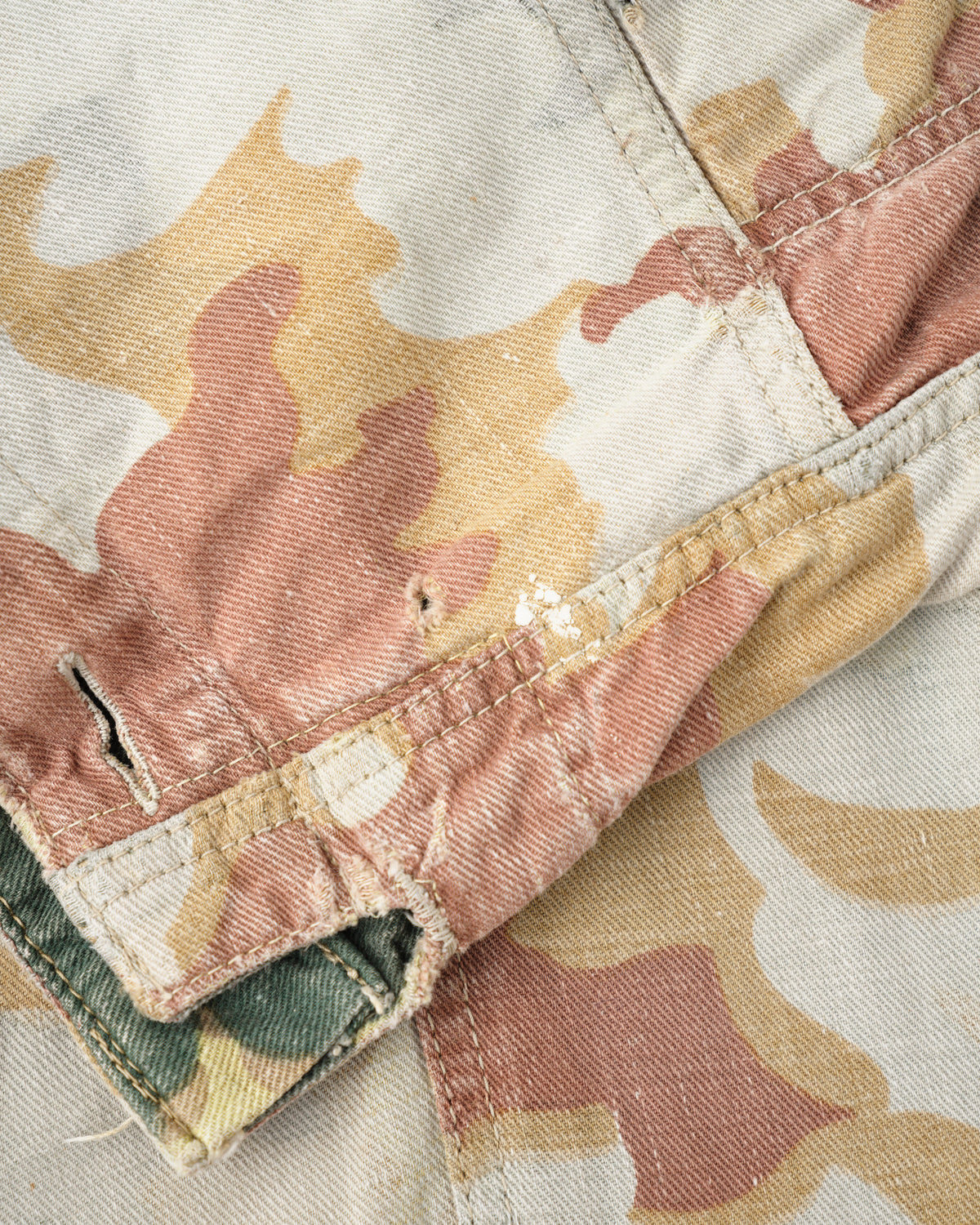
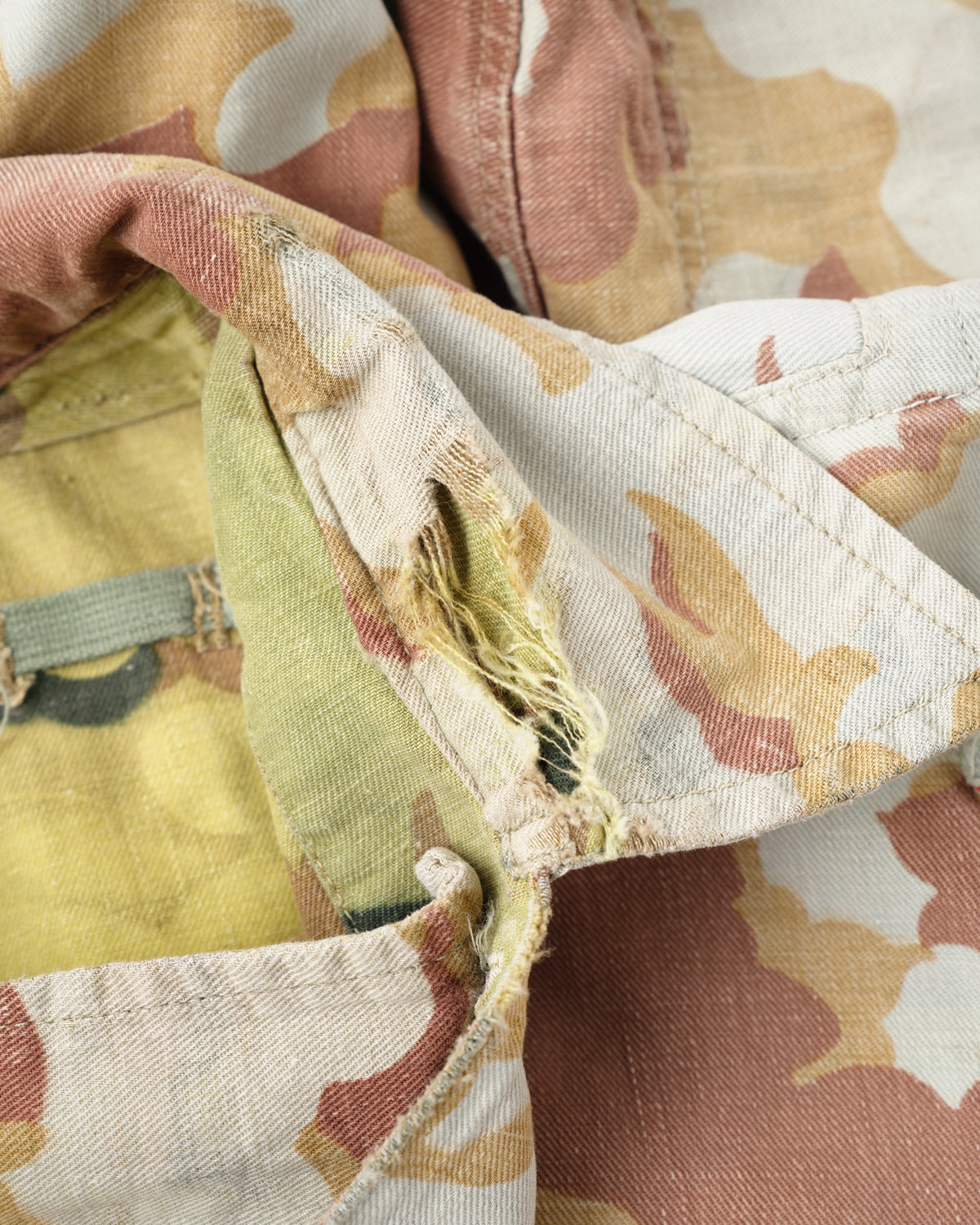
One face features pale green ground layered with dark and light olive 'clouds'; the reverse presents a greyish tan base with chocolate brown and bright olive-green 'clouds'. A single garment offering two entirely different aesthetic experiences. The green face was intended for spring wear; the grey face for autumn. One might adjust its presentation according to season or inclination.
One detail warrants particular emphasis. We have presented similar smocks previously, but the prior example arrived as a V-neck variant, its original hood removed. This specimen, by contrast, retains a collar. The significance of this distinction cannot be understated: among surviving examples, collared versions are substantially rarer than their V-neck counterparts. Our shop has handled numerous Czechoslovak military smocks over the years, and the vast majority have arrived as V-neck editions. Collared versions are genuinely uncommon.
This fact alone speaks to the scarcity of the present piece. Worn upright, the collar imparts considerable volume at the neckline, elevating the garment's military bearing considerably. Folded down, it acquires the lightness of a shirt jacket. This collar—something absent from V-neck versions—opens entirely new styling possibilities. This constitutes the piece's principal advantage.
The camouflage itself commands attention, yet the detailing remains remarkably spare and austere. By design: this smock was conceived as an over-smock, meant to be donned rapidly above uniform layers. Every unnecessary embellishment has been eliminated. Pure minimalism—the tool in its truest sense.
In original condition, the garment featured an oversized hood designed for wear over a helmet, and cuff attachments for gloves. The present example has been modified by its previous owner; both features have been removed. Yet this alteration has, in fact, enhanced its wearability as civilian dress, allowing the camouflage pattern itself to read more cleanly as a surface.
The neckline is a pullover collar design secured by a single dark brown button. The matte finish of this button functions as a restrained yet definite accent against the patterned field.
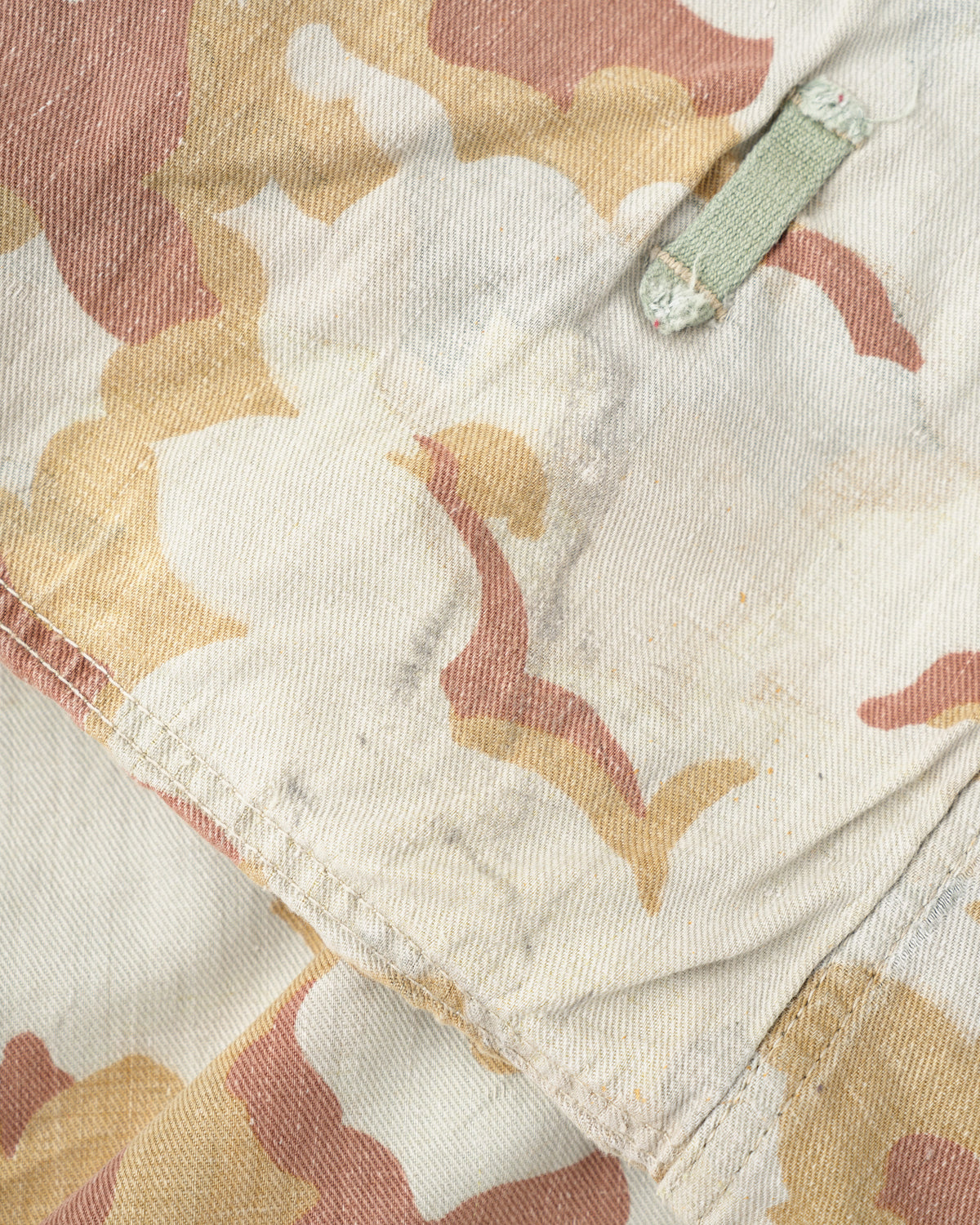
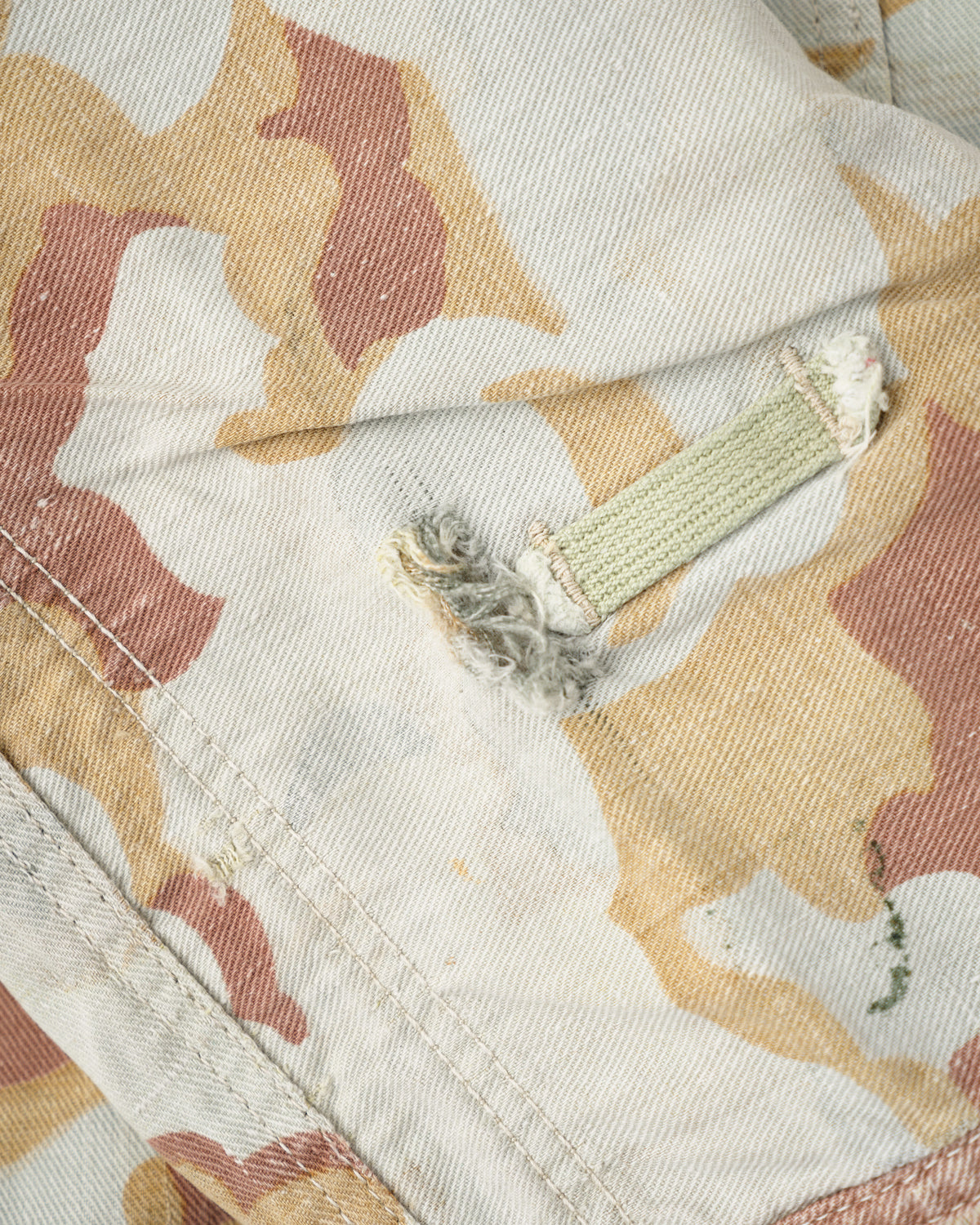
Note the scatter of small fabric loops across the body. Sage green cotton tape has been sewn at regular intervals across front, back, shoulders and sleeves.
These are 'foliage loops'—originally intended to receive grass and branches for three-dimensional camouflage effect in the field. On active service, they substantially enhanced concealment; from a fashion perspective, they introduce subtle dimensionality and textural interest to what might otherwise read as flat printed surface.
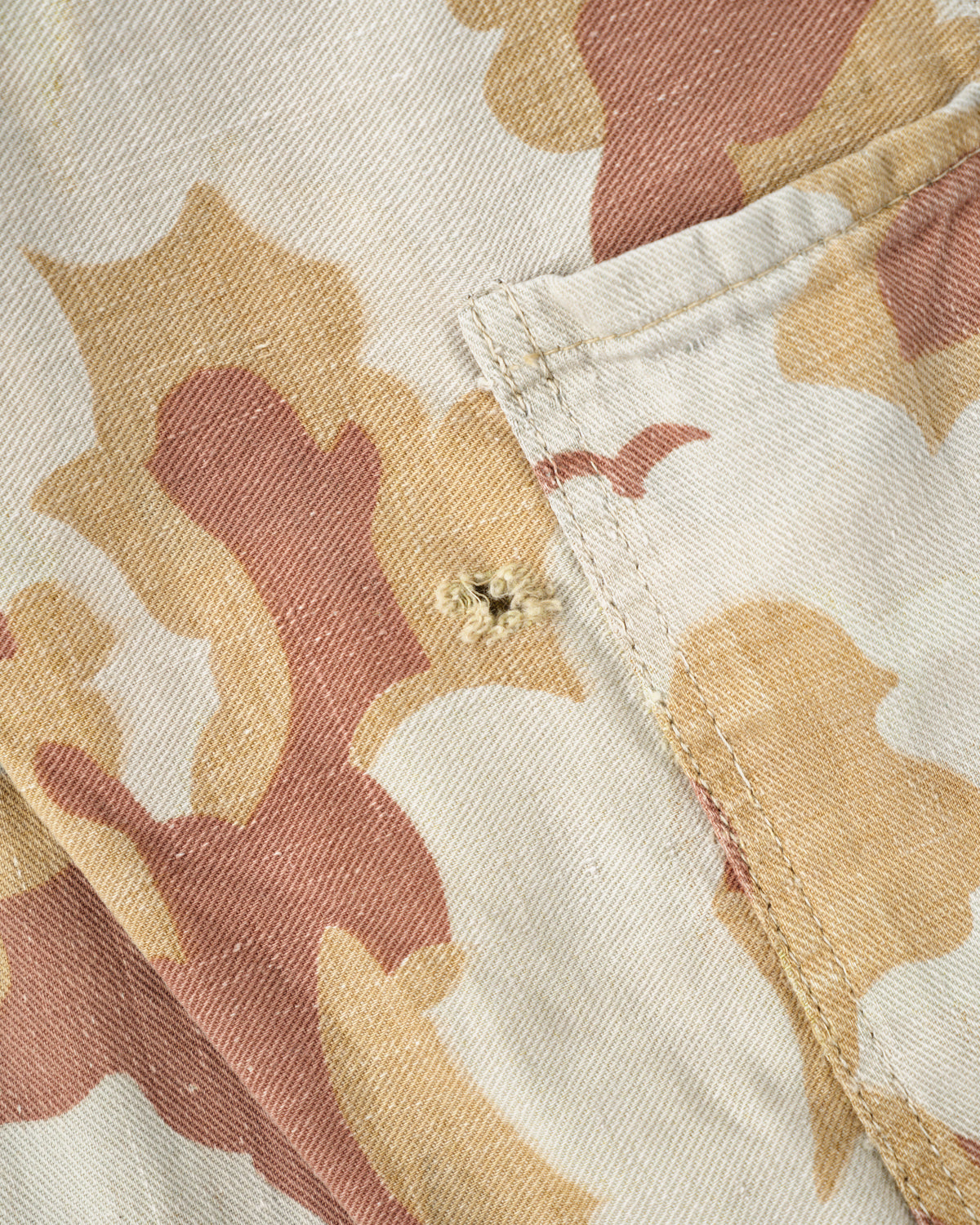
The vertical pass-through pockets at the body's centre were designed for direct access to the uniform beneath (they are sealed on this example). The left sleeve bears a narrow patch pocket—originally for ammunition—a detail inherited from sniper smock patterns.
Drawcords at the hem permit silhouette adjustment: cinched for a sharp, blouson-like profile; left open for an ample, oversized outline. A simple yet effective function, calibrated to individual preference and layering.
The fabric is light-weight cotton twill—supple and allowing uninhibited movement. As an over-smock, priority was given to breathability and minimal weight, making this ideal for shirt-jacket wear from early spring through early autumn.
Stylistically, the most effective approach is to allow this smock to serve as the principal element, with remaining pieces held in neutral restraint.
No size marking is visible, though proportions suggest roughly Japanese XL. Given the generous measurements overall, this should accommodate a wide range of frames comfortably, whether worn true to size or oversized.
Originally conceived for wear over standard-issue uniforms, over-smocks by their nature feature generous proportions. Armholes and body width both offer considerable volume, making this a piece suited to various builds.
The piece shows fading, soiling, abrasion, fraying, small holes, tears, and button loss—evidence of use consistent with vintage military wear. No damage impedes wearability; the garment remains entirely functional. What is particularly noteworthy: whilst most examples show pronounced colour shift, this specimen retains excellent colour saturation. The balance between historical document and practical garment remains notably strong.
'Clouds Camouflage' ranks among the rarest patterns in military camouflage history. This is the sole garment that permits experiencing two distinct configurations, employed according to season and mood.
This is not something money alone secures, nor can future availability be assured.
Appropriate equally as wardrobe element, collection piece, or design reference, this represents an exceedingly rare encounter domestically or internationally. Those seeking precisely such an object, or those drawn to uncommon items, should regard this arrival as noteworthy.
![[~50's]Czechoslovakian Army Clouds Camouflage Reversible Smock "Modified"](http://vieuxetnouveau-shop.com/cdn/shop/files/202505030479.jpg?v=1770701016&width=2400)
![[~50's]Czechoslovakian Army Clouds Camouflage Reversible Smock "Modified"](http://vieuxetnouveau-shop.com/cdn/shop/files/202505030480_d6f797e4-fc7e-49ba-a0fb-653afb5c690b.jpg?v=1770701016&width=2400)
![[~50's]Czechoslovakian Army Clouds Camouflage Reversible Smock "Modified"](http://vieuxetnouveau-shop.com/cdn/shop/files/202505030483_56cd5869-d856-4b46-b3e1-9f48ba5e6e88.jpg?v=1770701016&width=2400)
![[~50's]Czechoslovakian Army Clouds Camouflage Reversible Smock "Modified"](http://vieuxetnouveau-shop.com/cdn/shop/files/202505030484.jpg?v=1770701016&width=2400)
![[~50's]Czechoslovakian Army Clouds Camouflage Reversible Smock "Modified"](http://vieuxetnouveau-shop.com/cdn/shop/files/DSCF3240_f59c3102-91bf-4631-a7e9-27a8718d1709.jpg?v=1770701116&width=2400)
![[~50's]Czechoslovakian Army Clouds Camouflage Reversible Smock "Modified"](http://vieuxetnouveau-shop.com/cdn/shop/files/DSCF3221_b9b0faae-c37b-4159-bad4-e4f0cf481730.jpg?v=1770701116&width=2400)
![[~50's]Czechoslovakian Army Clouds Camouflage Reversible Smock "Modified"](http://vieuxetnouveau-shop.com/cdn/shop/files/DSCF3222_71568b92-4bbf-42c1-a842-fb97ff0cdda3.jpg?v=1770701116&width=2400)
![[~50's]Czechoslovakian Army Clouds Camouflage Reversible Smock "Modified"](http://vieuxetnouveau-shop.com/cdn/shop/files/DSCF3214_d732bddf-98aa-49eb-bc0b-6d4c6b84e11c.jpg?v=1770701116&width=2400)
![[~50's]Czechoslovakian Army Clouds Camouflage Reversible Smock "Modified"](http://vieuxetnouveau-shop.com/cdn/shop/files/DSCF3217_1f856ffa-2537-4f79-9e3b-45f08d1af81f.jpg?v=1770701116&width=2400)
![[~50's]Czechoslovakian Army Clouds Camouflage Reversible Smock "Modified"](http://vieuxetnouveau-shop.com/cdn/shop/files/DSCF3223_f2fc525e-9687-4ff6-9eba-91ae9ea0bdf8.jpg?v=1770701116&width=2400)
![[~50's]Czechoslovakian Army Clouds Camouflage Reversible Smock "Modified"](http://vieuxetnouveau-shop.com/cdn/shop/files/DSCF3224_8ea0b2d4-7b41-4f22-ae75-b6bb00b15292.jpg?v=1770701116&width=2400)
![[~50's]Czechoslovakian Army Clouds Camouflage Reversible Smock "Modified"](http://vieuxetnouveau-shop.com/cdn/shop/files/DSCF3225_a046b25e-4945-4111-97bc-8dff002091cc.jpg?v=1770701116&width=2400)
![[~50's]Czechoslovakian Army Clouds Camouflage Reversible Smock "Modified"](http://vieuxetnouveau-shop.com/cdn/shop/files/DSCF3228_2be58b73-eed8-42c0-95c9-55635df4bbfa.jpg?v=1770701116&width=2400)
![[~50's]Czechoslovakian Army Clouds Camouflage Reversible Smock "Modified"](http://vieuxetnouveau-shop.com/cdn/shop/files/DSCF3226_9d0301a4-5189-4536-a913-8211aa97d94c.jpg?v=1770701116&width=2400)
![[~50's]Czechoslovakian Army Clouds Camouflage Reversible Smock "Modified"](http://vieuxetnouveau-shop.com/cdn/shop/files/DSCF3227_a3a27d1d-499b-40ea-a52a-fc0e535aa3d3.jpg?v=1770701116&width=2400)
![[~50's]Czechoslovakian Army Clouds Camouflage Reversible Smock "Modified"](http://vieuxetnouveau-shop.com/cdn/shop/files/DSCF3229_1baf1d5e-38ed-45b9-b57a-ae213b9bc33c.jpg?v=1770701116&width=2400)
![[~50's]Czechoslovakian Army Clouds Camouflage Reversible Smock "Modified"](http://vieuxetnouveau-shop.com/cdn/shop/files/DSCF3230_0aaa6e0c-2762-4b72-96da-409bdbbb19cf.jpg?v=1770701116&width=2400)
![[~50's]Czechoslovakian Army Clouds Camouflage Reversible Smock "Modified"](http://vieuxetnouveau-shop.com/cdn/shop/files/DSCF3231_146923c1-2f28-4b02-b087-00728a3b1348.jpg?v=1770701116&width=2400)
![[~50's]Czechoslovakian Army Clouds Camouflage Reversible Smock "Modified"](http://vieuxetnouveau-shop.com/cdn/shop/files/DSCF3232_aea1e622-4c05-4b57-9436-3d38c928f7e1.jpg?v=1770701116&width=2400)
![[~50's]Czechoslovakian Army Clouds Camouflage Reversible Smock "Modified"](http://vieuxetnouveau-shop.com/cdn/shop/files/DSCF3218_30808a5e-322a-4b30-aaa5-dc4cd4715c00.jpg?v=1770701116&width=2400)
![[~50's]Czechoslovakian Army Clouds Camouflage Reversible Smock "Modified"](http://vieuxetnouveau-shop.com/cdn/shop/files/DSCF3219_03e8479c-7959-4599-b6ab-fc9ac876027b.jpg?v=1770701116&width=2400)
![[~50's]Czechoslovakian Army Clouds Camouflage Reversible Smock "Modified"](http://vieuxetnouveau-shop.com/cdn/shop/files/DSCF3239_018047fd-18a7-4001-b515-a5336d977489.jpg?v=1770701116&width=2400)
![[~50's]Czechoslovakian Army Clouds Camouflage Reversible Smock "Modified"](http://vieuxetnouveau-shop.com/cdn/shop/files/DSCF3220_56df5cd4-1c8c-4e0a-bad6-56632abec231.jpg?v=1770701116&width=2400)
![[~50's]Czechoslovakian Army Clouds Camouflage Reversible Smock "Modified"](http://vieuxetnouveau-shop.com/cdn/shop/files/DSCF3467_48bc637c-9818-4d25-871c-933c63eb6007.jpg?v=1770802379&width=2400)
![[~50's]Czechoslovakian Army Clouds Camouflage Reversible Smock "Modified"](http://vieuxetnouveau-shop.com/cdn/shop/files/DSCF3468_c3061f13-3ee9-4ef9-82ac-e071efa9f54b.jpg?v=1770802379&width=2400)
![[~50's]Czechoslovakian Army Clouds Camouflage Reversible Smock "Modified"](http://vieuxetnouveau-shop.com/cdn/shop/files/DSCF3471_ae8f1d10-b5b9-478b-92dc-6377a6b23909.jpg?v=1770802403&width=2400)
![[~50's]Czechoslovakian Army Clouds Camouflage Reversible Smock "Modified"](http://vieuxetnouveau-shop.com/cdn/shop/files/DSCF3470_45c905ce-22e6-4e21-bede-2c7f62c3fcb2.jpg?v=1770802403&width=2400)
![[~50's]Czechoslovakian Army Clouds Camouflage Reversible Smock "Modified"](http://vieuxetnouveau-shop.com/cdn/shop/files/DSCF3469_b71e8efc-b5c8-4f37-9b6a-20ff90c93f18.jpg?v=1770802403&width=2400)
![[~50's]Czechoslovakian Army Clouds Camouflage Reversible Smock "Modified"](http://vieuxetnouveau-shop.com/cdn/shop/files/DSCF3475_81d3b092-9901-4b26-8170-4f25780a9375.jpg?v=1770802403&width=2400)
![[~50's]Czechoslovakian Army Clouds Camouflage Reversible Smock "Modified"](http://vieuxetnouveau-shop.com/cdn/shop/files/DSCF3472_84f4f301-faaf-4267-a50f-60c28584915f.jpg?v=1770802403&width=2400)
![[~50's]Czechoslovakian Army Clouds Camouflage Reversible Smock "Modified"](http://vieuxetnouveau-shop.com/cdn/shop/files/DSCF3473_6deb8a22-20a6-4df6-a878-771c900bc0b2.jpg?v=1770802403&width=2400)
![[~50's]Czechoslovakian Army Clouds Camouflage Reversible Smock "Modified"](http://vieuxetnouveau-shop.com/cdn/shop/files/DSCF3474_f193c3fb-6f66-44d3-af73-1037dfc30aae.jpg?v=1770802403&width=2400)
![[~50's]Czechoslovakian Army Clouds Camouflage Reversible Smock "Modified"](http://vieuxetnouveau-shop.com/cdn/shop/files/DSCF3477_2e930342-0ab3-4503-b2da-79a2ad2639ef.jpg?v=1770802379&width=2400)
![[~50's]Czechoslovakian Army Clouds Camouflage Reversible Smock "Modified"](http://vieuxetnouveau-shop.com/cdn/shop/files/DSCF3478_9a54b6b8-2a89-41bc-98e7-473159b42eb4.jpg?v=1770802379&width=2400)
![[~50's]Czechoslovakian Army Clouds Camouflage Reversible Smock "Modified"](http://vieuxetnouveau-shop.com/cdn/shop/files/DSCF3482_298160ca-4a16-45a0-ad96-384bd0d845ec.jpg?v=1770802379&width=2400)