A Metis black chambray atelier coat, French-made, estimated from the 1950s.
The "Atelier Coat" — a staple of French workwear.
In France of that era, amid a flourishing of artistic and cultural expression—painting, sculpture, architecture—this garment was favored principally by artists engaged in creative work within their ateliers.
Historical records indicate, however, that the atelier coat was worn far more broadly than by artists alone: schoolteachers, office workers, and even children adopted it across various walks of life.
Painters of the period, in particular, maintained the convention of working in formal dress—suits and the like—and wore the atelier coat as protection against soiling their clothes. Named quite literally for its purpose—the coat worn in the atelier, the workshop—it stands among French workwear as a garment deeply rooted in cultural history.
Used daily in the creative workspace, yet possessed of both formal and functional beauty, it embodies that rare luxury: a work garment made beautiful by its very purposefulness.
What first commands attention is the restrained, dignified quality of the notched lapel collar.
Stripped of unnecessary ornament, its rectilinear lines—bearing the mark of the craftsman's hand—express an honest and austere beauty.
Patch pockets at chest and waist serve a practical function, designed to hold tools. The square stitching that secures them creates visual rhythm while bringing texture and depth to the fabric itself.
Though the silhouette reads as strictly linear at first glance, it possesses a subtle softness that conforms gently to the body when worn—that ineffable quality of ease particular to vintage garments.
At the cuff sits an adjustable tab secured by button.
This design assumes the sleeves will be rolled; it permits a flexibility of approach responsive to temperature and task alike—the very embodiment of functional reasoning.
Such details—each imbued with purpose—offer the wearer both assurance and freedom.
The back features not belt loops but a two-point martingale arrangement.
This discreet back detail maintains equilibrium with the front while introducing subtle dimension and depth. It provides functional sizing adjustment while preserving the dignity of the garment's rear profile.
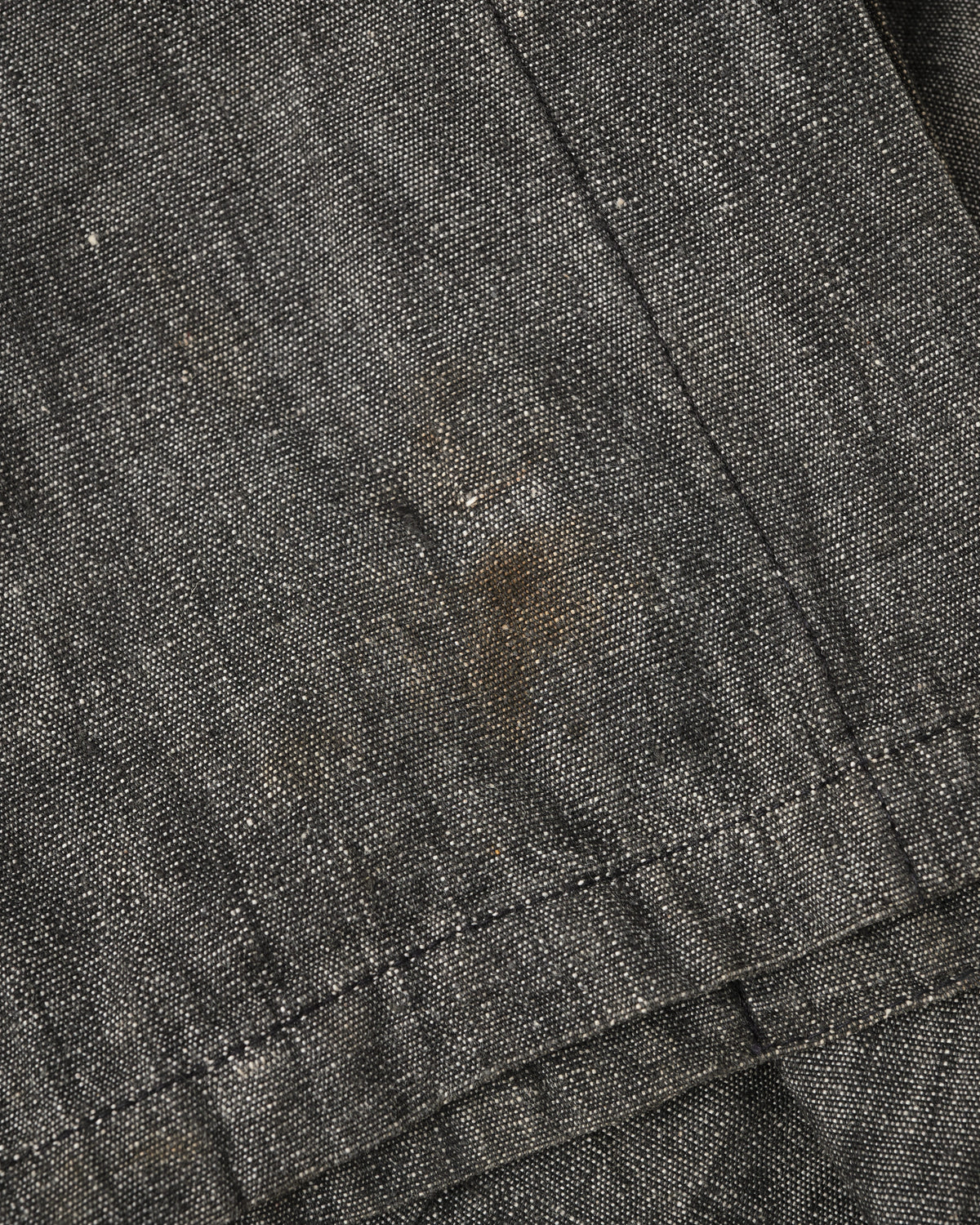
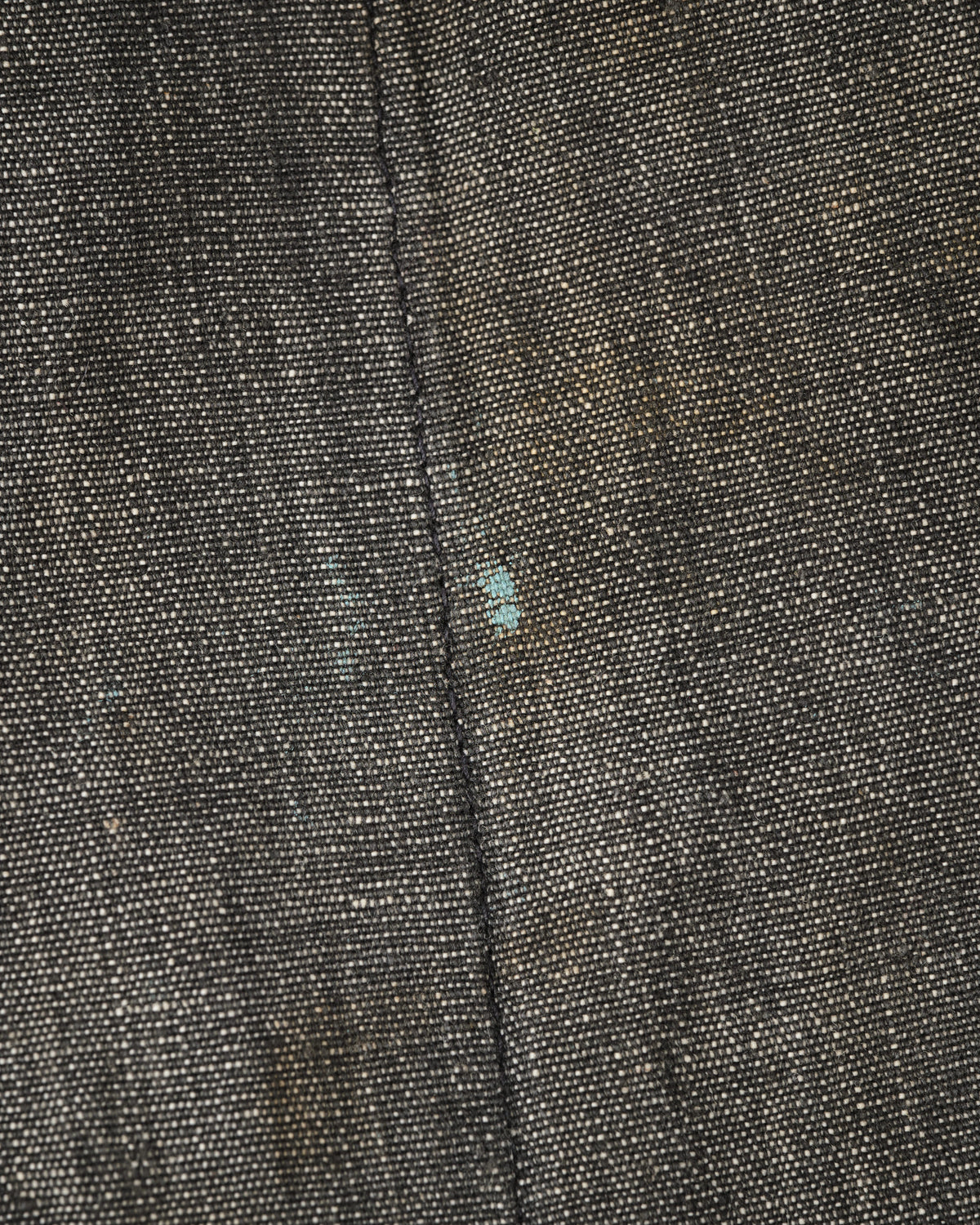
The fabric used here is Metis chambray—a cotton and linen blend.
While most French vintage atelier coats were constructed in twill cotton—the so-called "Salt & Pepper" weave—this example possesses singular rarity: it employs Metis fabric. Herein lies its greatest value.
Cotton's softness blends with linen's characteristic crispness and rustic character, creating a weave that grows more supple with wear, settling into the body while developing a depth of patina over time. The chambray structure itself introduces a textural quality—a "nubs"—that generates remarkable tonal complexity.
The color is that quintessential atelier coat shade: charcoal grey.
The mottled gradation of its tone shifts subtly with light and angle, lending a quiet individuality and depth that solid color cannot achieve.
It remains, at its essence, a work garment—yet examples that exhibit such aesthetic consideration in material selection are genuinely rare. This coat offers an understated way to embody sophistication through cloth alone, within the cadence of daily life.
No size marking is visible, though the measurements suggest an M to L range.
By actual dimensions, this represents a golden size for the Japanese frame—proportions that should suit a wide range of builds comfortably. Whether worn fitted or with ease, the garment carries itself with dignity.
Wear and surface marks are present, consistent with its history. No damage substantial enough to impede wear has been observed.
An atelier coat fashioned in rare Metis, further distinguished by its refined back martingale detail.
Rarity of material. Depth of history. The timeless beauty that inhabits the French craftsman's sensibility. This coat embodies all of these—it transcends mere vintage clothing; it is, quite simply, culture worn as a garment.
Such pieces arrive seldom at our shop. Should you be seeking one, this opportunity merits consideration.
![[~50’s]French Vintage Metis Black Chambray Atelier Coat](http://vieuxetnouveau-shop.com/cdn/shop/files/202505030633.jpg?v=1754317184&width=2400)
![[~50’s]French Vintage Metis Black Chambray Atelier Coat](http://vieuxetnouveau-shop.com/cdn/shop/files/202505030635.jpg?v=1754317184&width=2400)
![[~50’s]French Vintage Metis Black Chambray Atelier Coat](http://vieuxetnouveau-shop.com/cdn/shop/files/202505030638.jpg?v=1754317184&width=2400)
![[~50’s]French Vintage Metis Black Chambray Atelier Coat](http://vieuxetnouveau-shop.com/cdn/shop/files/DSCF6559_6ab67e25-e646-46b0-af1a-184acd1970f3.jpg?v=1754319622&width=2400)
![[~50’s]French Vintage Metis Black Chambray Atelier Coat](http://vieuxetnouveau-shop.com/cdn/shop/files/DSCF6560_95a169c6-ca0b-4485-be91-dac9439ecb32.jpg?v=1754319623&width=2400)
![[~50’s]French Vintage Metis Black Chambray Atelier Coat](http://vieuxetnouveau-shop.com/cdn/shop/files/DSCF6561_3efdae3c-721e-4b4d-8d84-ca9bba24f9b2.jpg?v=1754319623&width=2400)
![[~50’s]French Vintage Metis Black Chambray Atelier Coat](http://vieuxetnouveau-shop.com/cdn/shop/files/DSCF6562_36ada3f7-bfa4-42b1-a83c-f30f005f7181.jpg?v=1754319622&width=2400)
![[~50’s]French Vintage Metis Black Chambray Atelier Coat](http://vieuxetnouveau-shop.com/cdn/shop/files/DSCF6564_36cc5beb-108e-47d9-bf0d-1b90cca54402.jpg?v=1754319637&width=2400)
![[~50’s]French Vintage Metis Black Chambray Atelier Coat](http://vieuxetnouveau-shop.com/cdn/shop/files/DSCF6563_e2d4f966-ccf4-4914-8519-a9b47c08447c.jpg?v=1754319637&width=2400)
![[~50’s]French Vintage Metis Black Chambray Atelier Coat](http://vieuxetnouveau-shop.com/cdn/shop/files/DSCF6566_d931d311-0985-4fa6-8d3b-ccb1dd01b682.jpg?v=1754319637&width=2400)
![[~50’s]French Vintage Metis Black Chambray Atelier Coat](http://vieuxetnouveau-shop.com/cdn/shop/files/DSCF6568_76203408-caa0-4017-b2f0-d5cea1a1ed07.jpg?v=1754319637&width=2400)
![[~50’s]French Vintage Metis Black Chambray Atelier Coat](http://vieuxetnouveau-shop.com/cdn/shop/files/DSCF6567_aa193a6e-ac98-4dba-a05b-6543b6f5d341.jpg?v=1754319637&width=2400)
![[~50’s]French Vintage Metis Black Chambray Atelier Coat](http://vieuxetnouveau-shop.com/cdn/shop/files/DSCF6569_dd29c579-744a-4121-9f17-c72874db5ae6.jpg?v=1754319623&width=2400)
![[~50’s]French Vintage Metis Black Chambray Atelier Coat](http://vieuxetnouveau-shop.com/cdn/shop/files/DSCF6573_e15f53b4-f8da-4e50-b491-adac405a1ccd.jpg?v=1754319623&width=2400)
![[~50’s]French Vintage Metis Black Chambray Atelier Coat](http://vieuxetnouveau-shop.com/cdn/shop/files/DSCF6839_53908944-6d1b-4606-a7f6-1773618b9f77.jpg?v=1754403789&width=2400)
![[~50’s]French Vintage Metis Black Chambray Atelier Coat](http://vieuxetnouveau-shop.com/cdn/shop/files/DSCF6840_13dadc20-9b28-4d6b-ab91-4d9a4ddcdb1a.jpg?v=1754403789&width=2400)
![[~50’s]French Vintage Metis Black Chambray Atelier Coat](http://vieuxetnouveau-shop.com/cdn/shop/files/DSCF6841_bf0873d4-332c-4660-90a3-eb0494599d4f.jpg?v=1754403789&width=2400)
![[~50’s]French Vintage Metis Black Chambray Atelier Coat](http://vieuxetnouveau-shop.com/cdn/shop/files/DSCF6838_2f33b504-abd9-436c-908f-3519c37dd8c0.jpg?v=1754403789&width=2400)
![[~50’s]French Vintage Metis Black Chambray Atelier Coat](http://vieuxetnouveau-shop.com/cdn/shop/files/DSCF6835_dd23a7d9-79d9-4282-942c-26a81fb88a45.jpg?v=1754403789&width=2400)
![[~50’s]French Vintage Metis Black Chambray Atelier Coat](http://vieuxetnouveau-shop.com/cdn/shop/files/DSCF6836_cf85bd65-1314-418e-8603-452eb48ea036.jpg?v=1754403789&width=2400)
![[~50’s]French Vintage Metis Black Chambray Atelier Coat](http://vieuxetnouveau-shop.com/cdn/shop/files/DSCF6837_accc2092-300a-40eb-ab10-5fc74fbe83cd.jpg?v=1754403789&width=2400)
![[~50’s]French Vintage Metis Black Chambray Atelier Coat](http://vieuxetnouveau-shop.com/cdn/shop/files/DSCF6848_50d6425f-b547-47bf-ba6e-e106834860ec.jpg?v=1754403789&width=2400)
![[~50’s]French Vintage Metis Black Chambray Atelier Coat](http://vieuxetnouveau-shop.com/cdn/shop/files/DSCF6842_b6d74926-0478-4ca7-a507-841e392e3849.jpg?v=1754403789&width=2400)
![[~50’s]French Vintage Metis Black Chambray Atelier Coat](http://vieuxetnouveau-shop.com/cdn/shop/files/DSCF6843_3d540f48-edc1-4364-a5fb-6ba3d71d1019.jpg?v=1754403789&width=2400)
![[~50’s]French Vintage Metis Black Chambray Atelier Coat](http://vieuxetnouveau-shop.com/cdn/shop/files/DSCF6846_f5e0ae8e-95ba-40e0-9ffb-0fb2b314f011.jpg?v=1754403789&width=2400)