Dating to approximately the 1960s, this is a wool tweed hunting coat by INVERTERE.
A special acquisition.
INVERTERE is a venerable British coat specialist founded in 1904 in Newton Abbot, Devon, in south-west England, by Harold Parkin and his brother.
What distinguished the brand from its inception was the reversible coat—developed for affluent automobile owners.
The name "INVERTERE" derives from Latin, meaning 'to turn, to reverse'—a word that perfectly embodied their inventive product. The factory building still stands in Newton Abbot today, and the company's history of holding patents on reversible manufacturing methods is formally documented.
In 1948, the enterprise was sold to Walter Sawtell, a native of Yorkshire.
Subsequently, in 1966, operations were transferred to Simpson of Piccadilly Ltd., and in 1968 the company received the Queen's Award to Industry for Export Achievement.
British craftsmanship and export infrastructure were unified, establishing the brand's position in the international market.
Although the company's own factory closed in 1986, Harold Shaw, who had been technical director at the time, established Westcountry Clothing Ltd. and continued manufacturing INVERTERE coats under contract with DAKS–Simpson.
In 1995, Westcountry Clothing was sold to Moorbrook Textiles, after which Moorbrook acquired the INVERTERE trademark from DAKS–Simpson.
Then in 2001, Graham and Peter Shaw undertook a management buyout of Westcountry Clothing, and in 2003 reacquired Invertère Coat Company Ltd. itself from Moorbrook, reunifying the brand under the Shaw family's stewardship.
The company maintains its base in Newton Abbot to this day, with the Shaw family as owners, continuing to uphold tradition.
The essence of this brand lies in its design philosophy—the marriage of tailoring precision (pattern-making, stitching, finishing) with industrial scale.
In other words, 'an industrial product imbued with the philosophy of tailoring.'
From classic Chesterfields and Stetson collars to duffel and country coats, the brand embodies the true lineage of British coat-making: uncompromising construction rooted in traditional cutting and handwork, yet refined for everyday practicality.
INVERTERE is a 'coat for those who understand coats'—nurtured in the breath of British air.
The reversible concept born in Newton Abbot, the export credentials symbolised by the Queen's Award, and the contemporary craftsmanship carried forward by the Shaw family.
A coat that is classical yet timeless—one that 'orders the wearer's life.'
This is what INVERTERE represents.
Should you possess an original old INVERTERE, the archival value—the opportunity to experience the fabric character and tailoring refinement of its era—merits particular mention.
The current production, meanwhile, preserves the traditional design whilst refining material selection and finishing to an even higher standard.
A true coat for the discerning, embodying the 'orthodoxy' of British coat-making.
We present a hunting coat from INVERTERE, crafted in superior wool.
A single garment that distils the virtues of English country style—function and grace in harmonious coexistence.
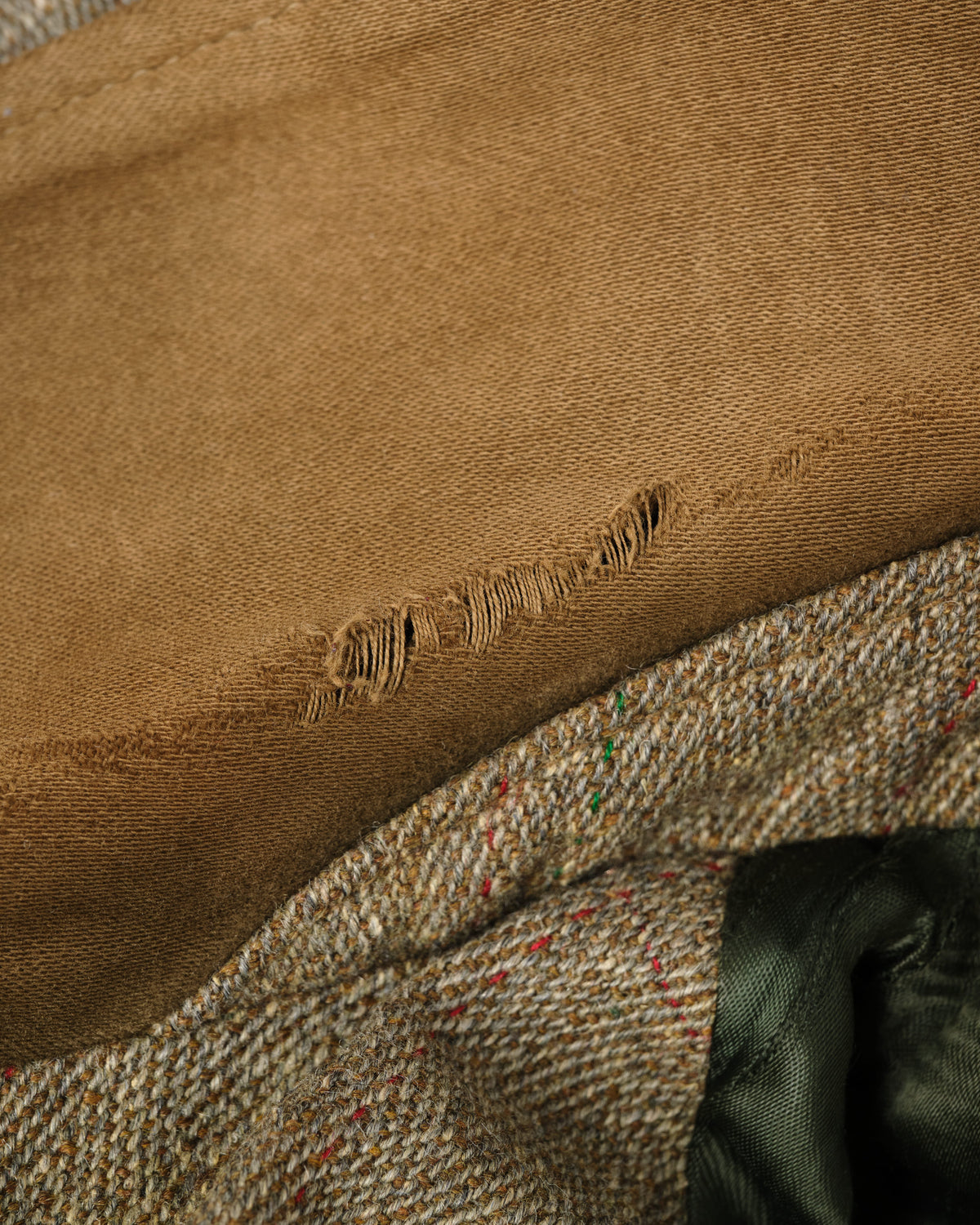
What immediately captures the eye is the moleskin cut at the collar.
Slightly generous, curved points soften the face while the brushed surface gently envelops the neck with practical comfort.
Inside, a robust chain-style hanger loop ensures the ease of suspending a heavyweight coat. (On this example, one hanger loop has come loose.)
The hand-warmer pockets positioned at both sides feature a pronounced slant that receives the hand at a natural angle.
They preserve the integrity of the silhouette whilst providing assured insulation on cold days.
The flap pockets at both hem employ a 'box pleat × gusset' construction—flat without, three-dimensional within.
Box pleats secure capacity while fine-width topstitching along the flap edge defines the outline. A rational design descended from hunting tradition: items like gloves and tools sit without creating bulk.
The pattern-matching between flap and body is equally noteworthy.
The interior features a large pocket particular to hunting coats, accented with a golden animal-motif button and loop closure in classic style.
The generous depth—ready to receive maps and gloves without fuss—becomes indispensable once experienced.
A centre vent runs the length of the back, adjusted to allow free stride without hem drag, reinforced with stitching at the vent edges to prevent tearing.
A 'working vent' that lends refinement even to one's gait.
The shoulders employ a raglan sleeve construction, a single continuous line flowing from neckline to cuff that accommodates layering whilst maintaining graceful drape.
Even when worn over a jacket, the shoulder line remains unassertive, the back rendering elegant folds.
The front closure employs minimal fly construction.
Only the throat button appears externally; the orderly row of buttons within blocks wind penetration.
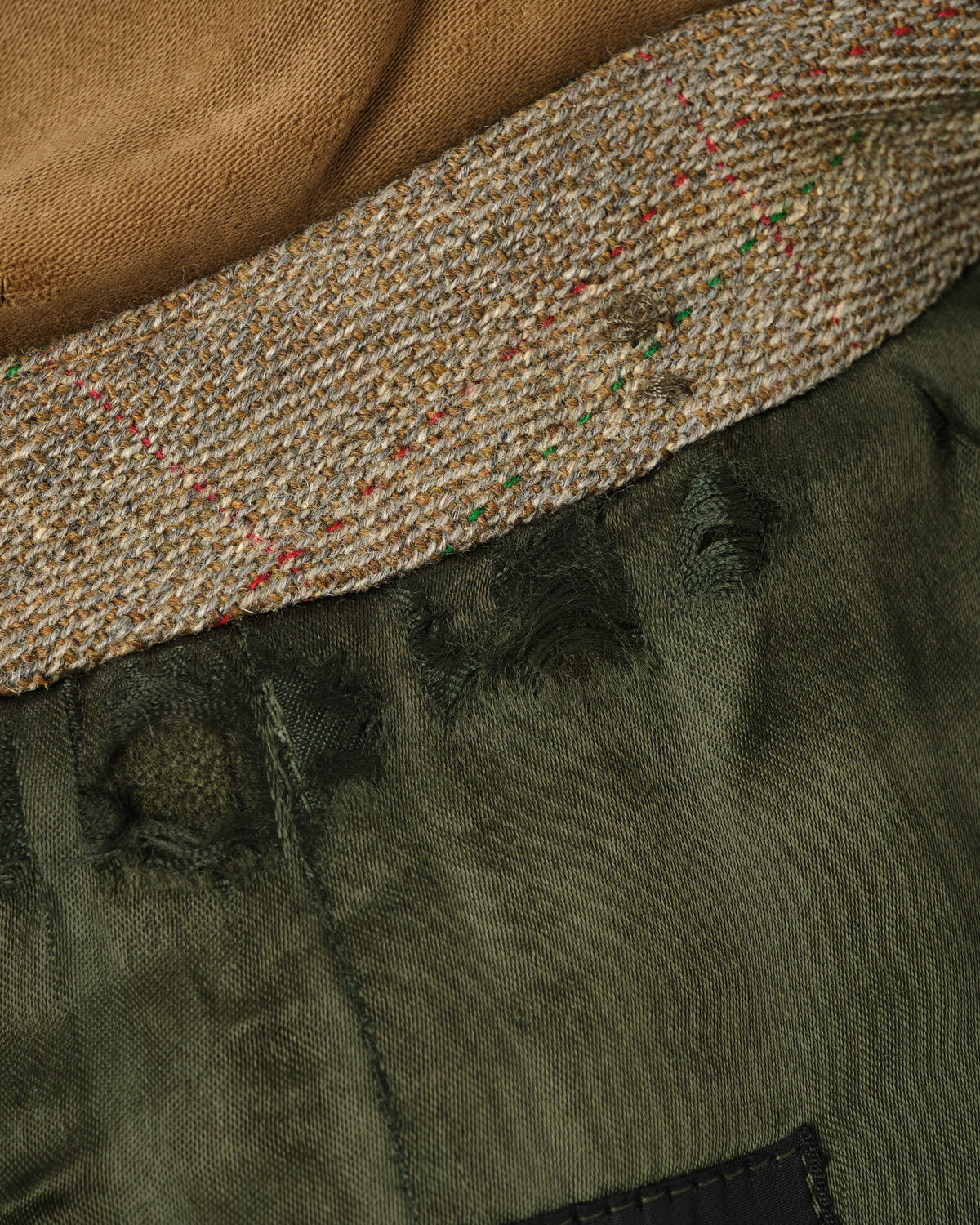
The lining is divided between upper and lower sections: from shoulders through upper back runs a lustrous, slippery fabric (likely rayon) for ease of dressing; the lower torso features brushed wool for warmth—a functional division between ease of wear and thermal comfort.
The interior collar bears a 1960s-era label reading "MADE IN ENGLAND," testimony to the pride of British manufacture.
Moreover, this example represents a special commission for J.C. CORDINGS & CO.LTD—a remarkably luxurious garment.
J.C. CORDING & CO. LTD is a venerable British country and outdoor wear house, founded in 1839 when John Charles Cording opened a waterproof clothing shop at 231 Strand, London.
This example employs a wool tweed rooted in English country tradition.
A fine herringbone weave, densely woven, communicates a touch both full-bodied and resolute upon handling.
The high-loft weave traps air for excellent insulation whilst wool's natural moisture-regulating properties prevent cling—a comfort-conscious design.
The surface is lightly brushed; running fingers across reveals subtle texture in the classical manner.
With wear, the pile settles; gentle rolls develop along elbows and shoulders; the distinctive 'deepening lustre' of tweed emerges gradually.
A fabric that grows more accomplished with time.
The moleskin at the collar imparts a soft touch against skin, whilst its contrast with tweed's solidity amplifies the material's appeal.
The colourway presents an olive-brown base with a restrained red and green overcheck—a traditional combination.
At distance, it settles as deep, quiet earth tone; approaching, the grain of the yarns and the subtlety of the check become evident—a two-layer presence.
A beige moleskin collar brightens the face, lending refined reticence to the whole, weaving urbane polish into hunting's sturdy character. This tone possesses 'quiet authority'—uninsistent, yet impossible to overlook.
It functions as your outfit's foundational hue or as a receptive ground for accent pieces, lending depth and conviction to styling.
Light and unforced when paired with jeans or chinos.
Combined with tailored pieces such as slacks, it shifts decidedly refined.
Its versatility answers broad interpretive needs—a reliable anchor to any wardrobe.
Uncompromising in quality and timeless in design, it possesses a presence untouched by fashion's flux.
It is a coat that becomes companion over years of wear.
Marked size "46"
Equivalent to approximately a Japanese "L."
The actual measurements indicate a generous fit, accommodating larger frames without difficulty.
Whilst showing evidence of wear—minor abrasion and loose stitching—no significant damage impairs function. It remains entirely wearable.
A special order example made by INVERTERE for J.C. CORDINGS & CO. LTD remains rare in the market.
A masterwork uniting tradition-backed tweed with purposeful hunting detail.
Old INVERTERE pieces arrive at our shop infrequently. Should you seek one, this opportunity warrants your attention.