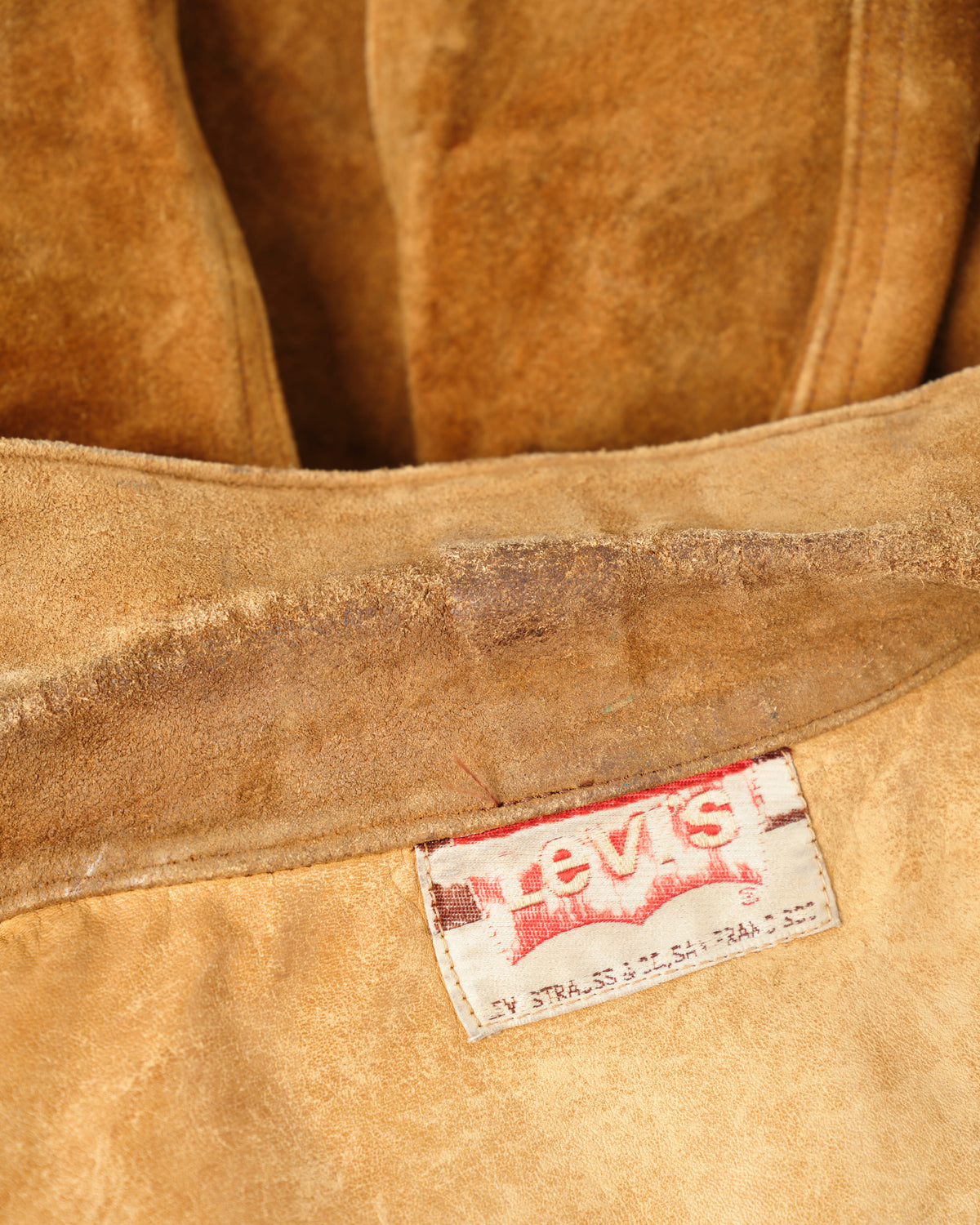
Circa 1970s, a Levi's suede leather trucker jacket.
Levi's traces its origins to 1853, when Levi Strauss, a German-immigrant, established a dry goods wholesale business in San Francisco, California. From this foundation, the brand would go on to introduce jeans to the world—inventing not merely a garment, but a category itself. Levi's remains the pioneering force in denim, continuously evolving what might be called 'clothing born of necessity' across both the rugged frontier and urban culture.
During the gold rush fever of that era, what workers demanded was not ostentation but 'tools that would not break'. Levi's listened to the laborer's voice. Initially, the company crafted work trousers from sturdy canvas—the same material once used for tents—before gradually transitioning to the more supple character of denim. This shift marks a fundamental truth: Levi's was not driven by trend, but by necessity.
Then in 1873, Nevada tailor Jacob Davis and Levi Strauss Company secured a patent for the 'waist overall'—reinforcing stress points with metal rivets. This rational innovation, particularly at pocket corners and the crotch, became the prototype of what would later be called the blue jean.
By 1890, the style number '501' was adopted as a product identifier. A standard was born, one that would endure. Even as patents expired and competition intensified, Levi's maintained its authority as the original through relentless refinement of design and quality.
The twentieth century witnessed denim's migration from workwear into culture itself.
The 1950s proved decisive. When cinema enshrined denim as the symbol of youth and rebellion—embodied by figures like Marlon Brando and James Dean—the jean ascended to become the uniform of a generation. The transformation was not that workwear suddenly became fashion. Rather, the tool of daily labor had simply revealed its own grace.
Levi's stands as the emblem of this shift: born to endure harsh conditions, beloved as urban expression, and still reigning as denim's measure of truth.
What follows is a suede trucker jacket conceived in the same design philosophy as the famed 3rd Type—the 501(3rd).
The hallmarks are familiar from the denim lineage: dual chest flap pockets, vertical pleats in the front panel, and a horizontal yoke across the chest. These lines—essential to the trucker's dimensional construction—gain heightened shadow and presence in raised suede, lending a quiet sensuality to the inherent austere character of workwear.
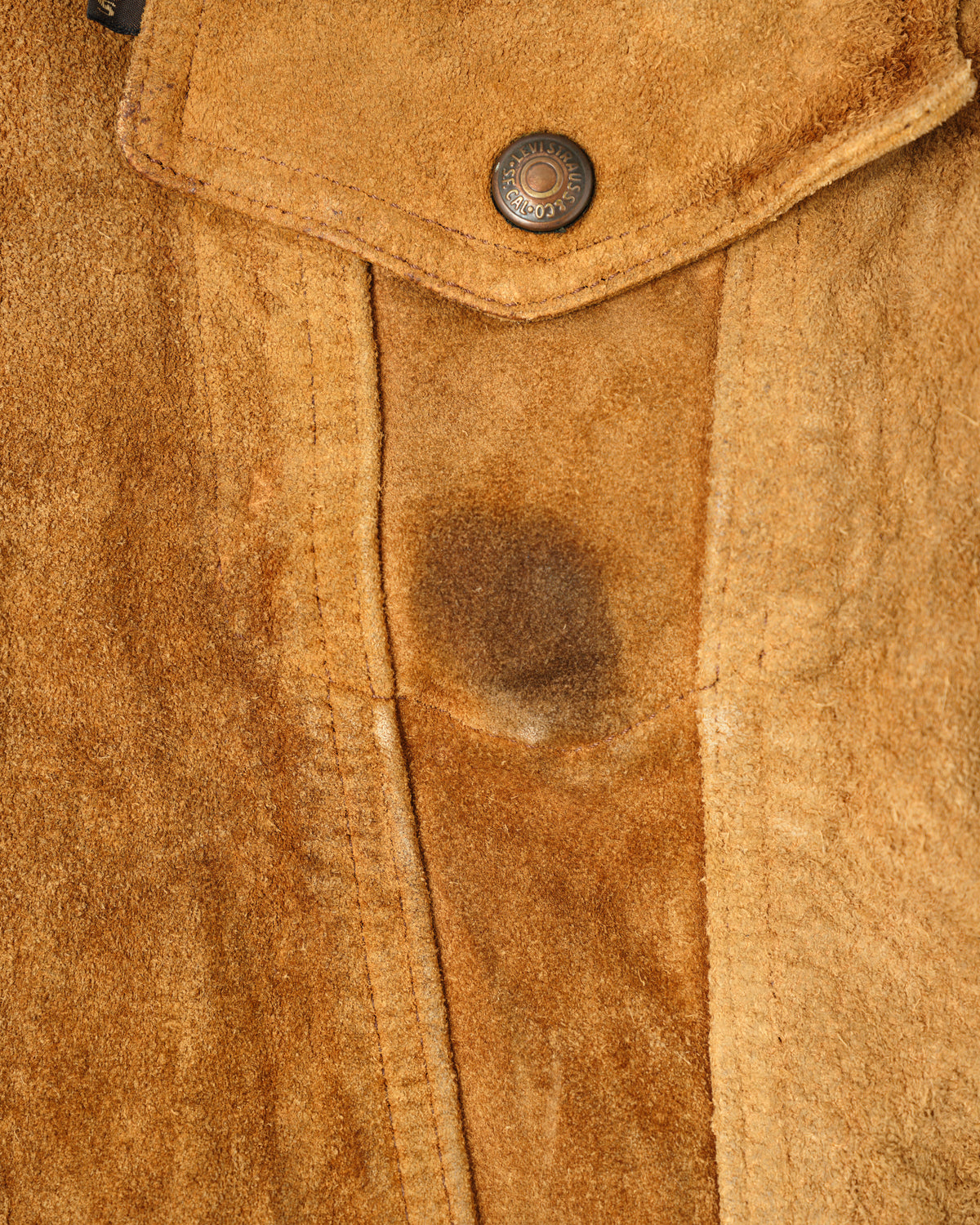
The front is unified with stamped metal buttons, asserting a presence equal to the leather's texture. The small 'e' piqu label sits in subdued brown—a restraint that dissolves into the suede's palette, offering a muted refinement distinct from the red tab of traditional denim.
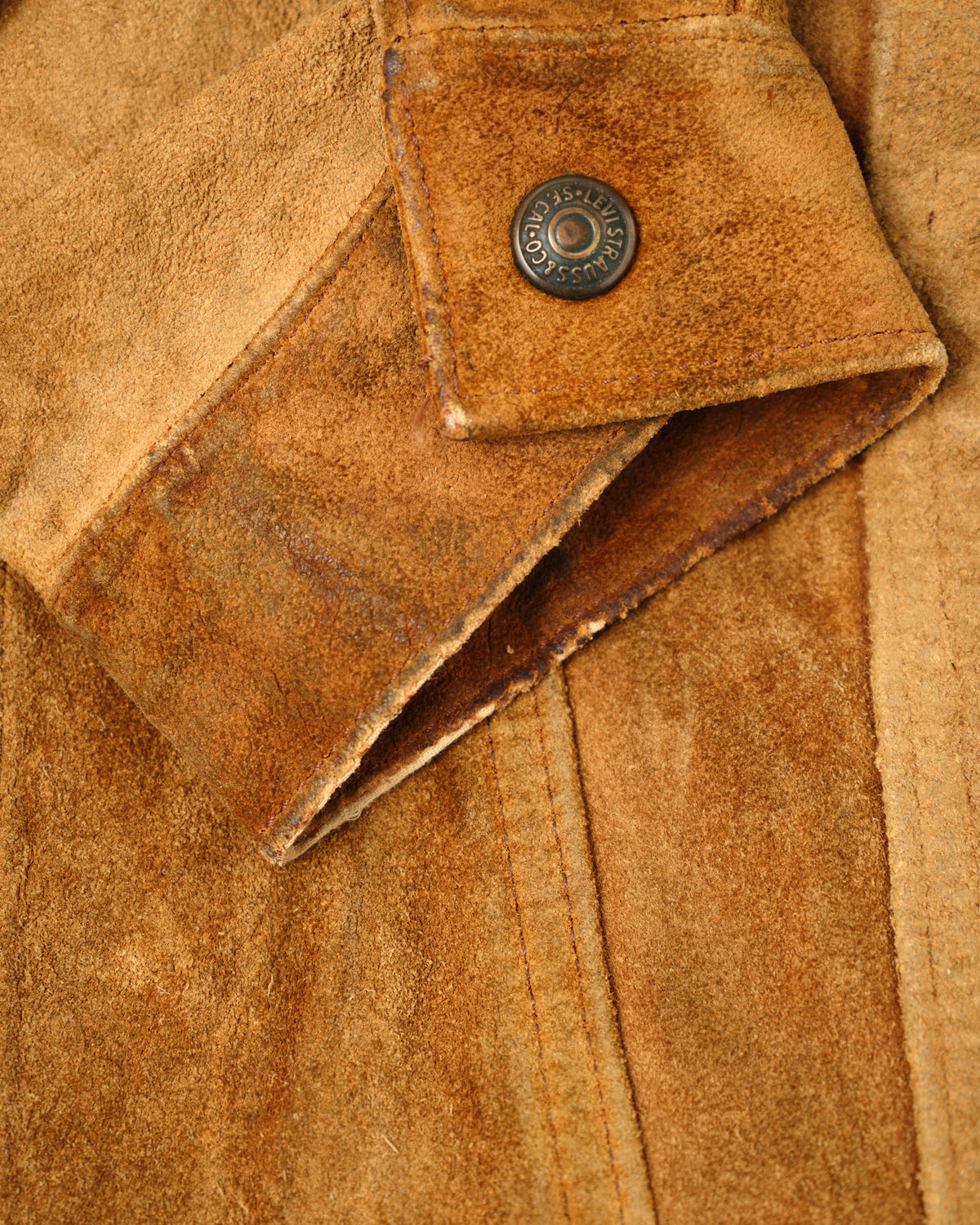
The jacket's essence lies in its abbreviated length and boxed silhouette—the defining comfort of a true trucker. The yoke seam descending through the back and waist, combined with side adjuster tabs (snapped to cinch the waist), creates automatic line and definition when simply layered. The buttoned cuffs read equally composed whether worn loose or precisely cuffed.
Simplicity serves best. A jacket of this nature is indispensable in any wardrobe. Thrown on casually, it immediately establishes its presence. We recommend wearing it plainly, without artifice.
This piece employs suede leather.
Fine nap rises uniformly across the surface, offering a matte, dry quality. While retaining leather's substantial weight, the suede's inherent softness imparts an understated refinement. With wear, the nap subsides, yielding to scuffs and pressings that emerge as tonal variation—the patina characteristic of vintage pieces you might actually live with.
The colorway is a warm brown-beige, suspended between lightness and depth. The boundary between beige's airiness and brown's restraint dissolves into an equanimous hue. Like earth holding grain-dust, this tonality carries warmth within its dryness, lending natural breathing room and dimensional depth to any composition.
The nap absorbs light; the direction of the pile and viewing angle shift the tone. Luminosity and shadow dance across a gentle gradient, quietly rising.
While no size tag remains visible, the measurements suggest an equivalent to Japanese M to L. The proportions read as an ideal golden size for the Japanese frame, accommodating a broad spectrum of builds.
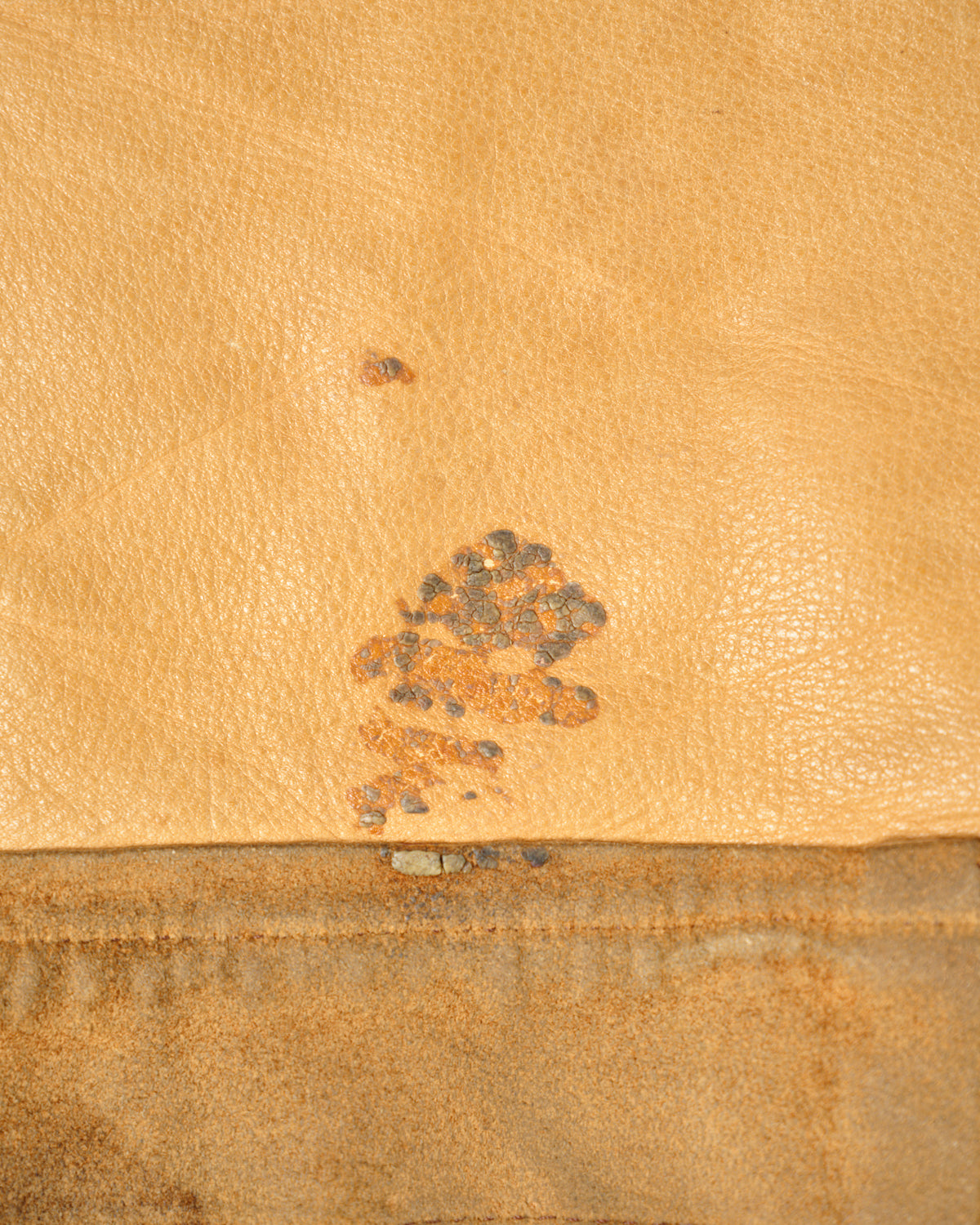
The piece carries the expected signs of wear—soiling, scuffs, minor tears—but exhibits no substantial damage preventing use. Certain areas show fabric weakening; careful handling will preserve this garment for years to come.
Levi's: the brand that grounded 'denim' as a standard across the world, updating itself from labor's rigorous demands to culture's urban expression. A trucker jacket conceived in the 3rd Type's foundational design, elevated by suede's dimensional play of shadow and warmth—such pieces arrive rarely. Its scarcity is genuine.
A wardrobe essential and a collection worthy piece in equal measure. Given the infrequency of such arrivals at our shop, we recommend acting decisively should this be what you seek.
![[~70's]Vintage Levi's Suede Leather Trucker Jacket](http://vieuxetnouveau-shop.com/cdn/shop/files/202505030157.jpg?v=1765445490&width=2400)
![[~70's]Vintage Levi's Suede Leather Trucker Jacket](http://vieuxetnouveau-shop.com/cdn/shop/files/202505030159.jpg?v=1765445490&width=2400)
![[~70's]Vintage Levi's Suede Leather Trucker Jacket](http://vieuxetnouveau-shop.com/cdn/shop/files/202505030163.jpg?v=1765445490&width=2400)
![[~70's]Vintage Levi's Suede Leather Trucker Jacket](http://vieuxetnouveau-shop.com/cdn/shop/files/DSCF0926_9b7f2822-07e9-42b1-a98f-c0422d118840.jpg?v=1765445521&width=2400)
![[~70's]Vintage Levi's Suede Leather Trucker Jacket](http://vieuxetnouveau-shop.com/cdn/shop/files/DSCF0925_7d6c9305-0677-4ac6-ba93-81dc739e83ef.jpg?v=1765445521&width=2400)
![[~70's]Vintage Levi's Suede Leather Trucker Jacket](http://vieuxetnouveau-shop.com/cdn/shop/files/DSCF0927_6bfd52ae-e052-4a6a-a35c-5bf1c6c1f6d7.jpg?v=1765445521&width=2400)
![[~70's]Vintage Levi's Suede Leather Trucker Jacket](http://vieuxetnouveau-shop.com/cdn/shop/files/DSCF0928_ac8649ac-debf-44a7-903d-ed5e421081d0.jpg?v=1765445521&width=2400)
![[~70's]Vintage Levi's Suede Leather Trucker Jacket](http://vieuxetnouveau-shop.com/cdn/shop/files/DSCF0929_8cdd0676-2bff-4034-bf6a-fcc3150b7679.jpg?v=1765445521&width=2400)
![[~70's]Vintage Levi's Suede Leather Trucker Jacket](http://vieuxetnouveau-shop.com/cdn/shop/files/DSCF0930_81ef5a08-d11e-4823-8c1c-dbffb4ba9146.jpg?v=1765445521&width=2400)
![[~70's]Vintage Levi's Suede Leather Trucker Jacket](http://vieuxetnouveau-shop.com/cdn/shop/files/DSCF0931_90a02afb-2267-4d81-b66f-4e2c672a4ee0.jpg?v=1765445521&width=2400)
![[~70's]Vintage Levi's Suede Leather Trucker Jacket](http://vieuxetnouveau-shop.com/cdn/shop/files/DSCF0934_1690b911-861a-431b-809c-e54edaeb6076.jpg?v=1765445521&width=2400)
![[~70's]Vintage Levi's Suede Leather Trucker Jacket](http://vieuxetnouveau-shop.com/cdn/shop/files/DSCF0932_00b1e1ce-a71c-4f47-9434-a028e96b5d41.jpg?v=1765445521&width=2400)
![[~70's]Vintage Levi's Suede Leather Trucker Jacket](http://vieuxetnouveau-shop.com/cdn/shop/files/DSCF0933_569c6412-0e23-4514-9977-546763acfc3b.jpg?v=1765445521&width=2400)
![[~70's]Vintage Levi's Suede Leather Trucker Jacket](http://vieuxetnouveau-shop.com/cdn/shop/files/DSCF0940_ea9f62d9-6bdd-411b-885d-da10dcec1296.jpg?v=1765445509&width=2400)
![[~70's]Vintage Levi's Suede Leather Trucker Jacket](http://vieuxetnouveau-shop.com/cdn/shop/files/DSCF1151_dddf8948-cb7d-4ee0-9687-b5ff8855a14f.jpg?v=1765766085&width=2400)
![[~70's]Vintage Levi's Suede Leather Trucker Jacket](http://vieuxetnouveau-shop.com/cdn/shop/files/DSCF1152_47b24dda-dffa-437c-a1e6-7cbd2848737c.jpg?v=1765766085&width=2400)
![[~70's]Vintage Levi's Suede Leather Trucker Jacket](http://vieuxetnouveau-shop.com/cdn/shop/files/DSCF1153_a02f85be-3752-48b3-87a7-ccae04fbdc63.jpg?v=1765766085&width=2400)
![[~70's]Vintage Levi's Suede Leather Trucker Jacket](http://vieuxetnouveau-shop.com/cdn/shop/files/DSCF1154_9db9031d-0339-4c13-abb0-8c7088851455.jpg?v=1765766085&width=2400)
![[~70's]Vintage Levi's Suede Leather Trucker Jacket](http://vieuxetnouveau-shop.com/cdn/shop/files/DSCF1155_1afa7e2f-d4f9-4ef7-bd95-462118b1da5d.jpg?v=1765766085&width=2400)
![[~70's]Vintage Levi's Suede Leather Trucker Jacket](http://vieuxetnouveau-shop.com/cdn/shop/files/DSCF1150_27cf1a47-de8d-465a-8089-c76e442c5748.jpg?v=1765766085&width=2400)
![[~70's]Vintage Levi's Suede Leather Trucker Jacket](http://vieuxetnouveau-shop.com/cdn/shop/files/DSCF1147_5b65aa0f-92c2-40b2-b4cb-10e9fde86379.jpg?v=1765766085&width=2400)
![[~70's]Vintage Levi's Suede Leather Trucker Jacket](http://vieuxetnouveau-shop.com/cdn/shop/files/DSCF1148_409912a3-8229-4e47-9530-869493a46e50.jpg?v=1765766085&width=2400)
![[~70's]Vintage Levi's Suede Leather Trucker Jacket](http://vieuxetnouveau-shop.com/cdn/shop/files/DSCF1149_f25b6fc0-d689-4dd7-9487-a000a19ecca4.jpg?v=1765766085&width=2400)
![[~70's]Vintage Levi's Suede Leather Trucker Jacket](http://vieuxetnouveau-shop.com/cdn/shop/files/DSCF1159_1ea020e5-1469-4958-81f3-7c696d74e88f.jpg?v=1765766085&width=2400)
![[~70's]Vintage Levi's Suede Leather Trucker Jacket](http://vieuxetnouveau-shop.com/cdn/shop/files/DSCF1156_36948d83-dcfe-4f2d-9d21-a5dca6ef05ce.jpg?v=1765766085&width=2400)
![[~70's]Vintage Levi's Suede Leather Trucker Jacket](http://vieuxetnouveau-shop.com/cdn/shop/files/DSCF1157_cdc54dc2-6e10-4baf-ad71-36a8602a24c3.jpg?v=1765766085&width=2400)
![[~70's]Vintage Levi's Suede Leather Trucker Jacket](http://vieuxetnouveau-shop.com/cdn/shop/files/DSCF1158_7d0ad8c6-082c-426c-b784-ff0f9e2b4eea.jpg?v=1765766085&width=2400)