An estimated 1970s Wrangler '124MJ denim jacket'.
Wrangler is renowned for its jeans designed for cowboys and rodeo riders.
Alongside Levi's and Lee, it stands as one of America's three major denim brands.
As a later entrant to the market, the brand distinguished itself by investing considerable effort into design—more so than any competing label.
The company traces its origins to Hudson Overall Company, founded in 1904 by C.C. Hudson, a workwear overalls manufacturer. Following business expansion, the company changed its name to Bluebells in 1919.
In 1943, it acquired Casey Jones Company, which held the Wrangler trademark, establishing it as one of its own brands.
The piece we present today is the "124MJ" model, regarded as a masterwork within the Wrangler canon.
It possesses details rarely—if ever—encountered on denim jackets from other brands. A truly singular garment in the Wrangler lineage.
One might describe this as the button-front iteration of the previously stocked "24MJZ", which featured a zip closure. This piece fastens entirely with buttons across the front.
The chest features parallel flap pockets, one on each side, while the waist carries angled hand-warming pockets—signatures of Wrangler design language.
What distinguishes this particular example most notably is the patched back panel.
Perhaps a previous owner customised it to their taste. This, too, embodies what makes vintage so compelling—that element of discovery inherent to each piece's journey.
The silhouette is sharp and refined, rendered with an understated elegance that transcends casual association.
A denim jacket of considerable merit, excelling in both design and function.
The indigo fade—vertical and horizontal threads breaking in harmony—only deepens with age.
Whilst many denim options flood the contemporary market, the distinction is immediately apparent.
Nothing surpasses the patina of vintage.
Simplicity is its own virtue. A jacket of this calibre invariably earns its place in one's wardrobe.
Effortless layering yields immediate presence. We encourage you to wear it plainly, without pretension.
Size marked "44"
In the vintage denim jacket market, larger sizes command proportionally greater value.
Most pieces carry either missing size labels or run small. A golden-sized example such as this is rarely encountered.
The denim retains a deep indigo tone.
The privilege of vintage denim lies partly in this—the pleasure of developing your own fades across time and wear.
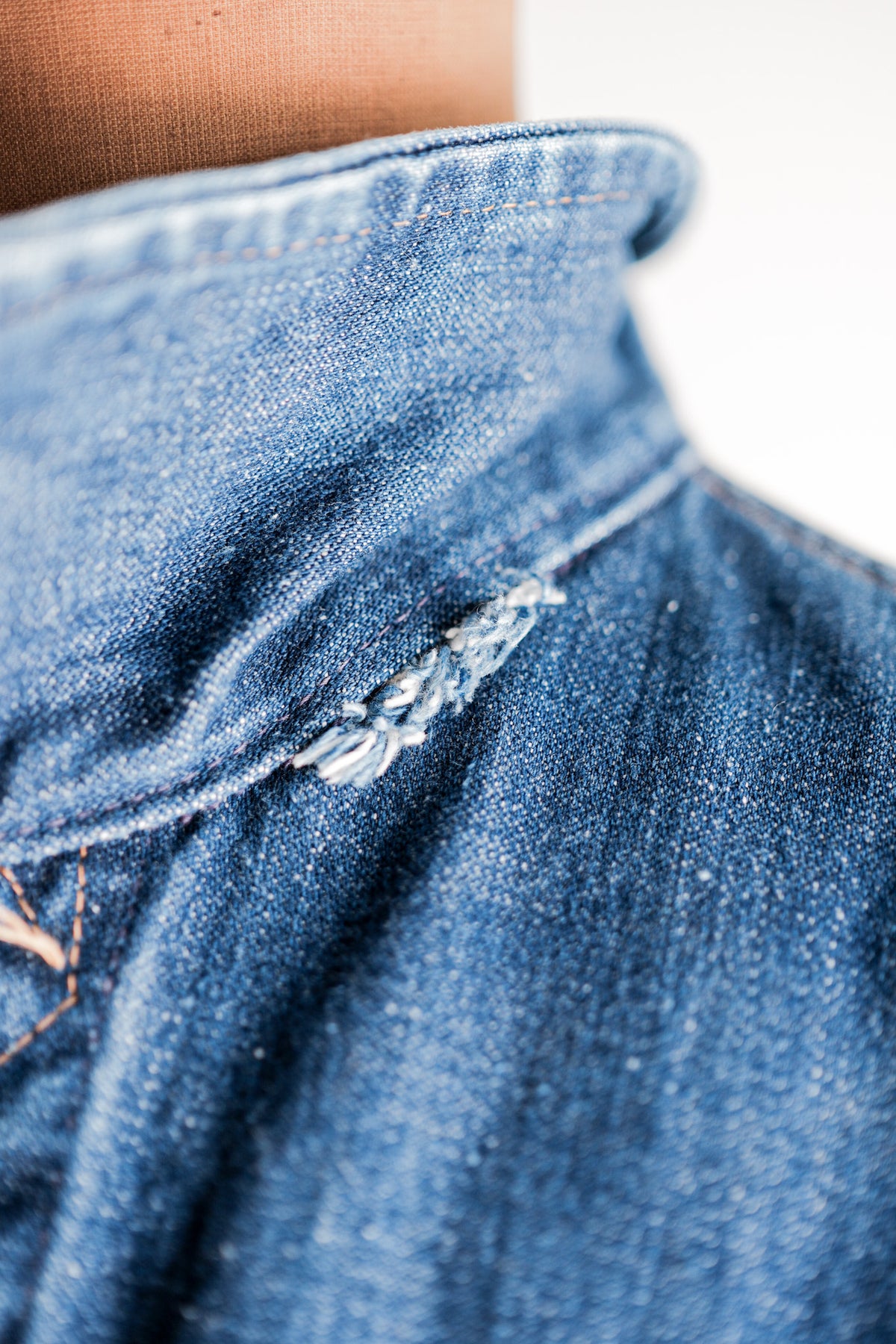
The collar shows minor fraying and small punctures characteristic of its age. No significant damage impedes wear.
Deep indigo preservation, proportionate sizing, an idiosyncratic patch panel—a specimen of considerable quality.
Should you seek a vintage denim jacket of substance, we urge you not to overlook this opportunity.
![[~70's]Vintage Wrangler 124MJ Denim Jacket With Patches Size.44](http://vieuxetnouveau-shop.com/cdn/shop/products/B64354C4-6A6B-42C2-AC96-19F6831FF41F-298-00000003051C23E8.jpg?v=1679498836&width=2400)
![[~70's]Vintage Wrangler 124MJ Denim Jacket With Patches Size.44](http://vieuxetnouveau-shop.com/cdn/shop/products/DF4A0841-BF4D-440C-AA30-FD9914310E1F-298-0000000376E436E9.jpg?v=1679498835&width=2400)
![[~70's]Vintage Wrangler 124MJ Denim Jacket With Patches Size.44](http://vieuxetnouveau-shop.com/cdn/shop/products/76D05438-CC14-4E66-B60C-591A1895874A-298-000000030E02C2EA.jpg?v=1679498832&width=2400)
![[~70's]Vintage Wrangler 124MJ Denim Jacket With Patches Size.44](http://vieuxetnouveau-shop.com/cdn/shop/products/63936CBC-55B9-4726-ACFA-1749CC01DA38-298-00000003144A1182.jpg?v=1679498837&width=2400)
![[~70's]Vintage Wrangler 124MJ Denim Jacket With Patches Size.44](http://vieuxetnouveau-shop.com/cdn/shop/products/196E0259-6EE6-4B5D-A32A-3846C37C6CF5-298-000000031C5FD55D.jpg?v=1679498835&width=2400)
![[~70's]Vintage Wrangler 124MJ Denim Jacket With Patches Size.44](http://vieuxetnouveau-shop.com/cdn/shop/products/12C1B344-9C85-41CD-A745-25F2D022BBAE-298-000000037E3A5942.jpg?v=1679498834&width=2400)
![[~70's]Vintage Wrangler 124MJ Denim Jacket With Patches Size.44](http://vieuxetnouveau-shop.com/cdn/shop/products/9BE512C7-85B1-4E8E-A89F-1133CE2DBA9F-298-00000003303565E2.jpg?v=1679498834&width=2400)
![[~70's]Vintage Wrangler 124MJ Denim Jacket With Patches Size.44](http://vieuxetnouveau-shop.com/cdn/shop/products/FB1363C8-52F0-493D-85ED-E616CF481C4E-298-000000033AFB9031.jpg?v=1679498833&width=2400)
![[~70's]Vintage Wrangler 124MJ Denim Jacket With Patches Size.44](http://vieuxetnouveau-shop.com/cdn/shop/products/AA8BE03F-A5D5-4F96-9D1B-747CED234F7C-298-00000003453BF5E0.jpg?v=1679498833&width=2400)
![[~70's]Vintage Wrangler 124MJ Denim Jacket With Patches Size.44](http://vieuxetnouveau-shop.com/cdn/shop/products/C2248744-0A61-4F73-A453-52EA6862775E-298-0000000356527514.jpg?v=1679498836&width=2400)
![[~70's]Vintage Wrangler 124MJ Denim Jacket With Patches Size.44](http://vieuxetnouveau-shop.com/cdn/shop/products/36A47144-40F9-4898-A06A-4994FFCEB437-298-000000034CEA28E9.jpg?v=1679498832&width=2400)
![[~70's]Vintage Wrangler 124MJ Denim Jacket With Patches Size.44](http://vieuxetnouveau-shop.com/cdn/shop/products/28899347-5098-4741-B6A0-65D9D5F0CC3B-298-0000000352871461.jpg?v=1679498838&width=2400)
![[~70's]Vintage Wrangler 124MJ Denim Jacket With Patches Size.44](http://vieuxetnouveau-shop.com/cdn/shop/products/0FA1BE4E-77FB-4DE0-9FC8-E338351FDAE0-298-000000035F6FF1B0.jpg?v=1679498834&width=2400)
![[~70's]Vintage Wrangler 124MJ Denim Jacket With Patches Size.44](http://vieuxetnouveau-shop.com/cdn/shop/products/C72B375C-734A-4462-8824-ED2375934A17-298-00000003675DE6D3.jpg?v=1679498833&width=2400)
![[~70's]Vintage Wrangler 124MJ Denim Jacket With Patches Size.44](http://vieuxetnouveau-shop.com/cdn/shop/products/89898F6C-E038-425D-BBDA-02E25B161472-298-000000035A2CDE2A.jpg?v=1679498836&width=2400)
![[~70's]Vintage Wrangler 124MJ Denim Jacket With Patches Size.44](http://vieuxetnouveau-shop.com/cdn/shop/products/85F3C7A1-36CD-4F65-B989-2A2E334675E6-298-0000000371303A6E.jpg?v=1679498832&width=2400)
![[~70's]Vintage Wrangler 124MJ Denim Jacket With Patches Size.44](http://vieuxetnouveau-shop.com/cdn/shop/products/AC320956-7A74-464E-A8D2-583125F5AEA3-298-00000003272C0768.jpg?v=1679498837&width=2400)
![[~70's]Vintage Wrangler 124MJ Denim Jacket With Patches Size.44](http://vieuxetnouveau-shop.com/cdn/shop/products/040F7FD6-7796-4D12-8F0F-369F3C0DE3E9-298-00000003878EE932.jpg?v=1679498832&width=2400)
![[~70's]Vintage Wrangler 124MJ Denim Jacket With Patches Size.44](http://vieuxetnouveau-shop.com/cdn/shop/products/1925F7CC-51A2-4516-AB2F-27E81ADA624C-298-000000038D7A66DA.jpg?v=1679498836&width=2400)
![[~70's]Vintage Wrangler 124MJ Denim Jacket With Patches Size.44](http://vieuxetnouveau-shop.com/cdn/shop/products/DC761B12-0483-4881-8BEF-99AD7AC82399-4743-00000AE3A96A19E5.jpg?v=1679498837&width=2400)
![[~70's]Vintage Wrangler 124MJ Denim Jacket With Patches Size.44](http://vieuxetnouveau-shop.com/cdn/shop/products/B2C86E6E-C7EC-42CE-BFDD-FB541908DB87-4743-00000AE3D297D36B.jpg?v=1679498832&width=2400)
![[~70's]Vintage Wrangler 124MJ Denim Jacket With Patches Size.44](http://vieuxetnouveau-shop.com/cdn/shop/products/442C25B9-C09E-4538-BE16-1496615D5004-4743-00000AE3DE86C8BC.jpg?v=1679498835&width=2400)
![[~70's]Vintage Wrangler 124MJ Denim Jacket With Patches Size.44](http://vieuxetnouveau-shop.com/cdn/shop/products/CD445640-2611-420D-9137-7B9AA3AA057E-4743-00000AE3C00F4360.jpg?v=1679498837&width=2400)
![[~70's]Vintage Wrangler 124MJ Denim Jacket With Patches Size.44](http://vieuxetnouveau-shop.com/cdn/shop/products/CF0109B9-74E6-4186-95AC-F94F50C7DF61-5742-00000BF22D176C0D.jpg?v=1679498834&width=2400)
![[~70's]Vintage Wrangler 124MJ Denim Jacket With Patches Size.44](http://vieuxetnouveau-shop.com/cdn/shop/products/6827233A-3275-4373-B8AF-95F25E498D19-5742-00000BF224DE44C0.jpg?v=1679498834&width=2400)
![[~70's]Vintage Wrangler 124MJ Denim Jacket With Patches Size.44](http://vieuxetnouveau-shop.com/cdn/shop/products/A862D35C-92FF-4BBD-883B-D997F94B4F3F-5742-00000BF2317939BA.jpg?v=1679498835&width=2400)
![[~70's]Vintage Wrangler 124MJ Denim Jacket With Patches Size.44](http://vieuxetnouveau-shop.com/cdn/shop/products/866C7334-F332-4BC9-8B06-3D2BF9357AAB-5742-00000BF23B9A1F23.jpg?v=1679498833&width=2400)
![[~70's]Vintage Wrangler 124MJ Denim Jacket With Patches Size.44](http://vieuxetnouveau-shop.com/cdn/shop/products/79634ED9-E8E7-4C2C-981D-B6D5A8D0C9BE-5742-00000BF242262D93.jpg?v=1679498833&width=2400)