1986 production, Barbour "Spey Jacket".
Barbour was founded in 1894 by "John Barbour" at Market Place in South Shields, northeast England. An established British brand specialising in outdoor and country wear.
Born from oilskin—waterproof garments supplied to sailors and fishermen exposed to sea winds and rain—the brand has refined "clothing that resists the elements" as its core philosophy.
In 1908, the second generation, "Malcolm Barbour," produced the company's first mail-order catalogue.
By 1917, mail-order sales accounted for approximately 75% of revenue, with goods shipped internationally to South America and Hong Kong. Functional garments rooted in British climate and life were reaching users in distant cities far earlier than one might expect.
In 1936, the third generation, "Duncan Barbour," unveiled the one-piece waxed suit "Barbour International (A1 Suit)" developed for the International Six Day Trial (ISDT). During wartime, this evolved into the two-piece "Ursula Suit," adopted as standard equipment by British submarine forces.
In the post-war period, it gained traction as civilian motorcycle wear. From the 1950s through 1970s, the majority of ISDT riders wore Barbour International. At the 1964 East German event, the American team and Steve McQueen acquired Barbour jackets for competition—such functional credentials established the brand's reputation.
The brand's greatest allure lies in its paradoxical mastery: the fusion of tailor's precision with industrial scale. In essence, "an industrial product with a tailor's philosophy."
Waxed cotton delivers waterproofing, windproofing, and durability. Rational details—throat latches, map pockets, waist belts, detachable linings—stack upon this foundation, answering professional demands while ascending to an elegance that sits comfortably within urban life.
This unwavering commitment to quality is further evidenced by Royal Warrant status. Barbour has received warrants from the Duke of Edinburgh (1974), Queen Elizabeth II (1982), and the Prince of Wales (1987, later King Charles III). Following administrative transition, a new warrant was granted by King Charles III in 2024. Being recognised by the Crown as a "practical article"—this is proof that connects the brand's origins directly to its present.
Today, headquarters and manufacturing remain in South Shields (Simonside), where craftspeople hand-produce waxed cotton jackets including the Bedale and Beaufort. Repair, re-waxing, and resale cycles are managed end-to-end, extending the garment's lifespan through a circular approach to making.
The piece presented here is a "Spey Jacket"—a 2-crest example produced exclusively between 1982 and 1987.
Barbour designates models by use: the Bedale for riding, the Beaufort for hunting. The Spey was assigned to fly fishing.
Developed specifically for European-style fly casting—a pursuit historically favoured by British nobility—this jacket embodies that singular purpose.
Production spans the late 1970s through 2001, but the detail to note is the number of crests on this example's label.
Any discussion of Barbour vintage inevitably addresses the crest. This piece bears two Royal Warrants: that of the Duke of Edinburgh (1974) and Queen Elizabeth II (1982)—the "2-crest" configuration. This dates manufacture between 1982 and 1987, before the Prince of Wales warrant was added in 1987.
The 3-crest Spey is relatively common in the market. 2-crest examples are significantly scarcer.
Whether the two differ materially in detail—honestly, not substantially. Yet for the vintage devotee, this temporal distinction carries a rigour that cannot be compromised.
The 3-crest is undoubtedly fine. But acquiring a 2-crest carries an elevation of satisfaction altogether separate.
The Spey's defining characteristic is its exceptionally cropped length—the shortest in the Barbour range.
Designed for fly fishing, the hem falls short of the water line, preventing water infiltration. This rationally derived silhouette remains unmatched in Barbour's lengthy history.
The Transport Jacket offers comparative shortness, yet still extends past the waist. No other Barbour model commits so decisively to this proportional principle.
Barbour's signature brown corduroy collar features pronounced ribbing. The volume and warmth when raised depend entirely upon this texture.
A chin strap on the collar interior allows it to remain fixed when raised, providing stability in wind.
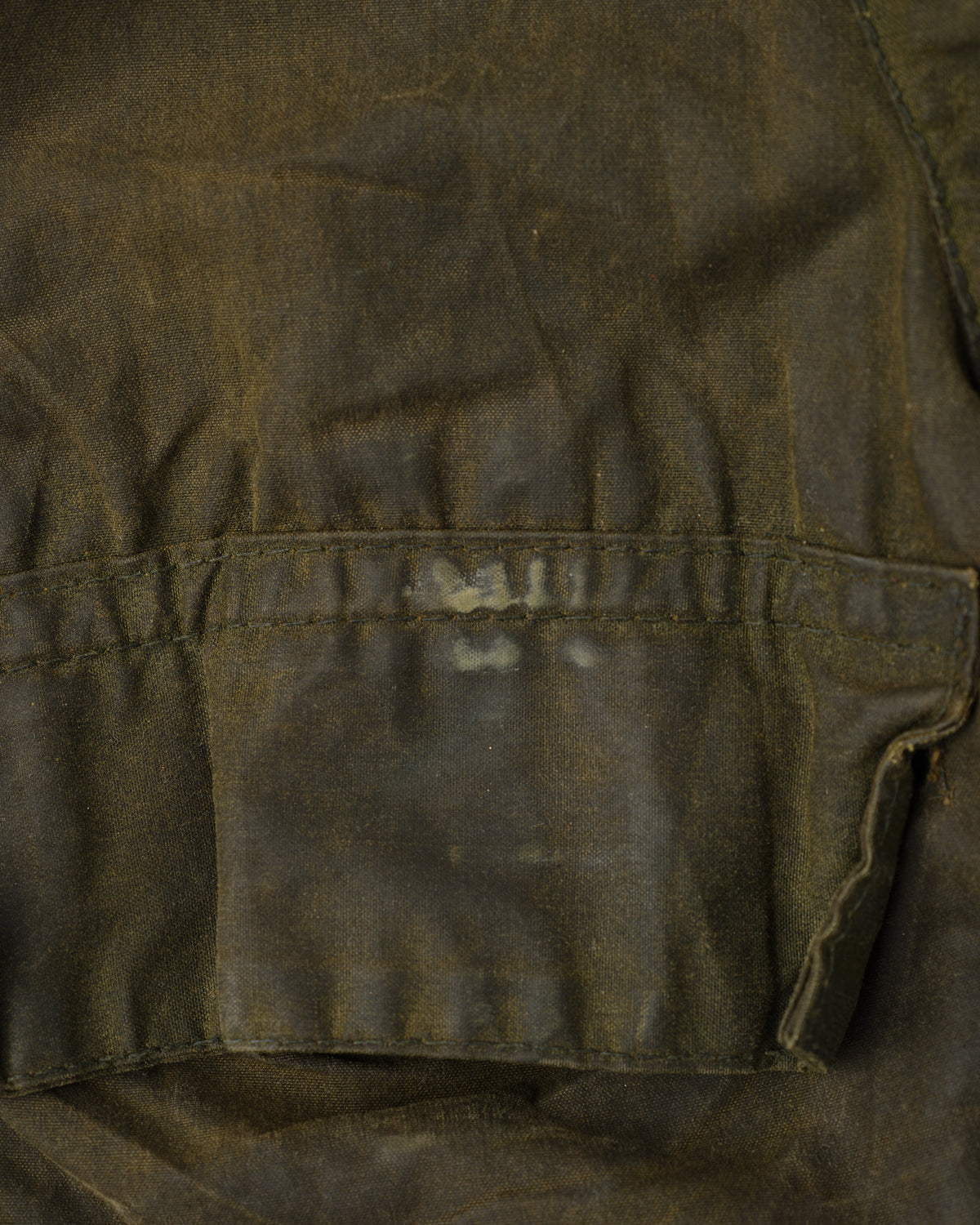
Flapped pockets of generous scale occupy both hips. The chest carries two brass D-rings with leather tabs.
Originally designed to secure fishing gear and landing nets, these rings prove equally serviceable for keys or carabiners in contemporary daily use.
The front closure employs a double structure: dual zip fasteners and snap buttons in a fly-front configuration. The zip slider is YKK-manufactured ring zip, operable even while wearing gloves.
The snap buttons bear Barbour stamping—original components that embed the brand's integrity into every detail.
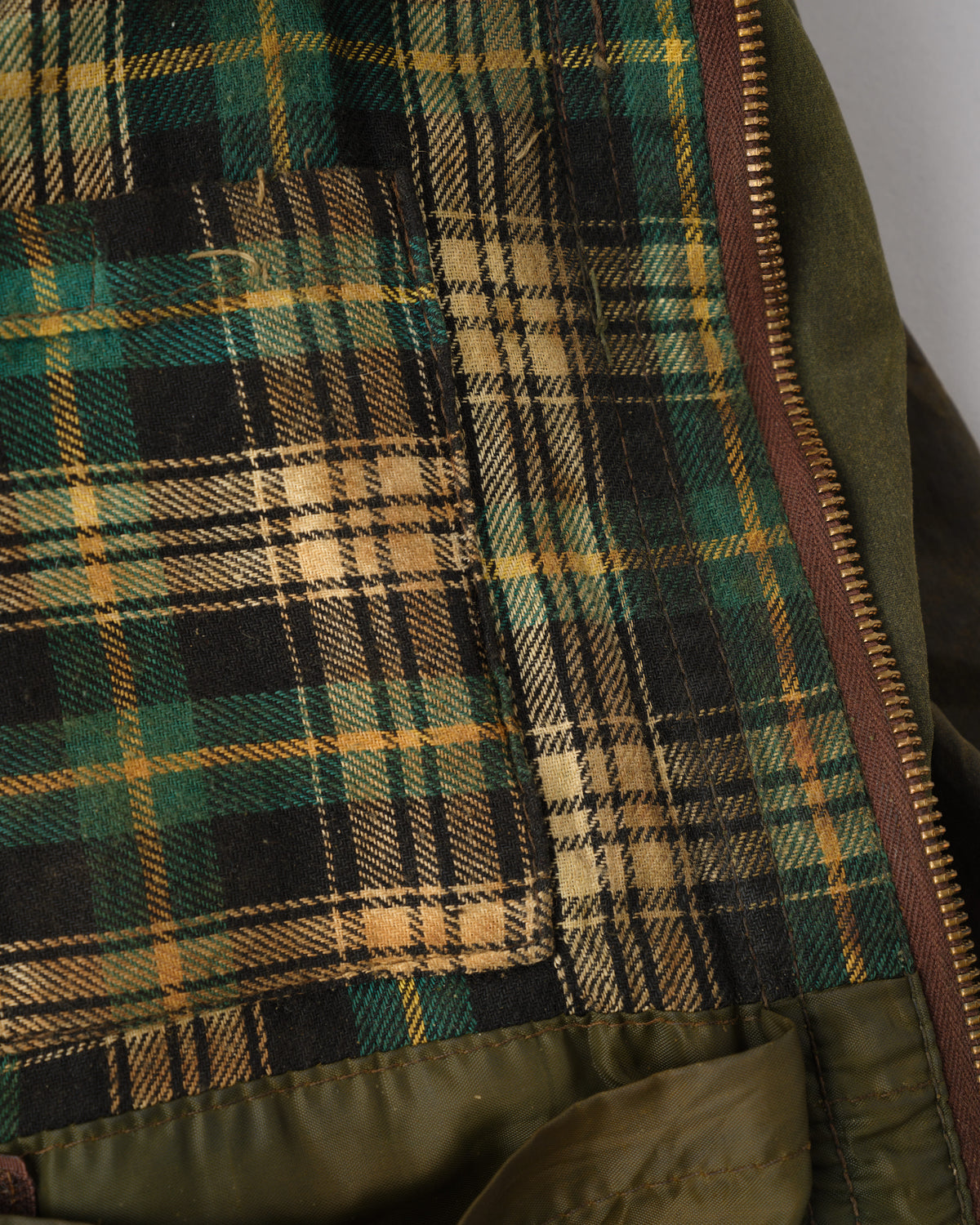
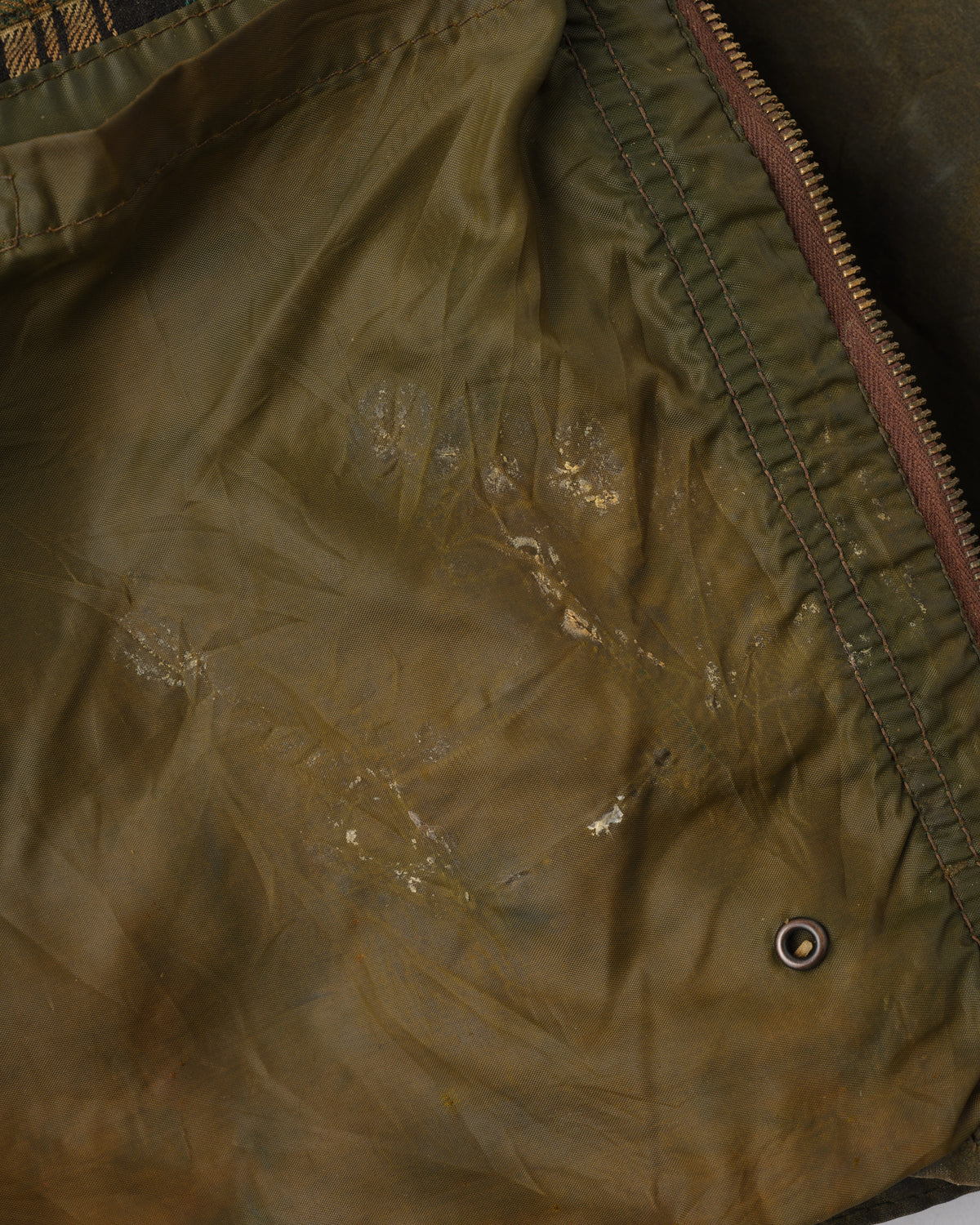
The lining's upper section features Barbour's familiar tartan check; the lower section includes a nylon drip strip. This construction honours fishing use while providing visual pleasure.
The waxed cotton employed is 6-ounce—medium weight, identical to that found on signature models such as the Bedale and Beaufort. It represents Barbour's most foundational gauge.
Neither too thick nor too thin, it performs across three seasons with perfect balance.
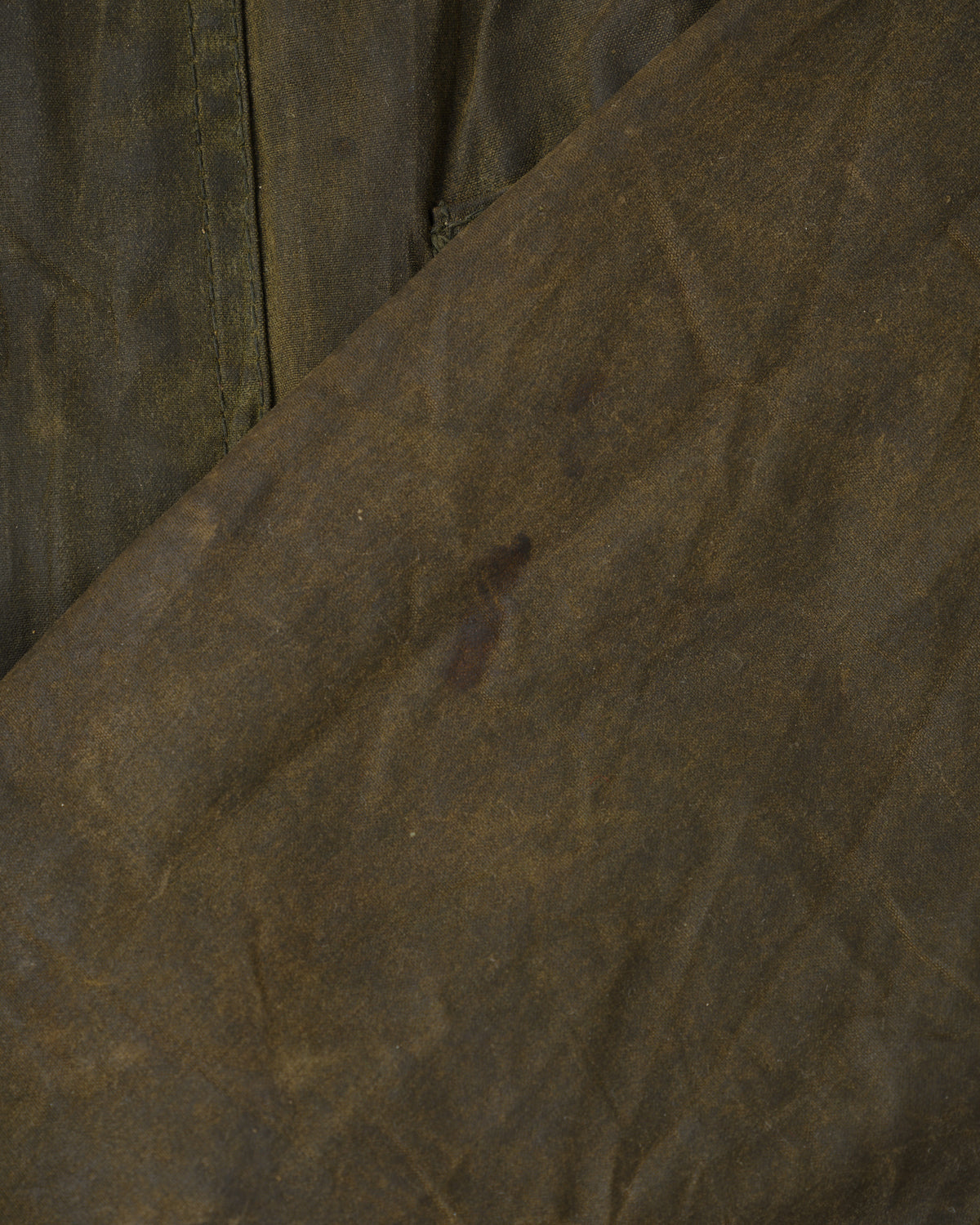
With age, the oil depletes appropriately, creating the texture characteristic of waxed cotton development—a quality unique to vintage examples.
The colour is sage green—quintessentially Barbour.
Deep olive tones form the base; time has introduced gradations of depth and tone, creating an expression entirely singular. A palette impossible to achieve in new production—only time paints such colours.
No two pieces age identically. Oil retention and wear patterns ensure each carries its own countenance. This is the essence of vintage Barbour.
The pairing with brown corduroy collar is thoroughly British in sensibility. Sage green and brown evoke the countryside itself—a pastoral, yet measured composition.
The tartan glimpsed from within provides subtle, but decisive, visual punctuation.
Size marking reads "MEDIUM"—equivalent to Japanese M to L.
By actual measurements, this represents a golden size for Japanese proportions, accommodating a broad range of builds.
Armhole and chest are generously proportioned, allowing comfortable layering and flexible styling. The single-sleeve construction means even a slightly larger fit maintains clean lines.
Soiling, coating loss, oil unevenness, and the characteristic odour of vintage oiled cloth are present, but no damage impairs wearability. The jacket remains eminently wearable.
Both current and vintage Barbour recognises the Spey as singularly coveted. Among these, the 2-crest examples are far scarcer than 3-crest production, making encounters exceptionally rare.
Vintage Barbour radiates an aura no current production approaches. This distinction is a primary reason collectors pursue the vintage path.
This shop sees infrequent Spey arrivals; rarer still, a 2-crest. Those seeking this piece would do well to regard this opportunity as precious.
![[~80's]Vintage Barbour Waxed Cotton Jacket "SPEY" 2 Crest Size.MEDIUM](http://vieuxetnouveau-shop.com/cdn/shop/files/202505030443_48d93ed5-11b5-4c73-84e5-b6672ee446b9.jpg?v=1770700158&width=2400)
![[~80's]Vintage Barbour Waxed Cotton Jacket "SPEY" 2 Crest Size.MEDIUM](http://vieuxetnouveau-shop.com/cdn/shop/files/202505030444.jpg?v=1770700158&width=2400)
![[~80's]Vintage Barbour Waxed Cotton Jacket "SPEY" 2 Crest Size.MEDIUM](http://vieuxetnouveau-shop.com/cdn/shop/files/202505030445.jpg?v=1770700158&width=2400)
![[~80's]Vintage Barbour Waxed Cotton Jacket "SPEY" 2 Crest Size.MEDIUM](http://vieuxetnouveau-shop.com/cdn/shop/files/202505030446_aae9428a-ca7e-41f4-aab7-8c2171c7d4da.jpg?v=1770700158&width=2400)
![[~80's]Vintage Barbour Waxed Cotton Jacket "SPEY" 2 Crest Size.MEDIUM](http://vieuxetnouveau-shop.com/cdn/shop/files/DSCF3262_36168e46-b3ae-44d8-b71a-b399ba1067f7.jpg?v=1770700191&width=2400)
![[~80's]Vintage Barbour Waxed Cotton Jacket "SPEY" 2 Crest Size.MEDIUM](http://vieuxetnouveau-shop.com/cdn/shop/files/DSCF3263_85467f56-77d8-43ab-ac0d-053a65466d28.jpg?v=1770700191&width=2400)
![[~80's]Vintage Barbour Waxed Cotton Jacket "SPEY" 2 Crest Size.MEDIUM](http://vieuxetnouveau-shop.com/cdn/shop/files/DSCF3264_f0deccd5-db07-4f41-81b6-3dbc0818f49c.jpg?v=1770700191&width=2400)
![[~80's]Vintage Barbour Waxed Cotton Jacket "SPEY" 2 Crest Size.MEDIUM](http://vieuxetnouveau-shop.com/cdn/shop/files/DSCF3268_4af1aa8e-ce95-4d51-a611-a650ba5dab2c.jpg?v=1770700230&width=2400)
![[~80's]Vintage Barbour Waxed Cotton Jacket "SPEY" 2 Crest Size.MEDIUM](http://vieuxetnouveau-shop.com/cdn/shop/files/DSCF3265_5ef05085-889b-494c-93e0-3af4acf4eaf4.jpg?v=1770700230&width=2400)
![[~80's]Vintage Barbour Waxed Cotton Jacket "SPEY" 2 Crest Size.MEDIUM](http://vieuxetnouveau-shop.com/cdn/shop/files/DSCF3266_dc2a93ee-6817-4aa4-940d-38ee8018988e.jpg?v=1770700230&width=2400)
![[~80's]Vintage Barbour Waxed Cotton Jacket "SPEY" 2 Crest Size.MEDIUM](http://vieuxetnouveau-shop.com/cdn/shop/files/DSCF3267_8621545d-1713-4daf-ad41-b04e2c15763f.jpg?v=1770700230&width=2400)
![[~80's]Vintage Barbour Waxed Cotton Jacket "SPEY" 2 Crest Size.MEDIUM](http://vieuxetnouveau-shop.com/cdn/shop/files/DSCF3273_fc1fe510-54e7-496a-853d-60e5c0fd4ca9.jpg?v=1770700230&width=2400)
![[~80's]Vintage Barbour Waxed Cotton Jacket "SPEY" 2 Crest Size.MEDIUM](http://vieuxetnouveau-shop.com/cdn/shop/files/DSCF3274_bd0eaca2-7a3b-4cb5-a4ba-64a7ba3b3d27.jpg?v=1770700230&width=2400)
![[~80's]Vintage Barbour Waxed Cotton Jacket "SPEY" 2 Crest Size.MEDIUM](http://vieuxetnouveau-shop.com/cdn/shop/files/DSCF3275_eb5e6d73-c94d-4f0e-9d58-601c1b934b01.jpg?v=1770700230&width=2400)
![[~80's]Vintage Barbour Waxed Cotton Jacket "SPEY" 2 Crest Size.MEDIUM](http://vieuxetnouveau-shop.com/cdn/shop/files/DSCF3276_272850f9-ce79-4e45-9a60-eaed777d3c4a.jpg?v=1770700230&width=2400)
![[~80's]Vintage Barbour Waxed Cotton Jacket "SPEY" 2 Crest Size.MEDIUM](http://vieuxetnouveau-shop.com/cdn/shop/files/DSCF3269_5ecdee24-56be-479a-922c-0eca41feb661.jpg?v=1770700230&width=2400)
![[~80's]Vintage Barbour Waxed Cotton Jacket "SPEY" 2 Crest Size.MEDIUM](http://vieuxetnouveau-shop.com/cdn/shop/files/DSCF3270_29cd9835-2091-4bd6-aac3-460bfbc65438.jpg?v=1770700230&width=2400)
![[~80's]Vintage Barbour Waxed Cotton Jacket "SPEY" 2 Crest Size.MEDIUM](http://vieuxetnouveau-shop.com/cdn/shop/files/DSCF3271_a2ef58a9-f131-4d20-baa0-ab368e710eef.jpg?v=1770700230&width=2400)
![[~80's]Vintage Barbour Waxed Cotton Jacket "SPEY" 2 Crest Size.MEDIUM](http://vieuxetnouveau-shop.com/cdn/shop/files/DSCF3272_acf3ca72-07df-4dea-b7fa-3e5153b872d6.jpg?v=1770700230&width=2400)
![[~80's]Vintage Barbour Waxed Cotton Jacket "SPEY" 2 Crest Size.MEDIUM](http://vieuxetnouveau-shop.com/cdn/shop/files/DSCF3278_8821835e-481b-4f28-9015-6ab75361eb6f.jpg?v=1770700230&width=2400)
![[~80's]Vintage Barbour Waxed Cotton Jacket "SPEY" 2 Crest Size.MEDIUM](http://vieuxetnouveau-shop.com/cdn/shop/files/DSCF3281_bc42fe62-18cf-4b95-af9b-1e0692d9b899.jpg?v=1770700230&width=2400)
![[~80's]Vintage Barbour Waxed Cotton Jacket "SPEY" 2 Crest Size.MEDIUM](http://vieuxetnouveau-shop.com/cdn/shop/files/DSCF3280_67aa1a95-17a2-4f45-9444-84ca2eff841b.jpg?v=1770700230&width=2400)
![[~80's]Vintage Barbour Waxed Cotton Jacket "SPEY" 2 Crest Size.MEDIUM](http://vieuxetnouveau-shop.com/cdn/shop/files/DSCF3279_2fce9d4c-6887-4e77-bbdc-06b70a12657e.jpg?v=1770700230&width=2400)
![[~80's]Vintage Barbour Waxed Cotton Jacket "SPEY" 2 Crest Size.MEDIUM](http://vieuxetnouveau-shop.com/cdn/shop/files/DSCF3364_348e44fc-e9c4-49ea-bfc1-38e9d64b7af3.jpg?v=1770801216&width=2400)
![[~80's]Vintage Barbour Waxed Cotton Jacket "SPEY" 2 Crest Size.MEDIUM](http://vieuxetnouveau-shop.com/cdn/shop/files/DSCF3365_983935b4-0edd-4947-83ad-7f7514c81a87.jpg?v=1770801216&width=2400)
![[~80's]Vintage Barbour Waxed Cotton Jacket "SPEY" 2 Crest Size.MEDIUM](http://vieuxetnouveau-shop.com/cdn/shop/files/DSCF3366_4104658d-3a13-4ef2-afde-5035a5b7ef45.jpg?v=1770801216&width=2400)
![[~80's]Vintage Barbour Waxed Cotton Jacket "SPEY" 2 Crest Size.MEDIUM](http://vieuxetnouveau-shop.com/cdn/shop/files/DSCF3361_2c044665-9c1c-467d-a01c-8da0a6399739.jpg?v=1770801216&width=2400)
![[~80's]Vintage Barbour Waxed Cotton Jacket "SPEY" 2 Crest Size.MEDIUM](http://vieuxetnouveau-shop.com/cdn/shop/files/DSCF3363_1aabf530-5fea-4778-b80e-b2f4456fbec5.jpg?v=1770801216&width=2400)
![[~80's]Vintage Barbour Waxed Cotton Jacket "SPEY" 2 Crest Size.MEDIUM](http://vieuxetnouveau-shop.com/cdn/shop/files/DSCF3357_2f7d431c-e884-45f6-bdf3-1f2158a89f93.jpg?v=1770801216&width=2400)
![[~80's]Vintage Barbour Waxed Cotton Jacket "SPEY" 2 Crest Size.MEDIUM](http://vieuxetnouveau-shop.com/cdn/shop/files/DSCF3360_8313446c-28d6-441f-a8fd-741f1d8dfe57.jpg?v=1770801216&width=2400)
![[~80's]Vintage Barbour Waxed Cotton Jacket "SPEY" 2 Crest Size.MEDIUM](http://vieuxetnouveau-shop.com/cdn/shop/files/DSCF3359_d0e86421-8a03-45c8-8fa3-8a4623fd5767.jpg?v=1770801216&width=2400)
![[~80's]Vintage Barbour Waxed Cotton Jacket "SPEY" 2 Crest Size.MEDIUM](http://vieuxetnouveau-shop.com/cdn/shop/files/DSCF3355_4d6c74c2-162a-4d5b-80f8-5f6bdef42628.jpg?v=1770801216&width=2400)
![[~80's]Vintage Barbour Waxed Cotton Jacket "SPEY" 2 Crest Size.MEDIUM](http://vieuxetnouveau-shop.com/cdn/shop/files/DSCF3351_12ceb4e7-97eb-40ea-aa2c-8917d04e1410.jpg?v=1770801216&width=2400)
![[~80's]Vintage Barbour Waxed Cotton Jacket "SPEY" 2 Crest Size.MEDIUM](http://vieuxetnouveau-shop.com/cdn/shop/files/DSCF3352_513c9b06-5786-4d2b-8c32-89ec7dbf5e0b.jpg?v=1770801216&width=2400)
![[~80's]Vintage Barbour Waxed Cotton Jacket "SPEY" 2 Crest Size.MEDIUM](http://vieuxetnouveau-shop.com/cdn/shop/files/DSCF3353_dc65fe95-07ff-4103-baf2-6dadaa0f44e9.jpg?v=1770801216&width=2400)
![[~80's]Vintage Barbour Waxed Cotton Jacket "SPEY" 2 Crest Size.MEDIUM](http://vieuxetnouveau-shop.com/cdn/shop/files/DSCF3372_bea2cf05-9893-4d8e-97b7-74e798f07c30.jpg?v=1770801216&width=2400)
![[~80's]Vintage Barbour Waxed Cotton Jacket "SPEY" 2 Crest Size.MEDIUM](http://vieuxetnouveau-shop.com/cdn/shop/files/DSCF3367_479ff042-598a-4242-913c-d8aac8698bea.jpg?v=1770801216&width=2400)
![[~80's]Vintage Barbour Waxed Cotton Jacket "SPEY" 2 Crest Size.MEDIUM](http://vieuxetnouveau-shop.com/cdn/shop/files/DSCF3356_ff50cab3-3326-4a33-9517-1cd12a84a3f9.jpg?v=1770801216&width=2400)
![[~80's]Vintage Barbour Waxed Cotton Jacket "SPEY" 2 Crest Size.MEDIUM](http://vieuxetnouveau-shop.com/cdn/shop/files/DSCF3370_4715de65-ca89-415e-a88f-b9779c1176bf.jpg?v=1770801216&width=2400)
![[~80's]Vintage Barbour Waxed Cotton Jacket "SPEY" 2 Crest Size.MEDIUM](http://vieuxetnouveau-shop.com/cdn/shop/files/DSCF3371_07b32c4b-f208-432c-ad6d-db7602086795.jpg?v=1770801216&width=2400)