Autumn/Winter 1982, C.P. Company 'Dutch Police Jacket'.
A special item arrival.
C.P. Company is an urban sportswear brand founded in 1971 in Bologna, Italy by Massimo Osti, a graphic designer by training, combining functionality with innovation.
Initially operating under the name Chester Perry, the brand changed its name to C.P. Company in 1978.
The initials 'C.P.' embedded in the brand name stand for 'Color of Passion', and true to its meaning, the brand has captured the hearts of fashion enthusiasts and urban dwellers across Europe through products that fuse deep colour expression with functionality.
The greatest appeal of this brand lies in its craftsmanship—a seamless fusion of 'tailoring's constructive beauty' with 'the forefront of material engineering'.
In a word, 'design clothing for the sake of functionality'—a presence that might truly be called 'wearable gear'.
Inseparable from the story of C.P. Company is 'Garment Dye', a world-first innovative dyeing technique.
Normally, clothing is sewn from dyed fabric, but C.P. Company introduced an entirely new approach: dyeing the finished product in its entirety.
This method creates depth of colour variation throughout the garment, subtle tone-on-tone expressions, realising an incomparable vintage character and 'commanding colour presence'.
Through years of research and development, this dyeing technology enabled some 60,000 colour variations, becoming the defining signature that distinguishes C.P. Company from all others.
Furthermore, noteworthy is the proprietary 'Double Dye in a Single Bath' technique.
This involves dyeing materials of different compositions simultaneously, applying distinct chemical approaches to each, layering multiple colour tones within a single garment to create more dramatic 'colour shading'.
Through this dyeing revolution, Massimo Osti earned international recognition as an 'alchemist of material and colour'.
Iconic pieces like the 'Goggle Jacket' and thoughtfully executed functional details—multiple pockets with superior visibility and utility drawn from military and workwear traditions—convey not merely practicality but a sense of 'the future form of clothing', abundant with originality.
Osti went on to develop a succession of innovative materials: the 'ICE Jacket' (where colour shifts with temperature), 'Rubber Flax', and 'Reflective Jacket'.
The pursuit of 'functional beauty'—a fusion of design and technology—knows no end; C.P. Company garments remain ever-evolving 'wearable laboratories'.
This avant-garde spirit extends beyond C.P. Company alone, inherited by other brands Osti directed—STONE ISLAND, Boneville, and Left Hand—demonstrating how his philosophy transcended the boundaries of Italian sportswear to reach the world.
Recognised for this vision, C.P. Company has established an unshakable position in major cities including London, Paris, and Tokyo, commanding unwavering popularity as a brand standing at the intersection of fashion and technology.
C.P. Company is 'an explorer of colour and function', a heterodox craftsman who imbued the garment with new context.
The pieces created are not merely clothing.
With each wearing, one encounters 'the story told by colour', and each individual piece—imbued with functional beauty and philosophy—stands as a truly 'intellectual armour' for the urban dweller.
What we present today is the 'Dutch Police Jacket', recognised as an archival piece essential to any account of C.P. Company's history.
From Autumn/Winter 1982, it is an exceptionally symbolic example, carrying the sensibility of Osti's early work in concentrated form.
True to its name, the Dutch Police Jacket draws inspiration from the uniforms of the Dutch motorcycle police.
It gained recognition in the July-August 1982 issue of L'Uomo Vogue, and exemplifies the brand's defining direction: 'translating the context of functional wear into urban clothing'.
The specimen's greatest allure lies in the contrast of 'disparate materials and divergent colour palettes' employed across each element.
The front body in brown leather, sleeves in navy cotton base, shoulder panel in olive suede, and collar in fleece—hard and soft, gloss and matte textures intersect three-dimensionally, achieving depth within a single piece.
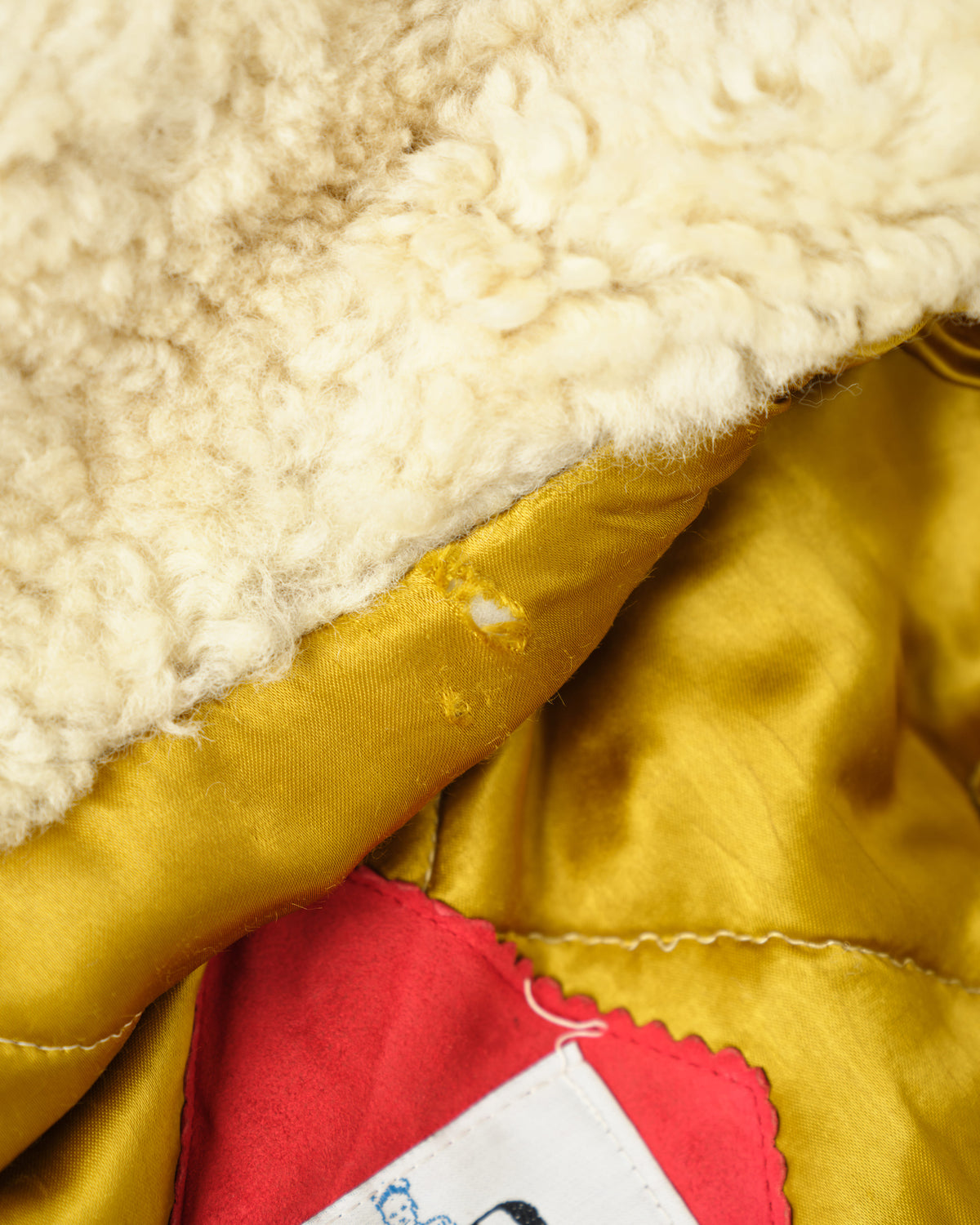
The lining features yellow-gold quilting, remaining a focal point even when removed—quintessential Osti.
As archive documentation attests, the interplay of disparate materials and the vibrant lining exemplify the hallmarks of this model.
Pocketing is equally considered: inverted V-shaped zip pockets run across the jacket's mid-section on either side.
The hand warmers, conversely, eschew zips in favour of minimalist slash openings.
This balance between 'gear sensibility' and 'everyday wearability' represents the Dutch Police's true essence.
The cuffs and hem are finished in ribbed knit, ensuring a flattering fit regardless of physique.
Particularly on smaller frames, the pooling sleeve creates a rounded silhouette where 'refinement' persists amid the rugged character.
The front closure employs a zip fastener.
The zip slider features an unmarked pull.
This specimen is notably Made in Italy—a detail many seek.
In later years, production shifted away from Italian manufacture, making Italian-produced examples increasingly rare for those particular about provenance.
The piece is recognised as appearing in the seminal work 'IDEAS FROM MASSIMO OSTI', placing it among those items essential to serious collectors.
The specimen employs the brand's signature combination body of 'cotton, polyurethane, and leather'.
Navy cotton interwoven with polyurethane achieves both a refined firmness and a subdued, shadowed tactility.
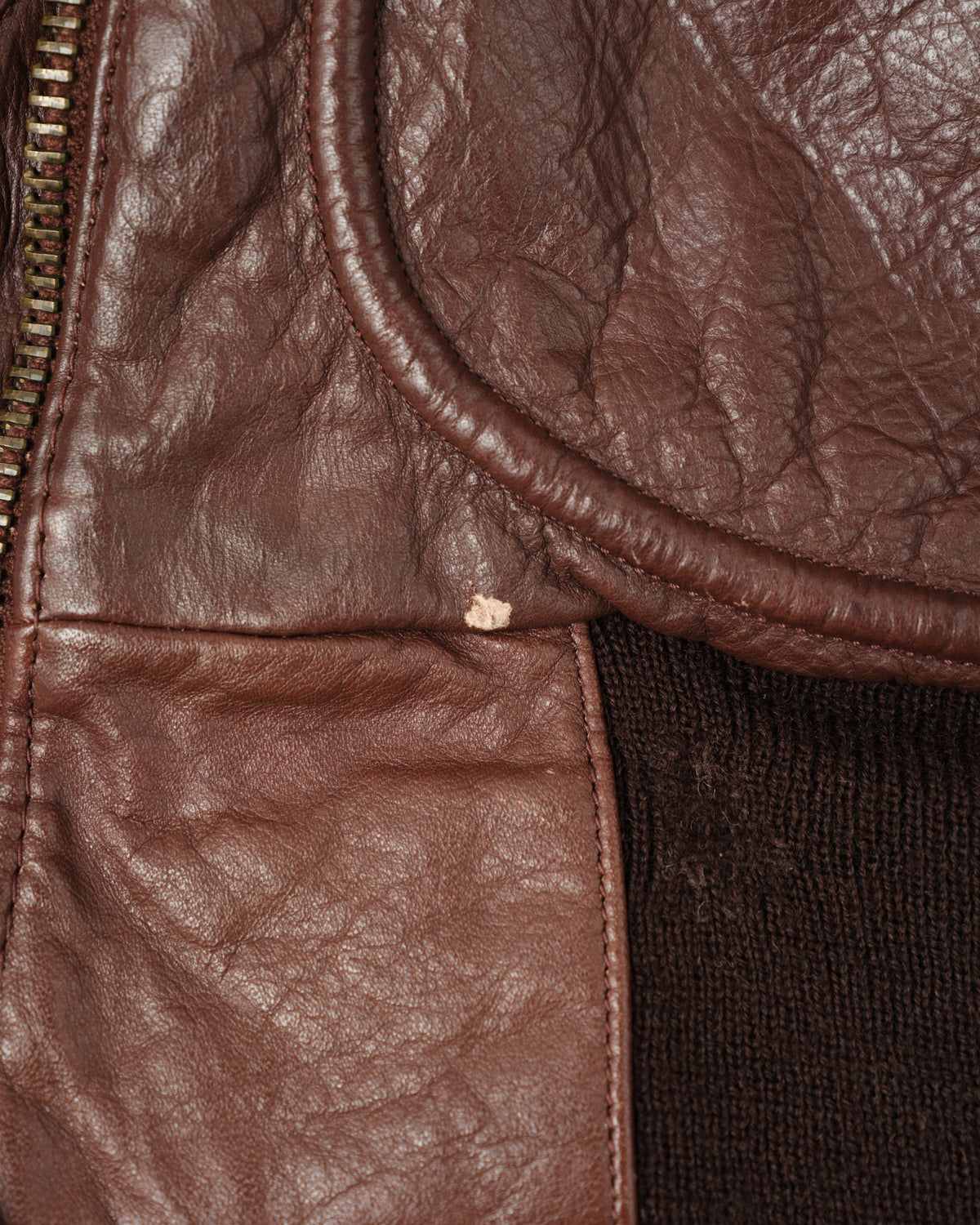
The front body showcases textured brown leather, introducing a lustrous sensuality beneath the utilitarian character.
Adding the olive panel at the shoulders, fleece at the collar, and the yellow-gold quilted lining.
Hard and soft, gloss and matte intersect dimensionally; with wear, the leather's creasing and patina layered with the cotton's fading promise rich, deepening age.
The colourway comprises four tones—navy, brown, olive, and yellow-gold—a true multi-colour composition.
A contrast that transcends mere colour coordination.
Against the recessive navy, the warmth-tinged lustre of brown leather surfaces, while the matte olive pivot tightens the whole.
Light's interaction shifts with each material, so tone and expression transform with viewing angle, gifting the wearer a three-dimensional presence.
And upon opening the front, the yellow-gold lining emerges like an 'unexpected accent concealed within'.
Utilitarian heritage mingles with sophistication and playfulness.
A colourway embodying this exquisite equilibrium.
Size marked as '52'.
Equivalent to approximately L–XL in Japanese sizing.
Actual measurements indicate a generous fit, suitable for those of larger build.
Surface wear, material-specific marks, and repair traces are present, though no significant damage impedes wear.
In recent years, early C.P. Company has undergone renewed appreciation, with valuations trending upward.
Particularly, the foundational pieces from Osti's own hand demonstrate material sensibility and design philosophy of exceptional density—singular, unobtainable elsewhere.
This specimen is recognised as appearing in the seminal 'IDEAS FROM MASSIMO OSTI', an archival necessity in any history of the brand.
Whether as daily wardrobe or collection piece, as design reference, it merits consideration.
For those who have searched, those who cannot overlook it. Do not miss this opportunity.
![[82AW]Old C.P.Company Dutch Police Jacket Size.52](http://vieuxetnouveau-shop.com/cdn/shop/files/202505030239.jpg?v=1766418584&width=2400)
![[82AW]Old C.P.Company Dutch Police Jacket Size.52](http://vieuxetnouveau-shop.com/cdn/shop/files/202505030240.jpg?v=1766418583&width=2400)
![[82AW]Old C.P.Company Dutch Police Jacket Size.52](http://vieuxetnouveau-shop.com/cdn/shop/files/202505030241.jpg?v=1766418583&width=2400)
![[82AW]Old C.P.Company Dutch Police Jacket Size.52](http://vieuxetnouveau-shop.com/cdn/shop/files/DSCF1447_1f4238fd-c746-46e1-a238-68dee2ab1f27.jpg?v=1766418599&width=2400)
![[82AW]Old C.P.Company Dutch Police Jacket Size.52](http://vieuxetnouveau-shop.com/cdn/shop/files/DSCF1448_24944bb2-5510-40f7-816f-a18881daa148.jpg?v=1766418598&width=2400)
![[82AW]Old C.P.Company Dutch Police Jacket Size.52](http://vieuxetnouveau-shop.com/cdn/shop/files/DSCF1449_81d81010-af48-45eb-9522-27ec938416c1.jpg?v=1766418598&width=2400)
![[82AW]Old C.P.Company Dutch Police Jacket Size.52](http://vieuxetnouveau-shop.com/cdn/shop/files/DSCF1450_26bb2a5f-b416-4daf-ae50-ac6c993c598c.jpg?v=1766418599&width=2400)
![[82AW]Old C.P.Company Dutch Police Jacket Size.52](http://vieuxetnouveau-shop.com/cdn/shop/files/DSCF1451_bbada97b-15fd-424f-895f-12a381f6d5d8.jpg?v=1766418598&width=2400)
![[82AW]Old C.P.Company Dutch Police Jacket Size.52](http://vieuxetnouveau-shop.com/cdn/shop/files/DSCF1452_81463776-df62-4899-9267-3fa6e26f333a.jpg?v=1766418598&width=2400)
![[82AW]Old C.P.Company Dutch Police Jacket Size.52](http://vieuxetnouveau-shop.com/cdn/shop/files/DSCF1453_2b517b80-fc0b-42d8-a376-1a1124263eb3.jpg?v=1766418599&width=2400)
![[82AW]Old C.P.Company Dutch Police Jacket Size.52](http://vieuxetnouveau-shop.com/cdn/shop/files/DSCF1454_56e336f5-6fe6-44aa-ac4b-7422ec0c8a9d.jpg?v=1766418599&width=2400)
![[82AW]Old C.P.Company Dutch Police Jacket Size.52](http://vieuxetnouveau-shop.com/cdn/shop/files/DSCF1457_d7643284-8881-45d6-aa11-94684a9c8d47.jpg?v=1766418642&width=2400)
![[82AW]Old C.P.Company Dutch Police Jacket Size.52](http://vieuxetnouveau-shop.com/cdn/shop/files/DSCF1455_800ea173-71fd-4e51-8c56-b41eb5067298.jpg?v=1766418642&width=2400)
![[82AW]Old C.P.Company Dutch Police Jacket Size.52](http://vieuxetnouveau-shop.com/cdn/shop/files/DSCF1458_ae322f82-6414-4761-830e-cbc0ebd8fcce.jpg?v=1766418642&width=2400)
![[82AW]Old C.P.Company Dutch Police Jacket Size.52](http://vieuxetnouveau-shop.com/cdn/shop/files/DSCF1456_9cfdc0a3-a4eb-4c3e-9e05-d6aeef053b5a.jpg?v=1766418642&width=2400)
![[82AW]Old C.P.Company Dutch Police Jacket Size.52](http://vieuxetnouveau-shop.com/cdn/shop/files/DSCF1462_c87e3339-f2b4-42fe-a209-fdfff338d65e.jpg?v=1766418598&width=2400)
![[82AW]Old C.P.Company Dutch Police Jacket Size.52](http://vieuxetnouveau-shop.com/cdn/shop/files/DSCF1463_384e0efd-3226-4936-98ab-fdcf5e3b1e28.jpg?v=1766418599&width=2400)
![[82AW]Old C.P.Company Dutch Police Jacket Size.52](http://vieuxetnouveau-shop.com/cdn/shop/files/DSCF1464_247898fa-ea56-4587-932c-0ebcf1fe49de.jpg?v=1766418599&width=2400)
![[82AW]Old C.P.Company Dutch Police Jacket Size.52](http://vieuxetnouveau-shop.com/cdn/shop/files/DSCF1465_2a14f8cb-bbe2-42b3-aad6-ce9afd19a346.jpg?v=1766418599&width=2400)
![[82AW]Old C.P.Company Dutch Police Jacket Size.52](http://vieuxetnouveau-shop.com/cdn/shop/files/DSCF1605_752484c2-c385-43cb-b1b2-c2ae99b33acc.jpg?v=1766418673&width=2400)
![[82AW]Old C.P.Company Dutch Police Jacket Size.52](http://vieuxetnouveau-shop.com/cdn/shop/files/DSCF1606.jpg?v=1766418673&width=2400)
![[82AW]Old C.P.Company Dutch Police Jacket Size.52](http://vieuxetnouveau-shop.com/cdn/shop/files/DSCF1607_4eae7c0d-2b74-4ef6-bf56-0f7d1d295a9d.jpg?v=1766418673&width=2400)
![[82AW]Old C.P.Company Dutch Police Jacket Size.52](http://vieuxetnouveau-shop.com/cdn/shop/files/DSCF1611_0803a619-00b7-4e6b-a988-1167fa4850da.jpg?v=1766418673&width=2400)
![[82AW]Old C.P.Company Dutch Police Jacket Size.52](http://vieuxetnouveau-shop.com/cdn/shop/files/DSCF1613_3ca77ee6-d909-426b-8652-22e5b9093fac.jpg?v=1766418673&width=2400)
![[82AW]Old C.P.Company Dutch Police Jacket Size.52](http://vieuxetnouveau-shop.com/cdn/shop/files/DSCF1612_f1dad551-b154-43c6-bb54-258bc96976c6.jpg?v=1766418673&width=2400)
![[82AW]Old C.P.Company Dutch Police Jacket Size.52](http://vieuxetnouveau-shop.com/cdn/shop/files/DSCF1604_8b1df945-cc52-4c46-a571-7a8b829b0280.jpg?v=1766418673&width=2400)
![[82AW]Old C.P.Company Dutch Police Jacket Size.52](http://vieuxetnouveau-shop.com/cdn/shop/files/DSCF1600_b982747e-d0c2-4ad3-9ec2-45f495ede393.jpg?v=1766418673&width=2400)
![[82AW]Old C.P.Company Dutch Police Jacket Size.52](http://vieuxetnouveau-shop.com/cdn/shop/files/DSCF1601_63d02ad5-cba9-4992-b615-321e1bae8abd.jpg?v=1766418673&width=2400)
![[82AW]Old C.P.Company Dutch Police Jacket Size.52](http://vieuxetnouveau-shop.com/cdn/shop/files/DSCF1602_e4551993-618d-482b-904a-4c9f906cb73f.jpg?v=1766418673&width=2400)
![[82AW]Old C.P.Company Dutch Police Jacket Size.52](http://vieuxetnouveau-shop.com/cdn/shop/files/DSCF1619_b6884541-b44e-44a3-8e7f-f18c5e7650fd.jpg?v=1766418673&width=2400)
![[82AW]Old C.P.Company Dutch Police Jacket Size.52](http://vieuxetnouveau-shop.com/cdn/shop/files/DSCF1614_6725316d-53d0-4411-b5ab-29f0743cc3e2.jpg?v=1766418673&width=2400)
![[82AW]Old C.P.Company Dutch Police Jacket Size.52](http://vieuxetnouveau-shop.com/cdn/shop/files/DSCF1617_bcbb36d8-ad24-4d75-97e2-41afc060d727.jpg?v=1766418673&width=2400)
![[82AW]Old C.P.Company Dutch Police Jacket Size.52](http://vieuxetnouveau-shop.com/cdn/shop/files/DSCF1618_3d781c97-a466-424f-b6f3-d98defc1667d.jpg?v=1766418599&width=2400)