1988AW, C.P.Company Black Leather Blouson.
C.P.Company is an urban sportswear brand founded in 1971 in Bologna, Italy by Massimo Osti, a designer of graphic origin, embodying both functionality and innovation.
Initially operating under the name Chester Perry, the brand adopted its current name C.P.Company in 1978.
The initials "C.P." carry the meaning of "Color of Passion," and true to its name, the brand has captivated fashion enthusiasts and urban dwellers across Europe through products that fuse profound colour expression with functionality.
The greatest allure of this brand lies in its craftsmanship—a masterful fusion of "tailoring's structural beauty" and "cutting-edge material engineering." In essence, "design clothing for function"—a garment that is truly "wearable gear."
Inseparable from C.P.Company's narrative is Garment Dye, a revolutionary dyeing technique pioneered worldwide.
Typically, garments are sewn from pre-dyed fabrics. C.P.Company introduced an entirely novel approach: dyeing the finished product as a whole.
This method creates depth of colour variation and tone-on-tone subtlety throughout the garment, realizing an incomparable vintage quality and dignified chromatic presence.
This dyeing technology, developed through years of research, enables up to 60,000 colour expressions—becoming the defining trademark of C.P.Company in surpassing other brands.
Equally remarkable is the proprietary technique known as Double Dye in a Single Bath.
This approach simultaneously dyes materials of different compositions, applying distinct chemical processes to each, layering multiple tonal qualities within a single garment and producing dramatically nuanced colour gradations.
Through this chromatic revolution, Massimo Osti gained international recognition as an "alchemist of material and colour."
The iconic Goggle Jacket, along with details drawn from military and workwear aesthetics—such as multiple functional pockets prioritizing visibility—embody not mere practicality but originality that suggests "the future of clothing."
Osti further pioneered innovative materials: the ICE Jacket with temperature-reactive pigmentation, Rubber Flax, and Reflective Jacket.
The pursuit of "functional beauty" through design and technology knows no end; C.P.Company garments continue to evolve as "wearable laboratories."
This avant-garde spirit extends beyond C.P.Company alone, inherited by other brands under Osti's direction—STONE ISLAND, Boneville, and Left Hand—demonstrating how his philosophy transcended Italian sportswear to influence the world.
This approach has earned C.P.Company its established position in major cities—London, Paris, Tokyo—securing it as a brand standing at the intersection of fashion and technology, commanding enduring esteem.
C.P.Company is a "seeker of colour and function," a heterodox craftsman who imbued "clothing as product" with new context.
Their creations transcend mere garments.
With each wearing, one encounters "the narrative told by colour," and each piece—infused with functional beauty and philosophy—becomes an "intellectual armour" for the urban dweller.
From such a C.P.Company, we present a leather blouson richly resonant with the sensibility of Massimo Osti himself.
The foundation evokes the composed balance of a Harrington jacket, with a striking curved yoke running across the back.
The defining detail familiar from esteemed British Harrington jackets such as BARACUTA G-9 is reinterpreted by C.P. through all-leather construction, ascending to a more austere and three-dimensional expression.
Surprisingly, Harrington silhouettes in all-leather remain scarcely produced across brands, which explains why this piece commands such presence among those seeking it.
The collar closes via dual buttons, rising like a stand collar when fastened, creating a crisp neckline that anchors the leather's weight.
Even a simple t-shirt beneath gains definition through this refined collar construction.
Open, it reveals the ease of Harrington tradition; closed, it inclines toward modish restraint.
The collar embodies considerable versatility in styling.
The pockets are thoughtfully executed: curved button-secured hand warmer pockets at the waist, echoing the back yoke's arc.
This curvature alone prevents the linearity of masculine severity, introducing an industrial, design-object quality distinctly characteristic of C.P..
The body employs raglan sleeves, ensuring natural shoulder accommodation and visually and tactilely softening leather's inherent rigidity.
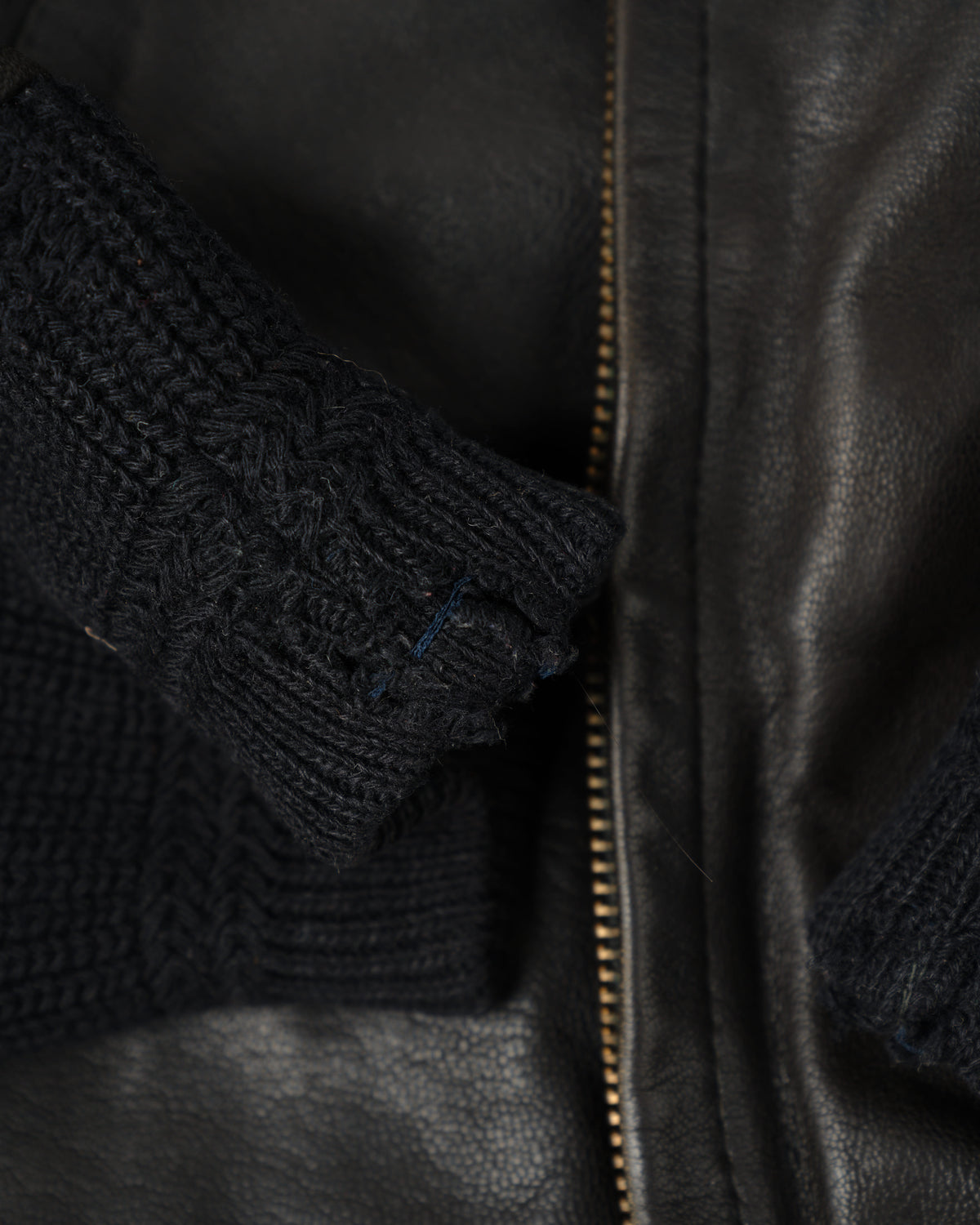
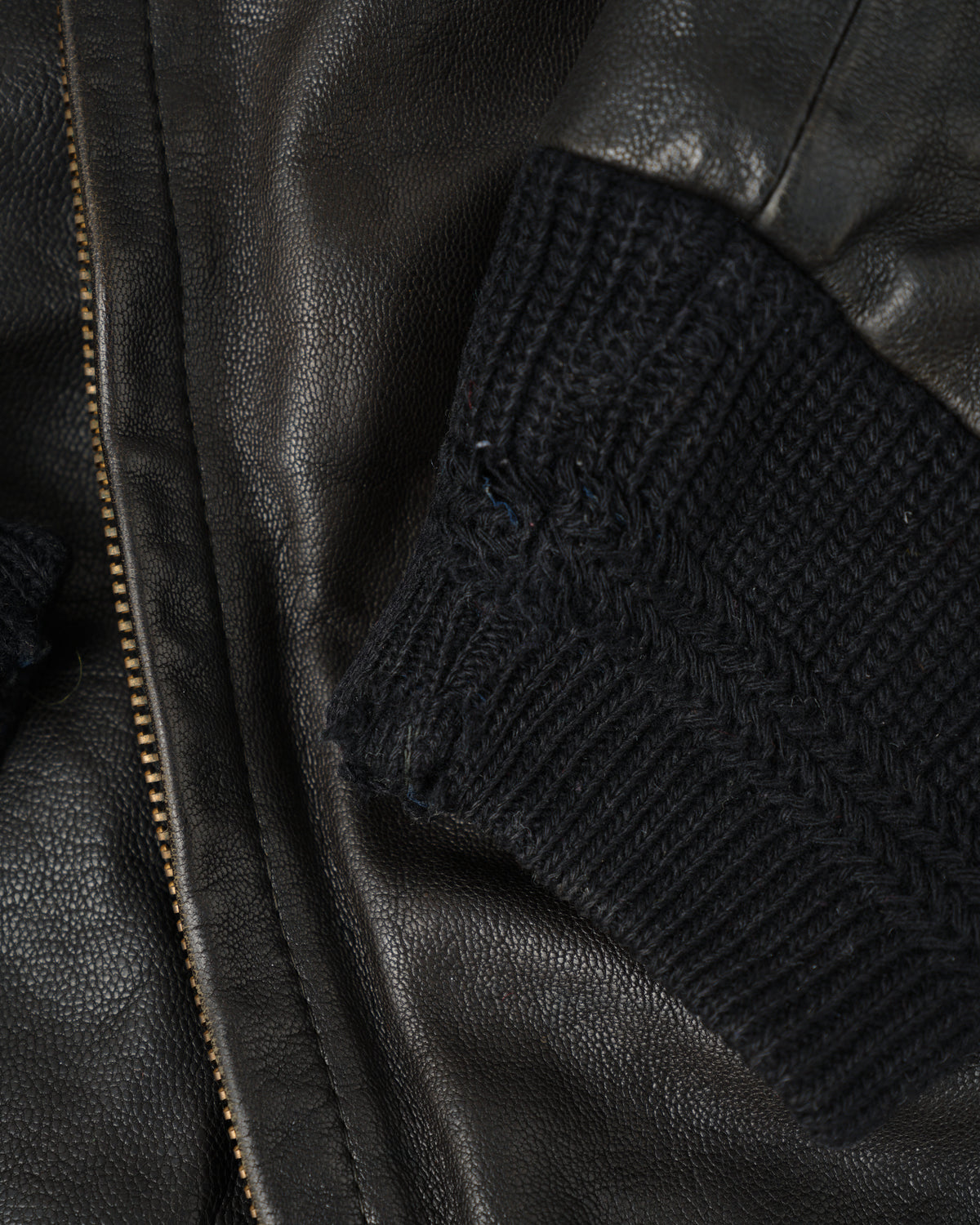
Cuffs and hem are finished in ribbed knit, creating rounded proportion while resisting wind intrusion—functional as well as aesthetic.
The piece respects classic "blouson grammar" while achieving deeper gravitas through leather's material presence.
Front closure employs a zip fastener for clean operation, though the original zip slider is absent—please understand this as part of the piece's condition.
This example features supple black leather of refined character.
The fine grain texture and measured firmness coexist with gravitas tempered by inherent dignity.
Creasing deepens through wear; sheen and variation accumulate.
The characterful patina distinctive to leather awaits.
The colour is a deep black.
Where light catches and shadows fall, tonal variation emerges; each time its muted sheen catches the eye, its expression transforms. This "smoky black" possesses a singular presence uniting quietude and impact.
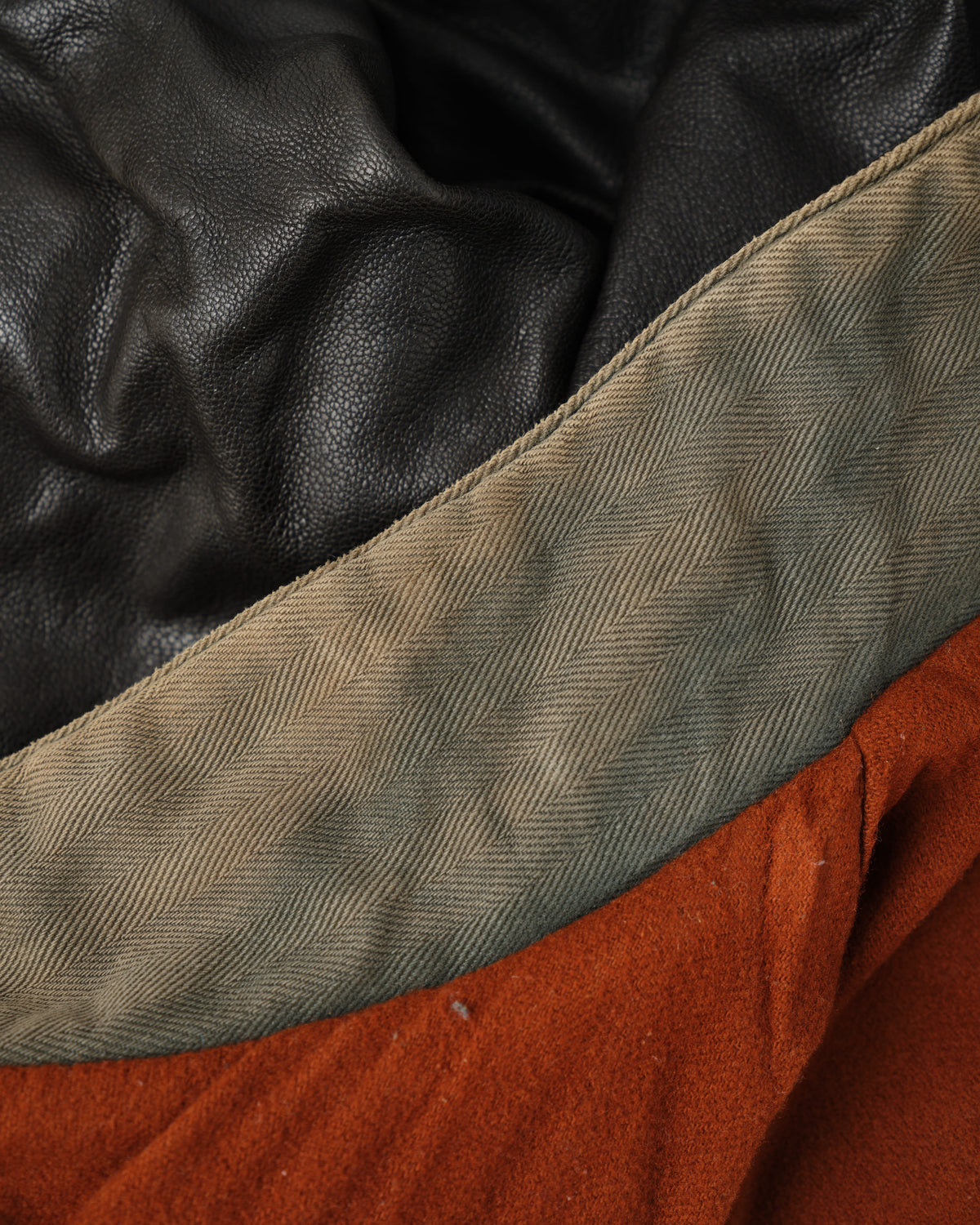
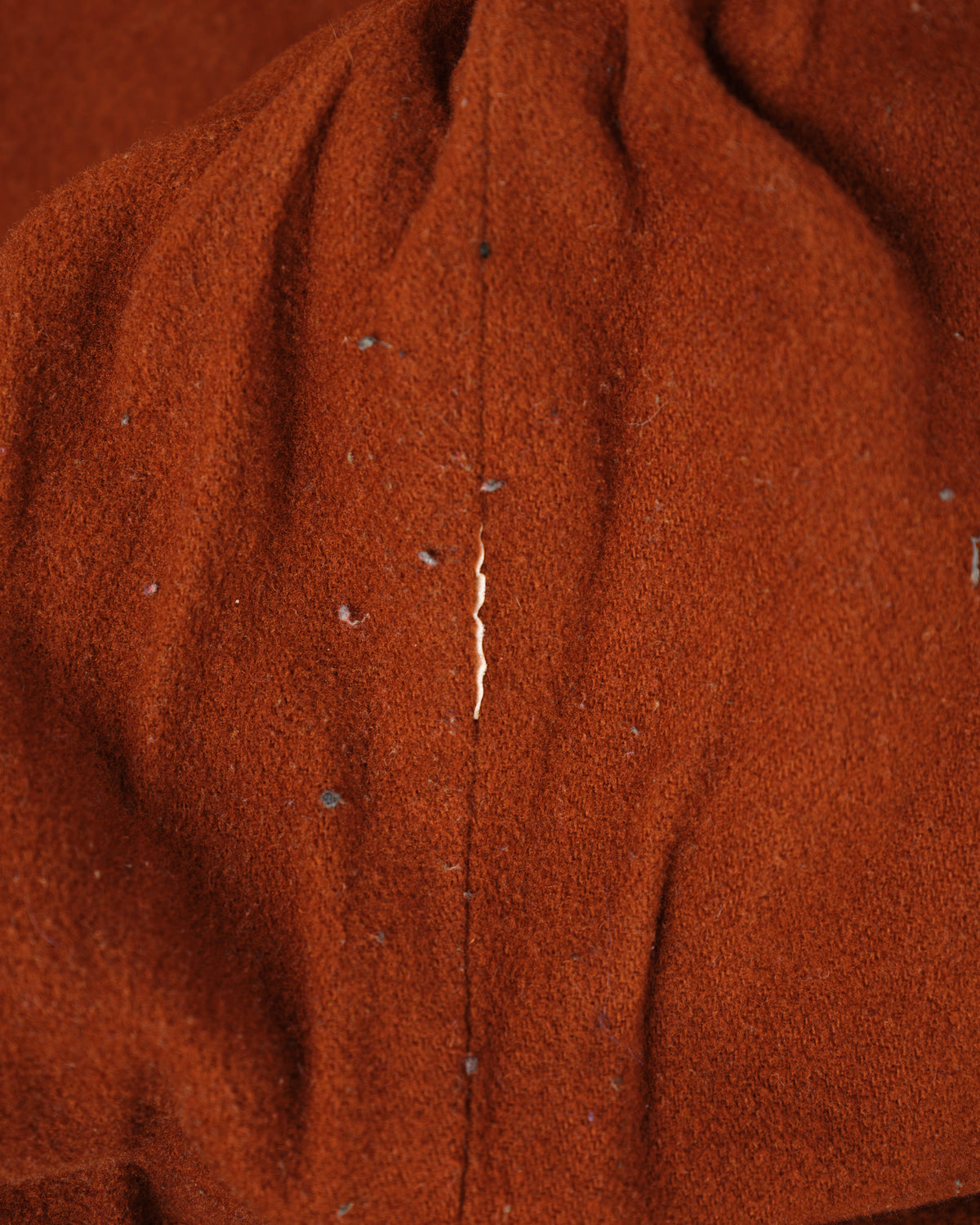
The lining is completed with a terracotta-toned fleece interior, while a herringbone-patterned grey-olive lines the collar, introducing warmth to black's coolness through "layered chromatic sensibility."
As the internal colours punctuate the leather's austere face, an unusual mood emerges—austere sophistication with subtle allure.
Size marked as "50,"
roughly equivalent to Japanese "L to XL."
Actual measurements suggest substantial sizing, suitable for larger frames without compromise.
Fading, loose threads, repair traces, missing tags, and missing zip slider are evident as use marks, though no significant damage impairs wearability. The piece remains entirely serviceable.
In recent years, early C.P.Company has experienced renewed appreciation, with values trending upward.
Pieces from the formative era under Massimo Osti's own hand carry exceptional density in material choice and design philosophy—qualities unobtainable elsewhere.
A distinguished rendering of Harrington's composed grammar through all-leather reconstruction.
The austere sensibility elevated to "product," concentrated in C.P.'s essence.
Among 1980s archive pieces from the designer's own hand, examples meeting the criteria of "Harrington silhouette × all-leather" remain rare in the market.
For those seeking quietude and presence unified in a single garment. Do not overlook this opportunity.
![[88AW]Old C.P.Company Black Leather Blouson Size.50](http://vieuxetnouveau-shop.com/cdn/shop/files/202505030284.jpg?v=1768020390&width=2400)
![[88AW]Old C.P.Company Black Leather Blouson Size.50](http://vieuxetnouveau-shop.com/cdn/shop/files/202505030285.jpg?v=1768020390&width=2400)
![[88AW]Old C.P.Company Black Leather Blouson Size.50](http://vieuxetnouveau-shop.com/cdn/shop/files/202505030286.jpg?v=1768020390&width=2400)
![[88AW]Old C.P.Company Black Leather Blouson Size.50](http://vieuxetnouveau-shop.com/cdn/shop/files/DSCF1878.jpg?v=1768020454&width=2400)
![[88AW]Old C.P.Company Black Leather Blouson Size.50](http://vieuxetnouveau-shop.com/cdn/shop/files/DSCF1879_ea60a8f7-11ac-49a0-a686-23bfa6768eaf.jpg?v=1768020454&width=2400)
![[88AW]Old C.P.Company Black Leather Blouson Size.50](http://vieuxetnouveau-shop.com/cdn/shop/files/DSCF1877_8141b8af-e92b-4bd5-995d-e47cb9689811.jpg?v=1768020454&width=2400)
![[88AW]Old C.P.Company Black Leather Blouson Size.50](http://vieuxetnouveau-shop.com/cdn/shop/files/DSCF1880_e40a2235-4959-4708-b1ee-2b3bda0ee0dd.jpg?v=1768020454&width=2400)
![[88AW]Old C.P.Company Black Leather Blouson Size.50](http://vieuxetnouveau-shop.com/cdn/shop/files/DSCF1881_7c57124a-afb9-41ec-955d-d9ee765b92bd.jpg?v=1768020454&width=2400)
![[88AW]Old C.P.Company Black Leather Blouson Size.50](http://vieuxetnouveau-shop.com/cdn/shop/files/DSCF1882_9490a014-7d36-4b54-b367-00d4d701280e.jpg?v=1768020454&width=2400)
![[88AW]Old C.P.Company Black Leather Blouson Size.50](http://vieuxetnouveau-shop.com/cdn/shop/files/DSCF1883_b61f5137-b91b-4d62-80f3-67b2f2003265.jpg?v=1768020454&width=2400)
![[88AW]Old C.P.Company Black Leather Blouson Size.50](http://vieuxetnouveau-shop.com/cdn/shop/files/DSCF1884_b01b7965-26e8-4ab4-bca1-3b58e58e72c7.jpg?v=1768020454&width=2400)
![[88AW]Old C.P.Company Black Leather Blouson Size.50](http://vieuxetnouveau-shop.com/cdn/shop/files/DSCF1885_3e079859-a6bc-4b4b-8eb0-cb7a66321d88.jpg?v=1768020454&width=2400)
![[88AW]Old C.P.Company Black Leather Blouson Size.50](http://vieuxetnouveau-shop.com/cdn/shop/files/DSCF1886_01d8a04a-3a0e-45a7-ba41-1ea6deaee302.jpg?v=1768020454&width=2400)
![[88AW]Old C.P.Company Black Leather Blouson Size.50](http://vieuxetnouveau-shop.com/cdn/shop/files/DSCF1887_80668929-6872-4d6a-a14c-00b0026a4418.jpg?v=1768020454&width=2400)
![[88AW]Old C.P.Company Black Leather Blouson Size.50](http://vieuxetnouveau-shop.com/cdn/shop/files/DSCF1890_0d50cc21-639a-4fed-bd78-89a93e672864.jpg?v=1768020454&width=2400)
![[88AW]Old C.P.Company Black Leather Blouson Size.50](http://vieuxetnouveau-shop.com/cdn/shop/files/DSCF1888.jpg?v=1768020454&width=2400)
![[88AW]Old C.P.Company Black Leather Blouson Size.50](http://vieuxetnouveau-shop.com/cdn/shop/files/DSCF1889_151ac11d-8790-4a64-8643-95b5384ccbe8.jpg?v=1768020454&width=2400)
![[88AW]Old C.P.Company Black Leather Blouson Size.50](http://vieuxetnouveau-shop.com/cdn/shop/files/DSCF2139_783e943a-6315-4261-8b60-079c51c97530.jpg?v=1768020454&width=2400)
![[88AW]Old C.P.Company Black Leather Blouson Size.50](http://vieuxetnouveau-shop.com/cdn/shop/files/DSCF2140_fda6d5af-7861-4681-ac00-35e79f828bc4.jpg?v=1768020454&width=2400)
![[88AW]Old C.P.Company Black Leather Blouson Size.50](http://vieuxetnouveau-shop.com/cdn/shop/files/DSCF2141_03ba1dc2-d145-4134-881b-d15596fffd29.jpg?v=1768020454&width=2400)
![[88AW]Old C.P.Company Black Leather Blouson Size.50](http://vieuxetnouveau-shop.com/cdn/shop/files/DSCF2142_0600877f-84c2-429c-9457-b3d7f33c712c.jpg?v=1768020454&width=2400)
![[88AW]Old C.P.Company Black Leather Blouson Size.50](http://vieuxetnouveau-shop.com/cdn/shop/files/DSCF2138_7a37406c-a6ca-4a87-b558-e1e5dd9008c7.jpg?v=1768020454&width=2400)
![[88AW]Old C.P.Company Black Leather Blouson Size.50](http://vieuxetnouveau-shop.com/cdn/shop/files/DSCF2135_75c22144-38b2-43b1-b6cb-941c32a2a60c.jpg?v=1768020454&width=2400)
![[88AW]Old C.P.Company Black Leather Blouson Size.50](http://vieuxetnouveau-shop.com/cdn/shop/files/DSCF2136_a7a8eb39-0f63-46ec-99ef-3e052ae138a0.jpg?v=1768020454&width=2400)
![[88AW]Old C.P.Company Black Leather Blouson Size.50](http://vieuxetnouveau-shop.com/cdn/shop/files/DSCF2137_b5dbaa03-464c-413b-af0a-20d85ee35812.jpg?v=1768020454&width=2400)
![[88AW]Old C.P.Company Black Leather Blouson Size.50](http://vieuxetnouveau-shop.com/cdn/shop/files/DSCF2150_4c81b97a-3b36-4fbd-adfb-0d82babeb934.jpg?v=1768020454&width=2400)
![[88AW]Old C.P.Company Black Leather Blouson Size.50](http://vieuxetnouveau-shop.com/cdn/shop/files/DSCF2145_8c1d4328-c3ff-43b7-8b41-59f121340911.jpg?v=1768020454&width=2400)
![[88AW]Old C.P.Company Black Leather Blouson Size.50](http://vieuxetnouveau-shop.com/cdn/shop/files/DSCF2146_249c4216-8276-40aa-ad89-69dc326f1393.jpg?v=1768020454&width=2400)
![[88AW]Old C.P.Company Black Leather Blouson Size.50](http://vieuxetnouveau-shop.com/cdn/shop/files/DSCF2149_92b373c8-d025-443d-ab52-37d3a0ca7987.jpg?v=1768020454&width=2400)