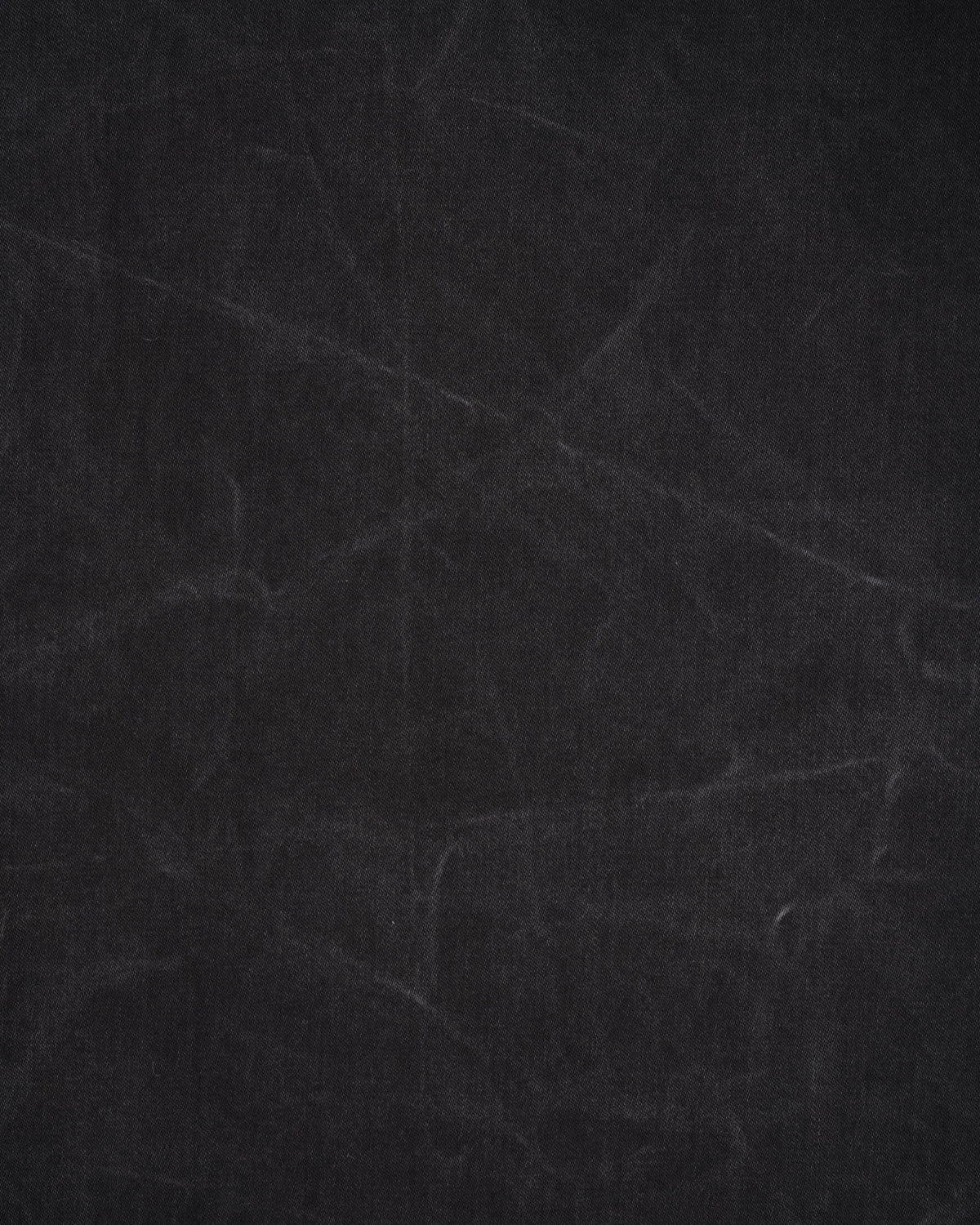
A HELMUT LANG black cotton four-pocket jacket, thought to date from around the 1990s.
This is the first time we have carried Helmut Lang in our online shop.
It is a piece that leaves me glad the first one should have been this.
HELMUT LANG is the label bearing the name of "Helmut Lang" himself, a designer born in Vienna, Austria, in 1956.
He did not train at a fashion school.
He began making clothes self-taught, and everything started from the small atelier and boutique he opened in Vienna in 1979.
His debut on the Paris collections came in 1986.
From there, across the whole of the 1990s, this man went on to rewrite the very vocabulary of fashion.
A slim silhouette stripped of ornament; the introduction of materials never before used in clothing, such as industrial tape and reflective trim; and that touch of his for dismantling the structures of uniform — military dress, workwear — and reassembling them as clothes for the city.
The sensibility we now take for granted, of clothing that is at once minimal and of the moment, was made by this man, and to say so is no exaggeration.
In 1997 he moved his base from Paris to New York, and in 1999 the Prada Group took a stake in the house.
Then in 2005 Lang himself left the label, and has since worked as a contemporary artist.
Which is to say that the period during which he held the reins is already closed.
There is no other label for which the phrase "the designer's own era" carries such urgent meaning.
Now, this particular piece retains a white woven label inside.
Beneath the "HELMUT LANG" logo runs a line reading "PRODUCED IN 19◯◯".
This practice of inscribing the year of manufacture into the garment itself is a detail emblematic of Lang in the latter half of the 1990s, and this piece can be read as having been made in 1998.
A jacket made squarely in the middle of the designer's own era.
The design would seem to be underpinned by the American military's jungle fatigue.
A four-pocket military shirt jacket made for the hot, humid theatre of Vietnam.
Two at the chest, two at the waist.
All of them squared off rather than rounded, and gusseted, so that they swell into three dimensions once filled. The flaps button down, and are likewise left angular.
A treatment that deliberately keeps some ruggedness in place.
Look to the front closure, however, and the impression turns completely.
Only a single button at the neck is left on show, everything below it made up as a fly placket.
A fly placket conceals the fastenings behind the cloth, and by this means the front of the jacket rises as a single unbroken plane.
To carry the function of a military garment over intact, and then to erase only the fastenings and grant it quietness.
This subtraction is, I think, precisely Lang's hand.
A horizontal seam runs across the sleeve just above the elbow, and the cuffs fasten with buttoned tabs.
The same buttoned tabs are fitted at either side of the hem, letting you adjust how it falls around the waist.
It is made unlined, and seen from within, the finishing of the seam allowances is genuinely quiet work.
The cloth is a cotton sateen.
A weave in which the yarn floats longer than in a twill; run a finger over it and there is not a single catch, the surface slipping cleanly away.
Garment dyeing and a wash treatment have then been applied, so that colour has lifted to white along the lines where the cloth creased, producing the look of something worn for many years.
Cloth treated in this way goes on changing as it is actually worn.
The inside of the elbow, the mouths of the pockets, the turn-back of the hem.
The black lifts from the places where friction gathers, and in a few years' time a play of light and shadow entirely your own should emerge.
The colour is a black well advanced into fading.
Not a pure black but something like sumi ink with ash in it, appearing charcoal depending on how the light falls.
This ambiguity is really rather good: the weight and tension particular to black have gone out of it, leaving the relaxed bearing of a garment for everyday life.
It is precisely those who find black clothing difficult who I should like to see this colour.
Thrown over a white shirt, with grey trousers below.
That alone makes a picture, and matching the layers beneath in black will settle the whole a degree further into quiet.
It holds the structure of the military, and yet worn, it looks nothing like military dress.
This curious balance is, I suspect, what will prove most useful of all in dressing day to day.
The size is marked "50".
In Japanese sizing this corresponds roughly to "L".
There is a degree of room through the body, while the length has been taken generously.
A knit layered underneath will not, I think, make the shoulders feel confined.
There is wear consistent with the cloth — burnishing at the edges, some fading — but no significant damage that would affect wearing it, so there is a great deal of life in it yet.
The label itself continues in New York to this day, but the clothes that Lang himself gave form to will not increase by so much as one.
A man at the very centre of fashion, making clothes that never looked like fashion.
This is a piece by which that fact can be verified, and I should be glad if you would take the opportunity to have it in your hands.