Circa 1990s, this is the Barbour 'Endurance' model.
A special acquisition.
Barbour is a heritage brand of outdoor and country wear, established in 1894 by founder John Barbour at Market Place in South Shields, northeast England.
Born from oilskin—waterproof garments supplied to sailors and fishermen exposed to sea wind and rain—the brand has refined "clothing that stands against the elements" across generations.
In 1908, second-generation proprietor Malcolm Barbour produced the company's first mail-order catalogue.
By 1917, mail-order sales accounted for approximately 75% of revenue, with international shipments reaching Chile and Hong Kong.
Functional garments rooted in British climate and life had already found their way to distant cities.
In 1936, third-generation proprietor Duncan Barbour unveiled the one-piece waxed suit "Barbour International (A1 Suit)," developed for the International Six Days Trial (ISDT).
During wartime, this evolved into the two-piece "Ursula Suit," standard equipment for British submarine forces.
Post-war, it became civilian motorcycle wear, and from the 1950s through 70s, the majority of ISDT riders wore Barbour International.
At the 1964 East German trials, the US team and Steve McQueen sourced Barbour jackets, establishing the brand's reputation through proven performance and function.
The brand's greatest distinction lies in reconciling an apparent contradiction: the precision of a tailor's craft merged seamlessly with industrial scale.
In essence, it is "industrial product imbued with the philosophy of tailoring."
Waxed cotton provides waterproofing, windproofness, and durability. To this, Barbour layered rational details—throat latch, map pocket, waist belt, detachable liner—responding to professional demands while ascending to an elegance that sits naturally within urban life.
Moreover, unwavering confidence in quality is evidenced by Royal Warrant status. Barbour received warrants from the Duke of Edinburgh in 1974, Queen Elizabeth II in 1982, and the Prince of Wales (later King Charles III) in 1987.
Following institutional transition and review, a new Royal Warrant was granted by King Charles III in 2024.
To be recognized by the Crown as a "practical item"—this threads the brand's origin directly to its present.
Headquarters and the proprietary factory remain in South Shields (Simonside), where craftsmen hand-manufacture waxed cotton jackets including Bedale and Beaufort models.
Repair, rewaxing, and resale-ready refurbishment extend the lifespan of garments, sustaining a circular approach to production.
The piece presented here represents a singular chapter in Barbour history: the 'Endurance' model, which embraced Ventile as its primary textile.
Ventile is a 100% cotton fabric of ultra-high density, developed during the Second World War at the Shirley Institute in Manchester, England.
Originally conceived to satisfy contradictory pilot requirements—comfort in the cockpit yet warmth and water-resistance if lost at sea—it entered mass production in 1943.
Adopted by RAF immersion suits, it dramatically extended survival time at sea and measurably improved rescue viability, as officially recorded.
The manufacturer documented that it increased expected survival duration tenfold and raised survival rates to 80%.
The fabric's foundation is Extra-Long Staple Cotton.
Only the finest high-grade ultra-long fiber cotton—comprising fewer than 2% of the world's cotton supply—is selected, spun into low-twist yarn, and woven at extraordinary density.
When dry, it is supple and breathable; when wet, fiber swelling closes the warp and weft gaps, physically blocking water intrusion.
This mechanism—the fabric itself responding to arrest water—is Ventile's defining characteristic.
Ventile employs water-repellent (DWR) treatment as a supplement, but core performance derives from the weave and cotton swelling.
Standard single-layer weights achieve approximately 750mm hydrostatic pressure (the UK Ministry of Defence cites 800mm as the "waterproof" threshold), while heavier weights reach 900mm; twin-layer construction further enhances weathering through stitch offset and synergistic layering.
It remains nearly silent in wear, with high breathability compared to synthetic membranes.
The very concept—raw materials alone meeting heavy weather—is Ventile's singularity.
Cotton's characteristic aging and durability under extended use represent further appeal.
That it was chosen for the first Everest ascent (1953) and polar expeditions remains testament to its enduring reputation as a "fabric of trust."
The Endurance, embracing this luxurious textile, was a field jacket deployed selectively in the 1990s. It preserved Barbour's classical aesthetic while pursuing a quiet, refined dry hand rather than wax.
Shop archives and collector records indicate limited distribution through the early to mid-1990s, with no contemporary reissue; it is recognized in the vintage market as a scarce model.
Hand warmers and bellowed lower pockets, corduroy collar, waist drawcord—the design follows Barbour vernacular, yet gains the distinctive "muted, silent touch" inherent to Ventile.
This unity of function and gesture represents the Endurance's foremost appeal.
Lineage variants exist; the "A1000 Arctic Endurance," for instance, is a padded iteration, with documented English-made examples.
This specimen bears the designation "A1005 Endurance," an unpadded variant distinct from the A1000, allowing broader seasonal wear.
Its details echo Barbour character throughout.
The collar employs brown wide-wale corduroy, an iconic Barbour signature.
The nap is soft to skin; when raised, a chin strap secures the throat in a wind-resistant configuration.
Slanted flap pockets sit at the chest.
Exposed buttons impart a military tone, angled for ergonomic hand insertion.
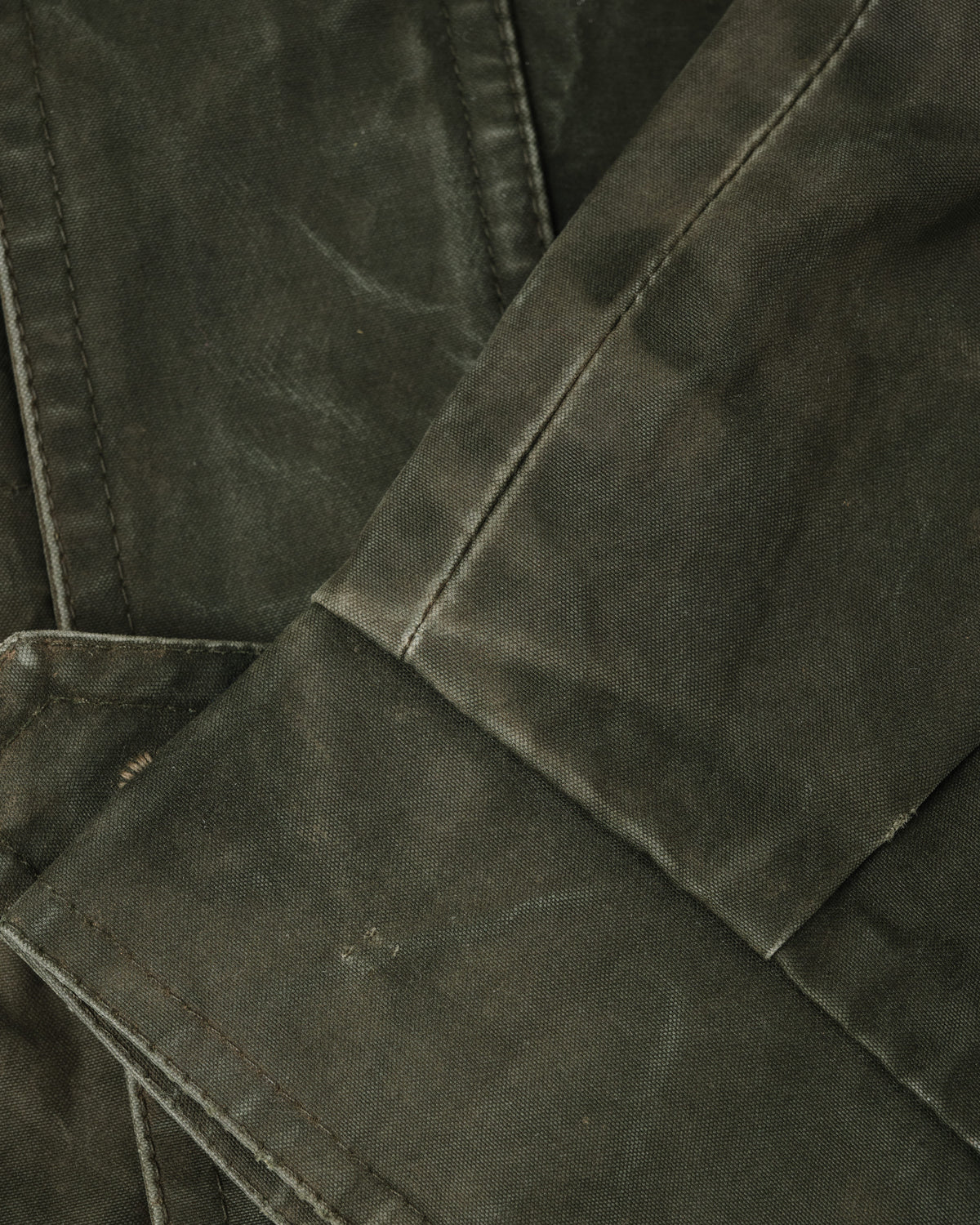
Capacious bellowed pockets occupy the lower sides.
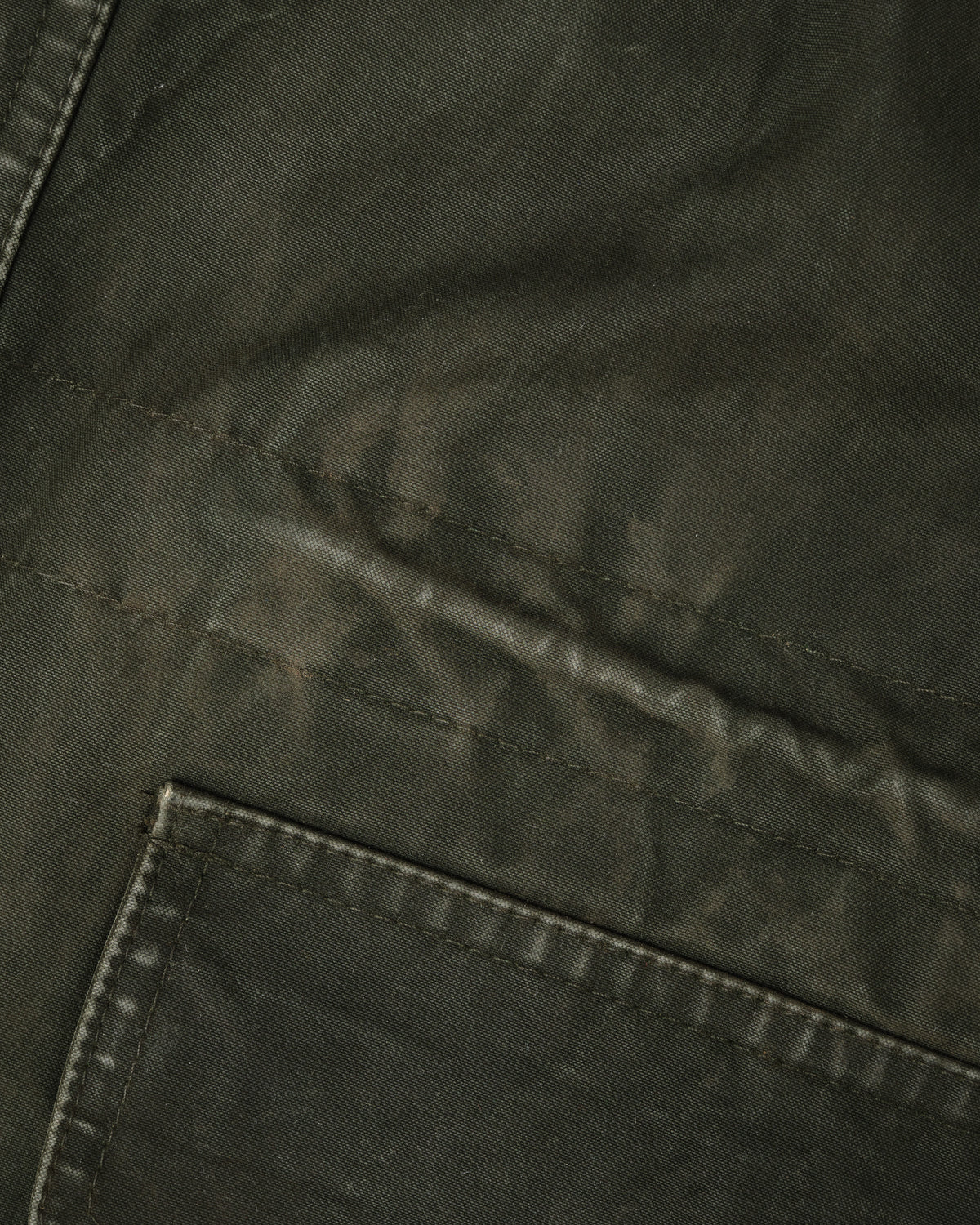
Flap edges are accentuated with narrow topstitching, their structure resisting visible expansion when laden.
An internal drawcord at the waist permits swift adjustment via metal eyelets and a disc toggle.
Silhouette and thermal response tune instantly to layering and circumstance.
The front closure employs a dual-mechanism: button and zipper combined.
Buttons are sizable four-hole pieces with good finger purchase; the zipper features a ring pull (Barbour stamped) for smooth operation even when gloved.
A deep burgundy zipper tape offers restrained contrast against the sage green body.
The color is sage green—a hallmark of Barbour identity.
An olive tone warmed by grey, it reads soft under natural light and settles into composed depth under interior illumination.
The ultra-high density cotton's matte face diffuses light, while seams and edges catch subtle highlights, articulating shadow.
As it absorbs wear, tonal variation and abrasion impart dimensionality, and alongside the brown corduroy collar and brass-toned hardware, it assumes a British restraint.
Sage speaks without excess, and never fades—a "refined military green" that lends quiet presence whether in city or field.
The size marking is "C44 / 112 CM," corresponding roughly to "L to XL" in Japanese sizing.
Actual measurements indicate a generous cut, accommodating larger frames without constraint.
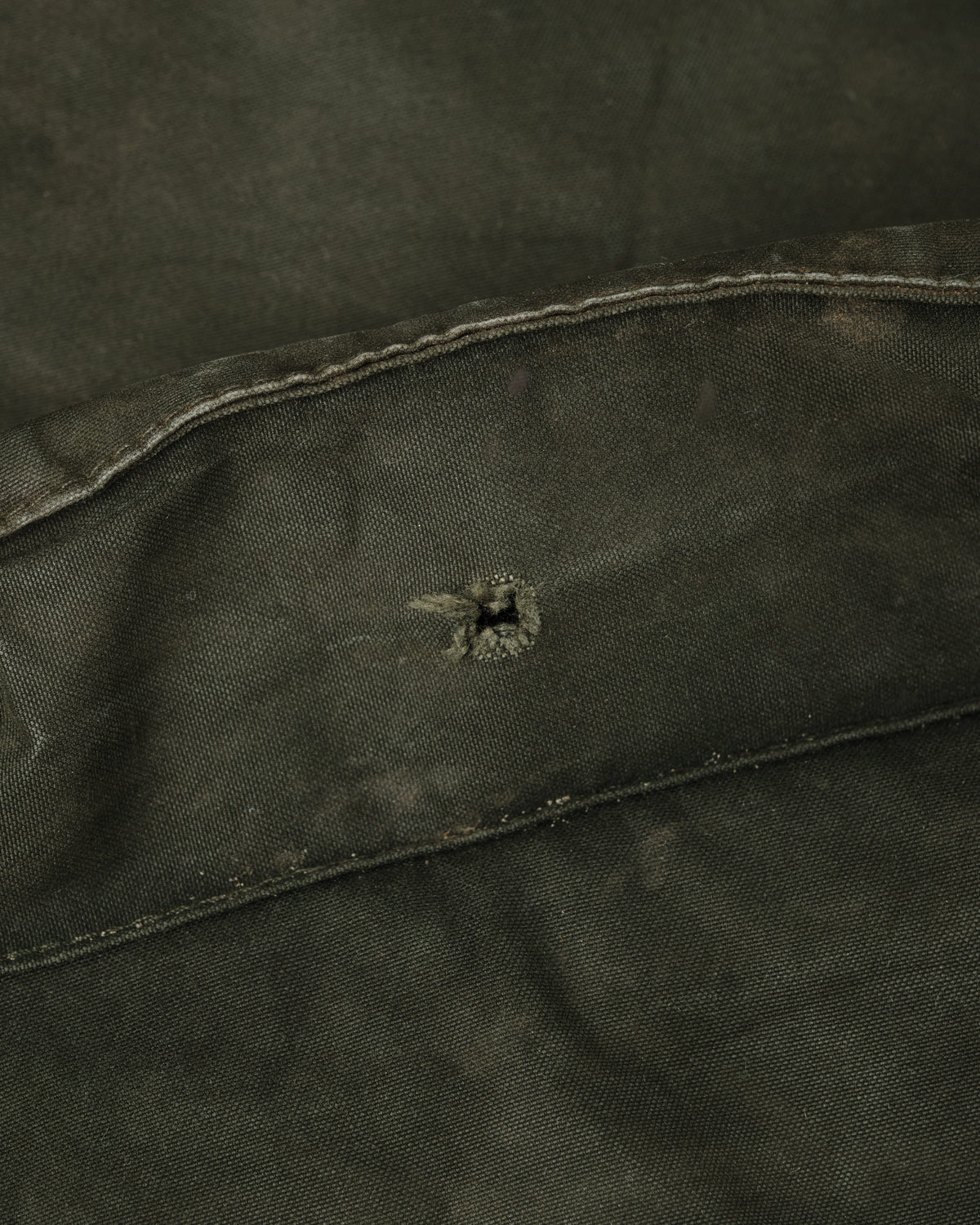
The garment exhibits fabric-inherent wear marks, fading, small perforations, and some button loss consistent with its age, though no significant damage impairs wearability.
The Endurance (A1005)—a singular expression of Ventile, the high-performance fabric born in the Second World War—embodies Barbour legacy.
Unpadded, it serves across extended seasons, distilling practical beauty that traverses street and field.
It is offered with confidence to those seeking quiet, assured dignity in daily dress.
The 'Endurance,' limited in 1990s distribution, circulates sparsely in the vintage market.
This shop sees few arrivals; it remains a scarce acquisition. Those who have sought it should not overlook this opportunity.
![[~90's]Vintage Barbour Ventile Jacket "ENDURANCE" 3 Crest Size.44](http://vieuxetnouveau-shop.com/cdn/shop/files/202505030892.jpg?v=1756736062&width=2400)
![[~90's]Vintage Barbour Ventile Jacket "ENDURANCE" 3 Crest Size.44](http://vieuxetnouveau-shop.com/cdn/shop/files/202505030897.jpg?v=1756736062&width=2400)
![[~90's]Vintage Barbour Ventile Jacket "ENDURANCE" 3 Crest Size.44](http://vieuxetnouveau-shop.com/cdn/shop/files/202505030899.jpg?v=1756736062&width=2400)
![[~90's]Vintage Barbour Ventile Jacket "ENDURANCE" 3 Crest Size.44](http://vieuxetnouveau-shop.com/cdn/shop/files/202505030902.jpg?v=1756736062&width=2400)
![[~90's]Vintage Barbour Ventile Jacket "ENDURANCE" 3 Crest Size.44](http://vieuxetnouveau-shop.com/cdn/shop/files/DSCF8074.jpg?v=1756736072&width=2400)
![[~90's]Vintage Barbour Ventile Jacket "ENDURANCE" 3 Crest Size.44](http://vieuxetnouveau-shop.com/cdn/shop/files/DSCF8075_8507e287-d09f-4c19-92f4-6769012e75c2.jpg?v=1756736072&width=2400)
![[~90's]Vintage Barbour Ventile Jacket "ENDURANCE" 3 Crest Size.44](http://vieuxetnouveau-shop.com/cdn/shop/files/DSCF8076_c4d8788f-dff2-4271-840b-17280f9dc1bf.jpg?v=1756736072&width=2400)
![[~90's]Vintage Barbour Ventile Jacket "ENDURANCE" 3 Crest Size.44](http://vieuxetnouveau-shop.com/cdn/shop/files/DSCF8077_d098c682-8809-4c97-b31d-1fb5bb77cd1e.jpg?v=1756736073&width=2400)
![[~90's]Vintage Barbour Ventile Jacket "ENDURANCE" 3 Crest Size.44](http://vieuxetnouveau-shop.com/cdn/shop/files/DSCF8078_78e2c11b-a695-4a1e-bd10-02bf241b5956.jpg?v=1756736072&width=2400)
![[~90's]Vintage Barbour Ventile Jacket "ENDURANCE" 3 Crest Size.44](http://vieuxetnouveau-shop.com/cdn/shop/files/DSCF8079_36fc3f3d-f206-4dc8-ab70-6209a259bccc.jpg?v=1756736072&width=2400)
![[~90's]Vintage Barbour Ventile Jacket "ENDURANCE" 3 Crest Size.44](http://vieuxetnouveau-shop.com/cdn/shop/files/DSCF8081_690e155f-d7ec-4c7b-a795-9fbf7286dd1f.jpg?v=1756736072&width=2400)
![[~90's]Vintage Barbour Ventile Jacket "ENDURANCE" 3 Crest Size.44](http://vieuxetnouveau-shop.com/cdn/shop/files/DSCF8089_a1f9f200-1ee2-44ea-80f2-0e84eb513441.jpg?v=1756736136&width=2400)
![[~90's]Vintage Barbour Ventile Jacket "ENDURANCE" 3 Crest Size.44](http://vieuxetnouveau-shop.com/cdn/shop/files/DSCF8082_3ea34a5f-4198-4fcd-95f2-ebaa0fd5d15e.jpg?v=1756736136&width=2400)
![[~90's]Vintage Barbour Ventile Jacket "ENDURANCE" 3 Crest Size.44](http://vieuxetnouveau-shop.com/cdn/shop/files/DSCF8083_a9c312a6-9e76-4ba5-b6f9-4b029a2e907b.jpg?v=1756736136&width=2400)
![[~90's]Vintage Barbour Ventile Jacket "ENDURANCE" 3 Crest Size.44](http://vieuxetnouveau-shop.com/cdn/shop/files/DSCF8085_7e066be2-c5aa-41ed-919f-8db35084ab0a.jpg?v=1756736136&width=2400)
![[~90's]Vintage Barbour Ventile Jacket "ENDURANCE" 3 Crest Size.44](http://vieuxetnouveau-shop.com/cdn/shop/files/DSCF8086.jpg?v=1756736136&width=2400)
![[~90's]Vintage Barbour Ventile Jacket "ENDURANCE" 3 Crest Size.44](http://vieuxetnouveau-shop.com/cdn/shop/files/DSCF8087_c389111d-83d8-48b4-afac-4a857b895daf.jpg?v=1756736136&width=2400)
![[~90's]Vintage Barbour Ventile Jacket "ENDURANCE" 3 Crest Size.44](http://vieuxetnouveau-shop.com/cdn/shop/files/DSCF8091_b5b04c35-0ce3-4e70-a0c0-40bd9c93e9f1.jpg?v=1756736136&width=2400)
![[~90's]Vintage Barbour Ventile Jacket "ENDURANCE" 3 Crest Size.44](http://vieuxetnouveau-shop.com/cdn/shop/files/DSCF8090_23a05a75-8cbd-4531-9236-10ed14c50f6a.jpg?v=1756736136&width=2400)
![[~90's]Vintage Barbour Ventile Jacket "ENDURANCE" 3 Crest Size.44](http://vieuxetnouveau-shop.com/cdn/shop/files/DSCF8092_6a26ef5e-64b2-4c71-a574-16ee0e967dc6.jpg?v=1756736136&width=2400)
![[~90's]Vintage Barbour Ventile Jacket "ENDURANCE" 3 Crest Size.44](http://vieuxetnouveau-shop.com/cdn/shop/files/DSCF8094_ed0b0610-e192-4448-9604-ce2490c07ec5.jpg?v=1756736136&width=2400)
![[~90's]Vintage Barbour Ventile Jacket "ENDURANCE" 3 Crest Size.44](http://vieuxetnouveau-shop.com/cdn/shop/files/DSCF8093_63896dd5-9edb-4a1d-bc1c-7ef7c67aa3e1.jpg?v=1756736136&width=2400)
![[~90's]Vintage Barbour Ventile Jacket "ENDURANCE" 3 Crest Size.44](http://vieuxetnouveau-shop.com/cdn/shop/files/DSCF8097_2dd9e680-df18-45b5-a88d-486ba6d3e825.jpg?v=1756736073&width=2400)
![[~90's]Vintage Barbour Ventile Jacket "ENDURANCE" 3 Crest Size.44](http://vieuxetnouveau-shop.com/cdn/shop/files/DSCF8445_8366bddc-38ca-45d7-a990-2a5030b4695e.jpg?v=1756800734&width=2400)
![[~90's]Vintage Barbour Ventile Jacket "ENDURANCE" 3 Crest Size.44](http://vieuxetnouveau-shop.com/cdn/shop/files/DSCF8446_26586ff0-d353-45fd-a99d-68eec0537f7d.jpg?v=1756800734&width=2400)
![[~90's]Vintage Barbour Ventile Jacket "ENDURANCE" 3 Crest Size.44](http://vieuxetnouveau-shop.com/cdn/shop/files/DSCF8447_eb2e8bca-08de-45ff-ba27-2abe2d3f4317.jpg?v=1756800734&width=2400)
![[~90's]Vintage Barbour Ventile Jacket "ENDURANCE" 3 Crest Size.44](http://vieuxetnouveau-shop.com/cdn/shop/files/DSCF8441_7ca4fe4f-cf98-4f92-800f-ae9d749f1bc6.jpg?v=1756800734&width=2400)
![[~90's]Vintage Barbour Ventile Jacket "ENDURANCE" 3 Crest Size.44](http://vieuxetnouveau-shop.com/cdn/shop/files/DSCF8440_ad5f8431-c82c-4cf3-97bf-c61540e97872.jpg?v=1756800734&width=2400)
![[~90's]Vintage Barbour Ventile Jacket "ENDURANCE" 3 Crest Size.44](http://vieuxetnouveau-shop.com/cdn/shop/files/DSCF8443_1381450f-d3a1-4922-a32a-e5beaa8ad1f2.jpg?v=1756800734&width=2400)
![[~90's]Vintage Barbour Ventile Jacket "ENDURANCE" 3 Crest Size.44](http://vieuxetnouveau-shop.com/cdn/shop/files/DSCF8438_9835ed0c-6bf7-48e7-9c68-0df360ff7796.jpg?v=1756800734&width=2400)
![[~90's]Vintage Barbour Ventile Jacket "ENDURANCE" 3 Crest Size.44](http://vieuxetnouveau-shop.com/cdn/shop/files/DSCF8435_41380350-91fa-4978-9051-3b51b60ac9ce.jpg?v=1756800734&width=2400)
![[~90's]Vintage Barbour Ventile Jacket "ENDURANCE" 3 Crest Size.44](http://vieuxetnouveau-shop.com/cdn/shop/files/DSCF8436_e64980c5-d52a-4acc-a111-0678a86ed864.jpg?v=1756800734&width=2400)
![[~90's]Vintage Barbour Ventile Jacket "ENDURANCE" 3 Crest Size.44](http://vieuxetnouveau-shop.com/cdn/shop/files/DSCF8437_78831753-562d-438a-ae87-cd5de1f9346b.jpg?v=1756800734&width=2400)
![[~90's]Vintage Barbour Ventile Jacket "ENDURANCE" 3 Crest Size.44](http://vieuxetnouveau-shop.com/cdn/shop/files/DSCF8454_c215c831-ca97-482c-bc0d-5d4665b05026.jpg?v=1756800734&width=2400)
![[~90's]Vintage Barbour Ventile Jacket "ENDURANCE" 3 Crest Size.44](http://vieuxetnouveau-shop.com/cdn/shop/files/DSCF8449_2cd54870-8932-44f8-817d-d756fdf19888.jpg?v=1756800734&width=2400)
![[~90's]Vintage Barbour Ventile Jacket "ENDURANCE" 3 Crest Size.44](http://vieuxetnouveau-shop.com/cdn/shop/files/DSCF8439_2837fc70-0cdb-41e4-91c5-c7b2b25fea5d.jpg?v=1756800734&width=2400)
![[~90's]Vintage Barbour Ventile Jacket "ENDURANCE" 3 Crest Size.44](http://vieuxetnouveau-shop.com/cdn/shop/files/DSCF8450_b6376fab-4342-424e-a366-14c42b06e781.jpg?v=1756800734&width=2400)
![[~90's]Vintage Barbour Ventile Jacket "ENDURANCE" 3 Crest Size.44](http://vieuxetnouveau-shop.com/cdn/shop/files/DSCF8453_951a2e14-56a9-4e87-9593-96465cb75760.jpg?v=1756800734&width=2400)