1997AW, STONE ISLAND cotton jacket finished with garment dye.
STONE ISLAND is a menswear brand established in 1982 by the legendary designer Massimo Osti in Ravarino, near Modena, Italy.
The brand's genesis traces back to an experimental project undertaken during Osti's time at C.P. Company, and from its inception, it has adhered to a singular philosophy: clothing as the manifestation of material research.
The origin story of STONE ISLAND centers on Tela Stella, introduced in 1982.
A robust fabric inspired by military waterproof tarpaulin, deliberately subjected to stonewash treatment to impart a distinctive character within its austere aesthetic.
This concept—translating military functionality into urban everyday wear—became the foundational principle that defined STONE ISLAND's identity.
Its signature is embodied in the compass badge that resides on the left sleeve.
More than mere branding, it functions as a banner of inquiry and experimental spirit, speaking to the values of those who wear it.
One of Osti's most obsessive pursuits was the art of color creation.
Garment Dye—inseparable from STONE ISLAND's narrative—is a method wherein finished garments are dyed after construction, incorporating the subtle variations, shadows, and depth-laden irregularities of differential absorption across components as deliberate design elements.
Osti championed garment dyeing from the 1970s at C.P. Company, and this philosophy and technique substantially elevated STONE ISLAND's expressive capacity.
The accumulated dyeing formulas born from decades of research number, officially stated, beyond 60,000.
In essence, color at STONE ISLAND is not selected from a swatch—it is seized through the chemical reaction between material and process.
Subtleties emerge between identical styles, and further transformation unfolds through wear and time.
This "color that evolves" is the source of an allure difficult to replicate elsewhere.
Beyond technique, STONE ISLAND possesses an exceptional equilibrium in rendering innovation functional as everyday garment.
In 1989, the brand introduced the thermochromic Ice Jacket, demonstrating to the world that material experimentation could become the very foundation of product appeal.
Through the 1990s and beyond, STONE ISLAND has pursued the translation of work and safety-derived technologies—reflective materials research, metallically lustrous Nylon Metal, and others—into sartorial excitement.
It embodies the fusion of functionality and design, true wearable product design.
The philosophy that has persisted since inception—questioning materials, finding answers through process—remains the brand's living core.
Tracing Osti's lineage reveals connections to C.P. Company, Boneville, Left Hand, and other projects born of the same experimental impulse.
Among this lineage, STONE ISLAND stands as the entity that articulated material research most emotionally through the medium of outerwear.
This is a 1997AW piece featuring the proprietary Garment Dye technique—the world's pioneering color treatment method from the house.
A piece from the Paul Harvey era, which inherited creative direction—austere and refined in execution, speaking through textile and function while eschewing ornamental excess.
This particular example is Italian-made, a detail many collectors actively seek.
Production later shifted away from Italian manufacturing for many models, making Italian origin a point of particular interest for those with such preferences.
STONE ISLAND under Paul Harvey asserts itself not through design gesture but through the direct translation of textile development, dyeing methodology, and functional performance into the product itself.
With military and workwear as its foundation, the silhouette remains deliberately minimal.
This restraint allows detail to resonate.
The core material is the brand's proprietary RASO GOMMATO fabric.
Deceptively simple in appearance—a cotton sateen—it is in fact a specialized textile housing an internal rubber (polyurethane) layer, as clearly noted on the label. This construction creates a wind-resistant density, and the shadows cast by creasing during wear achieve remarkable visual depth.
Functional rigor concealed within, visual quietude without.
This is STONE ISLAND's particular allure.
The second protagonist is the proprietary Garment Dyed process itself.
The uneven absorption characteristic of garment dyeing creates natural tonal gradations along seams and edges, enriching the navy fade—a navy approaching black that develops subtle purple undertones with age—in depth and complexity.
Fading and color shift become elements of expression across the plain surface, the inherent beauty of this method.
The design itself is notably spare and minimal.
This restraint is precisely where the conviction of detail emerges.
The collar incorporates a chin strap permitting slight elevation during wear.
When fastened, it achieves clean collar closure while visually "lifting" the neck—immediately shifting the impression toward sophistication.
At the hem sit substantial flap pockets.
Against the gear-forward material, the pockets remain elementary and flat.
This too follows the logic of refinement rather than addition, establishing an urbane, minimal workwear aesthetic.
The front closure employs a dual-layer construction: zip fastener with hook-and-loop facing.
The zip slider is unmarked.
The exterior reads clean while the interior maintains robust wind resistance.
The hook-and-loop area is generously proportioned, creating remarkable integrity when sealed.
The sleeve features the Green Edge specification windrose patch, a detail appearing in archives through the early 1990s.
Green Edge refers to examples where the embroidered frame of the patch is bordered in green—a detail now regarded as archival marker and commanding premium value in the market. This green border alone tightens the composition against a black body, offering substantial visual rest and equilibrium.
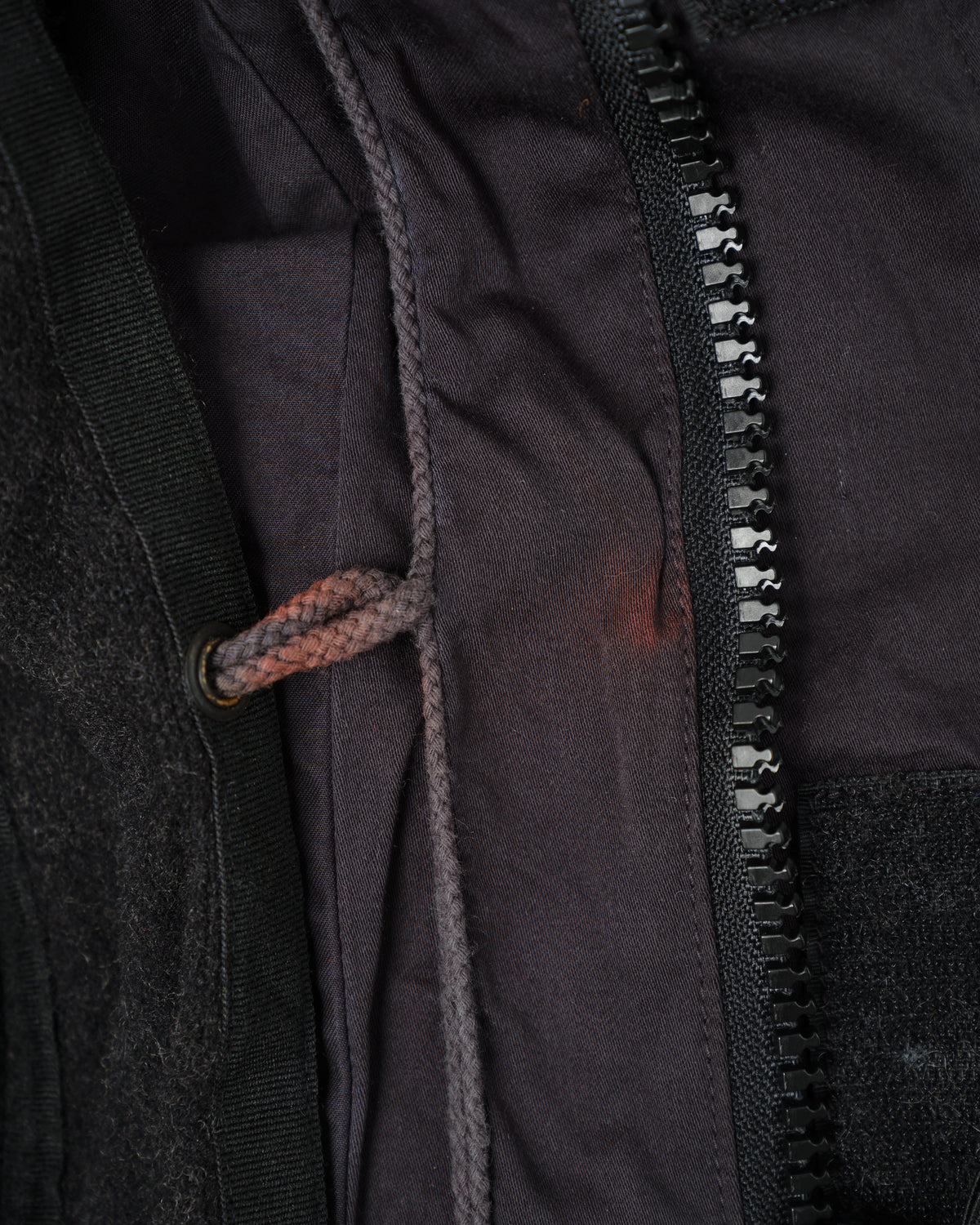
The removable liner with string attachment represents additional utility.
The liner, constructed from wool-blend material with brushed texture, transforms the jacket into a proper autumn-winter outer when installed, and performs equally as a lightweight transitional layer when removed.
The seasonal versatility this affords represents considerable practical value for wardrobe planning.
Size is marked "M"
This corresponds approximately to Japanese M to L sizing.
The measurements suggest a golden proportion for Japanese proportions, suiting a wide range of physiques.
Fading, discoloration, and signs of use are present, though no substantial damage impeding wear is evident, rendering it fully wearable.
A 1996 transition piece—after Massimo Osti withdrew from design, managed by his successor Paul Harvey—this example bears the Green Edge specification.
Though not from the Osti era proper, the refined simplicity characteristic of STONE ISLAND remains thoroughly intact.
Speaking quietly through material across the front, asserting archive legibly through the sleeve.
For those seeking STONE ISLAND that derives its authority from logic and tactile presence rather than graphic declaration, this represents an unqualified recommendation.
Equally suitable for active wardrobe or collection, this is a piece warranting serious regard.
For collectors devoted to STONE ISLAND, an exemplary acquisition. Those seeking such specimens should not overlook this opportunity.
![[97AW]Old STONE ISLAND Garment Dyed Cotton Jacket With Liner Size.M "RASO GOMMATO" "Green Edge"](http://vieuxetnouveau-shop.com/cdn/shop/files/202505030210.jpg?v=1766418431&width=2400)
![[97AW]Old STONE ISLAND Garment Dyed Cotton Jacket With Liner Size.M "RASO GOMMATO" "Green Edge"](http://vieuxetnouveau-shop.com/cdn/shop/files/202505030212.jpg?v=1766418432&width=2400)
![[97AW]Old STONE ISLAND Garment Dyed Cotton Jacket With Liner Size.M "RASO GOMMATO" "Green Edge"](http://vieuxetnouveau-shop.com/cdn/shop/files/202505030213.jpg?v=1766418431&width=2400)
![[97AW]Old STONE ISLAND Garment Dyed Cotton Jacket With Liner Size.M "RASO GOMMATO" "Green Edge"](http://vieuxetnouveau-shop.com/cdn/shop/files/DSCF1423_d8488300-5145-4801-8042-719f4d423540.jpg?v=1766418456&width=2400)
![[97AW]Old STONE ISLAND Garment Dyed Cotton Jacket With Liner Size.M "RASO GOMMATO" "Green Edge"](http://vieuxetnouveau-shop.com/cdn/shop/files/DSCF1424_e8174ff3-1e9d-4427-9382-f831aea894e9.jpg?v=1766418457&width=2400)
![[97AW]Old STONE ISLAND Garment Dyed Cotton Jacket With Liner Size.M "RASO GOMMATO" "Green Edge"](http://vieuxetnouveau-shop.com/cdn/shop/files/DSCF1425_9d50db80-31da-4007-9490-731ed4f2efb1.jpg?v=1766418456&width=2400)
![[97AW]Old STONE ISLAND Garment Dyed Cotton Jacket With Liner Size.M "RASO GOMMATO" "Green Edge"](http://vieuxetnouveau-shop.com/cdn/shop/files/DSCF1426_dd0e07e1-5117-4b2a-8739-ee764d0c3e80.jpg?v=1766418456&width=2400)
![[97AW]Old STONE ISLAND Garment Dyed Cotton Jacket With Liner Size.M "RASO GOMMATO" "Green Edge"](http://vieuxetnouveau-shop.com/cdn/shop/files/DSCF1427.jpg?v=1766418456&width=2400)
![[97AW]Old STONE ISLAND Garment Dyed Cotton Jacket With Liner Size.M "RASO GOMMATO" "Green Edge"](http://vieuxetnouveau-shop.com/cdn/shop/files/DSCF1428.jpg?v=1766418456&width=2400)
![[97AW]Old STONE ISLAND Garment Dyed Cotton Jacket With Liner Size.M "RASO GOMMATO" "Green Edge"](http://vieuxetnouveau-shop.com/cdn/shop/files/DSCF1430.jpg?v=1766418545&width=2400)
![[97AW]Old STONE ISLAND Garment Dyed Cotton Jacket With Liner Size.M "RASO GOMMATO" "Green Edge"](http://vieuxetnouveau-shop.com/cdn/shop/files/DSCF1429_ba9e6cc6-6269-4966-b99f-7a0e34db6dde.jpg?v=1766418545&width=2400)
![[97AW]Old STONE ISLAND Garment Dyed Cotton Jacket With Liner Size.M "RASO GOMMATO" "Green Edge"](http://vieuxetnouveau-shop.com/cdn/shop/files/DSCF1431_59cc0b48-4e72-4631-bec0-4cc5216d9152.jpg?v=1766418545&width=2400)
![[97AW]Old STONE ISLAND Garment Dyed Cotton Jacket With Liner Size.M "RASO GOMMATO" "Green Edge"](http://vieuxetnouveau-shop.com/cdn/shop/files/DSCF1435_a13f06b9-4d41-41b3-9ec4-86a2e3b77d33.jpg?v=1766418545&width=2400)
![[97AW]Old STONE ISLAND Garment Dyed Cotton Jacket With Liner Size.M "RASO GOMMATO" "Green Edge"](http://vieuxetnouveau-shop.com/cdn/shop/files/DSCF1433_123f3cf0-6cc1-48cc-ab6f-549379aca7ff.jpg?v=1766418545&width=2400)
![[97AW]Old STONE ISLAND Garment Dyed Cotton Jacket With Liner Size.M "RASO GOMMATO" "Green Edge"](http://vieuxetnouveau-shop.com/cdn/shop/files/DSCF1434_c372842a-8eb7-488b-b5a2-5c1a2dea7166.jpg?v=1766418545&width=2400)
![[97AW]Old STONE ISLAND Garment Dyed Cotton Jacket With Liner Size.M "RASO GOMMATO" "Green Edge"](http://vieuxetnouveau-shop.com/cdn/shop/files/DSCF1436_6a44d7fb-a240-4c7b-9d73-acf8af118228.jpg?v=1766418545&width=2400)
![[97AW]Old STONE ISLAND Garment Dyed Cotton Jacket With Liner Size.M "RASO GOMMATO" "Green Edge"](http://vieuxetnouveau-shop.com/cdn/shop/files/DSCF1437_ae35ffe5-d8bf-494a-bb4a-574f8f836620.jpg?v=1766418545&width=2400)
![[97AW]Old STONE ISLAND Garment Dyed Cotton Jacket With Liner Size.M "RASO GOMMATO" "Green Edge"](http://vieuxetnouveau-shop.com/cdn/shop/files/DSCF1440_8a86b6dc-3439-452d-a51e-d1aa0b40d04d.jpg?v=1766418545&width=2400)
![[97AW]Old STONE ISLAND Garment Dyed Cotton Jacket With Liner Size.M "RASO GOMMATO" "Green Edge"](http://vieuxetnouveau-shop.com/cdn/shop/files/DSCF1441_2104758b-292a-44a7-9fee-f7f4e87827f3.jpg?v=1766418545&width=2400)
![[97AW]Old STONE ISLAND Garment Dyed Cotton Jacket With Liner Size.M "RASO GOMMATO" "Green Edge"](http://vieuxetnouveau-shop.com/cdn/shop/files/DSCF1442_99659fcd-4f9c-4843-beda-8ecd4d971c97.jpg?v=1766418545&width=2400)
![[97AW]Old STONE ISLAND Garment Dyed Cotton Jacket With Liner Size.M "RASO GOMMATO" "Green Edge"](http://vieuxetnouveau-shop.com/cdn/shop/files/DSCF1443_a28fbc68-c581-4bda-ae09-a80509fdd001.jpg?v=1766418545&width=2400)
![[97AW]Old STONE ISLAND Garment Dyed Cotton Jacket With Liner Size.M "RASO GOMMATO" "Green Edge"](http://vieuxetnouveau-shop.com/cdn/shop/files/DSCF1439_8818fb67-bbd4-47d6-9aed-b5ba8caa9ce0.jpg?v=1766418545&width=2400)
![[97AW]Old STONE ISLAND Garment Dyed Cotton Jacket With Liner Size.M "RASO GOMMATO" "Green Edge"](http://vieuxetnouveau-shop.com/cdn/shop/files/DSCF1444_1a0c465f-404d-4565-8729-0294fdb8da68.jpg?v=1766418545&width=2400)
![[97AW]Old STONE ISLAND Garment Dyed Cotton Jacket With Liner Size.M "RASO GOMMATO" "Green Edge"](http://vieuxetnouveau-shop.com/cdn/shop/files/DSCF1663.jpg?v=1766418545&width=2400)
![[97AW]Old STONE ISLAND Garment Dyed Cotton Jacket With Liner Size.M "RASO GOMMATO" "Green Edge"](http://vieuxetnouveau-shop.com/cdn/shop/files/DSCF1664_94bffbb9-1041-4608-b7b2-6de8b40f083a.jpg?v=1766418545&width=2400)
![[97AW]Old STONE ISLAND Garment Dyed Cotton Jacket With Liner Size.M "RASO GOMMATO" "Green Edge"](http://vieuxetnouveau-shop.com/cdn/shop/files/DSCF1665_176cac1d-323e-4a66-ace1-262f72aa008b.jpg?v=1766418545&width=2400)
![[97AW]Old STONE ISLAND Garment Dyed Cotton Jacket With Liner Size.M "RASO GOMMATO" "Green Edge"](http://vieuxetnouveau-shop.com/cdn/shop/files/DSCF1666_625193f4-7368-41d8-b775-daeca0e35765.jpg?v=1766418545&width=2400)
![[97AW]Old STONE ISLAND Garment Dyed Cotton Jacket With Liner Size.M "RASO GOMMATO" "Green Edge"](http://vieuxetnouveau-shop.com/cdn/shop/files/DSCF1662.jpg?v=1766418545&width=2400)
![[97AW]Old STONE ISLAND Garment Dyed Cotton Jacket With Liner Size.M "RASO GOMMATO" "Green Edge"](http://vieuxetnouveau-shop.com/cdn/shop/files/DSCF1660_9aaf5f31-f497-4eb9-9b52-43c40a5fcd08.jpg?v=1766418545&width=2400)
![[97AW]Old STONE ISLAND Garment Dyed Cotton Jacket With Liner Size.M "RASO GOMMATO" "Green Edge"](http://vieuxetnouveau-shop.com/cdn/shop/files/DSCF1656_85007f2d-1eca-4535-a060-4ea78db23dbc.jpg?v=1766418545&width=2400)
![[97AW]Old STONE ISLAND Garment Dyed Cotton Jacket With Liner Size.M "RASO GOMMATO" "Green Edge"](http://vieuxetnouveau-shop.com/cdn/shop/files/DSCF1657_efe29467-7f3e-4622-aa57-905add7b2184.jpg?v=1766418545&width=2400)
![[97AW]Old STONE ISLAND Garment Dyed Cotton Jacket With Liner Size.M "RASO GOMMATO" "Green Edge"](http://vieuxetnouveau-shop.com/cdn/shop/files/DSCF1659_61385f6c-78f2-485b-8d85-c86f77114c04.jpg?v=1766418545&width=2400)
![[97AW]Old STONE ISLAND Garment Dyed Cotton Jacket With Liner Size.M "RASO GOMMATO" "Green Edge"](http://vieuxetnouveau-shop.com/cdn/shop/files/DSCF1670_a1aac31a-417f-44d4-8dd8-cd46a0cee13e.jpg?v=1766418545&width=2400)
![[97AW]Old STONE ISLAND Garment Dyed Cotton Jacket With Liner Size.M "RASO GOMMATO" "Green Edge"](http://vieuxetnouveau-shop.com/cdn/shop/files/DSCF1667.jpg?v=1766418545&width=2400)
![[97AW]Old STONE ISLAND Garment Dyed Cotton Jacket With Liner Size.M "RASO GOMMATO" "Green Edge"](http://vieuxetnouveau-shop.com/cdn/shop/files/DSCF1661_45f3691e-be9d-450e-9599-66deb550ee8c.jpg?v=1766418545&width=2400)
![[97AW]Old STONE ISLAND Garment Dyed Cotton Jacket With Liner Size.M "RASO GOMMATO" "Green Edge"](http://vieuxetnouveau-shop.com/cdn/shop/files/DSCF1668_a2071dc8-42c2-49da-a4bf-0cf346afeb05.jpg?v=1766418545&width=2400)
![[97AW]Old STONE ISLAND Garment Dyed Cotton Jacket With Liner Size.M "RASO GOMMATO" "Green Edge"](http://vieuxetnouveau-shop.com/cdn/shop/files/DSCF1669_846b75b8-4e6a-4724-99d8-ddd9acae99a7.jpg?v=1766418545&width=2400)