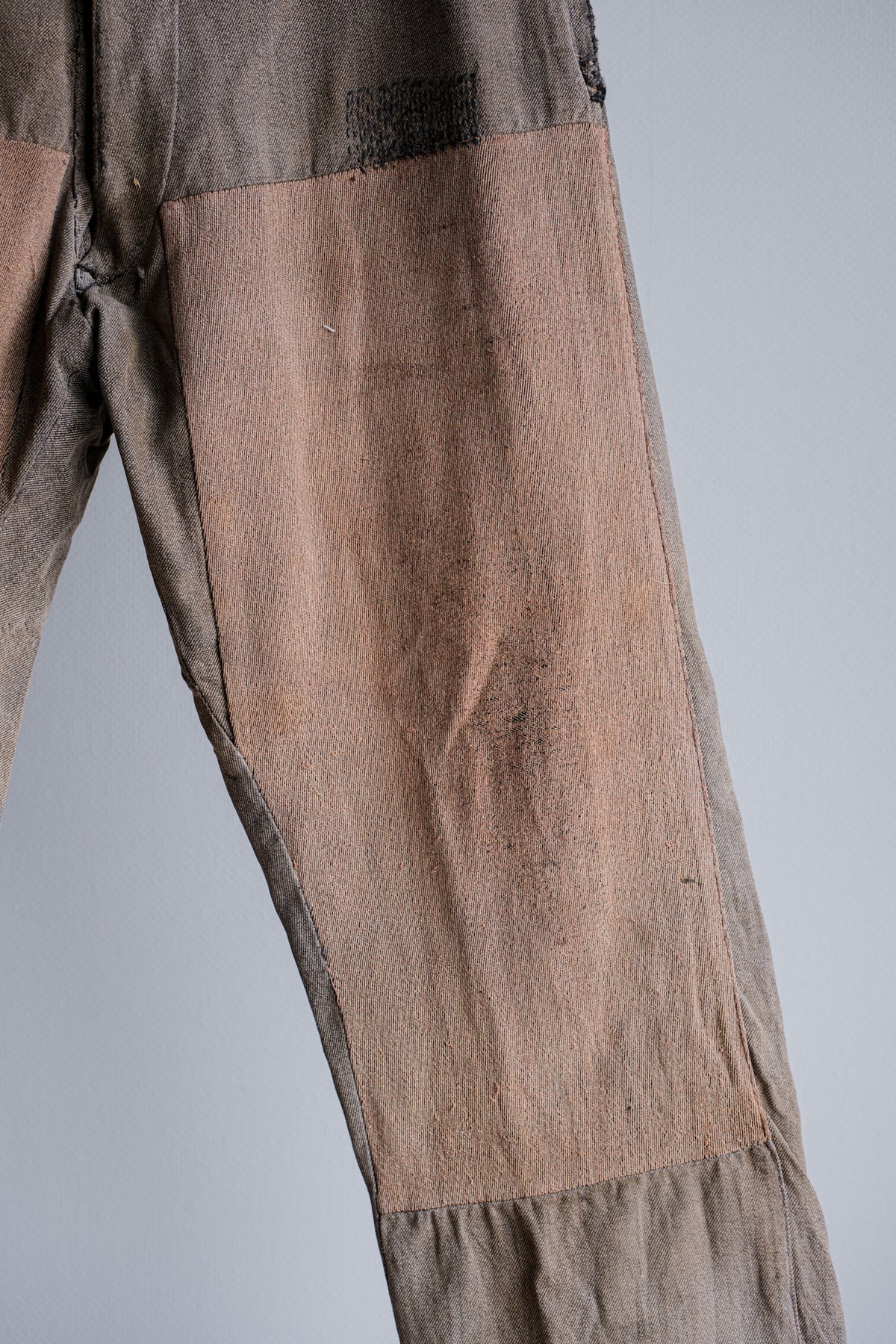
Circa 1910s, a pair of French-made "Brown Salt & Pepper Cotton Twill Work Pants."
A special arrival.
Work pants—an essential element of the French vintage aesthetic. These garments were widely worn as workwear by those laboring in French mines, factories, and farms of the era. The fabrics varied considerably depending on the working environment and historical period: cotton twill, moleskin, cotton piqué, corduroy, linen, and others.
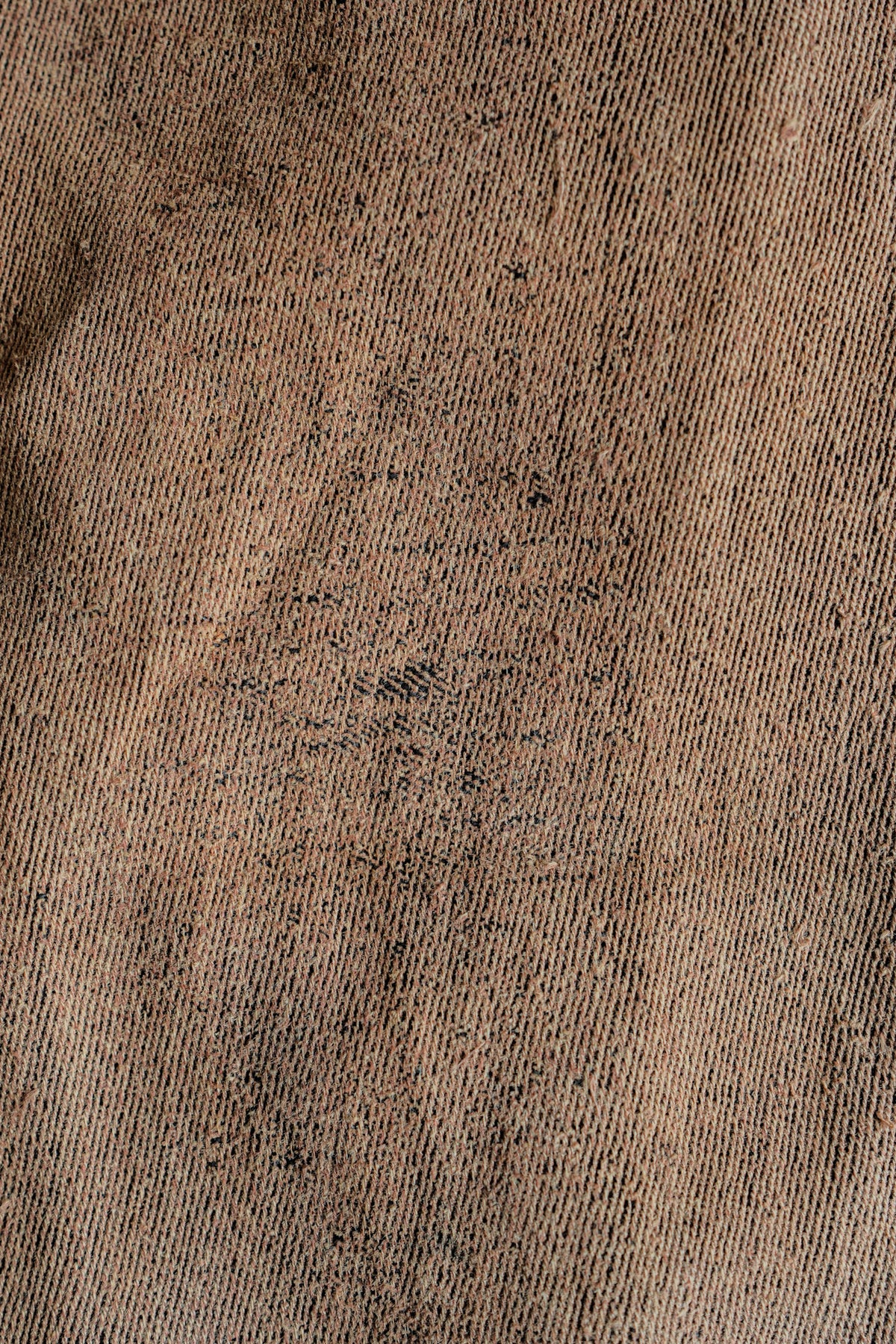
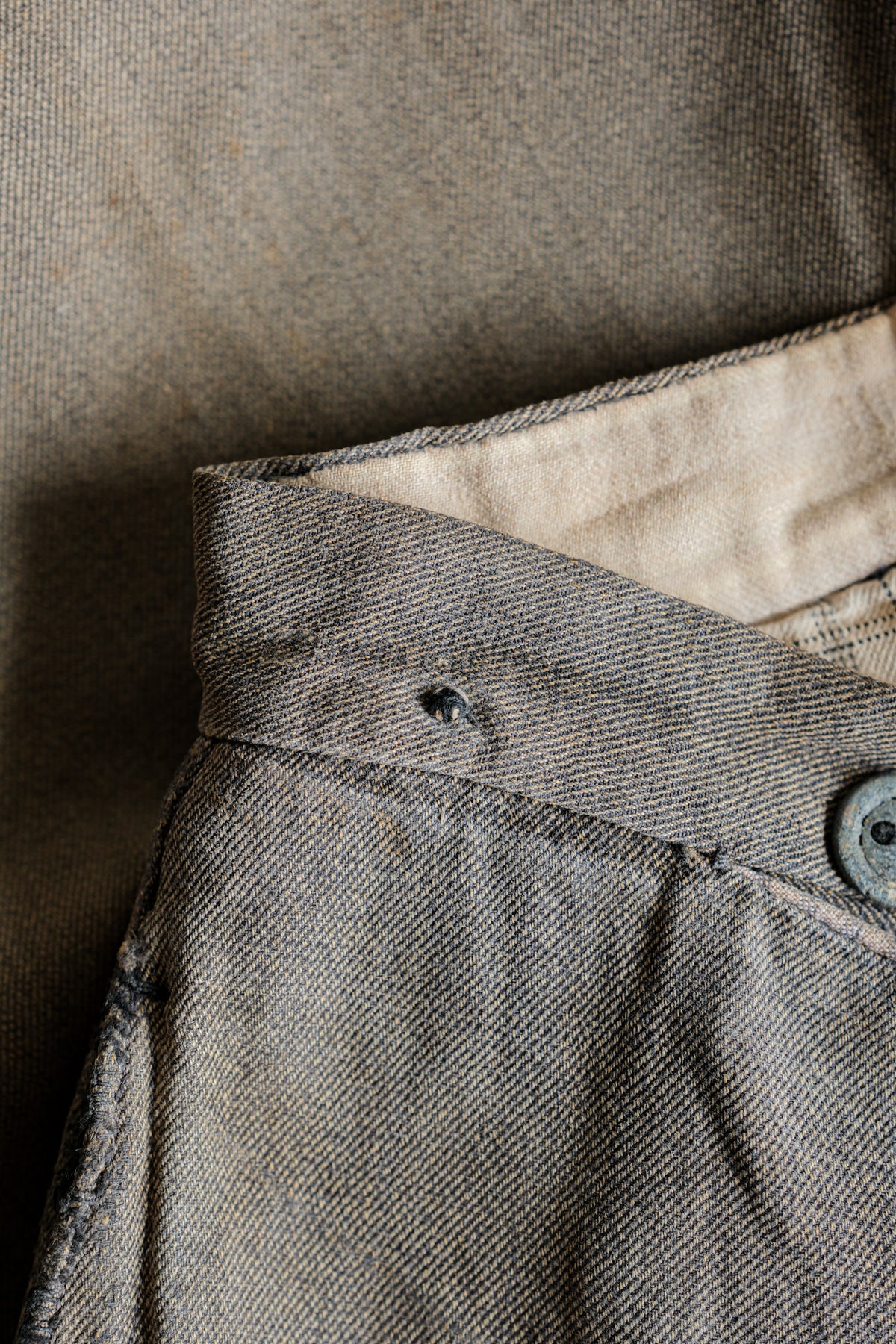
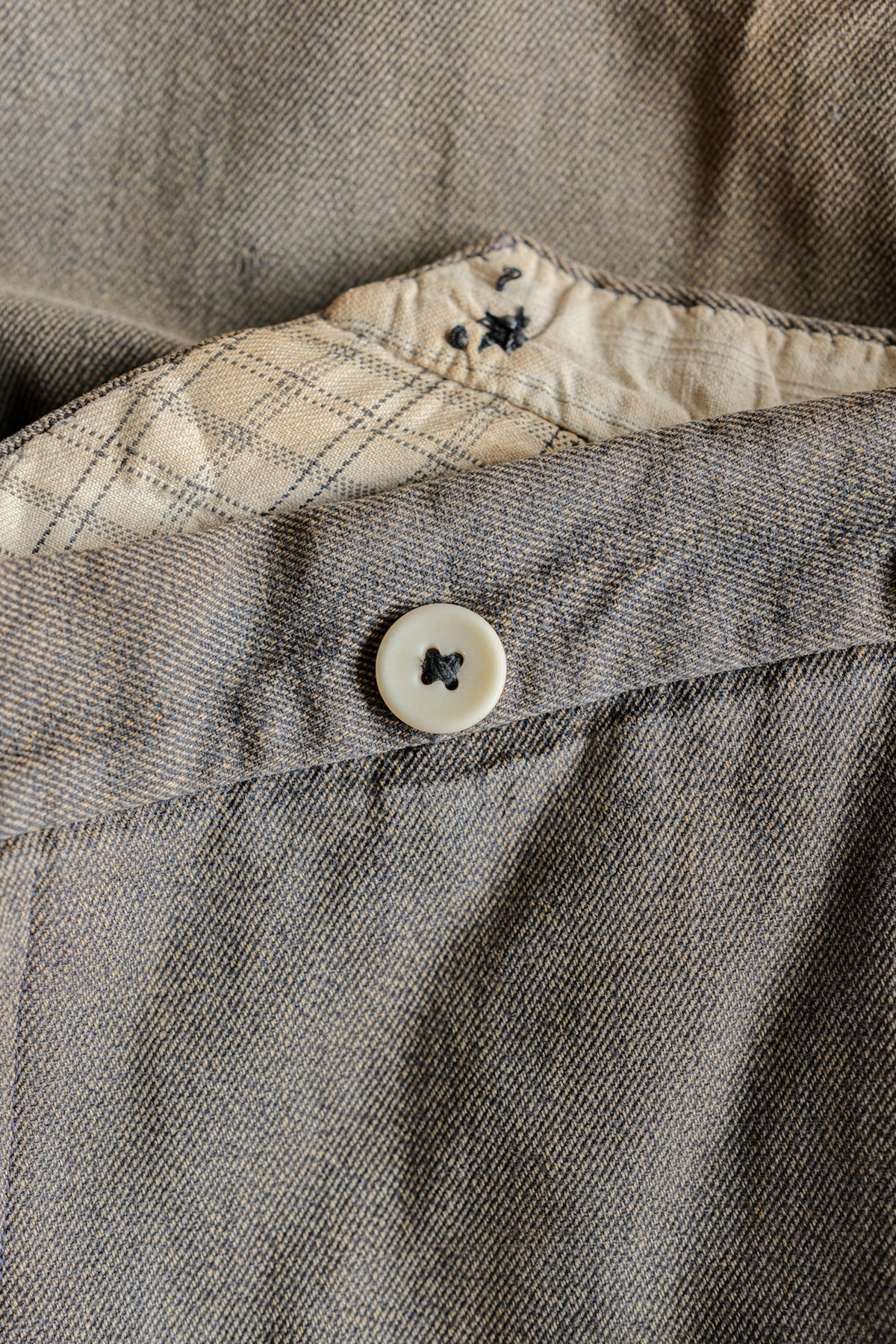
This particular pair is distinguished by the use of "Salt & Pepper" fabric—among the rarest weaves in French vintage workwear. The salt and pepper textile possesses the character of a brown chambray, its distinctive weave created by the intermingling of brown and grey threads. Such a fabric arrests the eye without question.
Within French workwear, chambray and salt & pepper fabrics command considerable regard. They remain difficult to locate—a scarcity that speaks to their desirability.
Where corduroy and wool limit the wearing season, cotton allows year-round wear. The versatility is evident.
The silhouette follows the manner of early-era work trousers: a straight cut that proves remarkably adaptable. This proportion elongates the leg and flatters diverse builds. It carries both modern directness and classical temperament, equally at home in formal or casual settings.
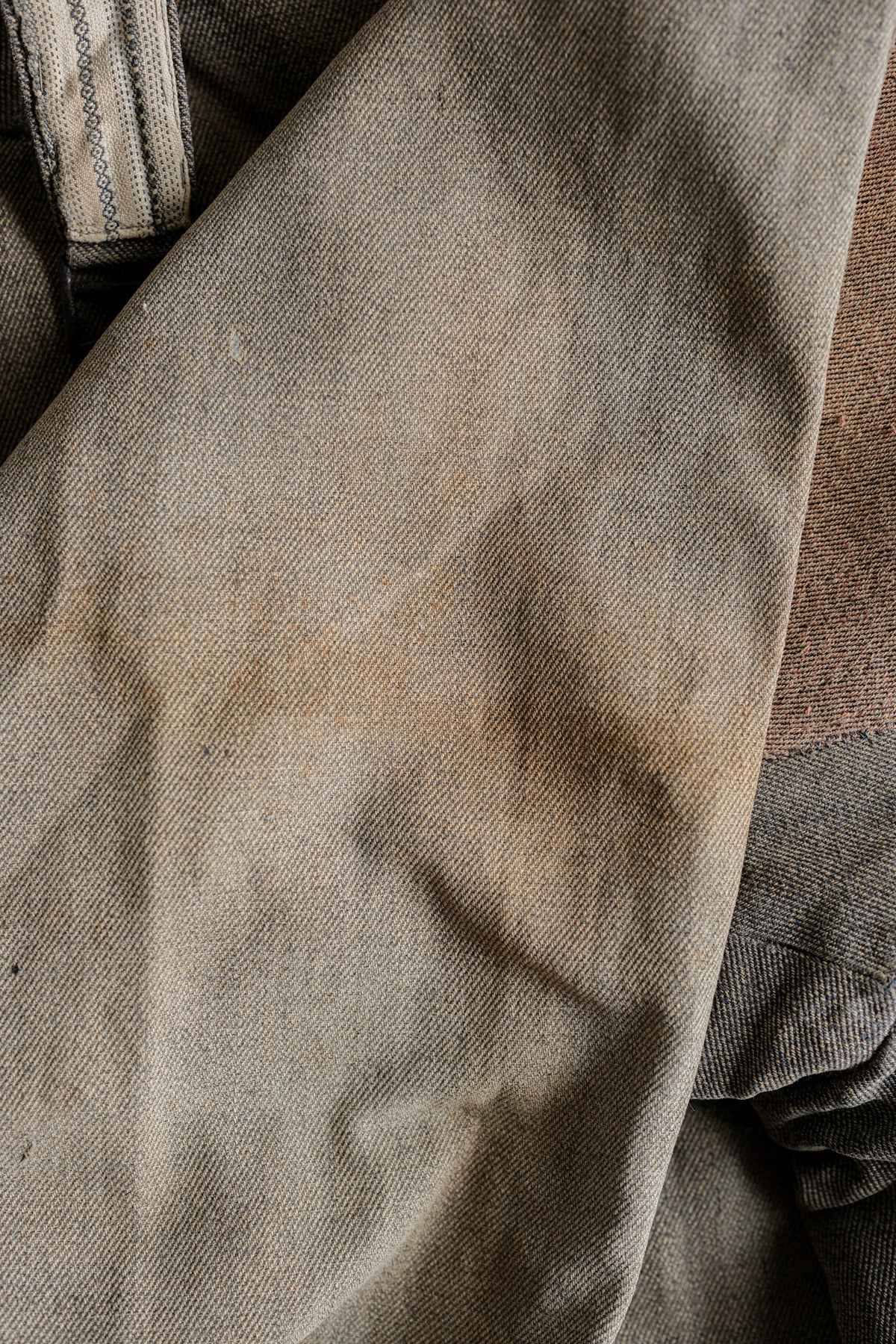
This pair lacks belt loops entirely. It was worn either suspended by braces or cinched at the back with a cinch strap. Note that one of the two front suspender buttons is absent—a replacement can be fitted according to your preference.
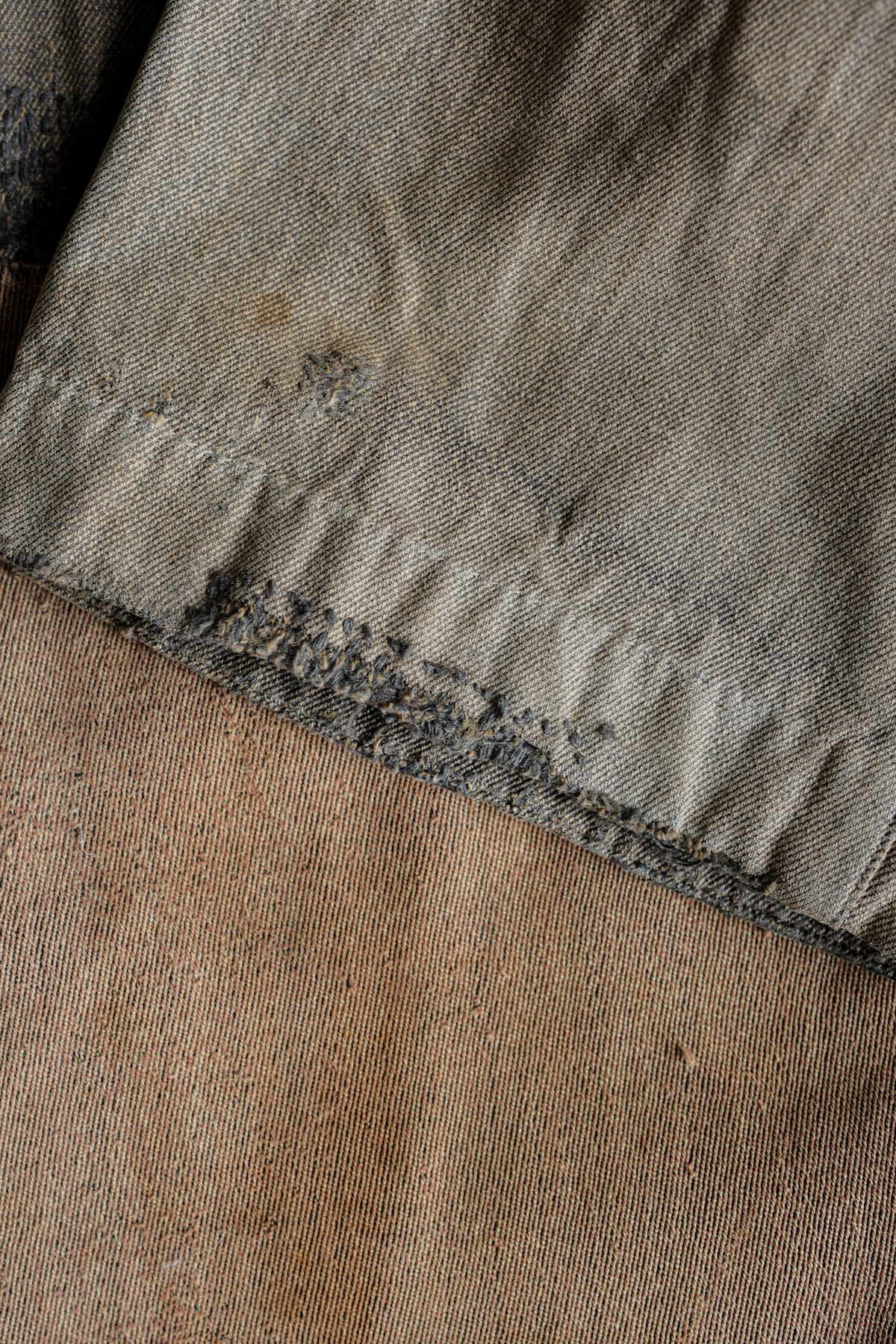
This is what might be called a "heavily worn" example. The original brown has faded through time into a tone approaching light grey—a patina earned through honest use.
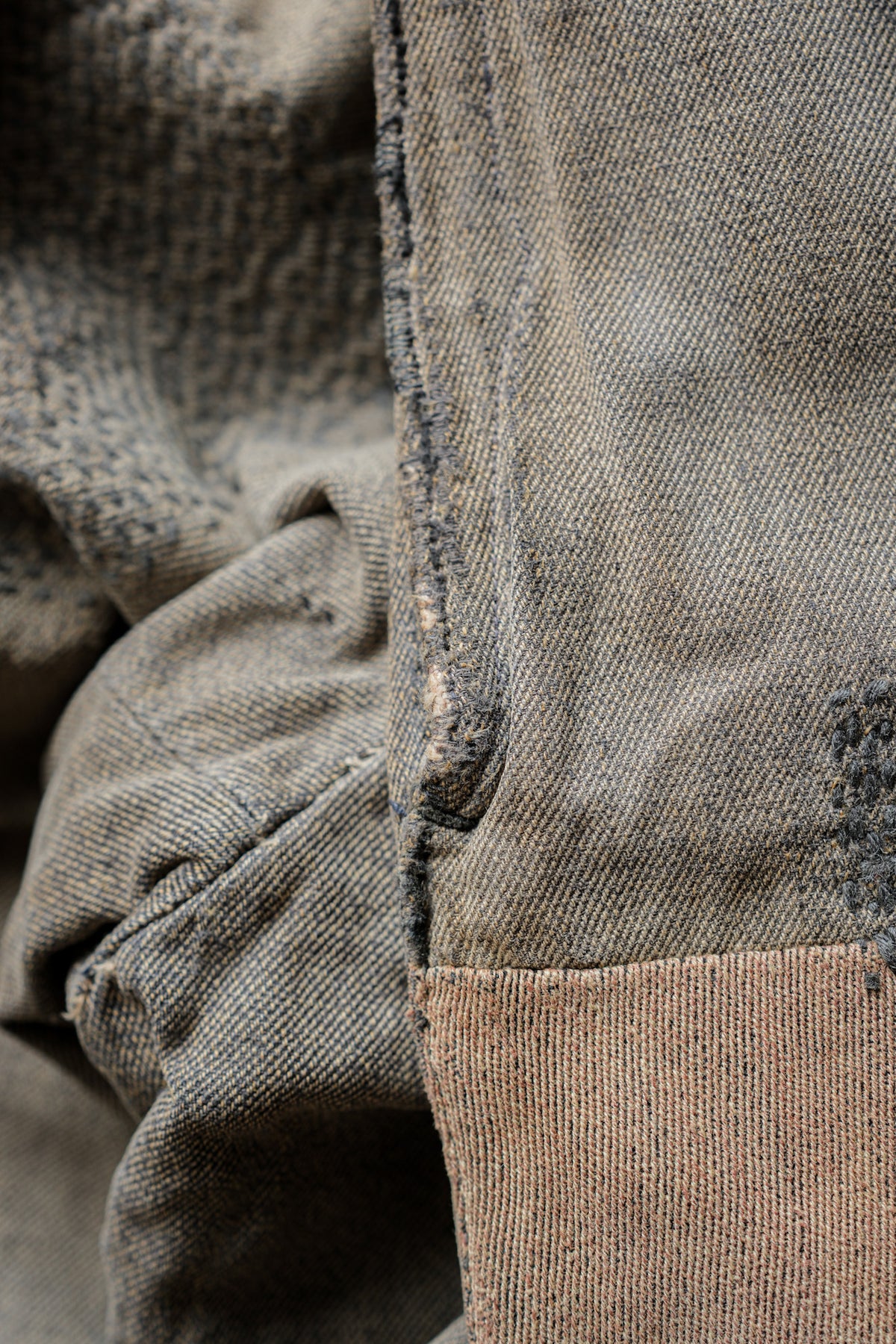
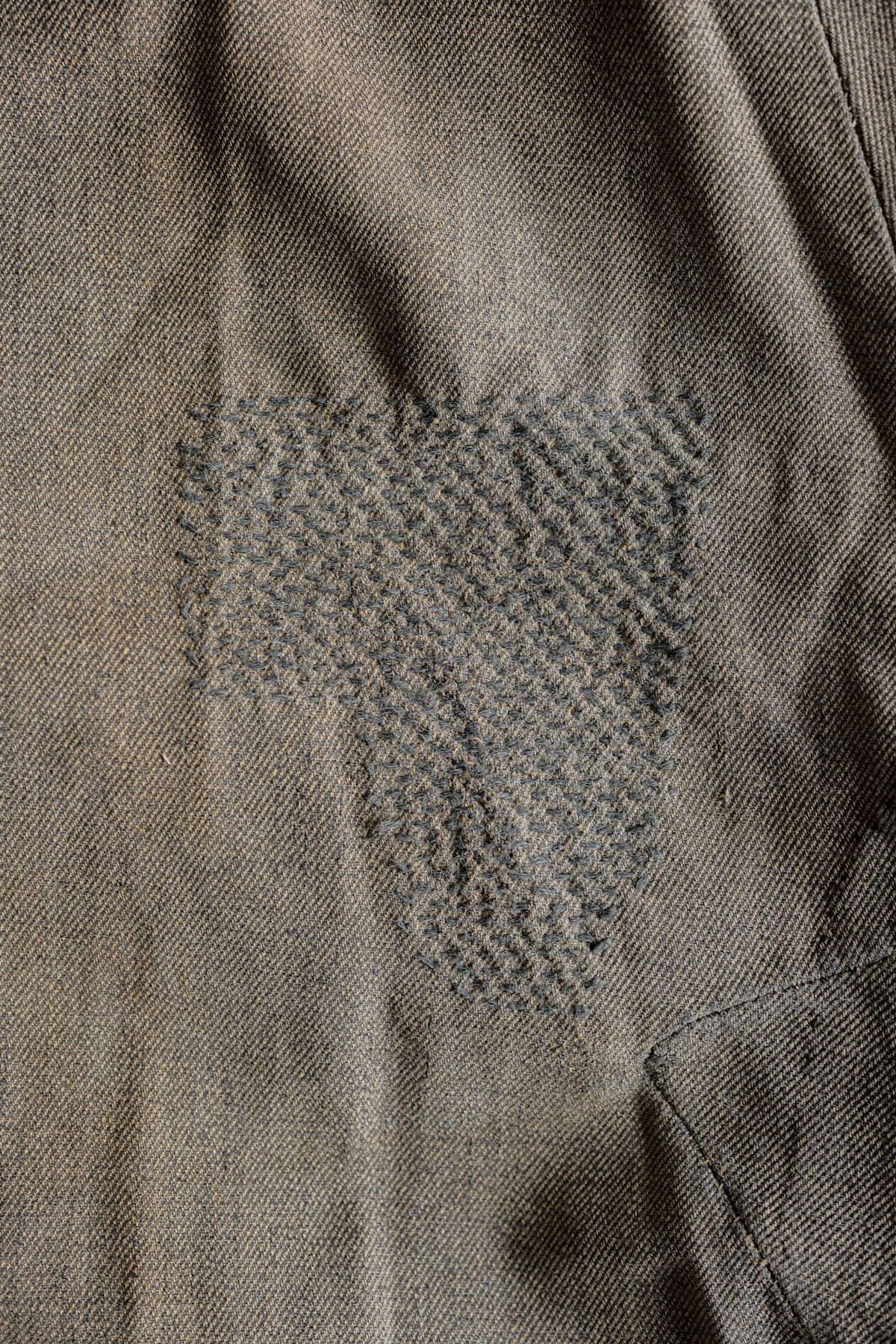
The entire garment bears witness to the rigorous labor and era from which it came: soiling, abrasion, fraying, and visible patchwork repairs in contrasting fabrics throughout.
The approach was not "repair a single garment and cherish it indefinitely" as modern practice might suggest, but rather the pragmatism of an earlier time. In an age where "mass production, mass disposal" now dominates discourse, this piece transmits something quietly profound: a lesson in stewardship of materials.
In an era when sewing machines remained uncommon, repairs were executed entirely by hand. Some may perceive a certain roughness in this work. Yet there is something deeply moving in recognizing that the thought and labor invested in these repairs remain present, made tangible across decades. It is beyond price.
This is a piece that will divide opinion—but we at VIEUX ET NOUVEAU believe such "authentic vintage" warrants greater attention going forward.
Deadstock examples in pristine condition possess their own appeal, certainly. But for those who wish to genuinely experience what vintage offers, we encourage you to engage with pieces such as this.
The addition of a single heavily worn piece to an otherwise refined wardrobe creates depth in proportion and suggests a refined sensibility.
No size marking is visible, though it appears to correspond to a Japanese S to M. Given the measurements, it represents a golden size for Japanese proportions—likely to suit a wide range of builds. The inseam runs somewhat short; those of greater height may embrace the cropped length.
The condition reflects comprehensive use: fading, soiling, abrasion, fraying, repair marks, missing buttons. Yet no damage exists that would impede wear. We encourage continued repair and use of this piece as it ages further.
Such heavily worn items hold little favor domestically, yet internationally they are actively sought and collected. This piece merits consideration both as functional wardrobe and as a collectible object.
No identical example exists. It is singular—an artwork in textile form. For those drawn to such pieces, this represents an opportunity not to be deferred.
ADD TO CART

![[~10's]French Antique Brown Salt & Pepper Cotton Twill Work Pants "Patchwork"](http://vieuxetnouveau-shop.com/cdn/shop/files/DSCF4777.jpg?v=1728497111&width=2400)
![[~10's]French Antique Brown Salt & Pepper Cotton Twill Work Pants "Patchwork"](http://vieuxetnouveau-shop.com/cdn/shop/files/DSCF4802.jpg?v=1728497111&width=2400)
![[~10's]French Antique Brown Salt & Pepper Cotton Twill Work Pants "Patchwork"](http://vieuxetnouveau-shop.com/cdn/shop/files/DSCF4787.jpg?v=1728497111&width=2400)
![[~10's]French Antique Brown Salt & Pepper Cotton Twill Work Pants "Patchwork"](http://vieuxetnouveau-shop.com/cdn/shop/files/DSCF4781.jpg?v=1728497111&width=2400)
![[~10's]French Antique Brown Salt & Pepper Cotton Twill Work Pants "Patchwork"](http://vieuxetnouveau-shop.com/cdn/shop/files/DSCF4803.jpg?v=1728497112&width=2400)
![[~10's]French Antique Brown Salt & Pepper Cotton Twill Work Pants "Patchwork"](http://vieuxetnouveau-shop.com/cdn/shop/files/DSCF4788.jpg?v=1728497111&width=2400)
![[~10's]French Antique Brown Salt & Pepper Cotton Twill Work Pants "Patchwork"](http://vieuxetnouveau-shop.com/cdn/shop/files/DSCF4782.jpg?v=1728497111&width=2400)
![[~10's]French Antique Brown Salt & Pepper Cotton Twill Work Pants "Patchwork"](http://vieuxetnouveau-shop.com/cdn/shop/files/DSCF4806.jpg?v=1728497111&width=2400)
![[~10's]French Antique Brown Salt & Pepper Cotton Twill Work Pants "Patchwork"](http://vieuxetnouveau-shop.com/cdn/shop/files/DSCF4783.jpg?v=1728497111&width=2400)
![[~10's]French Antique Brown Salt & Pepper Cotton Twill Work Pants "Patchwork"](http://vieuxetnouveau-shop.com/cdn/shop/files/DSCF4792.jpg?v=1728497112&width=2400)
![[~10's]French Antique Brown Salt & Pepper Cotton Twill Work Pants "Patchwork"](http://vieuxetnouveau-shop.com/cdn/shop/files/DSCF4795.jpg?v=1728497112&width=2400)
![[~10's]French Antique Brown Salt & Pepper Cotton Twill Work Pants "Patchwork"](http://vieuxetnouveau-shop.com/cdn/shop/files/DSCF4800.jpg?v=1728497111&width=2400)
![[~10's]French Antique Brown Salt & Pepper Cotton Twill Work Pants "Patchwork"](http://vieuxetnouveau-shop.com/cdn/shop/files/DSCF4804.jpg?v=1728497111&width=2400)
![[~10's]French Antique Brown Salt & Pepper Cotton Twill Work Pants "Patchwork"](http://vieuxetnouveau-shop.com/cdn/shop/files/DSCF4797.jpg?v=1728497111&width=2400)
![[~10's]French Antique Brown Salt & Pepper Cotton Twill Work Pants "Patchwork"](http://vieuxetnouveau-shop.com/cdn/shop/files/DSCF4790.jpg?v=1728497111&width=2400)
![[~10's]French Antique Brown Salt & Pepper Cotton Twill Work Pants "Patchwork"](http://vieuxetnouveau-shop.com/cdn/shop/files/DSCF4791.jpg?v=1728497112&width=2400)
![[~10's]French Antique Brown Salt & Pepper Cotton Twill Work Pants "Patchwork"](http://vieuxetnouveau-shop.com/cdn/shop/files/DSCF4789.jpg?v=1728497111&width=2400)
![[~10's]French Antique Brown Salt & Pepper Cotton Twill Work Pants "Patchwork"](http://vieuxetnouveau-shop.com/cdn/shop/files/DSCF4785.jpg?v=1728497111&width=2400)
![[~10's]French Antique Brown Salt & Pepper Cotton Twill Work Pants "Patchwork"](http://vieuxetnouveau-shop.com/cdn/shop/files/DSCF5505.jpg?v=1728497113&width=2400)
![[~10's]French Antique Brown Salt & Pepper Cotton Twill Work Pants "Patchwork"](http://vieuxetnouveau-shop.com/cdn/shop/files/DSCF5507.jpg?v=1728497112&width=2400)
![[~10's]French Antique Brown Salt & Pepper Cotton Twill Work Pants "Patchwork"](http://vieuxetnouveau-shop.com/cdn/shop/files/DSCF5508.jpg?v=1728497113&width=2400)
![[~10's]French Antique Brown Salt & Pepper Cotton Twill Work Pants "Patchwork"](http://vieuxetnouveau-shop.com/cdn/shop/files/DSCF5509.jpg?v=1728497113&width=2400)
![[~10's]French Antique Brown Salt & Pepper Cotton Twill Work Pants "Patchwork"](http://vieuxetnouveau-shop.com/cdn/shop/files/DSCF5510.jpg?v=1728497113&width=2400)
![[~10's]French Antique Brown Salt & Pepper Cotton Twill Work Pants "Patchwork"](http://vieuxetnouveau-shop.com/cdn/shop/files/DSCF5511.jpg?v=1728497113&width=2400)
![[~10's]French Antique Brown Salt & Pepper Cotton Twill Work Pants "Patchwork"](http://vieuxetnouveau-shop.com/cdn/shop/files/DSCF5512.jpg?v=1728497113&width=2400)
![[~10's]French Antique Brown Salt & Pepper Cotton Twill Work Pants "Patchwork"](http://vieuxetnouveau-shop.com/cdn/shop/files/DSCF5528.jpg?v=1728497112&width=2400)