A black indigo linen maquignon coat, made in France, which we date to around the 1940s.
A special piece has come in.
A maquignon, in French, is a livestock dealer — and particularly a man who buys and sells horses.
Walking the markets, looking over a horse's legs, setting a price and counting out notes on the spot. It was as their working garment that this long coat was born.
Which is why this coat carries a construction found in nothing else — but more on that shortly.
What surprised me first was the colour.
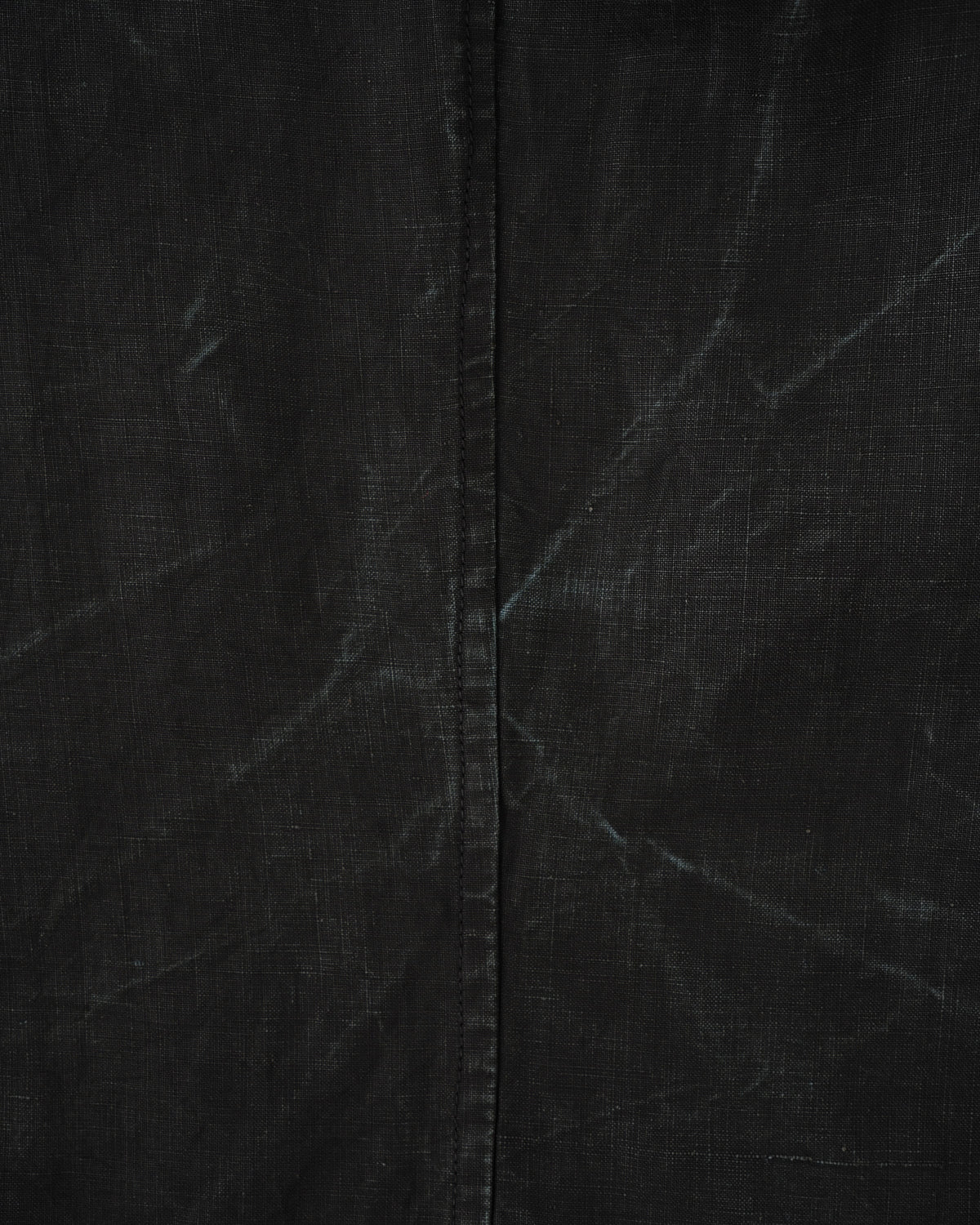
Black linen, or indigo linen? Even holding it and comparing for some while, it remains so deep that one cannot tell.
Linen of this period has usually faded well towards grey. And yet this is still so black.
The reason may lie on the inside.
A circular lion's face, embroidered in gold thread on a black ground. Beside it, "TEINTURE GARANTIE" and "GRAND TEINT", and in script, "Marque LION(DÉPOSÉE)".
— Dye guaranteed, fast-dyed, the Lion mark (registered trademark).
This is not the maker's mark but the dyer's guarantee.
Eighty years ago, whoever dyed this cloth promised that the colour would not run. And that promise is being kept to this day. Pieces where a single label holds a story of such persuasive force are not often met with.
Now, let us look at the details.
The collar is a lapel type, the most common specification on a maquignon coat.
This piece, however, can be fastened all the way to the top.
Worn open, it takes a neat expression drawn from tailoring; fastened, it turns severe. One button, and the whole personality of the coat changes over.
At the left breast, two pockets sit side by side.
The narrow one is a scissor pocket — a tall, vertical opening for slipping in shears or writing implements — with an ordinary patch pocket beside it. A genuinely lucid design for keeping tools and personal effects apart.
And then the waist. Here lies the heart of the maquignon coat.
Large D-shaped patch pockets sit left and right, and alongside each, another vertical slit is cut independently.
These are through pockets: a construction that lets you reach the pockets of the garment beneath without taking the coat off.
Price a horse at market, and produce money from your inside pocket on the spot. No need to open the front of the coat.
A livestock dealer's day is inscribed, as design, in this one slit.
The silhouette is an elegant A-line.
The hem opens widely against the chest, so it sways with every step.
The material is 100% linen.
It has that drape peculiar to French linen, which seems to quiver as it moves. Stiffness and softness live together in it, and lifted, the cloth undulates.
Look closely and the yarn is not uniform in thickness, with slubs rising irregularly. After eighty years, strength still remains in the fibre.
Because the cloth of this pattern is thin, the majority of surviving pieces carry tears or damage. Most maquignon coats one meets on the market have a repair somewhere.
Among them, this piece — fading aside — holds a distinctly good overall condition.
And this cloth has growing left in it.
Precisely because indigo remains, there is room for colour still to go. White will rise little by little at the sleeves and front edge, and the creases of wear will settle into their places.
A piece whose colour you can take down with your own hands from this state is, in fact, rather a luxury.
The colour is "black indigo".
Seen head-on it appears almost black. Catch the light at an angle, however, and indigo seeps out from within.
And along the creases, white fading runs like frost. It is the way this white enters that turns a merely black cloth into a cloth that has aged.
What is interesting is that rubbed areas take on a faint green. A phenomenon particular to dyeing where indigo and black are layered, the hue shifts with the angle.
Being close to black, it can be used without regard for what colours you put with it.
A white shirt and trousers alone should give you an outfit with a quiet tension.
Bring white underneath and it becomes an accent showing at the open neck. Conversely, unify everything in black and let the difference of materials alone create the shadows — that too is beautiful.
And do not forget to try wearing it fastened to the very top.
The lapel disappears, the neck closes, and the silhouette becomes a single vertical line. An expression appears that you would not take for the same coat, so please enjoy both.
There is no size marking, but I should say it corresponds to roughly a Japanese "M to L".
The balance makes it easy to handle as an outer layer, and the length falls around above the knee, which together with the A-line flare gives a vertical flow to how you stand.
There are marks of use — fading particular to the cloth, small holes — but no damage that would affect wearing, so there is plenty of life in it yet.
A maquignon coat tailored in black or indigo linen. Even for us, chances to take in a piece in this cloth are not many.
The good condition. The interest of the through-pocket construction, which the maquignon's trade made inevitable. And that dyer's lion.
Had any one of these been missing, I do not think I would have been drawn in this far. It is because everything is present that this coat is what it is.
I should add that the dyer's system itself — guaranteeing fast natural-indigo dyeing under a registered trademark — no longer exists.
With the move to chemical dyes, the trade that took responsibility for colour vanished from the industry. To dye the same cloth today is therefore impossible not for want of technique, but as a matter of the system itself.
The colour will not run, the dyer wrote.
That I should find myself verifying those words eighty years later strikes me as slightly comic. I should like to entrust that act of verification to the next owner.
![[~40’s] French Vintage Black Indigo Linen Maquignon Coat](http://vieuxetnouveau-shop.com/cdn/shop/files/C0186-1_35dfb1de-f962-42f5-b492-73b968a7e656.jpg?v=1786431891&width=2400)
![[~40’s] French Vintage Black Indigo Linen Maquignon Coat](http://vieuxetnouveau-shop.com/cdn/shop/files/C0186-2_df0a2be3-327d-42bf-8fd9-19a2919e9dc7.jpg?v=1786431891&width=2400)
![[~40’s] French Vintage Black Indigo Linen Maquignon Coat](http://vieuxetnouveau-shop.com/cdn/shop/files/C0186-3_2aaf2e10-cafa-4ef3-940d-9f3146ce66dc.jpg?v=1786431891&width=2400)
![[~40’s] French Vintage Black Indigo Linen Maquignon Coat](http://vieuxetnouveau-shop.com/cdn/shop/files/C0186-4_ab0f024f-8d48-4566-8a99-352e1ddd2315.jpg?v=1786431891&width=2400)
![[~40’s] French Vintage Black Indigo Linen Maquignon Coat](http://vieuxetnouveau-shop.com/cdn/shop/files/C0186-5_2273f877-822c-4ccd-a770-0db75c420184.jpg?v=1786431891&width=2400)
![[~40’s] French Vintage Black Indigo Linen Maquignon Coat](http://vieuxetnouveau-shop.com/cdn/shop/files/C0186-6_ee9f4810-a2e7-4858-b2a8-47df1d60c0b8.jpg?v=1786431891&width=2400)
![[~40’s] French Vintage Black Indigo Linen Maquignon Coat](http://vieuxetnouveau-shop.com/cdn/shop/files/C0186-7_17de77fb-8be4-4eee-aa46-51824a1b365d.jpg?v=1786431891&width=2400)
![[~40’s] French Vintage Black Indigo Linen Maquignon Coat](http://vieuxetnouveau-shop.com/cdn/shop/files/C0186-8_5b2ea7fb-edde-444f-82f0-5b77b7ea6edd.jpg?v=1786431891&width=2400)
![[~40’s] French Vintage Black Indigo Linen Maquignon Coat](http://vieuxetnouveau-shop.com/cdn/shop/files/C0186-9_d05efb97-9341-47f9-8265-04749650b00c.jpg?v=1786431891&width=2400)
![[~40’s] French Vintage Black Indigo Linen Maquignon Coat](http://vieuxetnouveau-shop.com/cdn/shop/files/C0186-10_5242816c-145e-4a57-b3ea-afa807567491.jpg?v=1786431891&width=2400)
![[~40’s] French Vintage Black Indigo Linen Maquignon Coat](http://vieuxetnouveau-shop.com/cdn/shop/files/C0186-11_3c480363-a11f-45b2-84f3-1f8278765528.jpg?v=1786431891&width=2400)
![[~40’s] French Vintage Black Indigo Linen Maquignon Coat](http://vieuxetnouveau-shop.com/cdn/shop/files/C0186-12_112b8d2a-0943-4ac0-93b0-57cc27ca993f.jpg?v=1786431891&width=2400)
![[~40’s] French Vintage Black Indigo Linen Maquignon Coat](http://vieuxetnouveau-shop.com/cdn/shop/files/C0186-13_028a5882-3f5c-44e0-a36a-44e524ac4f3a.jpg?v=1786431891&width=2400)
![[~40’s] French Vintage Black Indigo Linen Maquignon Coat](http://vieuxetnouveau-shop.com/cdn/shop/files/C0186-14_f9ba7b73-4e83-45e4-a2fa-8161fe9b0527.jpg?v=1786431891&width=2400)
![[~40’s] French Vintage Black Indigo Linen Maquignon Coat](http://vieuxetnouveau-shop.com/cdn/shop/files/C0186-15_5c6e9c04-6888-4d94-84d6-49824b569823.jpg?v=1786431891&width=2400)
![[~40’s] French Vintage Black Indigo Linen Maquignon Coat](http://vieuxetnouveau-shop.com/cdn/shop/files/C0186-16_a7868fef-aaf4-4a60-9cf3-69d18d3a9267.jpg?v=1786431891&width=2400)
![[~40’s] French Vintage Black Indigo Linen Maquignon Coat](http://vieuxetnouveau-shop.com/cdn/shop/files/C0186-17_3cd97c18-e014-42b5-8579-7ed5a94d42f5.jpg?v=1786431891&width=2400)
![[~40’s] French Vintage Black Indigo Linen Maquignon Coat](http://vieuxetnouveau-shop.com/cdn/shop/files/C0186-18_c78bb868-7201-46b5-b322-057bd38206a2.jpg?v=1786431891&width=2400)
![[~40’s] French Vintage Black Indigo Linen Maquignon Coat](http://vieuxetnouveau-shop.com/cdn/shop/files/C0186-19_4f533f74-733c-41bb-995b-d5c855973497.jpg?v=1786431891&width=2400)
![[~40’s] French Vintage Black Indigo Linen Maquignon Coat](http://vieuxetnouveau-shop.com/cdn/shop/files/C0186-20_4153b104-58a7-4d52-beca-bac8b03df0a3.jpg?v=1786431891&width=2400)
![[~40’s] French Vintage Black Indigo Linen Maquignon Coat](http://vieuxetnouveau-shop.com/cdn/shop/files/C0186-21_b57fea7e-d68b-44ae-a091-6033c10d4973.jpg?v=1786431891&width=2400)
![[~40’s] French Vintage Black Indigo Linen Maquignon Coat](http://vieuxetnouveau-shop.com/cdn/shop/files/C0186-22_e42596b6-5911-4ff8-b0c7-32677b078c1b.jpg?v=1786431891&width=2400)
![[~40’s] French Vintage Black Indigo Linen Maquignon Coat](http://vieuxetnouveau-shop.com/cdn/shop/files/C0186-23_0393ef3e-68db-4065-b35d-9c4bab14608d.jpg?v=1786431891&width=2400)
![[~40’s] French Vintage Black Indigo Linen Maquignon Coat](http://vieuxetnouveau-shop.com/cdn/shop/files/C0186-24_62f1859d-f4ea-4185-8164-b85055cad786.jpg?v=1786431891&width=2400)
![[~40’s] French Vintage Black Indigo Linen Maquignon Coat](http://vieuxetnouveau-shop.com/cdn/shop/files/C0186-25_84f0e19a-51bf-4bc8-a91c-29fe42aee710.jpg?v=1786431891&width=2400)
![[~40’s] French Vintage Black Indigo Linen Maquignon Coat](http://vieuxetnouveau-shop.com/cdn/shop/files/C0186-26_f2c5fb3b-85c5-4768-9b99-6f40553f488c.jpg?v=1786431891&width=2400)
![[~40’s] French Vintage Black Indigo Linen Maquignon Coat](http://vieuxetnouveau-shop.com/cdn/shop/files/C0186-27_9a92216b-7c86-4cd0-a41e-4577c8ca4a84.jpg?v=1786431891&width=2400)
![[~40’s] French Vintage Black Indigo Linen Maquignon Coat](http://vieuxetnouveau-shop.com/cdn/shop/files/C0186-28_1f0d3d1d-9099-4739-bc13-914dc655c73b.jpg?v=1786431891&width=2400)
![[~40’s] French Vintage Black Indigo Linen Maquignon Coat](http://vieuxetnouveau-shop.com/cdn/shop/files/C0186-29_96c05857-84fe-4871-ae6a-9d562167a13e.jpg?v=1786431891&width=2400)