A Gebirgsjäger Mountain Troops Windjacke from the Wehrmacht, estimated circa 1940s.
A truly exceptional arrival.
The Wehrmacht—the unified armed forces of Nazi Germany spanning 1935 to 1945—comprised three branches: the Heer (Army), Kriegsmarine (Navy), and Luftwaffe (Air Force).
The name Wehrmacht replaced the earlier "Reichswehr," reflecting the Nazi regime's efforts to rearm Germany beyond the limits permitted by the Treaty of Versailles.
Following Adolf Hitler's seizure of power in 1933, the establishment of the Wehrmacht represented one of his most audacious and explicit actions.
Following Germany's unconditional surrender on May 8, 1945, Allied occupation commenced and the Wehrmacht underwent systematic dissolution.
In the wake of the Wehrmacht's dissolution, Germany became a nation without military forces. The subsequent rearmament of both West Germany (the Federal Republic) and East Germany (the Democratic Republic) proceeded independently within the context of the Cold War.
These new military organizations were intentionally constituted as separate from Wehrmacht traditions and structure.
We present the "Gebirgsjäger Mountain Troops Windjacke"—a piece issued to and worn by alpine units of the German military as cold-weather and wind-resistant outerwear throughout the Second World War.
Gebirgsjäger (mountain rifleman) denotes the alpine infantryman in German and Austrian military nomenclature, a compound derived from "Gebirge" (mountain) and "Jäger" (rifleman).
This specimen represents the predecessor to the later-adopted "M42 Gebirgsjäger Reversible Windbluse," and ranks among the most sought-after items in the Wehrmacht archive.
Depending on production year and individual variation, the color may shift subtly, though the piece is constructed of densely-woven sage green cotton canvas—a rational material choice perfectly suited to alpine operations.
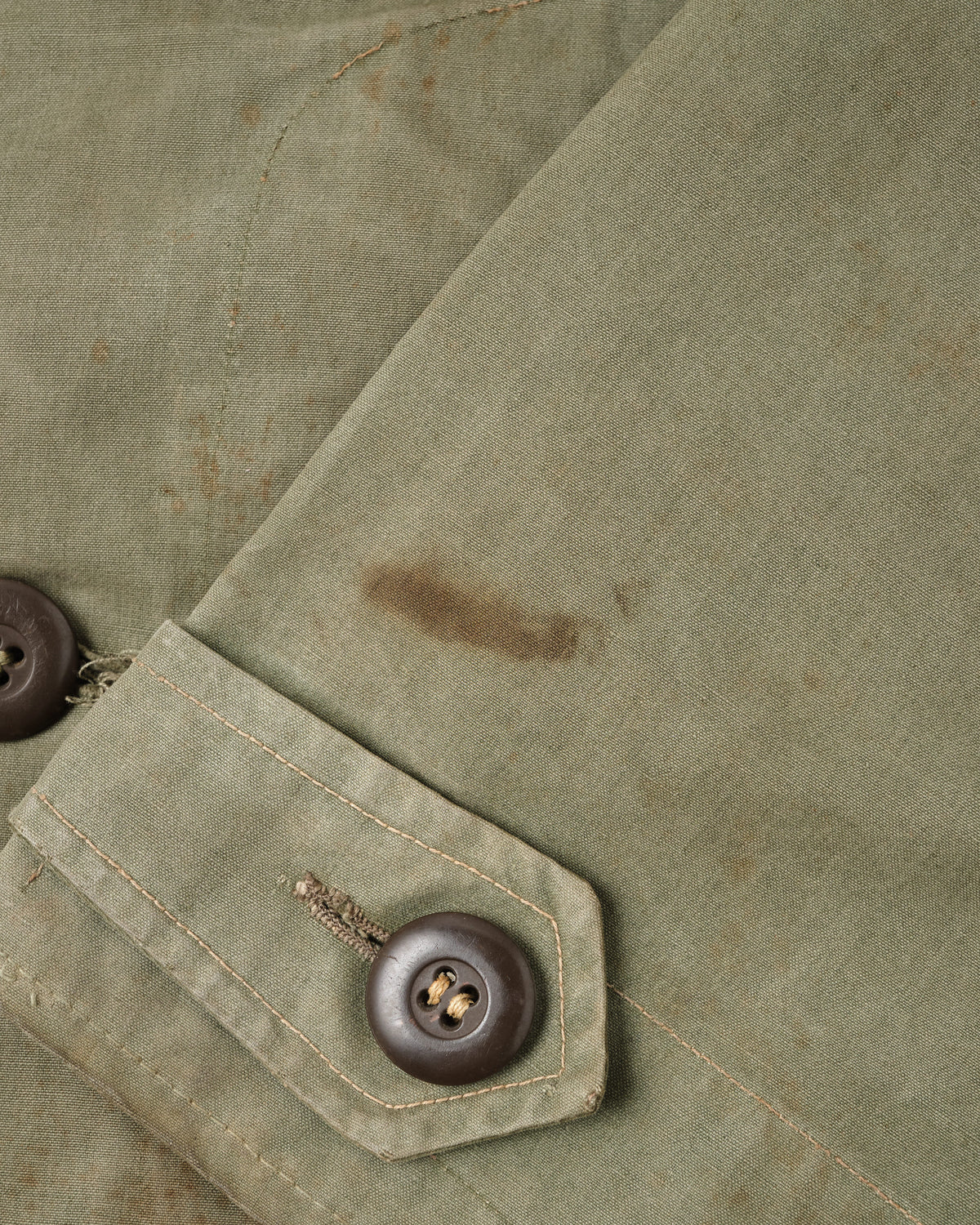
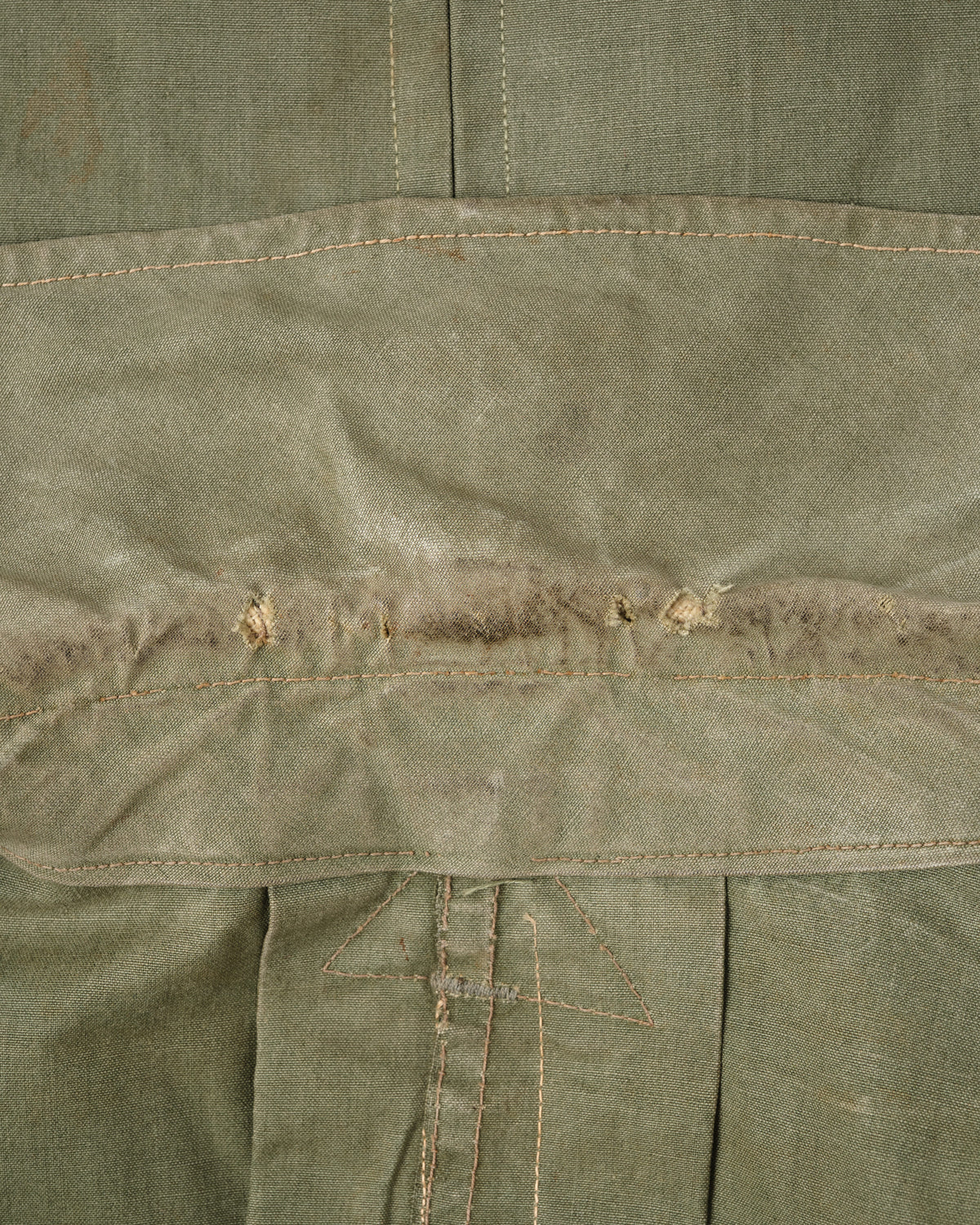
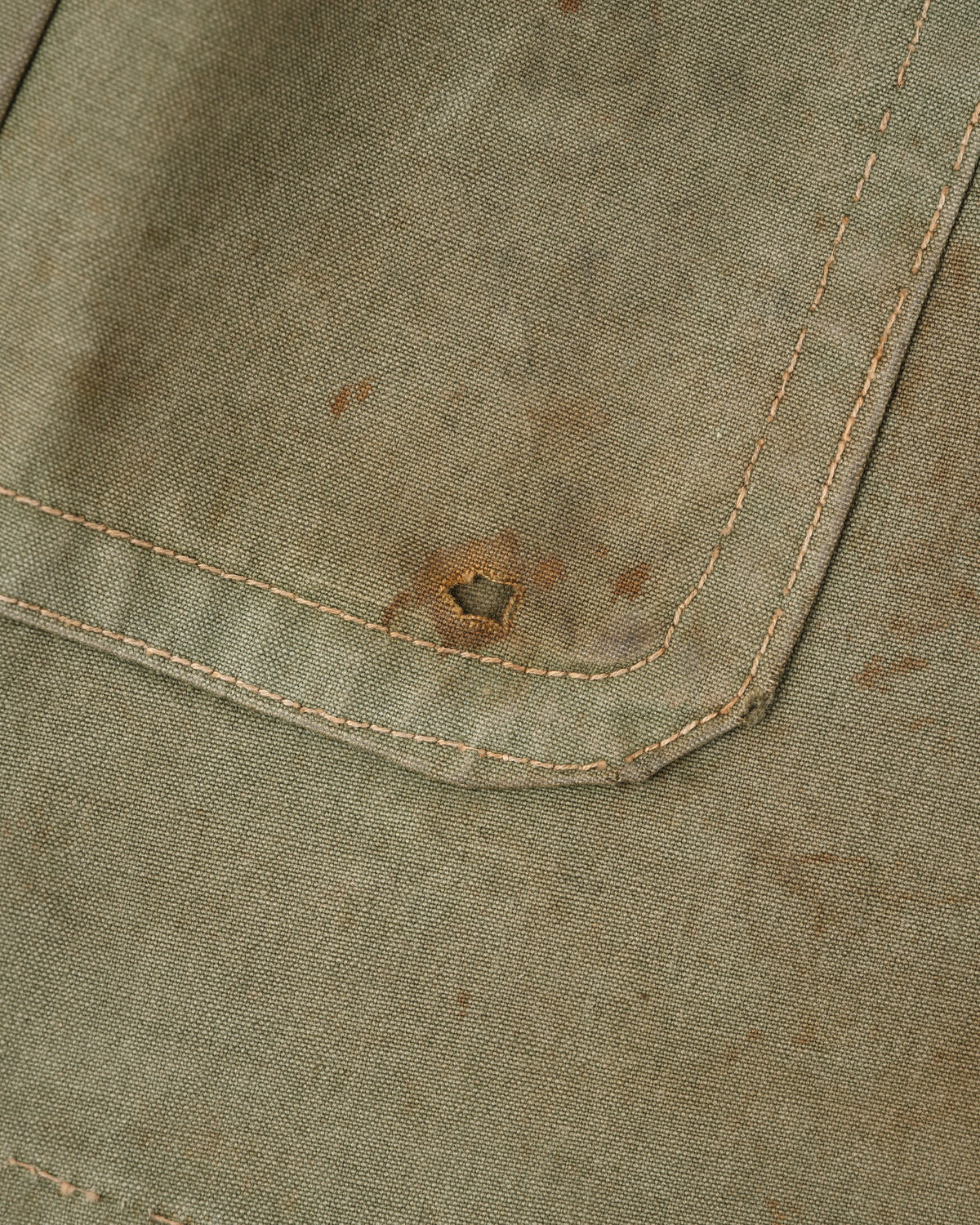
Details abound: a collared, button-down neckline with chin strap; a double-breasted configuration with ten buttons; exposed-button slash handwarmer pockets; large flap pockets at the hem; a center pleat across the back; and a pronounced A-line silhouette—a singular aesthetic vocabulary reserved entirely for this model.
The shoulders accommodate removable shoulder boards via dedicated buttons and loops.
The front closure employs button fastening.
A generously-scaled, stand-up collar fitted with a chin strap—engineered high to seal against wind and enhance insulation—can be worn as a standup collar with considerable effect.
Inside, faint stamps characteristic of Wehrmacht issue remain visible, confirming official provenance. Though age has rendered the text illegible, there is no question of authenticity.
The refined A-line silhouette—understated in its elegance—constitutes much of the garment's appeal.
Among the vast spectrum of Wehrmacht uniforms from the Second World War era, this piece is celebrated for its particular sartorial refinement—a quality that has attracted devoted collectors for decades.
Beyond its historical rarity, when evaluated purely as a fashion object, this is an exceptionally compelling garment. We encourage its genuine use without hesitation.
No size marking is present, though dimensions suggest an equivalent to Japanese size M–L.
The measurements indicate a golden size that accommodates the Japanese frame comfortably, making it accessible to a wide range of builds.
Designed originally as an outer layer worn over formal uniform, all examples retain proportionally ample dimensions.
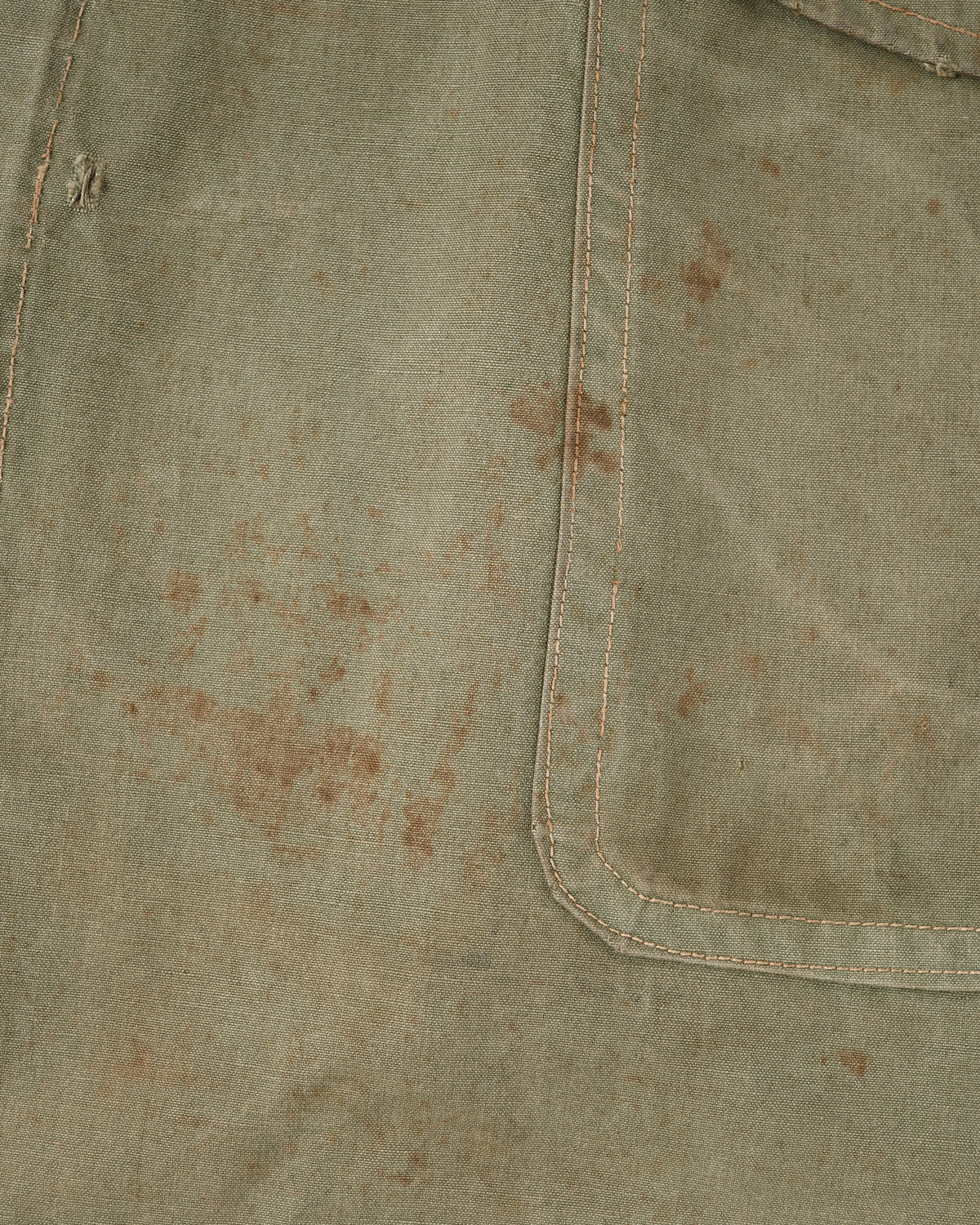
The piece exhibits expected patina consistent with its age and use—fading, surface wear, small holes, repair marks, and button variations—yet sustains no damage compromising wear. It remains entirely serviceable.
Wehrmacht pieces have drawn particular attention in recent years, yet surviving examples remain scarce relative to demand—a scarcity rooted in historical circumstances beyond simple market economics.
With a devoted international collector base, this represents the sort of archive piece that rarely reaches the market—a piece collectors themselves seldom release.
This is not merchandise one purchases simply by offering sufficient funds; future acquisitions cannot be assured.
It serves equally as active wardrobe, collection cornerstone, and design reference. A piece of genuine rarity—uncommon both domestically and internationally. Those who have sought such an item, or who value the genuinely exceptional, should not forgo this opportunity.
ADD TO CART

![[~40’s]WWII German Army Gebirgsjäger Mountain Troops Windjacke "Wehrmacht"](http://vieuxetnouveau-shop.com/cdn/shop/files/202505030587.jpg?v=1754317249&width=2400)
![[~40’s]WWII German Army Gebirgsjäger Mountain Troops Windjacke "Wehrmacht"](http://vieuxetnouveau-shop.com/cdn/shop/files/202505030588.jpg?v=1754317249&width=2400)
![[~40’s]WWII German Army Gebirgsjäger Mountain Troops Windjacke "Wehrmacht"](http://vieuxetnouveau-shop.com/cdn/shop/files/202505030589.jpg?v=1754317249&width=2400)
![[~40’s]WWII German Army Gebirgsjäger Mountain Troops Windjacke "Wehrmacht"](http://vieuxetnouveau-shop.com/cdn/shop/files/202505030591.jpg?v=1754317249&width=2400)
![[~40’s]WWII German Army Gebirgsjäger Mountain Troops Windjacke "Wehrmacht"](http://vieuxetnouveau-shop.com/cdn/shop/files/DSCF6627.jpg?v=1754320606&width=2400)
![[~40’s]WWII German Army Gebirgsjäger Mountain Troops Windjacke "Wehrmacht"](http://vieuxetnouveau-shop.com/cdn/shop/files/DSCF6628_51ef4332-c9fb-4ef4-9b56-b60c0d10199f.jpg?v=1754320606&width=2400)
![[~40’s]WWII German Army Gebirgsjäger Mountain Troops Windjacke "Wehrmacht"](http://vieuxetnouveau-shop.com/cdn/shop/files/DSCF6629_ffc0302e-f900-426a-bdef-ced3225d9fe7.jpg?v=1754320606&width=2400)
![[~40’s]WWII German Army Gebirgsjäger Mountain Troops Windjacke "Wehrmacht"](http://vieuxetnouveau-shop.com/cdn/shop/files/DSCF6630.jpg?v=1754320606&width=2400)
![[~40’s]WWII German Army Gebirgsjäger Mountain Troops Windjacke "Wehrmacht"](http://vieuxetnouveau-shop.com/cdn/shop/files/DSCF6631_45c6fd2a-a98d-4321-aa6c-c290749c2b5a.jpg?v=1754320606&width=2400)
![[~40’s]WWII German Army Gebirgsjäger Mountain Troops Windjacke "Wehrmacht"](http://vieuxetnouveau-shop.com/cdn/shop/files/DSCF6632_390f013b-7485-43d1-8ae2-ef7b8ffc7d6c.jpg?v=1754320606&width=2400)
![[~40’s]WWII German Army Gebirgsjäger Mountain Troops Windjacke "Wehrmacht"](http://vieuxetnouveau-shop.com/cdn/shop/files/DSCF6633_e9150a28-a04e-4d94-a1d9-87fec86c5fab.jpg?v=1754320606&width=2400)
![[~40’s]WWII German Army Gebirgsjäger Mountain Troops Windjacke "Wehrmacht"](http://vieuxetnouveau-shop.com/cdn/shop/files/DSCF6635_572d5fe4-27e1-4472-90f7-7b1acf9e2173.jpg?v=1754320606&width=2400)
![[~40’s]WWII German Army Gebirgsjäger Mountain Troops Windjacke "Wehrmacht"](http://vieuxetnouveau-shop.com/cdn/shop/files/DSCF6636.jpg?v=1754320606&width=2400)
![[~40’s]WWII German Army Gebirgsjäger Mountain Troops Windjacke "Wehrmacht"](http://vieuxetnouveau-shop.com/cdn/shop/files/DSCF6637.jpg?v=1754320606&width=2400)
![[~40’s]WWII German Army Gebirgsjäger Mountain Troops Windjacke "Wehrmacht"](http://vieuxetnouveau-shop.com/cdn/shop/files/DSCF6638.jpg?v=1754320606&width=2400)
![[~40’s]WWII German Army Gebirgsjäger Mountain Troops Windjacke "Wehrmacht"](http://vieuxetnouveau-shop.com/cdn/shop/files/DSCF6640.jpg?v=1754320638&width=2400)
![[~40’s]WWII German Army Gebirgsjäger Mountain Troops Windjacke "Wehrmacht"](http://vieuxetnouveau-shop.com/cdn/shop/files/DSCF6639.jpg?v=1754320638&width=2400)
![[~40’s]WWII German Army Gebirgsjäger Mountain Troops Windjacke "Wehrmacht"](http://vieuxetnouveau-shop.com/cdn/shop/files/DSCF6641_a0e5d848-5944-43c7-9a34-aea9cba0682f.jpg?v=1754320638&width=2400)
![[~40’s]WWII German Army Gebirgsjäger Mountain Troops Windjacke "Wehrmacht"](http://vieuxetnouveau-shop.com/cdn/shop/files/DSCF6647_c982155c-a9f2-4efd-807b-38e09e2bdd78.jpg?v=1754320606&width=2400)
![[~40’s]WWII German Army Gebirgsjäger Mountain Troops Windjacke "Wehrmacht"](http://vieuxetnouveau-shop.com/cdn/shop/files/DSCF6789_b2104e39-04ba-452c-a52c-e3b5882daa34.jpg?v=1754404231&width=2400)
![[~40’s]WWII German Army Gebirgsjäger Mountain Troops Windjacke "Wehrmacht"](http://vieuxetnouveau-shop.com/cdn/shop/files/DSCF6790_caf052f3-e0c7-45e0-80c6-dd626745e515.jpg?v=1754404231&width=2400)
![[~40’s]WWII German Army Gebirgsjäger Mountain Troops Windjacke "Wehrmacht"](http://vieuxetnouveau-shop.com/cdn/shop/files/DSCF6791_8f0b8f9c-dfb5-45fb-9205-434c7b415c42.jpg?v=1754404231&width=2400)
![[~40’s]WWII German Army Gebirgsjäger Mountain Troops Windjacke "Wehrmacht"](http://vieuxetnouveau-shop.com/cdn/shop/files/DSCF6792_fe887025-bdaa-482c-9b5d-ea6fd68bd3f4.jpg?v=1754404231&width=2400)
![[~40’s]WWII German Army Gebirgsjäger Mountain Troops Windjacke "Wehrmacht"](http://vieuxetnouveau-shop.com/cdn/shop/files/DSCF6793_0876255b-4842-4bf0-9b6b-5f86c0e44498.jpg?v=1754404231&width=2400)
![[~40’s]WWII German Army Gebirgsjäger Mountain Troops Windjacke "Wehrmacht"](http://vieuxetnouveau-shop.com/cdn/shop/files/DSCF6788_d6aeb93e-8f08-45fb-a985-8325b83e3b95.jpg?v=1754404231&width=2400)
![[~40’s]WWII German Army Gebirgsjäger Mountain Troops Windjacke "Wehrmacht"](http://vieuxetnouveau-shop.com/cdn/shop/files/DSCF6785_64f789e0-d766-4b73-9cf9-1b3b5bd307e6.jpg?v=1754404231&width=2400)
![[~40’s]WWII German Army Gebirgsjäger Mountain Troops Windjacke "Wehrmacht"](http://vieuxetnouveau-shop.com/cdn/shop/files/DSCF6786_e649695e-7a52-43ff-8840-1e896faea143.jpg?v=1754404231&width=2400)
![[~40’s]WWII German Army Gebirgsjäger Mountain Troops Windjacke "Wehrmacht"](http://vieuxetnouveau-shop.com/cdn/shop/files/DSCF6787_b960c570-3ee3-4316-851d-6f47e44ca95c.jpg?v=1754404231&width=2400)
![[~40’s]WWII German Army Gebirgsjäger Mountain Troops Windjacke "Wehrmacht"](http://vieuxetnouveau-shop.com/cdn/shop/files/DSCF6797_2942628c-5dd9-4154-bb8a-2dda67536d3c.jpg?v=1754404231&width=2400)
![[~40’s]WWII German Army Gebirgsjäger Mountain Troops Windjacke "Wehrmacht"](http://vieuxetnouveau-shop.com/cdn/shop/files/DSCF6794_d8b7dab8-2a50-49c5-853d-4401e89d8b30.jpg?v=1754404231&width=2400)
![[~40’s]WWII German Army Gebirgsjäger Mountain Troops Windjacke "Wehrmacht"](http://vieuxetnouveau-shop.com/cdn/shop/files/DSCF6795_5761b6e5-4385-45a2-8cc7-fdb62eb62110.jpg?v=1754404231&width=2400)
![[~40’s]WWII German Army Gebirgsjäger Mountain Troops Windjacke "Wehrmacht"](http://vieuxetnouveau-shop.com/cdn/shop/files/DSCF6796_3b10335e-45ae-4b3d-abaa-3655d60c1e84.jpg?v=1754404231&width=2400)