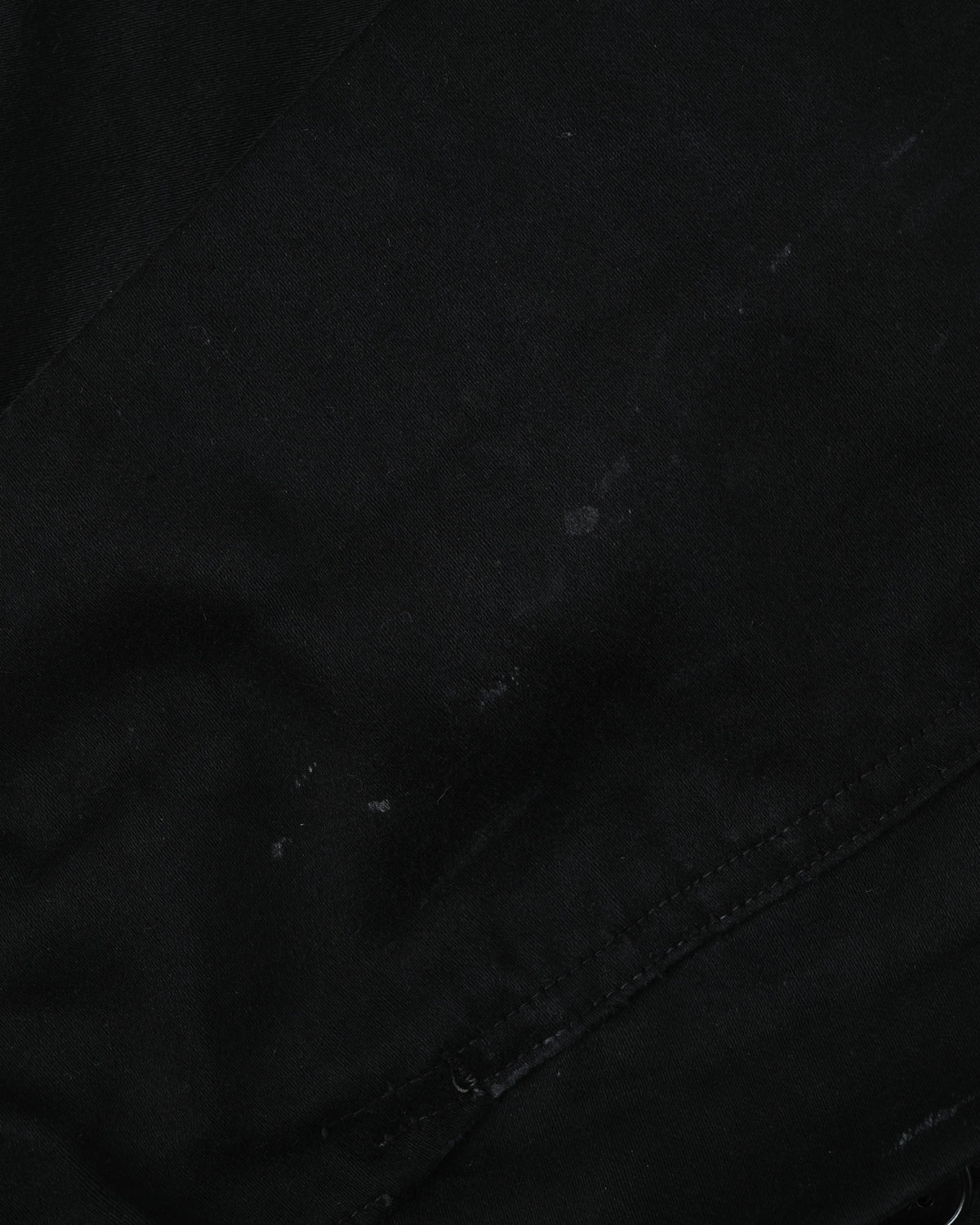
Circa 1940s, a black moleskin work jacket by Vulcain.
A special arrival.
Among French workwear brands, Vulcain carries the reputation of a storied house.
Details of Vulcain's founding remain elusive—the exact year and founder's name lost to time—but the brand emerged as an established workwear manufacturer in Lyon, the ancient city of France.
Lyon, the birthplace of this house, has been the sacred ground of textile craft since the 17th century.
The brand name itself, "Vulcain," is said to derive from Vulcanus, the Roman god of the forge and craftsmanship.
From this storied workwear house comes the introduction of the "black moleskin jacket"—the enduring staple of French workwear.
This particular example employs moleskin, the fabric most characteristic of French vintage workwear.
The name itself derives from its resemblance to mole skin—a texture unmistakably tactile and dense.
To touch it is to understand: the hand encounters a smoothness and weight one would not expect from cotton.
The secret resides in the weave structure.
Satin weave employs five or more threads in its basic repeat, creating a surface where the warp or weft alone appears visible. The result is a fabric of exceptional density, thickness, and flexibility, with a distinctive sheen.
This density, this substance, this suppleness—these qualities made moleskin the natural choice for workwear, for garments that would endure the severity of labor.
This jacket saw actual service as workwear, so its functionality remains beyond question.
Work jackets in moleskin—regardless of era, maker, or condition—appear seldom. Black moleskin work jackets are scarce; a Vulcain example rarer still.
Most distinctive is the signature arch-hemmed pocket—the hallmark of Vulcain manufacture. This detail defines the house; collectors seek it above all else.
By the 1950s, even Vulcain had abandoned the arched hem. To encounter it here is to possess something only this era offers.
It is a small matter—a detail among details—yet I believe the enduring classics demand such precision throughout.
Inside, a Vulcain embroidered label: black ground, gold thread.
No size marking survives, though the measurements suggest a fit comparable to modern medium.
Wear is evident—scuffing, soiling—but nothing severe compromises function. It remains entirely wearable.
Black moleskin appears in the market far less often than blue. A Vulcain example with arched pockets is, domestically and abroad, rarely encountered.
As a wardrobe piece, certainly. As a collection object, unquestionably. This represents an exceptional iteration of the black moleskin jacket—a rarity among rarities. Those drawn to uncommon pieces should not overlook this one.
ADD TO CART

![[~40's]French Vintage Black Moleskin Work Jacket "Vulcain"](http://vieuxetnouveau-shop.com/cdn/shop/files/Pro-CaptureOne0093_422a041b-ddab-49c1-b654-239a246f6b45.jpg?v=1746278475&width=2400)
![[~40's]French Vintage Black Moleskin Work Jacket "Vulcain"](http://vieuxetnouveau-shop.com/cdn/shop/files/Pro-CaptureOne0094_96f53901-a5b4-4a66-901e-f61ae8ad6601.jpg?v=1746278475&width=2400)
![[~40's]French Vintage Black Moleskin Work Jacket "Vulcain"](http://vieuxetnouveau-shop.com/cdn/shop/files/Pro-CaptureOne0095_c9e7163b-be19-4064-a053-53833ccae7bf.jpg?v=1746278475&width=2400)
![[~40's]French Vintage Black Moleskin Work Jacket "Vulcain"](http://vieuxetnouveau-shop.com/cdn/shop/files/Pro-CaptureOne0099_108590bb-c99b-4bed-92b2-630b101add7f.jpg?v=1746278475&width=2400)
![[~40's]French Vintage Black Moleskin Work Jacket "Vulcain"](http://vieuxetnouveau-shop.com/cdn/shop/files/DSCF3240_cbf460a1-f18a-4100-953f-301498edcd87.jpg?v=1746278475&width=2400)
![[~40's]French Vintage Black Moleskin Work Jacket "Vulcain"](http://vieuxetnouveau-shop.com/cdn/shop/files/DSCF3249_f294ea10-a75a-4617-a467-567f319f1101.jpg?v=1746278475&width=2400)
![[~40's]French Vintage Black Moleskin Work Jacket "Vulcain"](http://vieuxetnouveau-shop.com/cdn/shop/files/DSCF3241_9722adbc-0ac7-47c6-87e7-93e8818cd0d7.jpg?v=1746278475&width=2400)
![[~40's]French Vintage Black Moleskin Work Jacket "Vulcain"](http://vieuxetnouveau-shop.com/cdn/shop/files/DSCF3242_332b6af7-da1e-4226-8d25-d240fcaf2f53.jpg?v=1746278475&width=2400)
![[~40's]French Vintage Black Moleskin Work Jacket "Vulcain"](http://vieuxetnouveau-shop.com/cdn/shop/files/DSCF3243_ff406a1b-2c20-4df7-b179-32b12ee2971a.jpg?v=1746278475&width=2400)
![[~40's]French Vintage Black Moleskin Work Jacket "Vulcain"](http://vieuxetnouveau-shop.com/cdn/shop/files/DSCF3245_a483c86c-4a60-4065-a56c-69584e8e96ec.jpg?v=1746278475&width=2400)
![[~40's]French Vintage Black Moleskin Work Jacket "Vulcain"](http://vieuxetnouveau-shop.com/cdn/shop/files/DSCF3246_2dcd6977-3fd6-41e2-8d41-7cca0497974a.jpg?v=1746278475&width=2400)
![[~40's]French Vintage Black Moleskin Work Jacket "Vulcain"](http://vieuxetnouveau-shop.com/cdn/shop/files/DSCF3247_d74a57ac-6f0a-4c15-9094-db08a442e945.jpg?v=1746278475&width=2400)
![[~40's]French Vintage Black Moleskin Work Jacket "Vulcain"](http://vieuxetnouveau-shop.com/cdn/shop/files/DSCF3252_3cda01b4-4417-42ce-b0db-ef93a4c86bfc.jpg?v=1746278475&width=2400)
![[~40's]French Vintage Black Moleskin Work Jacket "Vulcain"](http://vieuxetnouveau-shop.com/cdn/shop/files/DSCF3254_d77b6c7a-d0ac-4983-9451-85422f669dac.jpg?v=1746278475&width=2400)
![[~40's]French Vintage Black Moleskin Work Jacket "Vulcain"](http://vieuxetnouveau-shop.com/cdn/shop/files/DSCF3255_fcf75a11-f6d8-474a-8e9b-6471f31549a5.jpg?v=1746278464&width=2400)
![[~40's]French Vintage Black Moleskin Work Jacket "Vulcain"](http://vieuxetnouveau-shop.com/cdn/shop/files/DSCF3527_ef621f0a-22ef-4cad-a006-76e52669ba18.jpg?v=1746365326&width=2400)
![[~40's]French Vintage Black Moleskin Work Jacket "Vulcain"](http://vieuxetnouveau-shop.com/cdn/shop/files/DSCF3528.jpg?v=1746365326&width=2400)
![[~40's]French Vintage Black Moleskin Work Jacket "Vulcain"](http://vieuxetnouveau-shop.com/cdn/shop/files/DSCF3530.jpg?v=1746365326&width=2400)
![[~40's]French Vintage Black Moleskin Work Jacket "Vulcain"](http://vieuxetnouveau-shop.com/cdn/shop/files/DSCF3531.jpg?v=1746365326&width=2400)
![[~40's]French Vintage Black Moleskin Work Jacket "Vulcain"](http://vieuxetnouveau-shop.com/cdn/shop/files/DSCF3526_700ce3f6-8463-45ac-8f9c-8789740725ae.jpg?v=1746365326&width=2400)
![[~40's]French Vintage Black Moleskin Work Jacket "Vulcain"](http://vieuxetnouveau-shop.com/cdn/shop/files/DSCF3524.jpg?v=1746365326&width=2400)
![[~40's]French Vintage Black Moleskin Work Jacket "Vulcain"](http://vieuxetnouveau-shop.com/cdn/shop/files/DSCF3522_5b90c951-c253-471c-970b-d280a470de34.jpg?v=1746365326&width=2400)
![[~40's]French Vintage Black Moleskin Work Jacket "Vulcain"](http://vieuxetnouveau-shop.com/cdn/shop/files/DSCF3523.jpg?v=1746365326&width=2400)
![[~40's]French Vintage Black Moleskin Work Jacket "Vulcain"](http://vieuxetnouveau-shop.com/cdn/shop/files/DSCF3525_4b70565d-3748-4d46-976e-bbba585adc22.jpg?v=1746365326&width=2400)
![[~40's]French Vintage Black Moleskin Work Jacket "Vulcain"](http://vieuxetnouveau-shop.com/cdn/shop/files/DSCF3535_8e430504-5bf8-495a-87c0-8ec32b44e598.jpg?v=1746365326&width=2400)
![[~40's]French Vintage Black Moleskin Work Jacket "Vulcain"](http://vieuxetnouveau-shop.com/cdn/shop/files/DSCF3532.jpg?v=1746365326&width=2400)
![[~40's]French Vintage Black Moleskin Work Jacket "Vulcain"](http://vieuxetnouveau-shop.com/cdn/shop/files/DSCF3533_ac567dff-41e3-4a8c-b951-60d133fb3687.jpg?v=1746365326&width=2400)
![[~40's]French Vintage Black Moleskin Work Jacket "Vulcain"](http://vieuxetnouveau-shop.com/cdn/shop/files/DSCF3534_71a6fffb-7627-4541-a757-7e1265ec3f8c.jpg?v=1746365326&width=2400)