An estimated 1940s Luftwaffe personal leather flight jacket.
A truly exceptional acquisition.
The Luftwaffe, the aerial combat arm of the Wehrmacht alongside the Heer and Kriegsmarine, represented Nazi Germany's unified air force during the period from 1935 to 1945.
Though the Treaty of Versailles following the First World War prohibited German military aviation, the Nazi regime's rearmament agenda accelerated aerial force development. The Luftwaffe was formally established in 1935, establishing the organizational framework of a modern air force.
In the early stages of the Second World War, the Luftwaffe served as the cornerstone of Blitzkrieg operations, integrating air superiority, reconnaissance, and close air support. Its tactical mobility proved instrumental in the invasion of Poland (1939) and the Western Campaign (1940), substantially contributing to Germany's initial military victories.
However, during the 1940 Battle of Britain, the integrated British air defense system—comprising radar networks, warning systems, and fighter control—prevented the Luftwaffe from achieving air superiority. This strategic turning point saw the collapse of Germany's planned invasion of Britain.
Following Germany's unconditional surrender in May 1945, the Allied powers proceeded with occupation and disarmament. On August 20, 1946, by decree of the Allied Control Council, the Wehrmacht and all its constituent branches were formally dissolved. The Luftwaffe ceased to exist.
In the postwar period, Germany initially lost its military capability. Reconstruction proceeded within the Cold War framework, with the country divided between West Germany (Federal Republic) and East Germany (German Democratic Republic).
The West established the Bundeswehr in 1955, while the East founded the NVA in 1956, each developing air forces within their respective frameworks.
These new military organizations were positioned as distinct from their Wehrmacht predecessors in institutional structure and command philosophy.
The development of German military apparel during this period reflected a division of labor that began with functional requirements and extended to visual presentation.
In matters of design, specialists such as artist Karl Diebitsch and graphic designer Walter Heck contributed to the visual conception of uniforms including the SS black uniform, advancing standardization of silhouette, color, and ornamentation. Meanwhile, multiple manufacturers including Hugo Boss undertook the actual production, managing mass production and quality control according to official specifications.
The common misconception that design equates to Hugo Boss obscures the reality: a division of labor between design authority (government agencies and designers) and manufacturing (suppliers).
This is a personal leather flight jacket worn by a Luftwaffe fighter pilot during the Second World War—procured and worn independently rather than issued as standard equipment.
Given that servicemen acquired civilian-manufactured garments as alternatives to issued uniforms, this piece bears no military stamps or markings. However, the sewn attachment points for insignia and ribbon bars above the right chest pocket and below the left chest pocket represent authentic period details reflecting actual wartime practice.
According to dealers specializing in German military artifacts, this particular jacket was worn by a pilot who flew the Messerschmitt Bf 109—a meaningful provenance that elevates its significance.
The Bf 109 stands as one of the Second World War's most representative single-engine fighters, serving as the Luftwaffe's primary aircraft from war's beginning to its end, generating numerous variants. Celebrated for its balanced combination of speed, climb rate, and maneuverability, it remains the quintessential symbol of the Luftwaffe.
The design prioritizes the demands of cockpit operation with a notably short length characteristic of aviation wear.
The front employs a zip fastening, with zippered pockets positioned at the chest and hem, creating both visual and functional integrity as a working tool. The abbreviated length combined with strategically positioned three-dimensional pockets ensures this jacket reads as a commanding piece whether paired with high-waisted trousers, military-cut pants, or denim worn casually.
The detailing throughout is remarkably sophisticated.
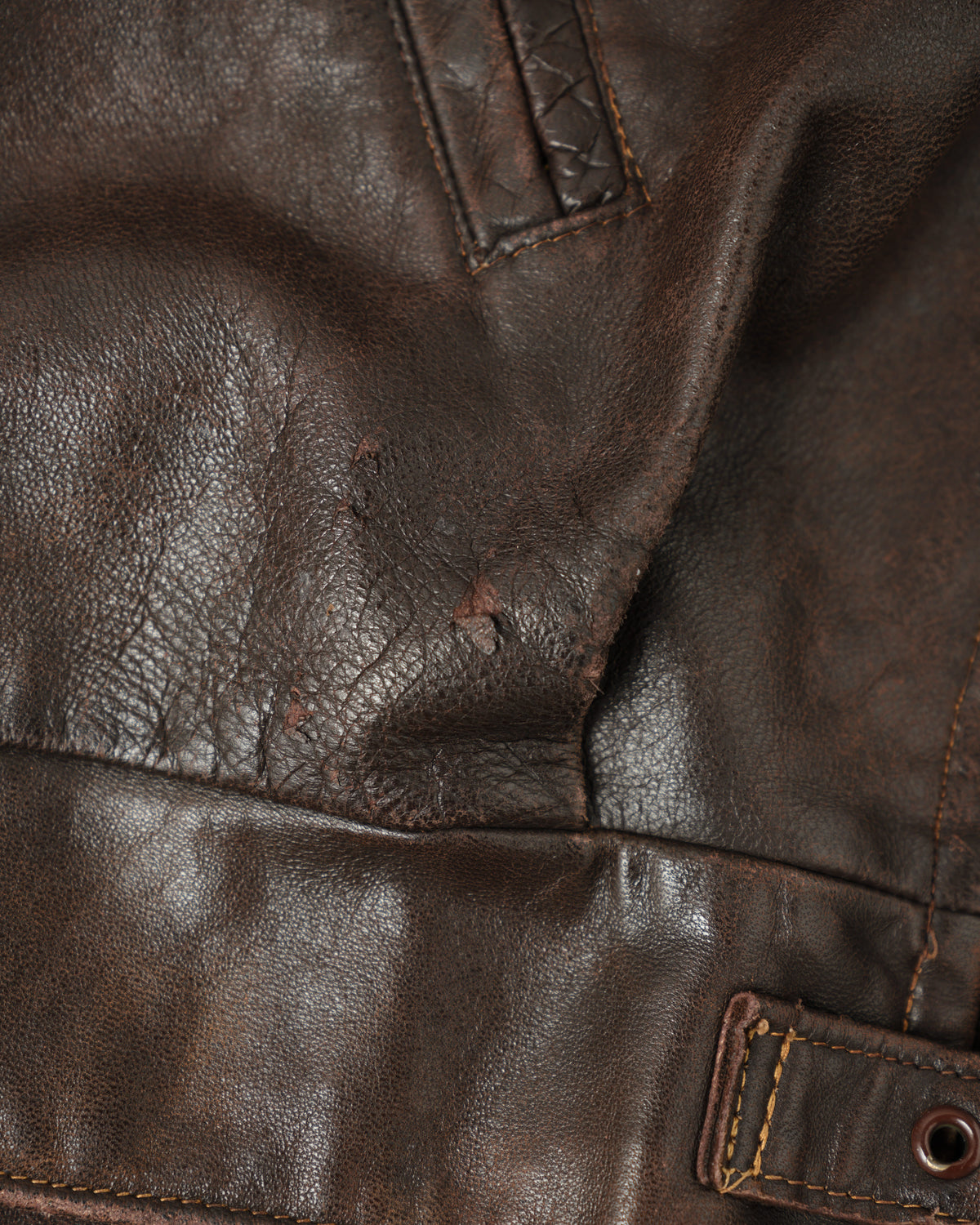
The chest features inverse-chevron zippered pockets that naturally draw the eye upward, creating definition across the chest when worn while introducing visual precision within an otherwise austere composition.
The hem incorporates chevron-shaped zippered pockets that impart diagonal lines across the torso, introducing movement and a visual lightness that counteracts the inherent weight of leather.
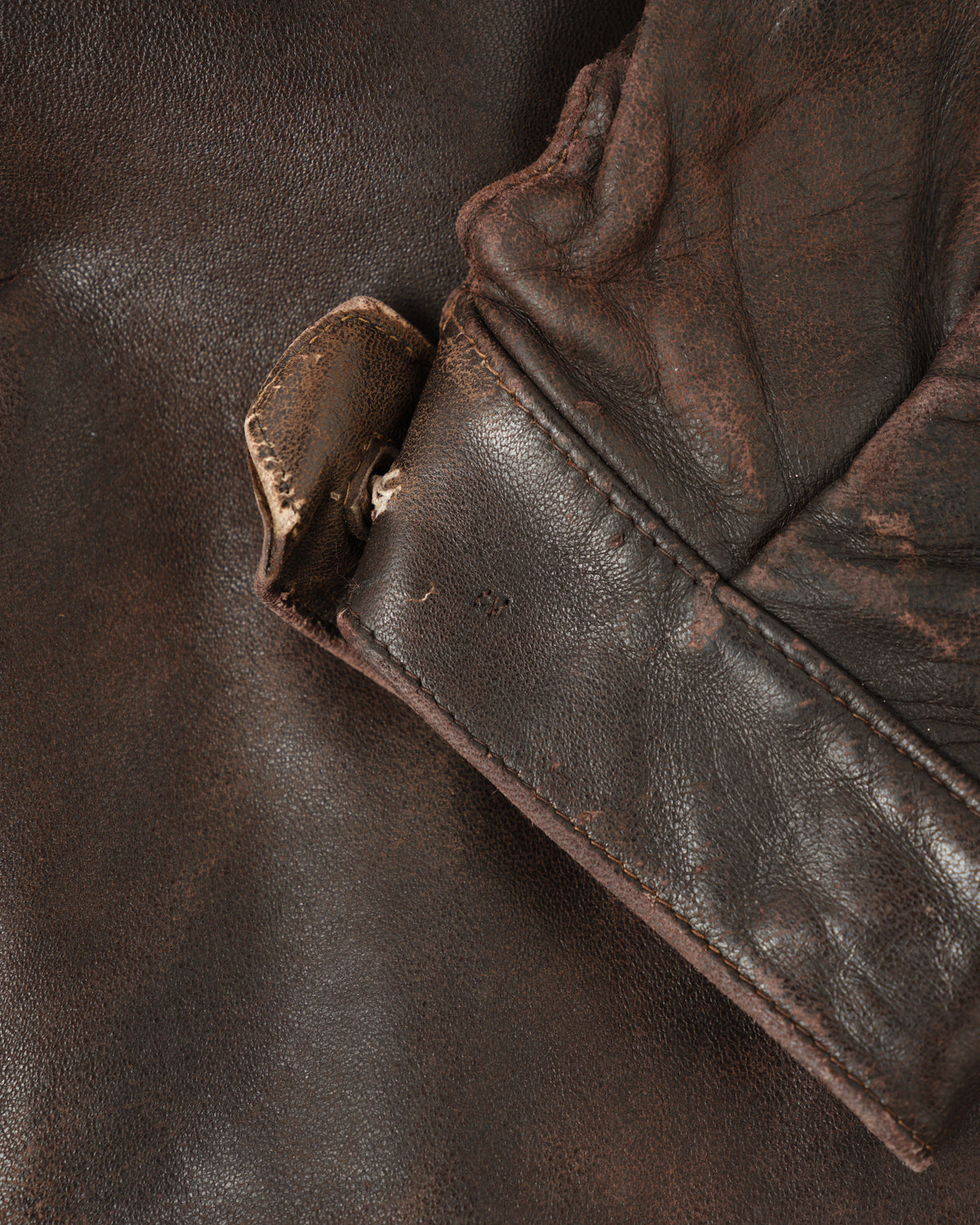
Of particular note are the shoulder strap attachment loops and period-accurate German military buttons—elements absent from standard civilian manufacture. The shoulder loops represent a distinctly military vocabulary that, when encountered on a leather civilian piece, establish a hybrid aesthetic particular to the era—a conjunction of civilian leather craft and military bearing that achieves considerable visual presence.
The buttons throughout are original Wehrmacht specifications, lending undeniable authenticity through their metallic character and finish.
The rear hem includes side adjusters secured with rivets, permitting minimal but meaningful refinement of fit. A leather short jacket's proportions shift considerably with small adjustments; these adjusters allow tailoring of the rear silhouette between structured and relaxed profiles according to preference.
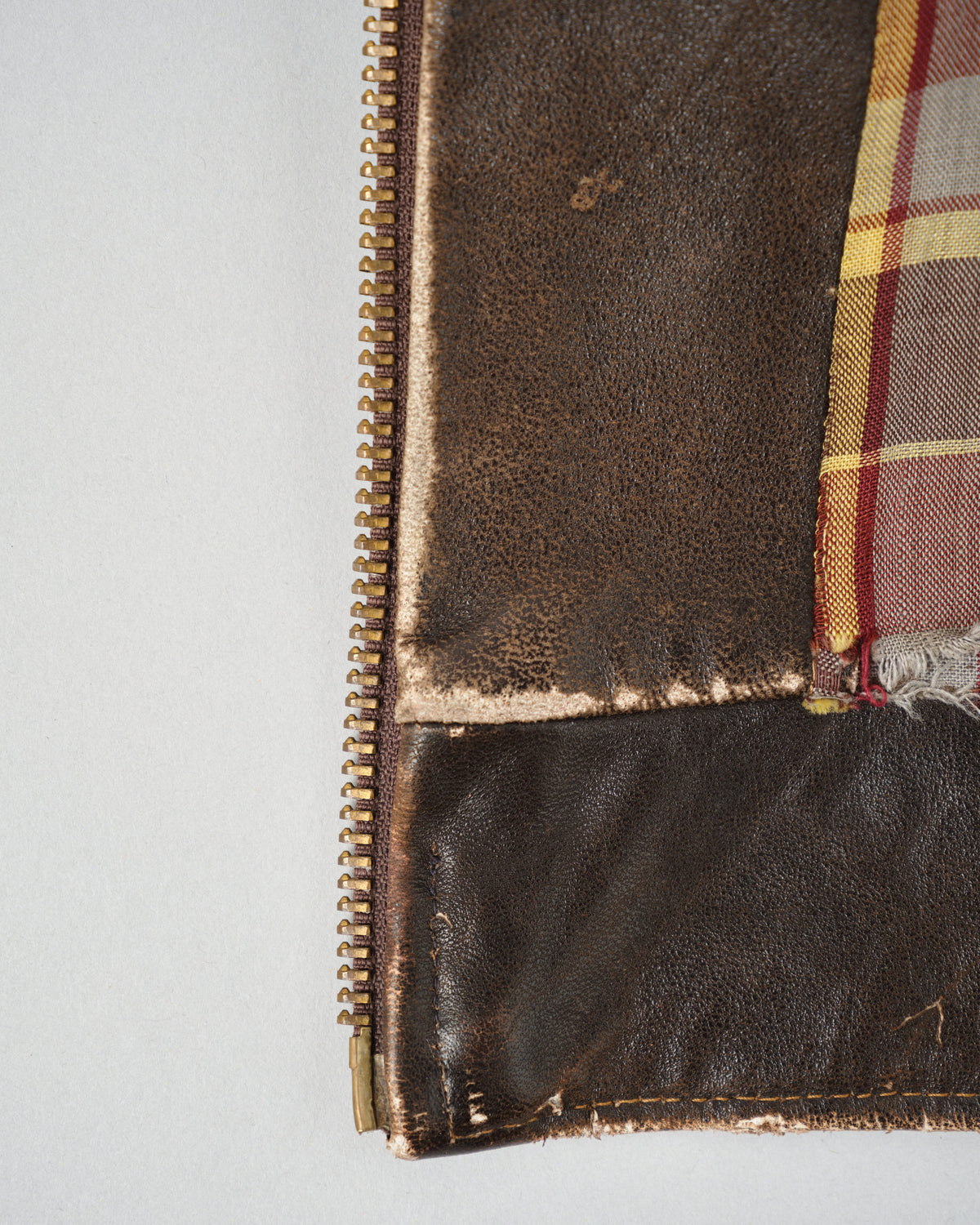
The main zip features an unmarked slider, while pocket zippers employ sliders marked ORIG RITSCH—representative of German-period industrial pragmatism, lending integrity to the mechanical gesture of opening and closing.
This jacket is constructed from sheepskin leather, with a cotton lining.
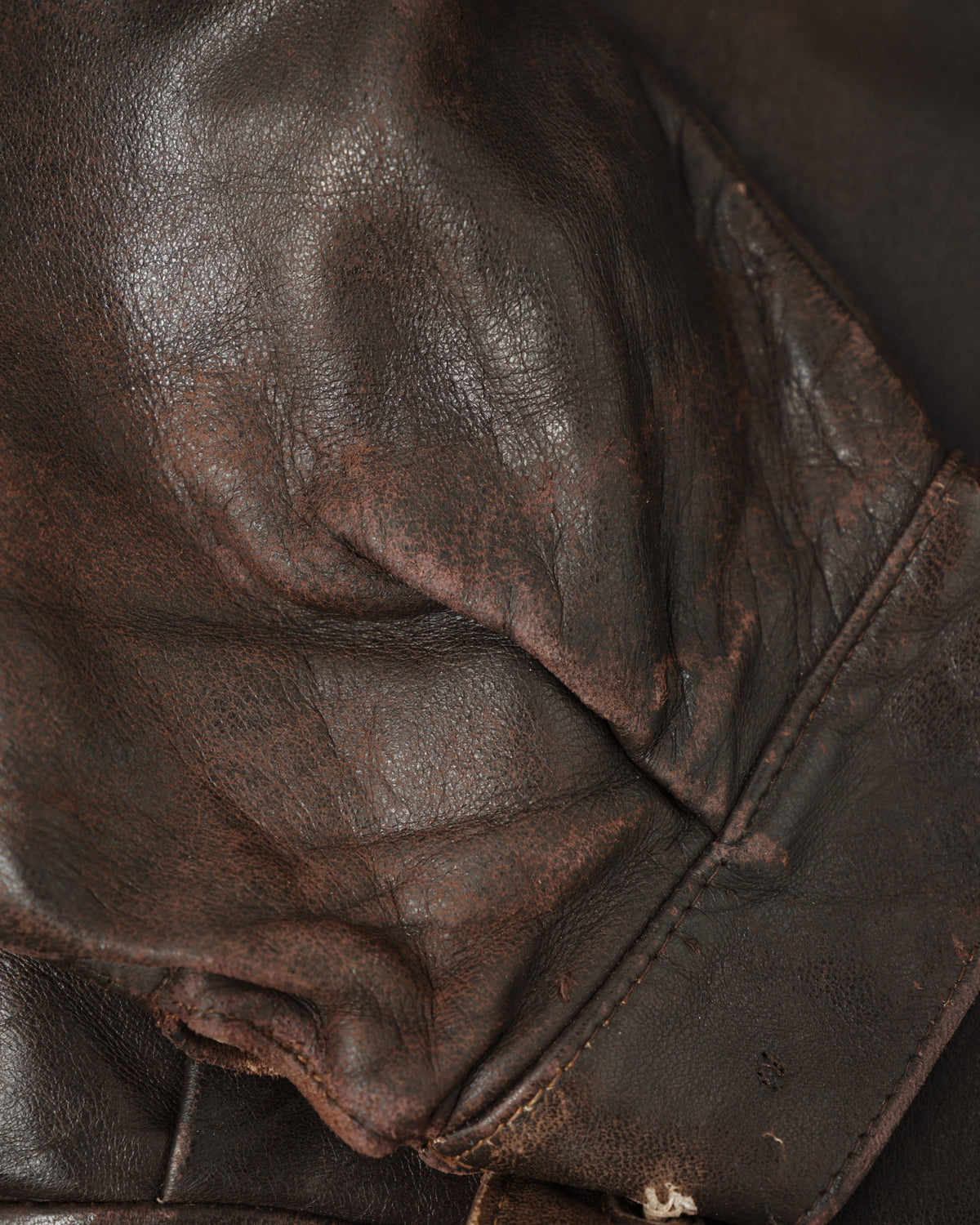
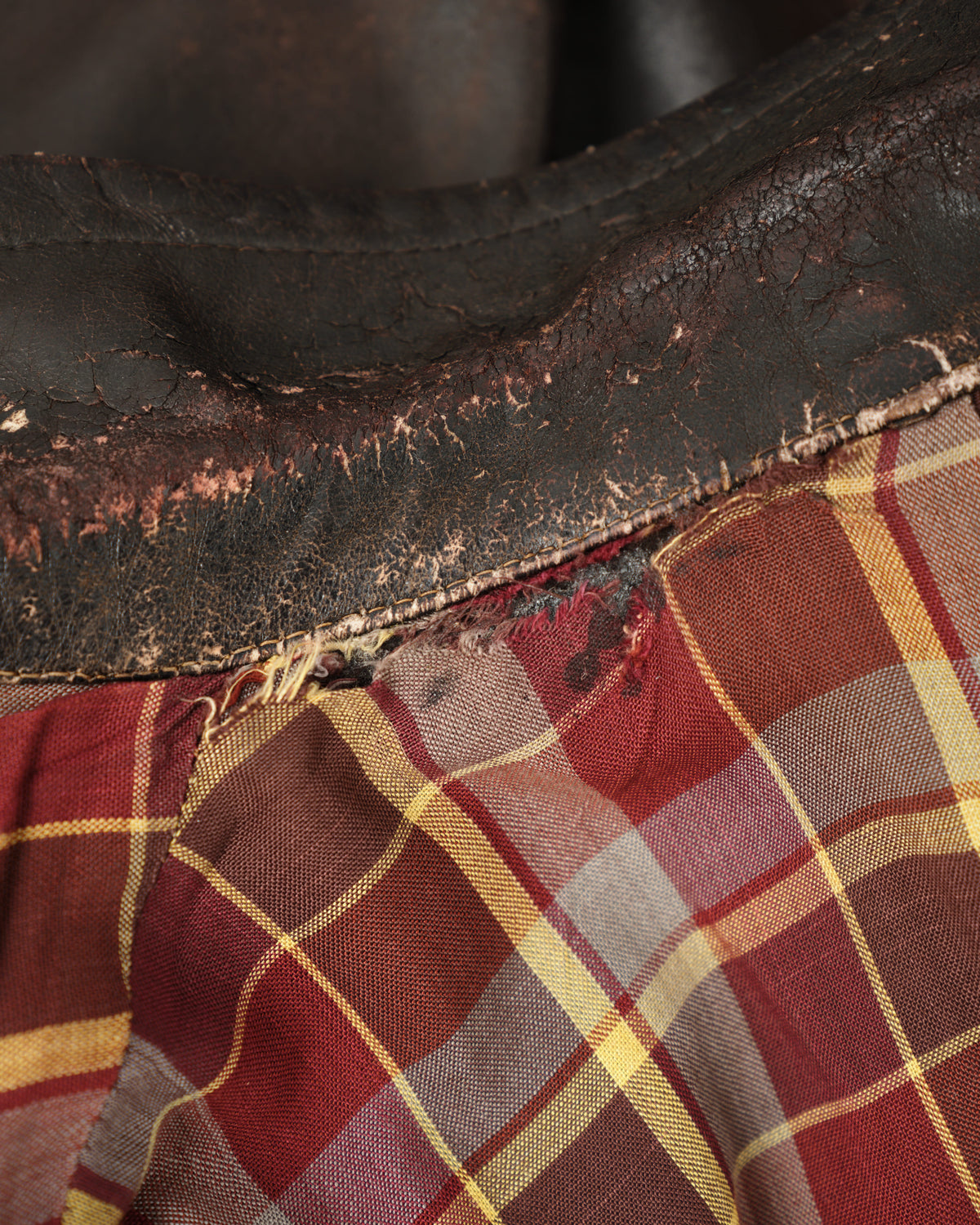
The texture presents finely grained leather with a restrained suppleness, conveying quality and refinement despite its military origins. It possesses inherent structural integrity while responding to the wearer's movement, developing patina, creasing, and surface marks that constitute the characteristic evolution of leather—a transformation that unfolds over years of wear.
The check-patterned cotton lining introduces warmth and humanity in contrast to military austerity, its coloration evident during dressing and contributing atmosphere. The lining achieves a precise balance, tempering leather's stark utility with quiet character, ensuring even minimal layering acquires subtle presence.
The color reads as brown with undertones of red—a depth that simple brown nomenclature cannot adequately describe.
This particular brown maintains temperature between black and russet, shifting tonality with light and deepening through shadow.
Wear marks and surface irregularities establish dimensionality, with a composed countenance at rest that intensifies where creasing concentrates. Gradations of tone reveal themselves depending on angle of view.
Beyond its value as historical documentation, this piece commands conviction as functional wardrobe—an economical design paired with undeniable material presence.
Beyond rarity, it achieves distinction through sheer aesthetic strength. Wear it without hesitation; let it assume its place as the foremost piece in your repertoire.
No size marking is visible, though proportions suggest an approximate equivalent to Japanese size L, with actual measurements likely to accommodate most frames comfortably.
The jacket exhibits the expected evidence of prolonged wear—fading, soiling, creasing, surface abrasion, fraying, small tears, minor button wear, and surface marking. These do not compromise wearability, and the piece remains entirely serviceable.
German military pieces have attracted increasing attention in recent years. Concurrently, historical considerations have rendered extant examples exceedingly scarce, with demand substantially exceeding available supply.
Within this category exists a devoted collector base for whom such archival pieces represent the most coveted acquisitions—objects rarely relinquished once acquired.
This is not an object available to the highest bidder, nor can future acquisition be assured.
As both wardrobe component and collected artifact—as design reference and historical document—this jacket warrants serious consideration. Seldom encountered domestically or abroad, it represents a rare opportunity for those actively seeking such examples or drawn to exceptional, singular pieces.
ADD TO CART