A Luftwaffe Winter Flight Jacket, estimated from the 1940s.
A truly exceptional acquisition.
The Luftwaffe, or German Air Force, was established in 1935 and operated through 1945 during the Nazi era as one of three branches of the Reichswehr—alongside the Army and Navy.
It stood as a principal division of the Nazi German military apparatus.
Throughout the Second World War, the Luftwaffe functioned as Germany's primary aerial fighting force.
At its inception, it rapidly expanded by adopting world-leading aviation technology and tactical doctrine.
Once hostilities commenced, the Luftwaffe became central to Blitzkrieg operations, participating in many pivotal early engagements—the invasion of Poland (1939), France (1940), and the Battle of Britain (1940).
Yet the defeat at the Battle of Britain marked a strategic turning point. Thereafter, mounting Allied air superiority and resource depletion steadily eroded its capacity.
By war's end, the Luftwaffe had been substantially diminished and was formally dissolved with Germany's surrender in 1945.
This piece is a Winter Flight Jacket, issued to high-altitude fighter and dive-bomber pilots of the Luftwaffe operating along the Eastern Front.
Known alternatively as the Kanal Jacke or Channel Jacket, it ranks among the most coveted Luftwaffe artifacts—a top-tier specimen in any serious collection.
Its rarity stems from a remarkably narrow production window: adopted for individual flight operations for merely two years, between 1943 and 1945. Few examples have entered the market; many encounter it for the first time.
Two construction variants of this model are documented: those of cotton-blend fabric and those of leather.
Its colorways vary as well—bluegrey, blackgrey, brown, and whitegrey have all been confirmed.
This particular example employs the rarer black leather construction.
Black offers perhaps the greatest versatility in wardrobe integration.
The lower handwarmer pockets feature a slash configuration without snap closures, distinguishing them from more conventional examples.
The front closure operates via a full-length zipper.
The zipper bears no maker's marks, suggesting it has been replaced at some point during its service life.
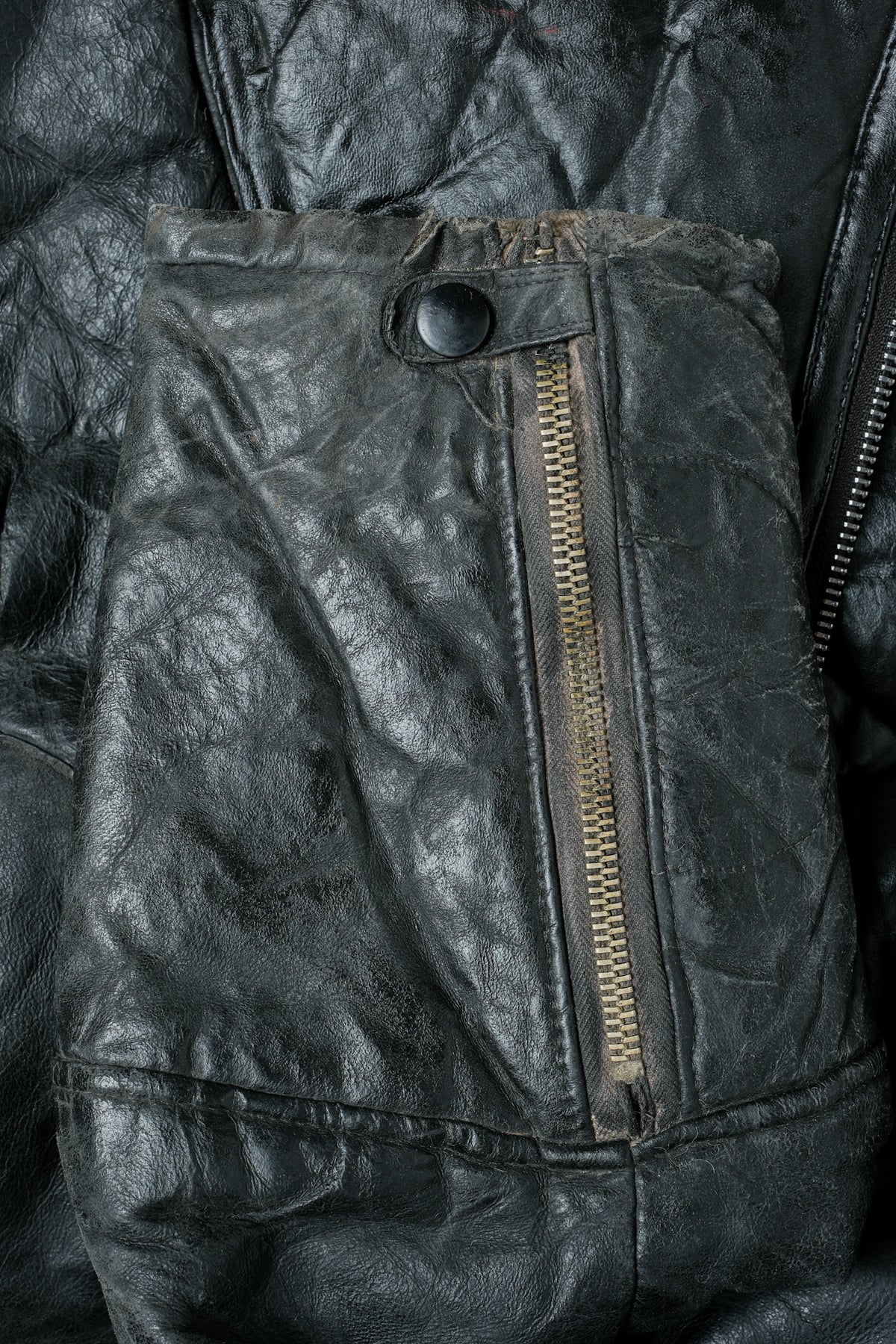
The sleeve sliders present a mixed history: the right sleeve slider is absent; the left bears a ZIPP-branded example.
The cuffs feature both snaps and an operable zipper—details peculiar to this example—while the sleeve linings employ a layered construction in contrasting fabric, exemplifying the meticulous German engineering of the period.
A snap-fastened chin strap adorns the collar, designed to seal the neckline and hold the collar upright against windchill.
Its graduated button configuration allows modest sizing adjustment.
An internal buckle belt at the waist both refines the silhouette and prevents wind infiltration from below.
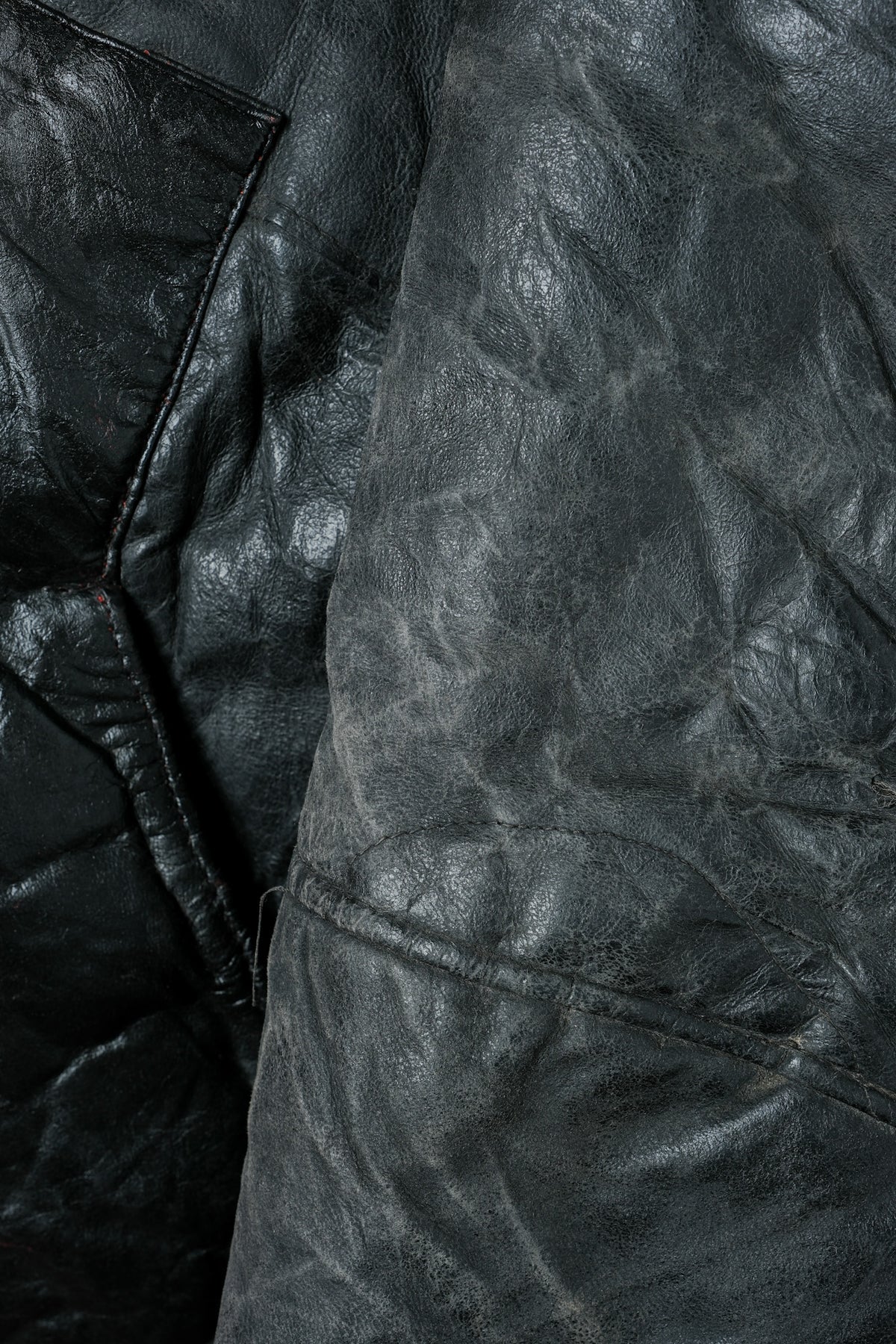
The body is crafted from sheepskin, generously employed throughout.
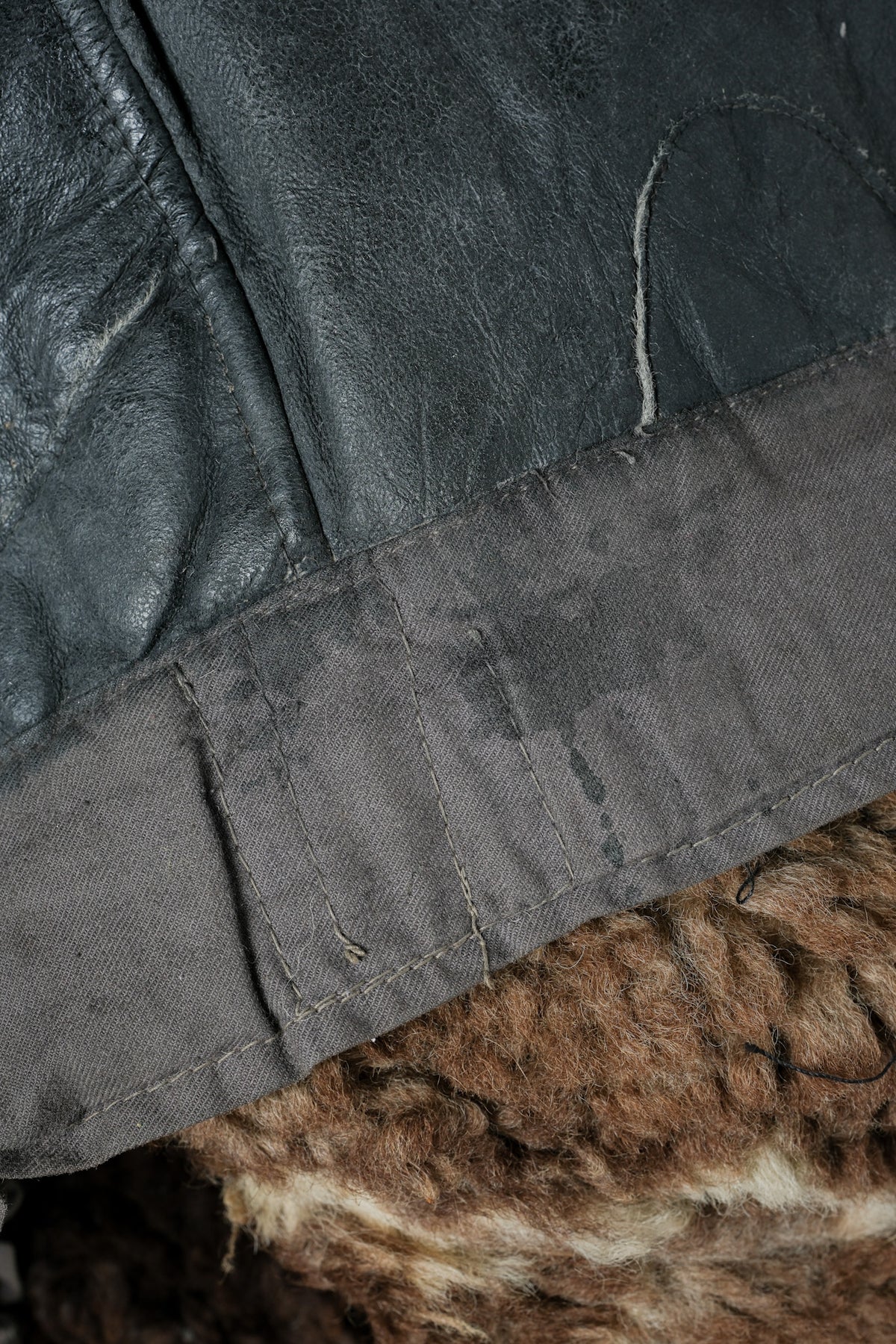
The lining features genuine fur.
Sheepskin derives from animals at least one year of age. Among leathers, it is the lightest and softest—though trade-offs exist in tensile strength and abrasion resistance compared to heavier hides. Its supple, skin-adhesive quality provides exceptional comfort against the body.
Genuine fur, derived directly from animal pelts, offers superior insulation and confers a sense of richness and refinement—qualities that have long justified its use in garments of elevated status.
Such lavish material choices were possible only in an era that prized craft and durability above expedience.
Beyond its historical significance, this jacket commands respect as a fashion object—handsome, purposeful, deserving of genuine wear.
No size label is visible, though proportions suggest an equivalent to modern M–L.
Measurements indicate a golden proportion well-suited to Japanese frames—accommodating a broad range of builds.
In the military tradition, oversized wearing over the frame reads equally assured.
Visible wear is present—soiling, creasing, minor abrasions, fur loss, and one absent slider—yet nothing structurally compromises its wearability.
German military pieces have garnered increased attention in recent years, yet authentic examples remain extraordinarily scarce, with demand far exceeding supply.
A devoted collector base ensures that pieces of this caliber rarely change hands—they are the stuff of aspiration.
Confined to a two-year adoption window between 1943 and 1945, scarcity is inevitable.
Not an item to be procured by simple expenditure, nor one whose future availability can be assured.
As wardrobe, as archive, as design reference—it demands no apology.
A piece encountered rarely, domestically or abroad. For those who have sought it, or who prize the uncommon, this moment warrants attention.