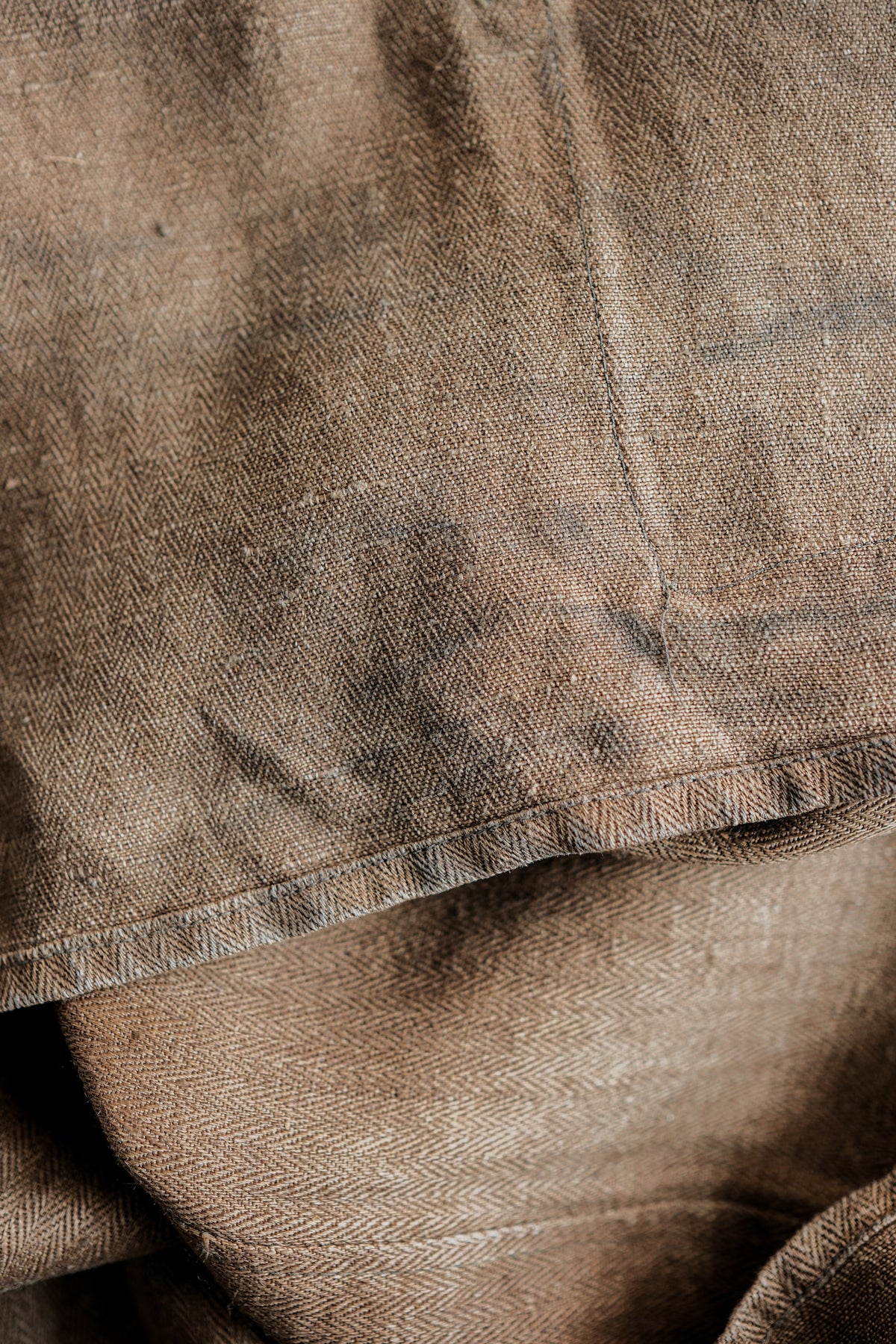
Estimated 1940s Wehrmacht Drillich Herringbone Twill Linen Jacket.
A significant acquisition.
The Wehrmacht—the unified armed forces of Nazi Germany spanning 1935 to 1945—comprised three branches: the Heer (Army), Kriegsmarine (Navy), and Luftwaffe (Air Force).
The name Wehrmacht replaced the earlier Reichswehr, embodying the Nazi regime's efforts to rearm Germany beyond the limits prescribed by the Treaty of Versailles.
Following Adolf Hitler's consolidation of power in 1933, the establishment of the Wehrmacht represented one of his most deliberate and audacious undertakings.
Following Germany's unconditional surrender on May 8, 1945, Allied occupation of Germany commenced, and the Wehrmacht underwent systematic dissolution.
Following the Wehrmacht's dissolution, Germany became a nation without military capability. The subsequent reconstruction of military forces in both West Germany (the Federal Republic) and East Germany (the German Democratic Republic) proceeded separately within the context of the Cold War.
These new military organizations were established as distinct entities, separate from Wehrmacht traditions and structures.
We present the Drillich Jacket—a work garment worn within German military installations.
Drillich refers to a durable work uniform that saw widespread use within the German military, particularly during World War II.
The German military Drillich is said to have drawn inspiration from the French Bourgeron, and indeed, both detail and fabric character share remarkable similarities.
While many Drillich examples have no front pockets, this specimen features exposed-button flap pockets at both chest and hem.
The fabric is linen—a material highly valued within vintage markets. Its distinctive suppleness, comparable to fine French linen and fluid in movement, has long accounted for its appeal.
Linen of this era stands apart in ways immediately apparent to even the untrained hand—a standard contemporary manufacture cannot replicate. Its reputation remains deservedly high, and the fabric alone possesses considerable inherent value.
Viewed not merely as a historical artifact but as a fashion garment in its own right, this remains a remarkably compelling piece, and we encourage its active wearing without reservation.
No size marking is legible, though proportions suggest an equivalent to Japanese size L.
The measured dimensions indicate a generous fit, accommodating larger frames without constraint.
Fading and surface wear are evident, yet no damage severe enough to compromise wearability is apparent. The piece remains serviceable.
German military items have received particular attention in recent years, yet their historical scarcity means existing examples remain profoundly limited relative to demand.
With a dedicated and devoted following, Wehrmacht pieces—rarely released by collectors—represent the kind of archival work that commands reverence.
Whether as wardrobe staple, collection cornerstone, or design reference, this piece warrants consideration on every level.German military pieces arrive at our shop infrequently. If you have sought such an example, this opportunity merits serious attention.
ADD TO CART