Circa 1940s Wehrmacht Drillich herringbone twill linen trousers.
The Wehrmacht, the unified armed forces of Nazi Germany spanning 1935 to 1945, comprised three branches: the Heer (Army), Kriegsmarine (Navy), and Luftwaffe (Air Force).
The name Wehrmacht replaced the earlier designation Reichswehr, marking the Nazi regime's rearmament efforts that exceeded the limits permitted under the Treaty of Versailles.
Following Adolf Hitler's rise to power in 1933, the establishment of the Wehrmacht represented one of his most overt and audacious actions.
After Germany's unconditional surrender on May 8, 1945, Allied occupation began and the Wehrmacht underwent systematic dissolution.
Following Wehrmacht dissolution, Germany became a demilitarized nation, with military reconstruction in the subsequent West Germany (Federal Republic) and East Germany (Democratic Republic) proceeding separately within the Cold War context.
These new military organizations were deliberately positioned as distinct from Wehrmacht traditions and structures.
We present here a pair of Drillich linen trousers, believed to have been issued and worn as base fatigue wear during the Second World War by the Wehrmacht.
Drillich refers to a durable work garment widely utilized by the Wehrmacht throughout the Second World War.
Originally adopted as unbleached work and training wear, these garments later saw expanded use as summer combat uniforms when deployed to active theaters, owing to their comfort and practical utility.
While initially designed for work and training purposes, these pieces underwent continued refinement in color and construction, evolving in response to practical field requirements.
Both front and back remain free of superfluous ornamentation—a studied simplicity of detail that proves essential to their contemporary appeal as fashion garments.
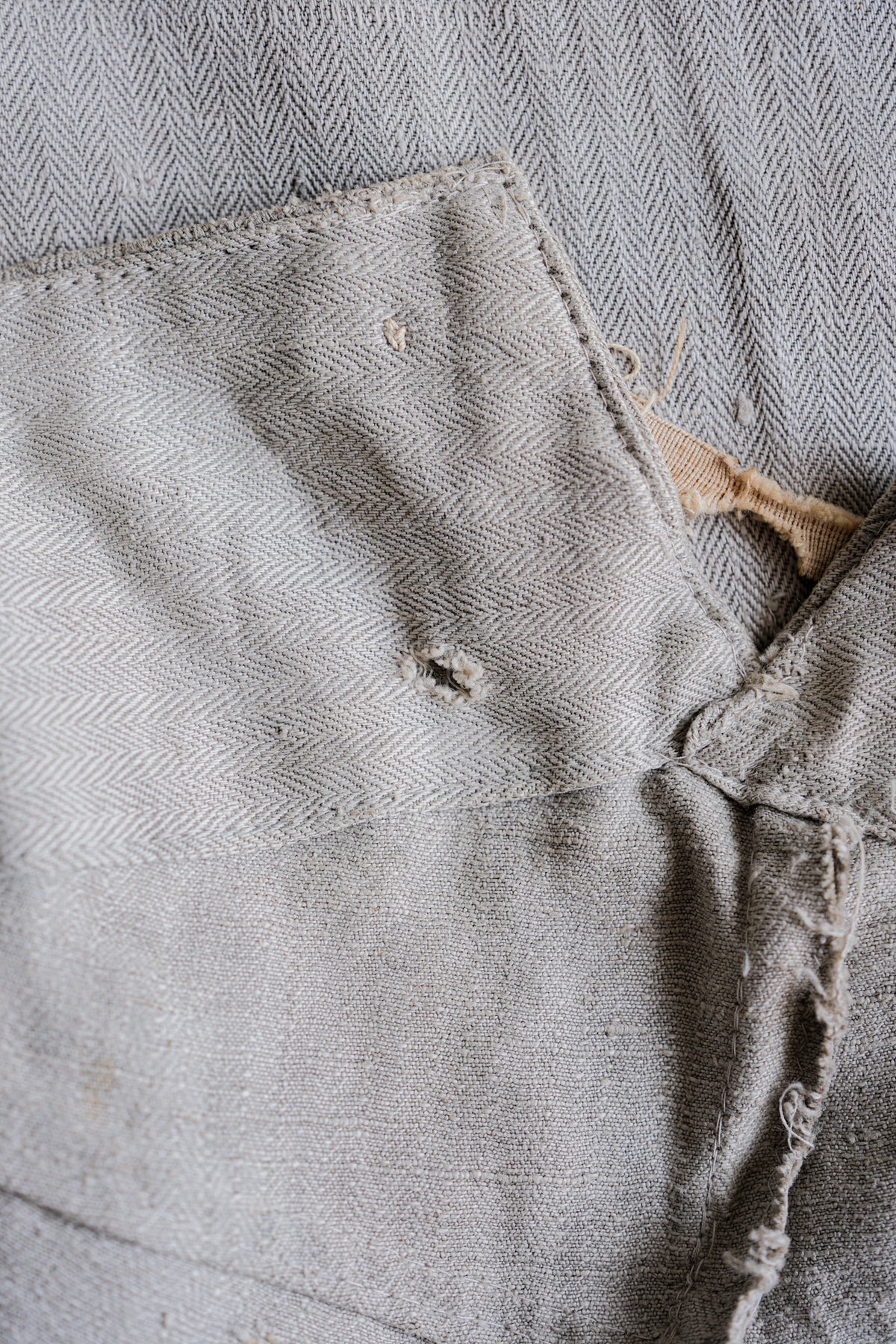
The front features a button fly, equipped with horn buttons—a detail uncommonly seen in Wehrmacht issue.
The silhouette presents an unexpectedly refined straight cut, far removed from typical military construction.
This straight silhouette lengthens and flatters the leg, creating elegant proportions regardless of frame.
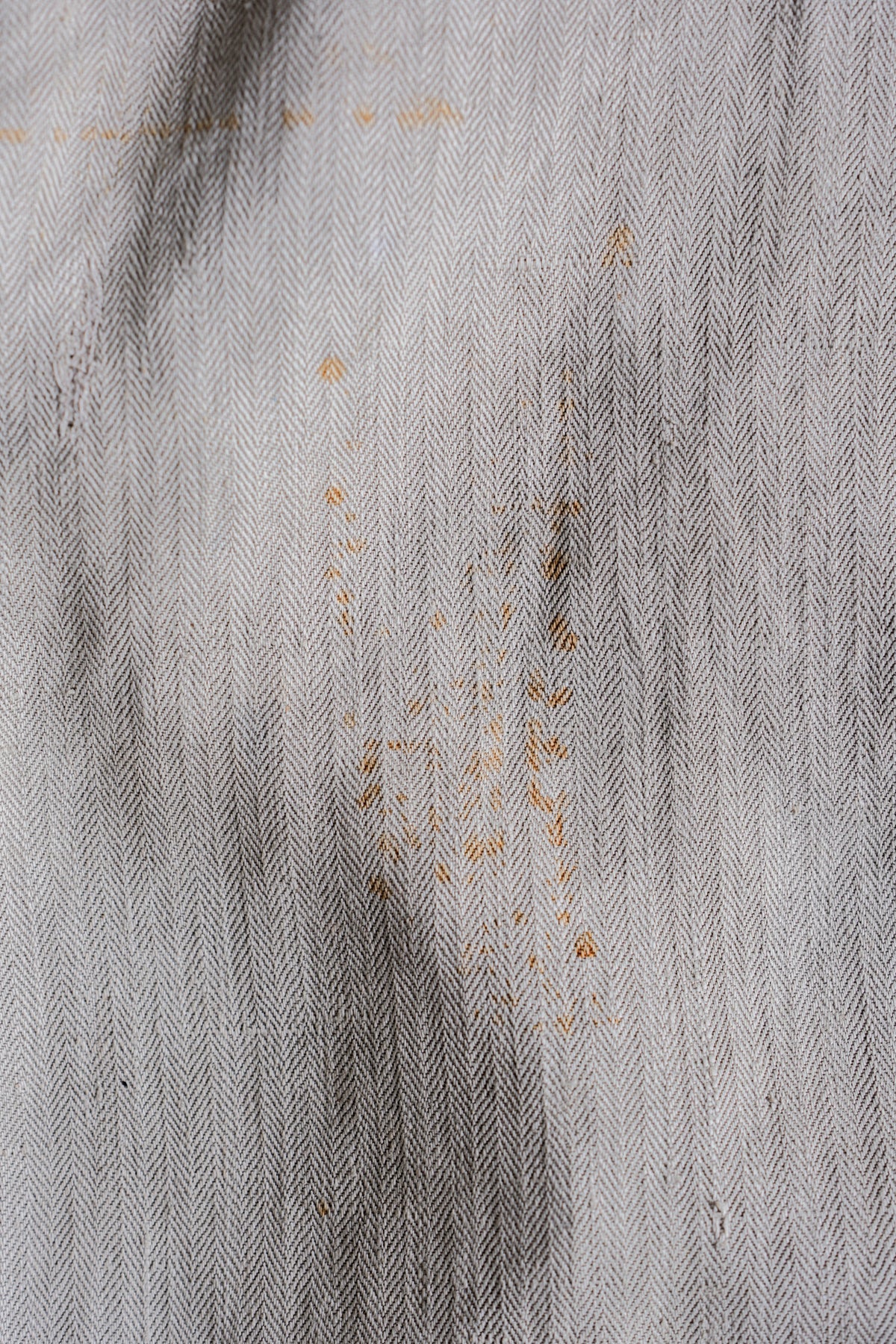
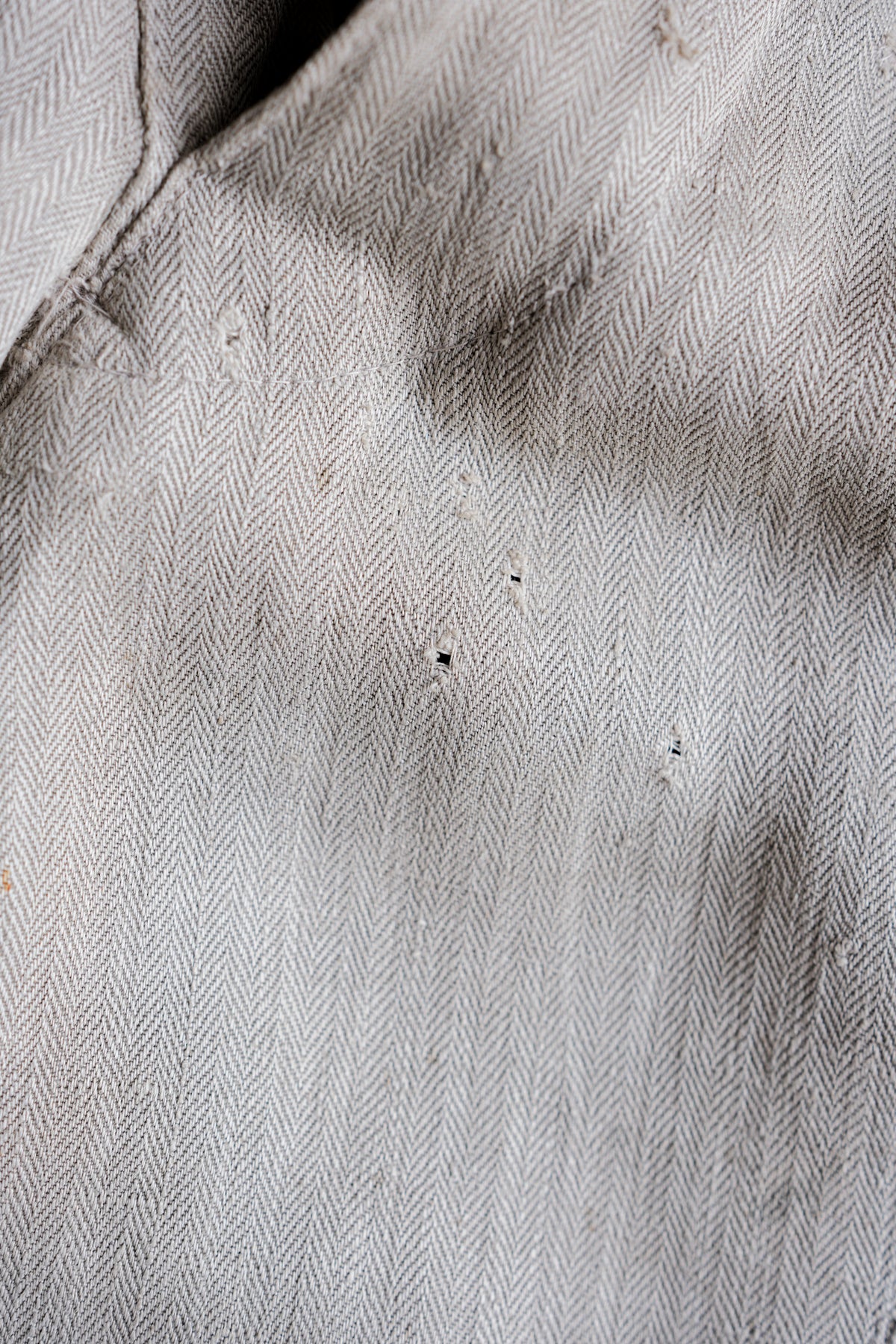
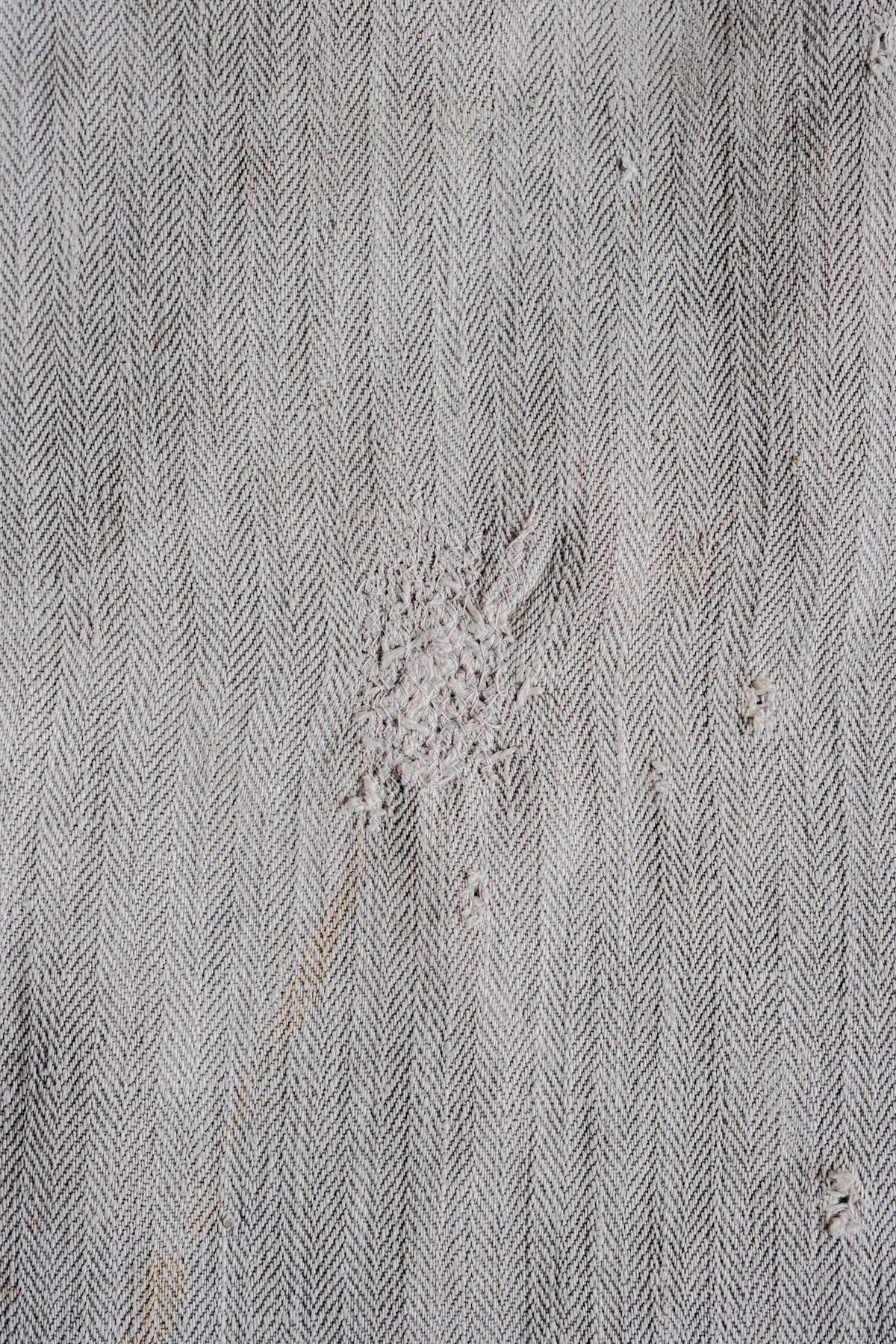
The fabric employs the Drillich characteristic to Wehrmacht manufacture—a 100% linen herringbone twill held in high regard throughout the vintage market.
Linen of this era possesses a tangible quality—discernible even to untrained hands—now deemed beyond reproduction. The fabric alone warrants considerable value.
This pair lacks belt loops, intended for suspension wear or adjustment via side cinches.
No size marking is evident, though dimensions suggest an approximate fit equivalent to Japanese S to M.
Proportions align well with typical Japanese frames, accommodating a range of builds.
Visible wear—soiling, abrasion, minor tears, small holes, and repair marks—are present, though no damage precludes continued wear.
Wehrmacht pieces have drawn increasing attention in recent years, yet originals remain exceptionally scarce given historical context. Supply struggles to meet demand.
With a devoted collector base, Wehrmacht items represent archive pieces collectors seldom relinquish.
Worthy both as wardrobe staple and collection piece.Wehrmacht items remain rare acquisitions at our shop. Should you seek such a piece, this represents an uncommon opportunity.
ADD TO CART

![[~40's]WWⅡ German Army Drillich HBT Linen Trousers "Wehrmacht"](http://vieuxetnouveau-shop.com/cdn/shop/files/DSCF7555.jpg?v=1728491991&width=2400)
![[~40's]WWⅡ German Army Drillich HBT Linen Trousers "Wehrmacht"](http://vieuxetnouveau-shop.com/cdn/shop/files/DSCF7573.jpg?v=1728491991&width=2400)
![[~40's]WWⅡ German Army Drillich HBT Linen Trousers "Wehrmacht"](http://vieuxetnouveau-shop.com/cdn/shop/files/DSCF7566.jpg?v=1728491991&width=2400)
![[~40's]WWⅡ German Army Drillich HBT Linen Trousers "Wehrmacht"](http://vieuxetnouveau-shop.com/cdn/shop/files/DSCF7558.jpg?v=1728491991&width=2400)
![[~40's]WWⅡ German Army Drillich HBT Linen Trousers "Wehrmacht"](http://vieuxetnouveau-shop.com/cdn/shop/files/DSCF7574.jpg?v=1728491991&width=2400)
![[~40's]WWⅡ German Army Drillich HBT Linen Trousers "Wehrmacht"](http://vieuxetnouveau-shop.com/cdn/shop/files/DSCF7567.jpg?v=1728491991&width=2400)
![[~40's]WWⅡ German Army Drillich HBT Linen Trousers "Wehrmacht"](http://vieuxetnouveau-shop.com/cdn/shop/files/DSCF7559.jpg?v=1728491991&width=2400)
![[~40's]WWⅡ German Army Drillich HBT Linen Trousers "Wehrmacht"](http://vieuxetnouveau-shop.com/cdn/shop/files/DSCF7560.jpg?v=1728491991&width=2400)
![[~40's]WWⅡ German Army Drillich HBT Linen Trousers "Wehrmacht"](http://vieuxetnouveau-shop.com/cdn/shop/files/DSCF7561.jpg?v=1728491991&width=2400)
![[~40's]WWⅡ German Army Drillich HBT Linen Trousers "Wehrmacht"](http://vieuxetnouveau-shop.com/cdn/shop/files/DSCF7568.jpg?v=1728491991&width=2400)
![[~40's]WWⅡ German Army Drillich HBT Linen Trousers "Wehrmacht"](http://vieuxetnouveau-shop.com/cdn/shop/files/DSCF7569.jpg?v=1728491991&width=2400)
![[~40's]WWⅡ German Army Drillich HBT Linen Trousers "Wehrmacht"](http://vieuxetnouveau-shop.com/cdn/shop/files/DSCF7572.jpg?v=1728491991&width=2400)
![[~40's]WWⅡ German Army Drillich HBT Linen Trousers "Wehrmacht"](http://vieuxetnouveau-shop.com/cdn/shop/files/DSCF7575.jpg?v=1728491991&width=2400)
![[~40's]WWⅡ German Army Drillich HBT Linen Trousers "Wehrmacht"](http://vieuxetnouveau-shop.com/cdn/shop/files/DSCF7576.jpg?v=1728491991&width=2400)
![[~40's]WWⅡ German Army Drillich HBT Linen Trousers "Wehrmacht"](http://vieuxetnouveau-shop.com/cdn/shop/files/DSCF7562.jpg?v=1728491991&width=2400)
![[~40's]WWⅡ German Army Drillich HBT Linen Trousers "Wehrmacht"](http://vieuxetnouveau-shop.com/cdn/shop/files/DSCF7582.jpg?v=1728491991&width=2400)
![[~40's]WWⅡ German Army Drillich HBT Linen Trousers "Wehrmacht"](http://vieuxetnouveau-shop.com/cdn/shop/files/DSCF8180.jpg?v=1728491992&width=2400)
![[~40's]WWⅡ German Army Drillich HBT Linen Trousers "Wehrmacht"](http://vieuxetnouveau-shop.com/cdn/shop/files/DSCF8181.jpg?v=1728491992&width=2400)
![[~40's]WWⅡ German Army Drillich HBT Linen Trousers "Wehrmacht"](http://vieuxetnouveau-shop.com/cdn/shop/files/DSCF8182.jpg?v=1728491992&width=2400)
![[~40's]WWⅡ German Army Drillich HBT Linen Trousers "Wehrmacht"](http://vieuxetnouveau-shop.com/cdn/shop/files/DSCF8183.jpg?v=1728491992&width=2400)
![[~40's]WWⅡ German Army Drillich HBT Linen Trousers "Wehrmacht"](http://vieuxetnouveau-shop.com/cdn/shop/files/DSCF8184.jpg?v=1728491992&width=2400)
![[~40's]WWⅡ German Army Drillich HBT Linen Trousers "Wehrmacht"](http://vieuxetnouveau-shop.com/cdn/shop/files/DSCF8185.jpg?v=1728491992&width=2400)
![[~40's]WWⅡ German Army Drillich HBT Linen Trousers "Wehrmacht"](http://vieuxetnouveau-shop.com/cdn/shop/files/DSCF8186.jpg?v=1728491992&width=2400)
![[~40's]WWⅡ German Army Drillich HBT Linen Trousers "Wehrmacht"](http://vieuxetnouveau-shop.com/cdn/shop/files/DSCF8342.jpg?v=1728491992&width=2400)