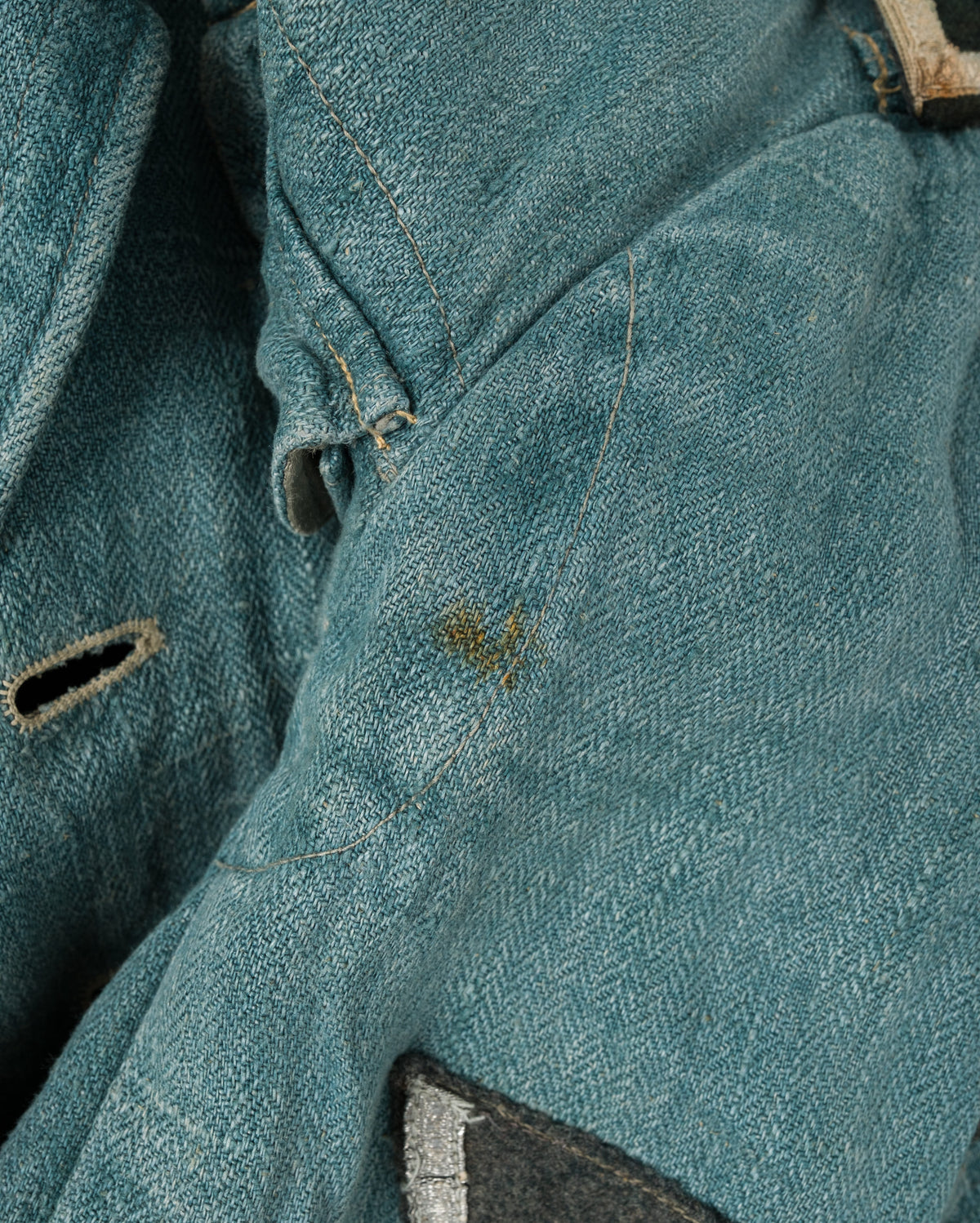
Circa 1940s Wehrmacht Turquoise Green Drillich Herringbone Twill Linen Summer Field Jacket.
A truly exceptional acquisition.
Wehrmacht, the unified military force of Nazi Germany spanning 1935–1945, comprised three branches: the Heer (Army), Kriegsmarine (Navy), and Luftwaffe (Air Force).
The designation Wehrmacht replaced the earlier "Reichswehr," embodying Nazi Germany's ambitious rearmament efforts that exceeded the constraints of the Treaty of Versailles.
Following Adolf Hitler's consolidation of power in 1933, the establishment of Wehrmacht represented one of his most audacious undertakings.
Following Germany's unconditional surrender on 8 May 1945, Allied occupation commenced and Wehrmacht underwent systematic dissolution.
In the aftermath of Wehrmacht's dissolution, Germany became a demilitarised nation. Subsequent rearmament occurred separately within the contexts of Cold War division: West Germany and East Germany each pursued distinct military development.
These successor military organisations were formally constituted as distinct entities, separated from Wehrmacht tradition and structure.
From the Wehrmacht itself, we present the "Drillich Summer Field Jacket (Drillichanzug)," issued and worn as summer field dress during the Second World War.
Drillich—a German term for a sturdy twill cloth (drill)—was, in the German military of the period, mainly made as Herringbone Twill fabric.
Originally manufactured in undyed tones as training and work wear, its comfort and practical utility prompted adoption as summer combat dress once hostilities commenced.
Though initially conceived for training and work purposes, the Drillich underwent continual refinement in colour and construction to suit combat conditions, evolving to address practical field requirements.
The Wehrmacht's Drillich was produced with reference to the French Bourgeron, resulting in striking similarities in both detail and fabric character.
While Drillich-fabricated items in Wehrmacht service typically manifest as work jackets for base duties—items relatively common in the marketplace—a summer field jacket (Drillichanzug) such as this specimen remains exceptionally scarce, the object of serious collector interest.
The field jacket before us exhibits details—a six-button front and pleated pocket construction—that overseas specialists designate "1st Pattern," commanding significant valuations.
A lead green variant of this pattern exists. This particular example, however, employs an uncommon turquoise green—a shade bearing distinctly bluish undertones—representing genuine rarity.
The vast majority of surviving examples present in lead green. This turquoise variant marks the first I have encountered personally.
The collar bears insignia for general service; detachable shoulder boards identify the 248th Regiment; the left sleeve displays Waffen-SS Sturmmann rank markings; the right chest bears the state eagle emblem. (Please refer to the final statement before purchase.)
Front buttons employ Wehrmacht-specific specification, retained via S-ring fixtures on the reverse.
The interior presents rayon lining throughout, including a field dressing pocket.
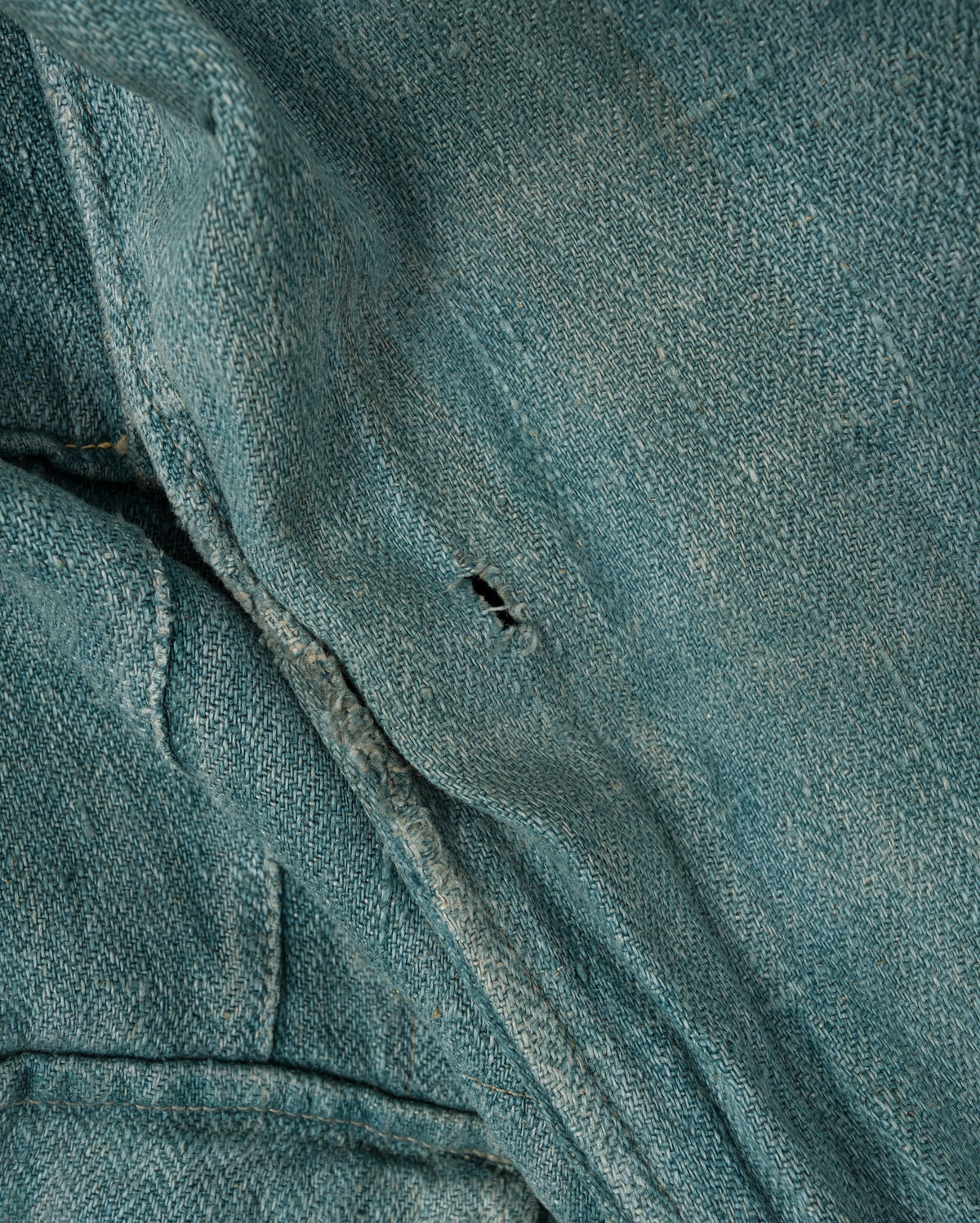
The fabric employs Drillich—the herringbone twill technique specific to Wehrmacht manufacture—realised in 100% linen, a material commanding considerable esteem within vintage textile markets.
Linen of this era remains demonstrably superior; even an untrained hand perceives its distinction. Contemporary reproduction remains, by consensus, impossible. The textile alone justifies serious consideration.
No size designation remains legible, though proportions suggest Japanese XS to S scale.
The actual measurements confirm a compact fit; those of slight stature should find it entirely wearable.
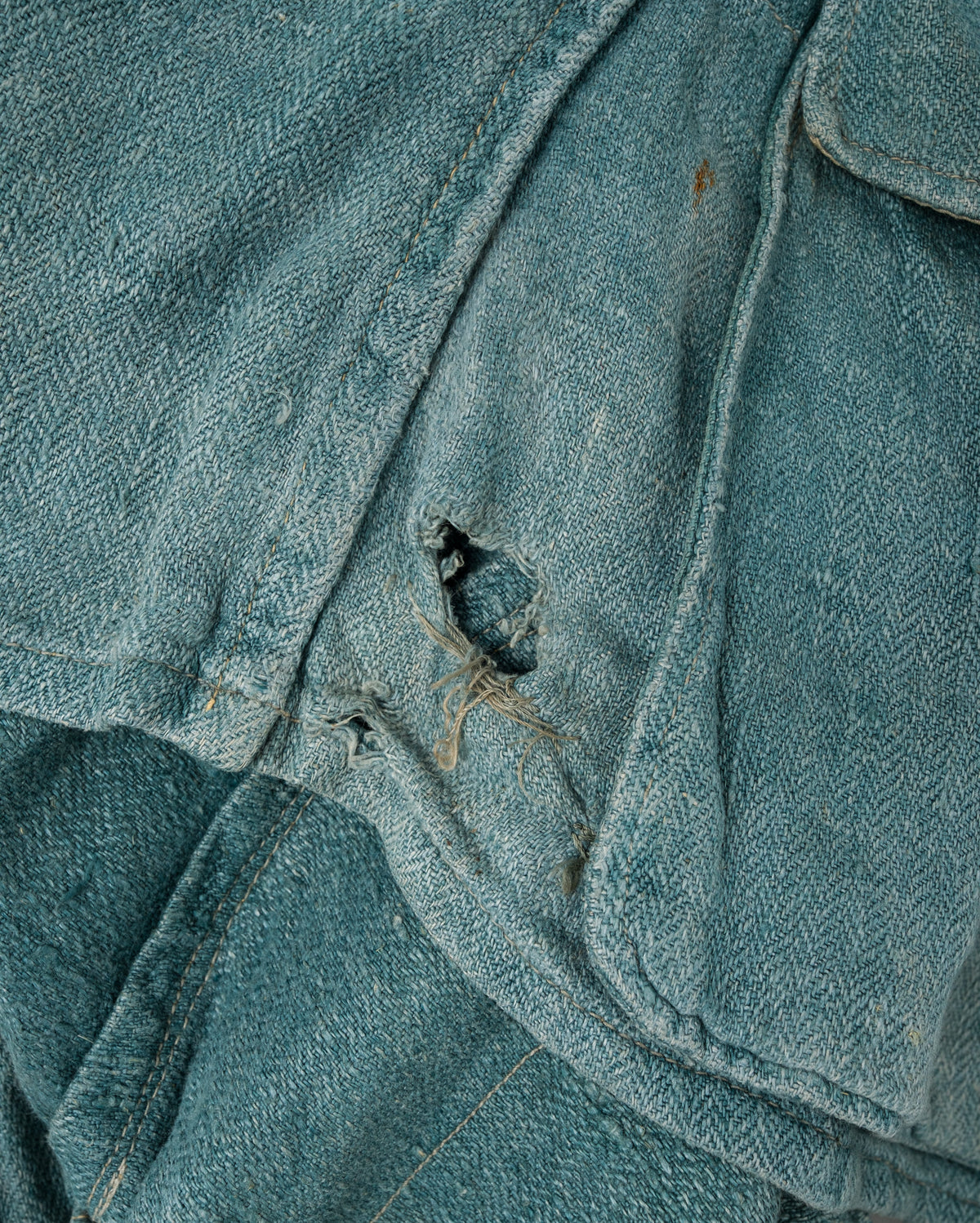
Evidence of use is present—soiling, rust, small holes, tears, missing buttons—yet no damage of consequence impedes wear. It remains serviceable.
Wehrmacht material has commanded increased attention recently, yet the historical circumstances surrounding such pieces ensure their scarcity. Supply fundamentally lags demand.
Wehrmacht holds a dedicated collector following; such archive pieces remain firmly within serious collections, rarely released to market.
Such objects transcend commercial transaction—availability cannot be assured.
As both a functional wardrobe element and archival specimen, this example remains without compromise. Its rarity within domestic and international markets cannot be overstated. Those who have sought such material should regard this opportunity seriously.
Note: We handle uniforms and related military material from Nazi Germany during the Second World War, offered exclusively for their value as historical documentation and collectible objects.
Such material serves legitimate demand from film, television, theatrical production, and historical scholarship, as well as serious collectors. This commerce remains entirely separate from, and bears no endorsement of, the historical ideologies and events from which these objects originate.
Certain examples bear state eagle insignia from the period (including insignia integral to Nazi iconography).
We ask that purchase be made only by those who comprehend and respect this material as historical documentation, free from ideological association.
ADD TO CART