Estimated 1940s Kriegsmarine linen bespoke trousers.
A special acquisition.
Kriegsmarine , the Kriegsmarine, was established in 1935 under the Rearmament Act and served as the naval branch of the Reichswehr.
Heavily constrained by the Treaty of Versailles following the First World War, the German Navy quietly expanded its naval capabilities—including submarines—during the rearmament period of the 1930s.
The Kriegsmarine inherited the legacy of the Imperial Navy (Kaiserliche Marine) from the First World War and the Reichsmarine of the Weimar Republic, operating from 1935 to 1945 throughout the Second World War.
Its organization and operations carried forward much from the Reichsmarine, engaging in various military campaigns throughout the conflict.
What we present here are bespoke trousers, believed to have been tailored specifically for Kriegsmarine officers of that period.
The white working and training uniforms of the Kriegsmarine trace their lineage to the Royal Prussian Navy (1701–1867), were continued with minor modifications through the German Imperial Navy (1871–1918), and were ultimately inherited by the Kriegsmarine itself.
This particular piece, however, stands apart from standard working or training garments. These are bespoke trousers tailored for officers—a special archive.
Both front and back feature an absence of unnecessary embellishment. This simplicity and restraint—devoid of decorative excess—is perhaps essential for wear as a fashion item in the contemporary context.
The front employs a button fly, fitted with metal buttons typical of German military hardware.
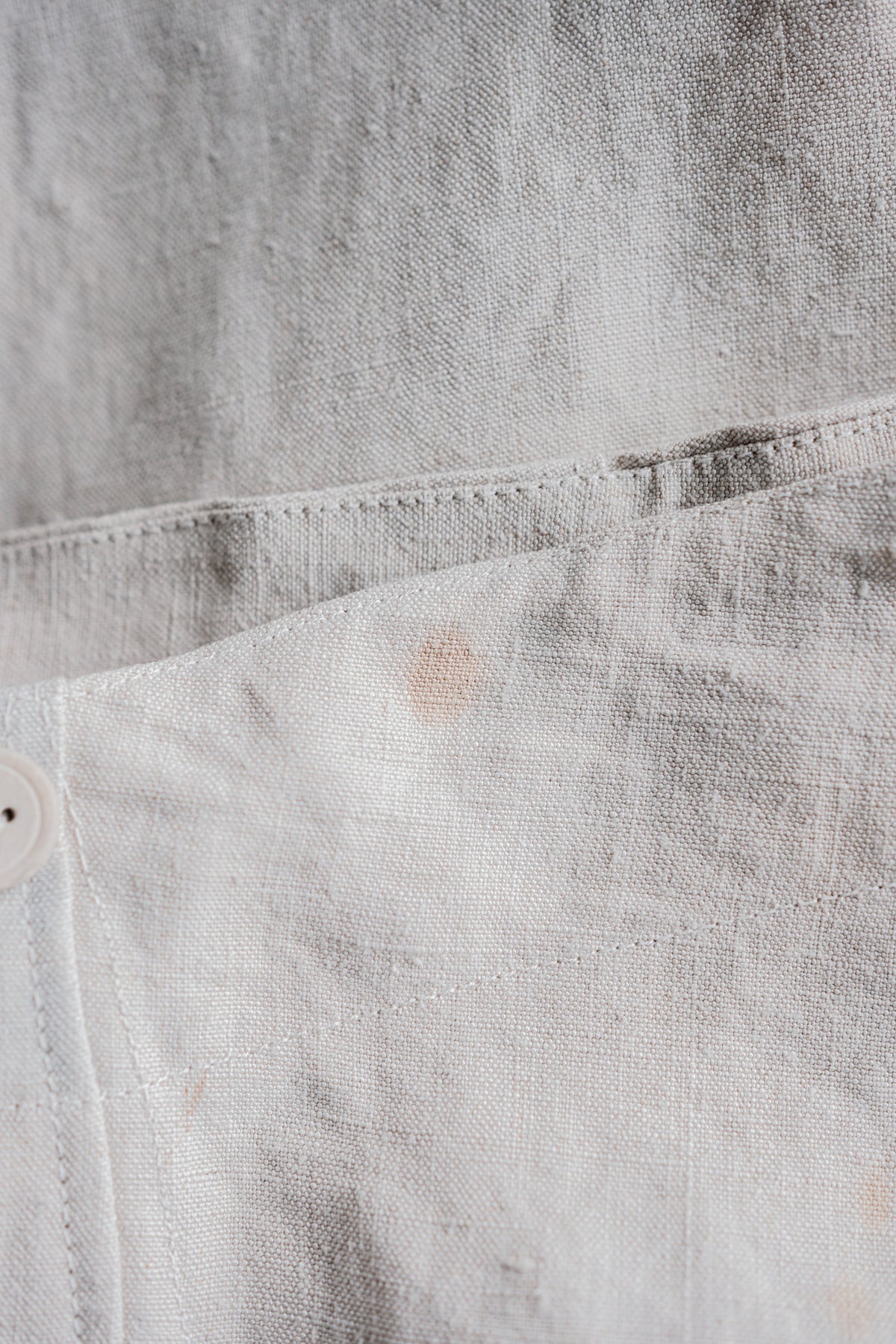
The fabric is a substantial linen, regarded highly in the vintage market. It shares the quality of French linen, with that distinctive drape and subtle movement that has become sought-after among enthusiasts.
German military and Kriegsmarine linens typically employ Drillich—an HBT weave. These trousers, however, feature plain weave linen, an exceptionally rare detail for the period and context.
Linen of this era possesses a quality discernible to the untrained touch, a standard deemed impossible to replicate in modern production. The fabric alone carries substantial historical and material value.
Beyond rarity, these trousers possess genuine sartorial merit and are executed with considerable presence. They warrant genuine wear, not merely collection.
No size marking is visible, though these appear to correspond roughly to a modern large to extra-large.
The measurements suggest a generous fit, suitable for larger frames. For slighter builds, the integrated suspender buttons ensure clean proportions and proper drape.
Patina and evidence of wear are present, yet no damage of consequence impedes wear. These remain entirely serviceable.
With a devoted following, Kriegsmarine pieces are regarded as archive of the highest order—pieces collectors are reluctant to release.
These serve equally as wardrobe essential, collection anchor, or design reference. They transcend simple utility.German military items arrive infrequently at our shop. If you have sought such a piece, do not overlook this opportunity.
ADD TO CART

![[~40's]WWⅡ German Navy Linen Bespoke Trousers "Kriegsmarine"](http://vieuxetnouveau-shop.com/cdn/shop/files/DSCF6350.jpg?v=1728532963&width=2400)
![[~40's]WWⅡ German Navy Linen Bespoke Trousers "Kriegsmarine"](http://vieuxetnouveau-shop.com/cdn/shop/files/DSCF6371.jpg?v=1728532963&width=2400)
![[~40's]WWⅡ German Navy Linen Bespoke Trousers "Kriegsmarine"](http://vieuxetnouveau-shop.com/cdn/shop/files/DSCF6361.jpg?v=1728532963&width=2400)
![[~40's]WWⅡ German Navy Linen Bespoke Trousers "Kriegsmarine"](http://vieuxetnouveau-shop.com/cdn/shop/files/DSCF6351.jpg?v=1728532963&width=2400)
![[~40's]WWⅡ German Navy Linen Bespoke Trousers "Kriegsmarine"](http://vieuxetnouveau-shop.com/cdn/shop/files/DSCF6373_ec7045c5-96ab-4770-b330-ba1883bbb3b1.jpg?v=1728532963&width=2400)
![[~40's]WWⅡ German Navy Linen Bespoke Trousers "Kriegsmarine"](http://vieuxetnouveau-shop.com/cdn/shop/files/DSCF6362_5d0602e2-cdf2-4692-958d-7ad0b0146be6.jpg?v=1728532963&width=2400)
![[~40's]WWⅡ German Navy Linen Bespoke Trousers "Kriegsmarine"](http://vieuxetnouveau-shop.com/cdn/shop/files/DSCF6352.jpg?v=1728532963&width=2400)
![[~40's]WWⅡ German Navy Linen Bespoke Trousers "Kriegsmarine"](http://vieuxetnouveau-shop.com/cdn/shop/files/DSCF6355_c1a6b8f0-70f3-4873-9e25-aaf3acf0afd0.jpg?v=1728532963&width=2400)
![[~40's]WWⅡ German Navy Linen Bespoke Trousers "Kriegsmarine"](http://vieuxetnouveau-shop.com/cdn/shop/files/DSCF6358.jpg?v=1728532963&width=2400)
![[~40's]WWⅡ German Navy Linen Bespoke Trousers "Kriegsmarine"](http://vieuxetnouveau-shop.com/cdn/shop/files/DSCF6364_ef7d184a-ae1f-4830-9b4d-2597b093bed9.jpg?v=1728532963&width=2400)
![[~40's]WWⅡ German Navy Linen Bespoke Trousers "Kriegsmarine"](http://vieuxetnouveau-shop.com/cdn/shop/files/DSCF6369.jpg?v=1728532963&width=2400)
![[~40's]WWⅡ German Navy Linen Bespoke Trousers "Kriegsmarine"](http://vieuxetnouveau-shop.com/cdn/shop/files/DSCF6370.jpg?v=1728532963&width=2400)
![[~40's]WWⅡ German Navy Linen Bespoke Trousers "Kriegsmarine"](http://vieuxetnouveau-shop.com/cdn/shop/files/DSCF6368_41a07c33-a29f-44f4-acc8-e68e1cf4469e.jpg?v=1728532963&width=2400)
![[~40's]WWⅡ German Navy Linen Bespoke Trousers "Kriegsmarine"](http://vieuxetnouveau-shop.com/cdn/shop/files/DSCF6363_090c0d3f-f02a-453e-820c-5554728c7785.jpg?v=1728532963&width=2400)
![[~40's]WWⅡ German Navy Linen Bespoke Trousers "Kriegsmarine"](http://vieuxetnouveau-shop.com/cdn/shop/files/DSCF6374.jpg?v=1728532963&width=2400)
![[~40's]WWⅡ German Navy Linen Bespoke Trousers "Kriegsmarine"](http://vieuxetnouveau-shop.com/cdn/shop/files/DSCF6359_1a925b2d-d8c4-4c0e-8d9c-2d4e530a8dab.jpg?v=1728532963&width=2400)
![[~40's]WWⅡ German Navy Linen Bespoke Trousers "Kriegsmarine"](http://vieuxetnouveau-shop.com/cdn/shop/files/DSCF7002.jpg?v=1728532963&width=2400)
![[~40's]WWⅡ German Navy Linen Bespoke Trousers "Kriegsmarine"](http://vieuxetnouveau-shop.com/cdn/shop/files/DSCF7003_1c2358e5-573d-4030-8a7f-90070afb2bd4.jpg?v=1728532963&width=2400)
![[~40's]WWⅡ German Navy Linen Bespoke Trousers "Kriegsmarine"](http://vieuxetnouveau-shop.com/cdn/shop/files/DSCF7004.jpg?v=1728532963&width=2400)
![[~40's]WWⅡ German Navy Linen Bespoke Trousers "Kriegsmarine"](http://vieuxetnouveau-shop.com/cdn/shop/files/DSCF7005.jpg?v=1728532963&width=2400)
![[~40's]WWⅡ German Navy Linen Bespoke Trousers "Kriegsmarine"](http://vieuxetnouveau-shop.com/cdn/shop/files/DSCF7008_0a8f780e-e581-4987-9551-2ac4aeb56b0f.jpg?v=1728532963&width=2400)
![[~40's]WWⅡ German Navy Linen Bespoke Trousers "Kriegsmarine"](http://vieuxetnouveau-shop.com/cdn/shop/files/DSCF7009_f11feba2-af65-4b63-891e-51b12876841f.jpg?v=1728532963&width=2400)
![[~40's]WWⅡ German Navy Linen Bespoke Trousers "Kriegsmarine"](http://vieuxetnouveau-shop.com/cdn/shop/files/DSCF7007.jpg?v=1728532963&width=2400)
![[~40's]WWⅡ German Navy Linen Bespoke Trousers "Kriegsmarine"](http://vieuxetnouveau-shop.com/cdn/shop/files/DSCF7011_b26dc19c-b662-4e21-a1fb-9b5ccd1716b5.jpg?v=1728532963&width=2400)