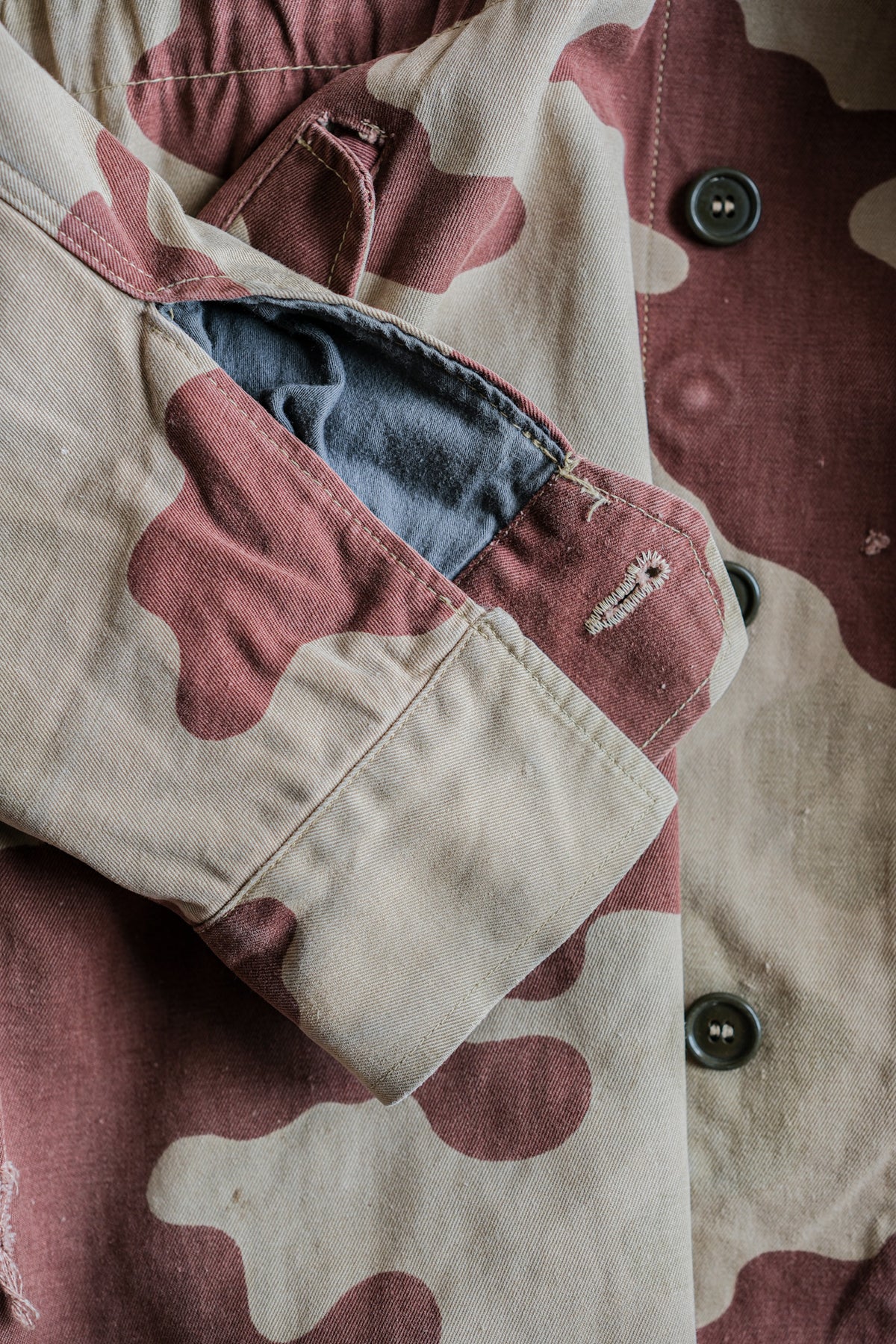
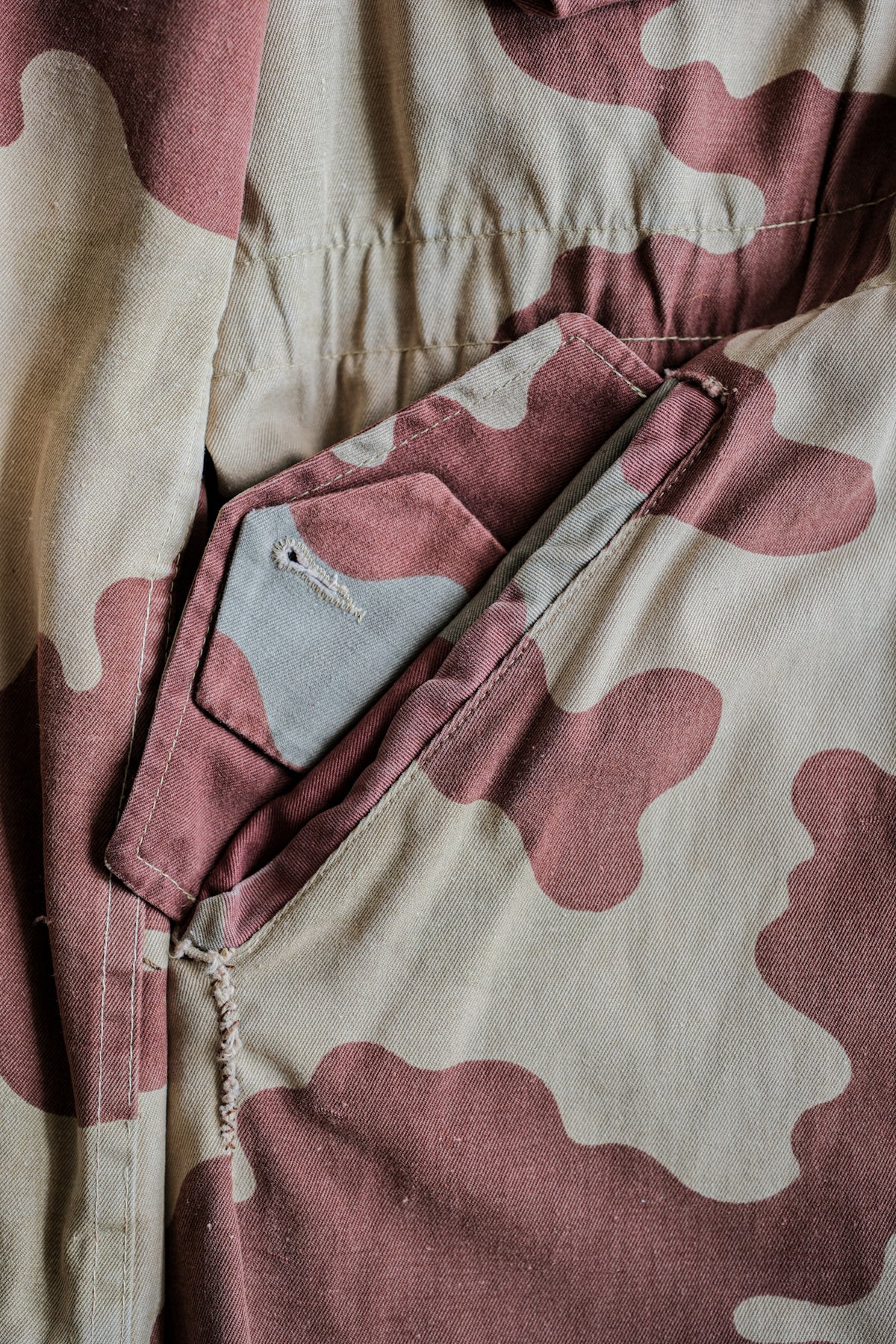
Circa 1940s, an Italian Social Republic National Republican Army "San Marco Camouflage Field Jacket."
A superb acquisition.
The National Republican Army (ENR) was the military force of the Italian Social Republic (RSI), which fought alongside Nazi Germany during the Second World War from 1943 to 1945.
Formed officially on October 28, 1943, it unified former Royal Army units loyal to fascist dictator Benito Mussolini with pro-fascist Italian forces established by Germany after its occupation of Italy.
The National Republican Army comprised primarily four infantry divisions, organized, trained, and equipped in Germany: the 1st Bersaglieri Division "Italia," the 2nd Grenadier Division "Littorio," the 3rd Marine Infantry Division "San Marco," and the 4th Alpine Division "Monterosa."
The National Republican Army served primarily in defensive operations against the Allies and in suppressing partisan activities. It played a significant role in defending the Gothic Line, and achieved notable success in engagements against the American 92nd Infantry Division in cooperation with German forces. Ultimately, it surrendered to Allied forces in April 1945.
The Italian Social Republic (RSI) existed from September 1943 to April 1945 as a collaborative state with Nazi Germany. Established at Hitler's behest to govern German-occupied Italian territory following the Armistice of Cassibile, it was led by Benito Mussolini.
The government was headquartered in the small town of "Salò" on Lake Garda in northern Italy, rendering it alternatively known as the "Salò Republic."
Italian partisans waged guerrilla warfare against both German forces and the National Republican Army, eventually liberating northern Italy in April 1945 with Allied support. Mussolini was captured by partisans on April 27, 1945, and executed the following day, whereupon the Italian Social Republic was formally dissolved, having endured merely nineteen months.
We present a Field Jacket bearing San Marco camouflage, issued and worn by the National Republican Army during the Second World War, a relic of the Italian Social Republic's brief existence.
The camouflage pattern appears to be an evolution of the "M1929 telo mimetico," the first mass-produced military camouflage. It is commonly known as "San Marco Camouflage."
The San Marco pattern varied considerably by period and command authority. This example presents an exceptionally rare colorway.
At first glance, it bears similarity to the pattern adopted by the Italian Navy circa the 1960s, yet closer examination reveals distinct differences.
The 1960s variant, worn by both the San Marco Battalion (Battaglione San Marco) and the Naval Special Forces (COMSUBIN), employed three colours—light grey ground with red-brown and sand—a classic composition.
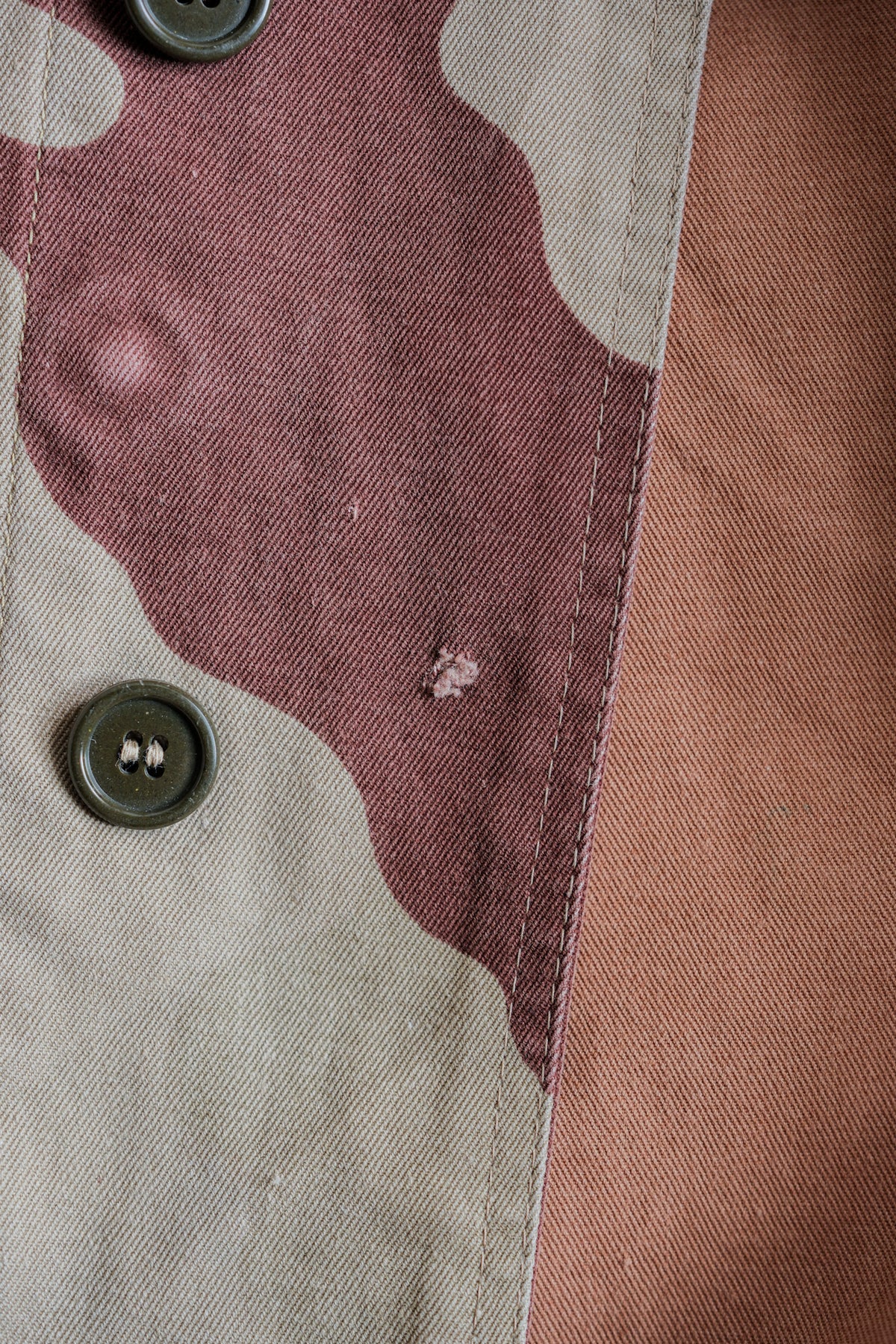
This example, by contrast, employs a sand-coloured ground with brown and scarcely perceptible light grey, rendering it essentially a two-tone palette.
Though subtle, this distinction is significant. This particular colorway represents my first encounter with such a pattern.
While this example's camouflage is rare, its other details align with later variants of the jacket.
An open-collar design, military epaulettes, chest-mounted flap pockets with interior button closures, hem-level hand warmer pockets secured similarly—all these elements speak to the unmistakable presence of a true military piece.
Drawcords are fitted at the waist and hem. This dual-function design allows for silhouette adjustment—a versatility worth exploring according to mood and circumstance.
The collar is designed generously high, fitted with a chinstrap to prevent wind infiltration and enhance thermal retention. Standing the collar yields considerable visual presence.
The presence or absence of a chinstrap makes a profound difference. The elevation and atmosphere achieved by raising the collar represents an entirely different order of statement.
Among European military pieces, this example occupies a distinguished position with its special camouflage pattern. Beyond its rarity, from the perspective of pure fashion, it is an exceptionally compelling garment—one genuinely worth wearing.
No size marking is evident, though we estimate it corresponds to Japanese sizing "XL to XXL."
The actual measurements confirm a generous scale, suitable for larger frames without compromise. In the manner of military wear, it presents exceptionally well worn oversized.
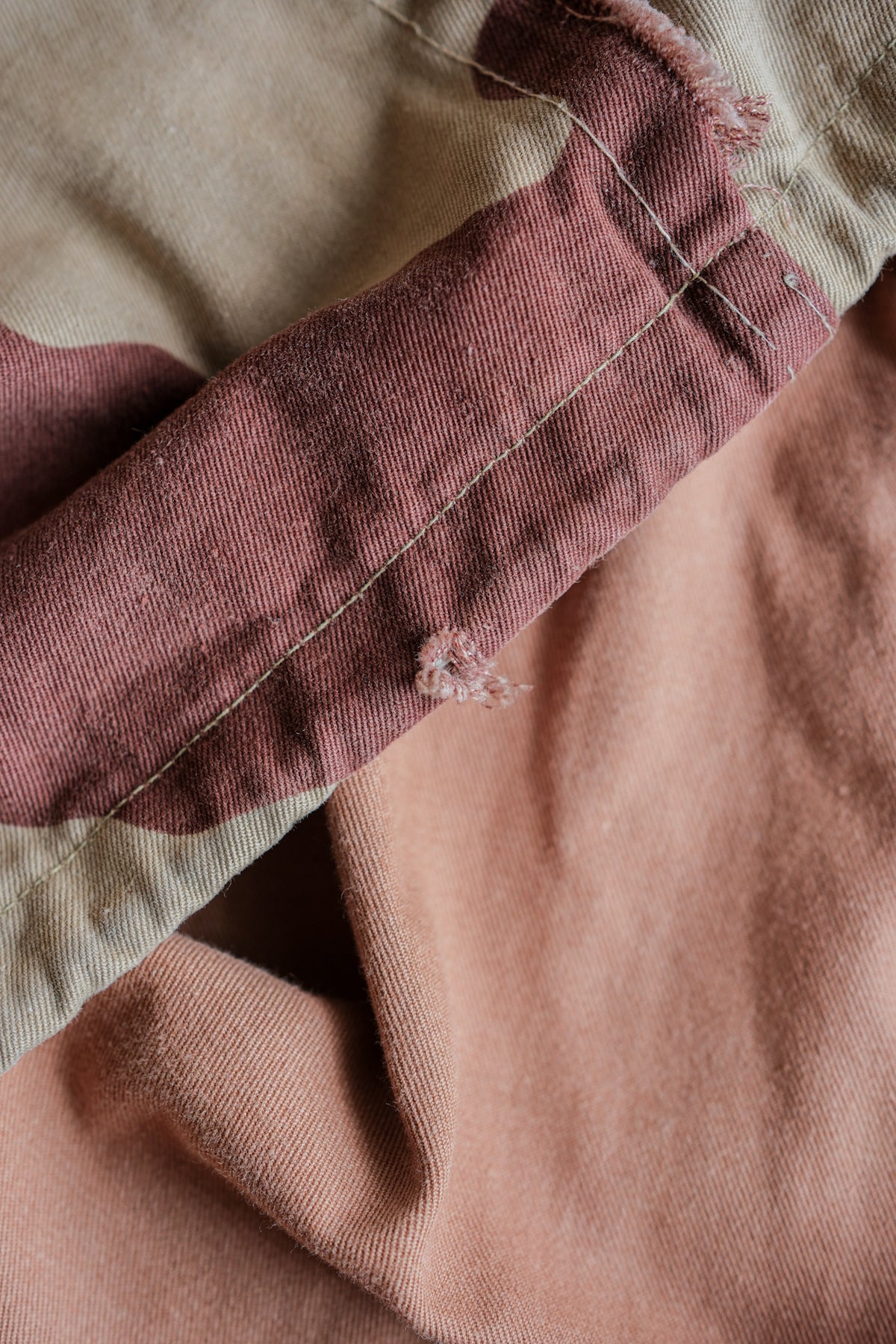
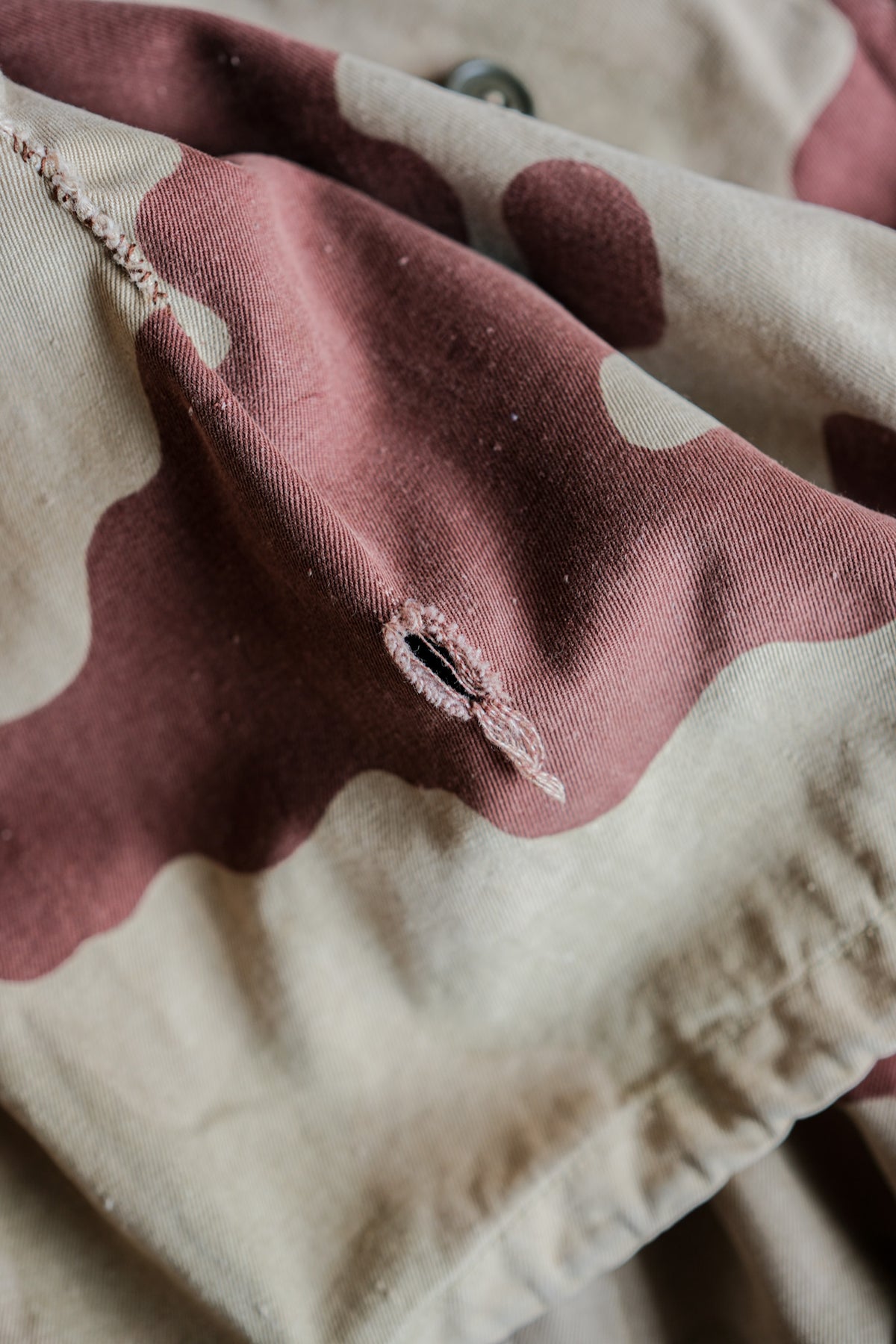
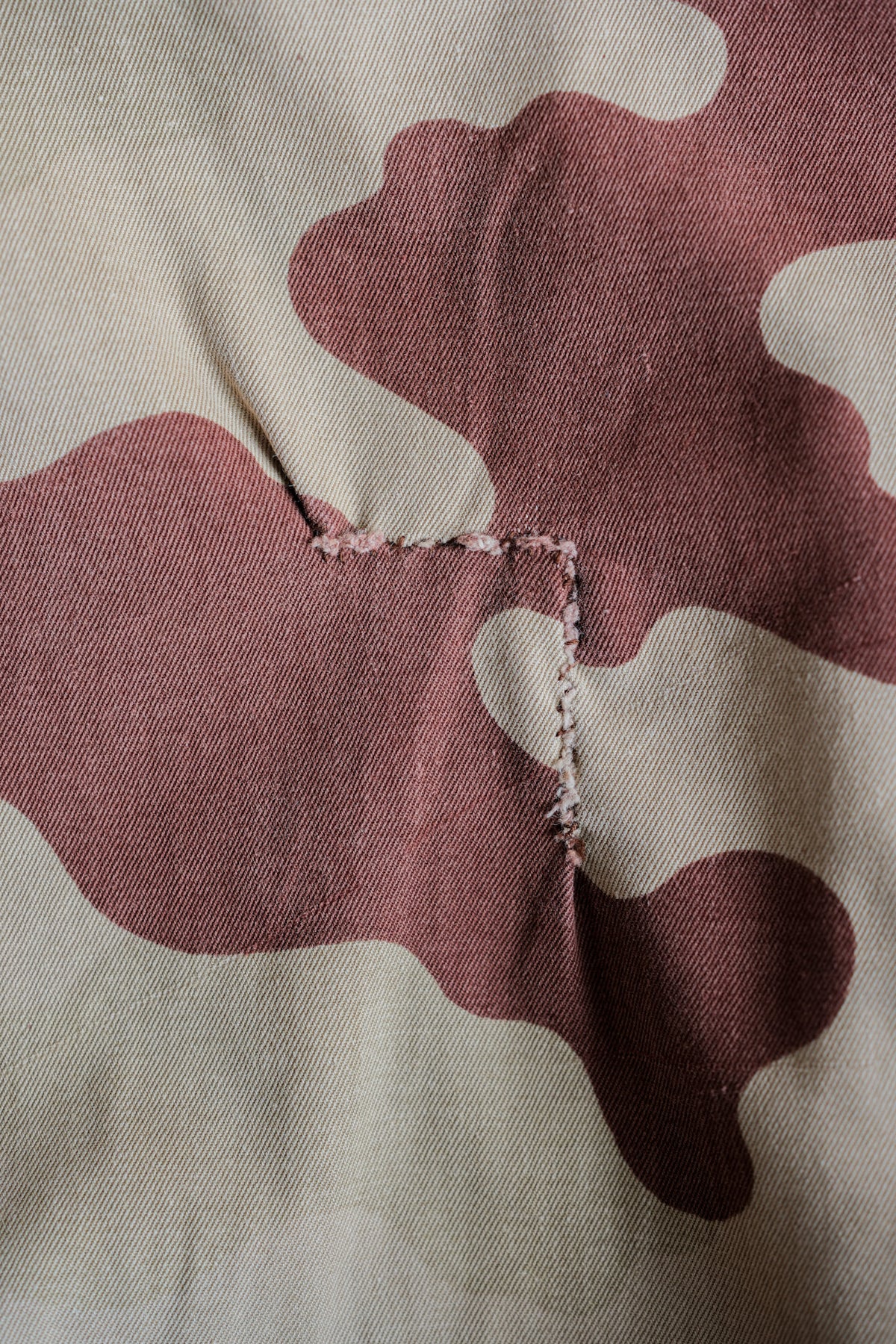
The jacket exhibits the patina of use—soiling, abrasion, loose threads, small holes, tears, repair work, button loss—yet no damage of consequence to wearability. It remains very much a functional garment.
Given its brief adoption window from 1943 to 1945, National Republican Army pieces are seldom encountered in the marketplace. This example, with its fashionable and distinctive camouflage pattern, merits careful consideration.
The National Republican Army maintains a devoted following among discerning collectors, making this an archive piece of undeniable significance.
Such an example cannot be procured simply by offering payment; future availability cannot be assured.
Whether as a wardrobe piece, collection piece, or design reference, this jacket warrants serious consideration. Rarely seen domestically or internationally, it deserves the attention of those who have sought such a piece or whose interest extends toward uncommon artifacts.
ADD TO CART