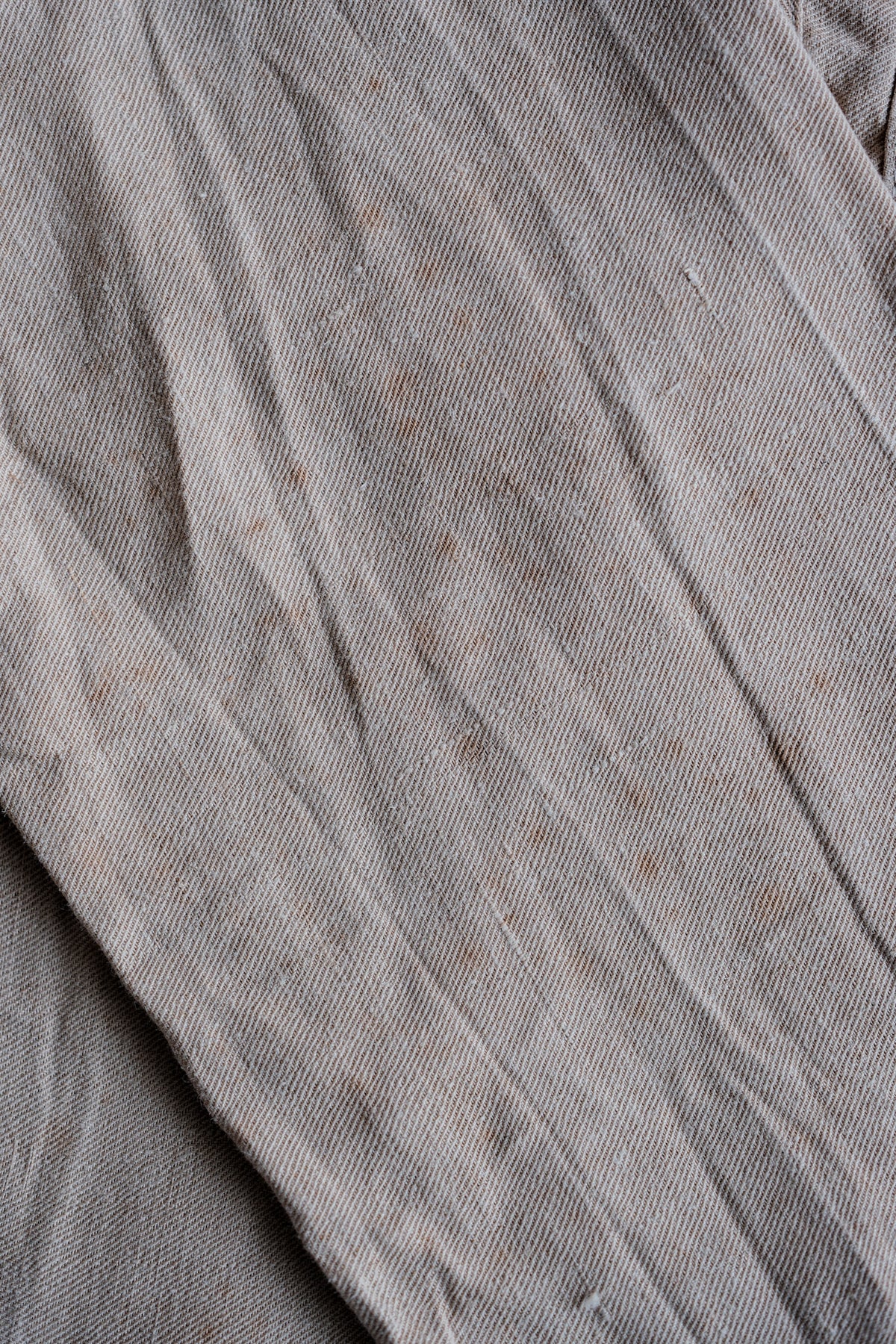
Circa 1940s, Royal Italian Navy Linen Twill Work Smock.
A special acquisition.
The Italian Navy carries a remarkably long military tradition, having stood at the center of European military conflict from Ancient Rome through the Medieval period, Renaissance, and the Italian unification campaigns.
The Royal Italian Navy was established in 1861 following Italian unification and participated in numerous conflicts—the Battle of Lissa, the Battle of Preveza, the Battle of Beirut, the Battle of Cunfuda Bay, World War I, and World War II among them.
During World War I, it sank the Austro-Hungarian battleship SMS Szent István. In World War II, its frogmen disabled the British battleships Queen Elizabeth and Valiant in the harbour at Alexandria.
The Royal Italian Navy was dissolved in 1946 with the abolition of the monarchy, transitioning to the modern Italian Navy upon the establishment of the Italian Republic that same year.
The service underwent a name change as well—from "Regia Marina" to "Marina Militare."
This piece is a "Linen Twill Work Smock," believed to have been issued and worn during summer months as a battleship deck working garment throughout World War II in the Royal Italian Navy.
A non-combatant work smock of the sort that regularly appears among the military clothing of many nations—French, German, and others.
This garment belongs to that lineage of practical workwear, occupying a position akin to the French Bourgeron.
Sharp, acutely pointed collar, three-button front closure, and a singular mountain-peaked flap pocket positioned on the left chest—details singular to this piece alone.
Vintage items that command admiration both in stillness and in wear possess a quality that stirs the spirit. The design restraint here is remarkable, its legibility undiminished by time.
Military-issue stamps remain visible along the interior hem, testament to its provenance.
The garment is constructed in linen, a material held in high regard within vintage markets.
Linen of this era possesses a quality immediately apparent even to the untrained hand, a benchmark that modern manufacture cannot approach. The fabric alone carries significant value.
Twill weave, being superior in durability to plain weave, grants this piece the fortitude to be worn without reservation—a practical advantage worth noting.
Beyond its scarcity, this is simply a handsome garment. Wear it without hesitation.
Size marked "2"
The measurements suggest a proportional fit for Japanese frames—a golden size capable of accommodating a range of builds.
There are marks, creases, and abrading consistent with wear, though no significant damage impeding use is evident. It remains serviceable.
Royal Italian Navy pieces surface rarely.
The Royal Italian Navy maintains a devoted following of collectors, for whom such archive pieces represent the essential quarry.
As a wardrobe element, equally as a collection piece or design reference, this stands beyond reservation.
ADD TO CART