A ‘Frogskin Camouflage Short Jacket’ of the U.S. Army / Marine Corps, estimated to date from around the 1940s.
Did the American forces ever have a jacket like this — that was my first thought on finding it.
And with reason, because this was not a jacket to begin with.
The original was a one-piece: coveralls, with top and bottom joined.
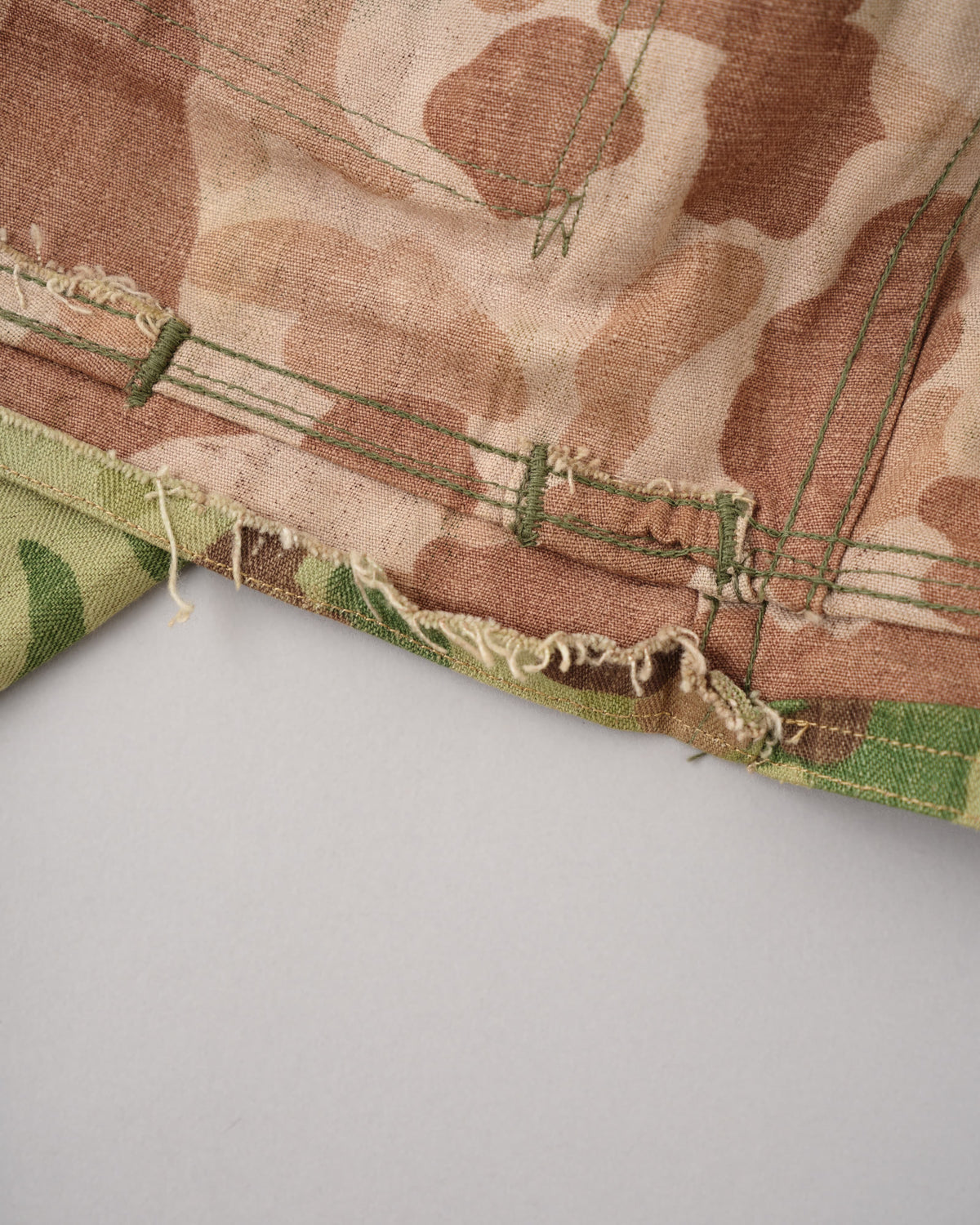
A previous owner cut it clean across, somewhere below the chest pockets, and remade it as a jacket.
To be honest, I would not have the nerve to do this myself.
Taking scissors to an eighty-year-old one-piece is not something one manages easily. This piece was already in this state when I found it, so in that sense you may wear it without any misgivings.
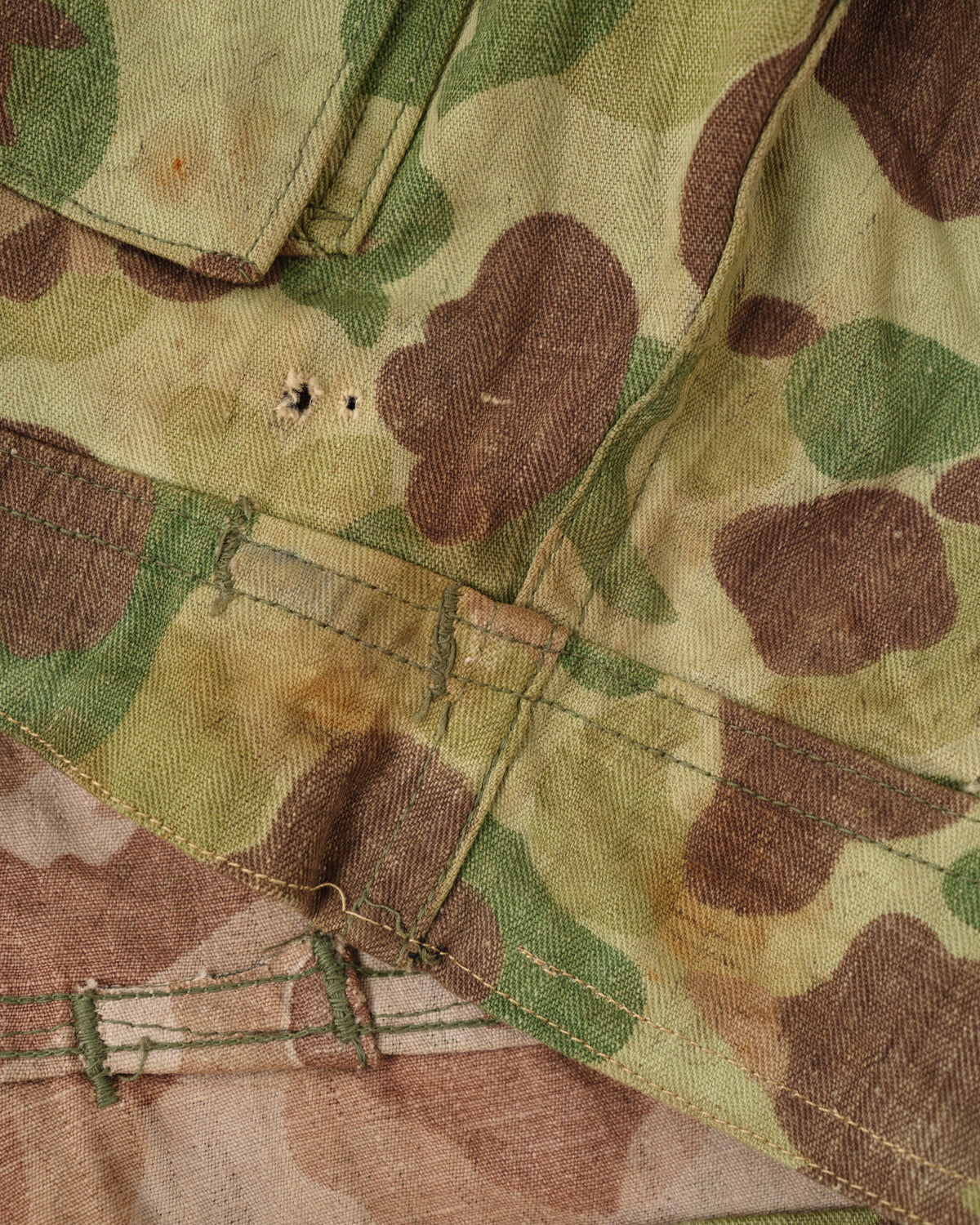
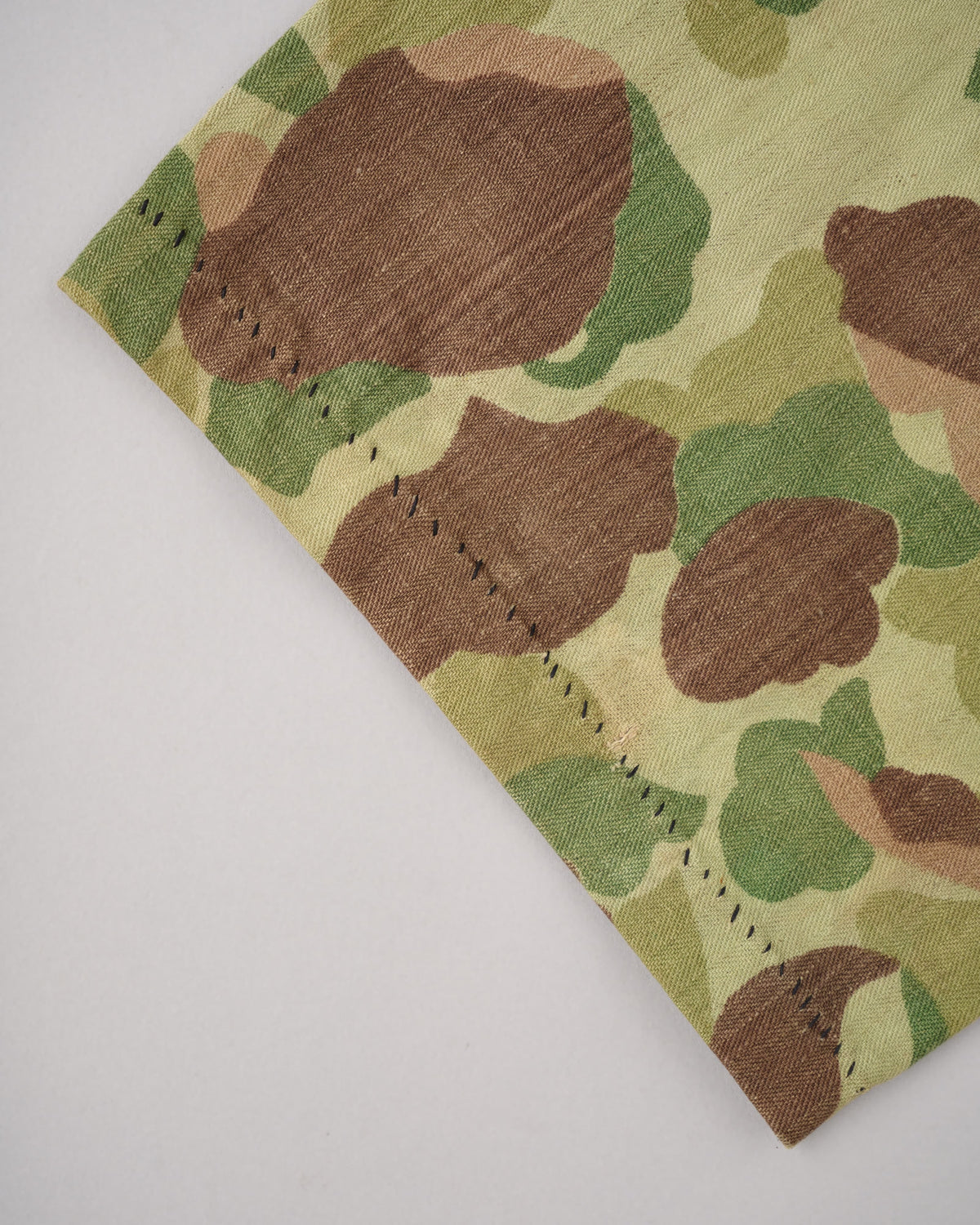
The cut edge has simply been whipped over, roughly and without ceremony.
That roughness is, on the contrary, what makes it good. Someone decided the length for themselves, with their own hands. That trace remains exactly as it was.
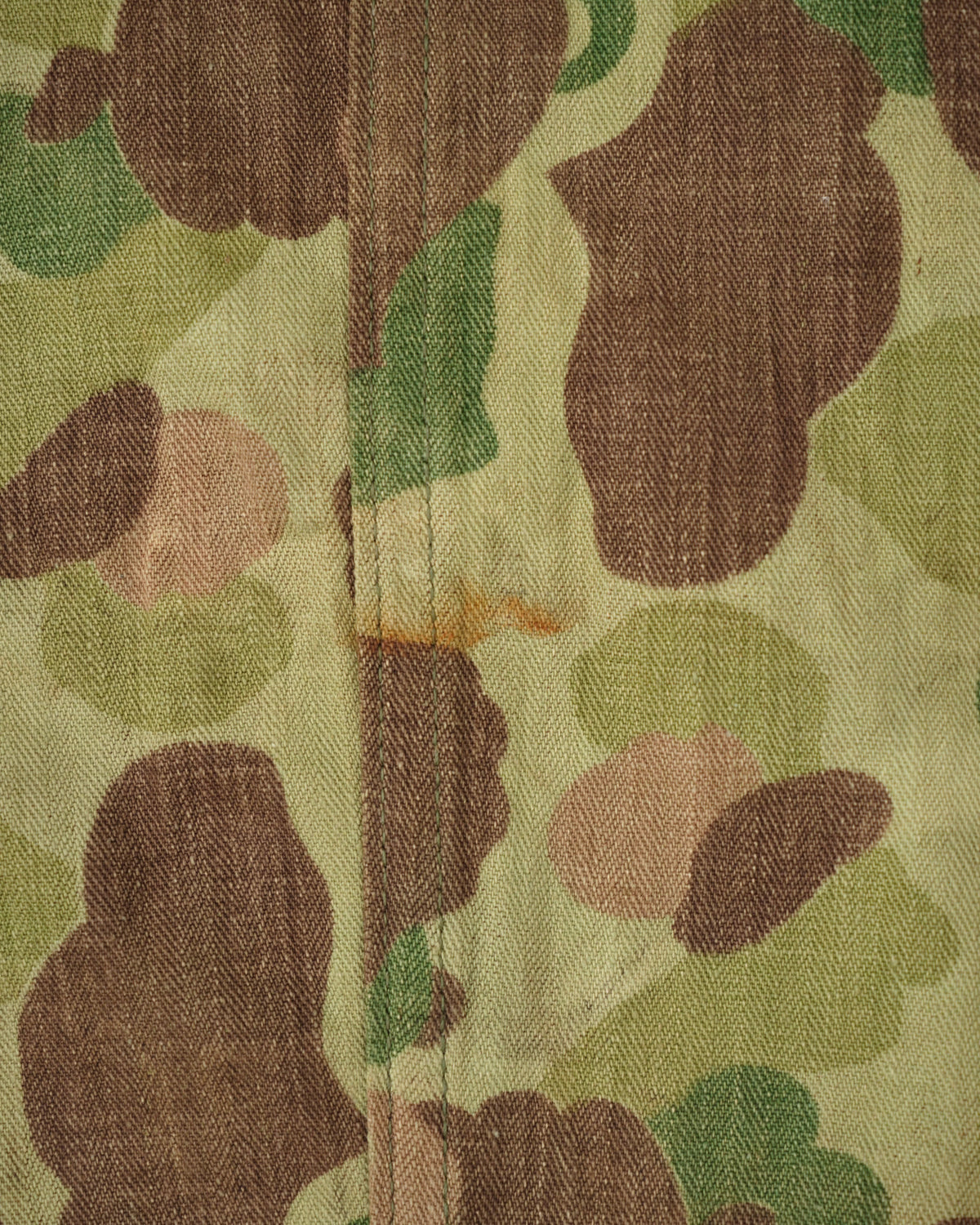
This camouflage is what is called frogskin.
Adopted by the American forces in 1942, it was the country's first camouflage pattern in earnest.
The way its rounded spots overlap resembles the back of a frog, and so it came to be called by this name.
What is interesting is the account that the pattern was designed not by a soldier but by the editor of a horticultural magazine.
The idea was to transpose, straight onto cloth, the shadows and dapples of light cast by the leaves of plants.
Once you are told, these irregular spots really do begin to look like sunlight through the trees, don't they.
And there is one more pleasure in this cloth: it is reversible.
The face is a green scheme for the jungle; the reverse a brown one, matched to sand and dry ground.
A different pattern was printed on each side of a single cloth, the intention being to turn it inside out according to the environment of the theatre.
So it is with this piece: open the front and a pale brown camouflage appears from within.
The contrast of the two schemes is genuinely beautiful, and simply wearing it open lets you enjoy both expressions at once.
Used in the Pacific theatre, the pattern flowed out into civilian hands in great quantity after the war.
Prized as clothing for hunting, it is known today by the alternative name of "duck hunter camo".
A pattern standing at the very starting point of the history of camouflage, one might fairly say.
Let us look, in turn, at the details that define the model.
Both sides of the chest carry flap pockets with gussets.
A gusset is the surplus cloth folded into the side of a pocket, which lets the bag swell out in three dimensions when something is put in.
A make thoroughly of military wear, premised on stuffing equipment inside.
The flaps fasten with black snap buttons.
That black works as the one achromatic note within the green and brown camouflage, and makes an unexpectedly good accent.
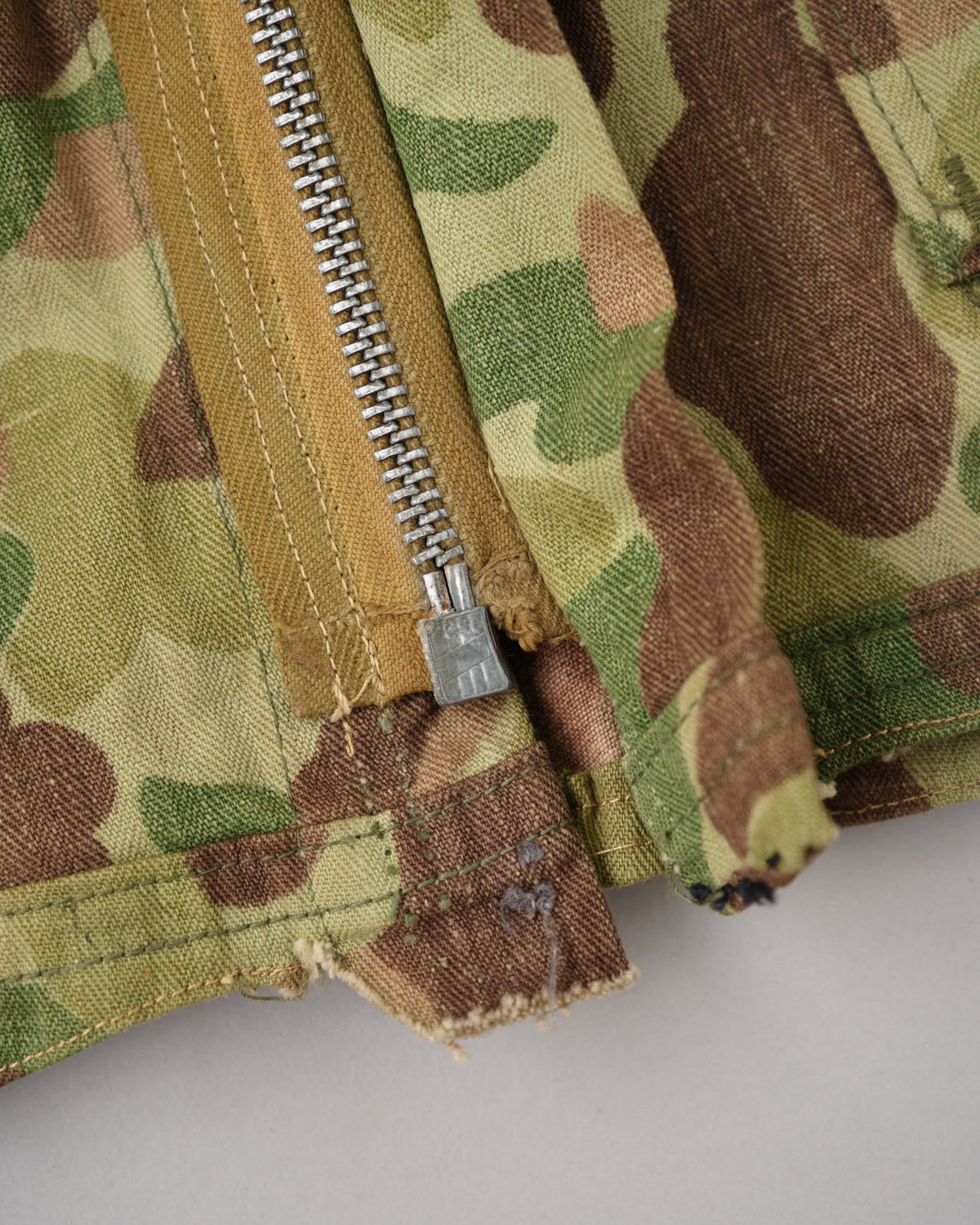
The front is a zip closure concealed by a fly.
The slider carries a "TALON" stamp — the old American maker that supported the earliest days of the zip, and that stamp alone makes the dating considerably surer.
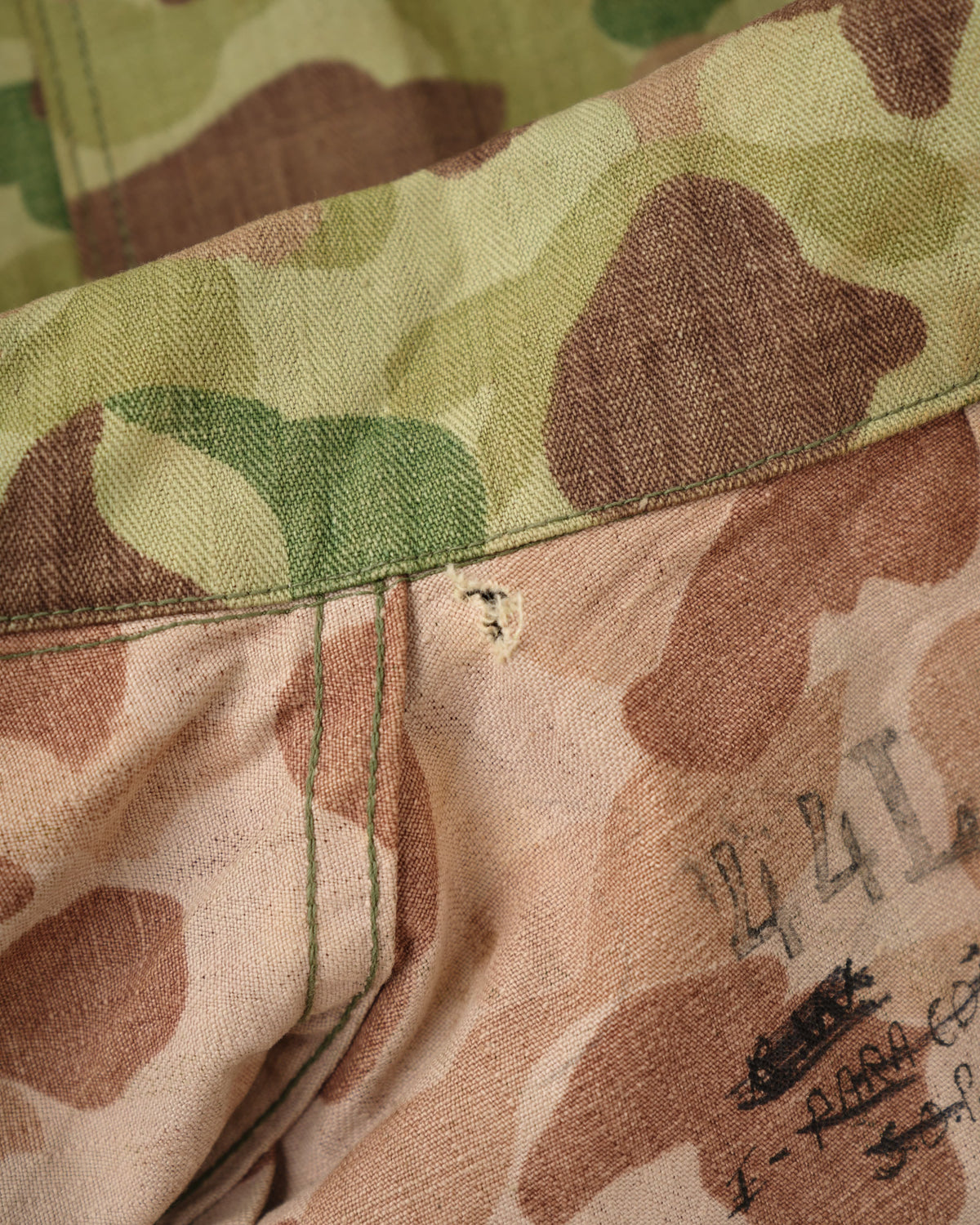
Inside, at the back, the size marking "44L" remains, and beneath it what appears to be writing by a previous owner.
It is too rubbed to read, but such traces surviving are, in a military piece, the greatest attraction of all.
The cloth is HBT — herringbone twill — the pride of the American forces.
Woven by alternating the direction of the twill, so that a chevron like the leaf of a cedar rises on the surface of the cloth.
Stronger than a plain twill and, on top of that, breathable. A cloth chosen for soldiers fighting in the punishing tropics.
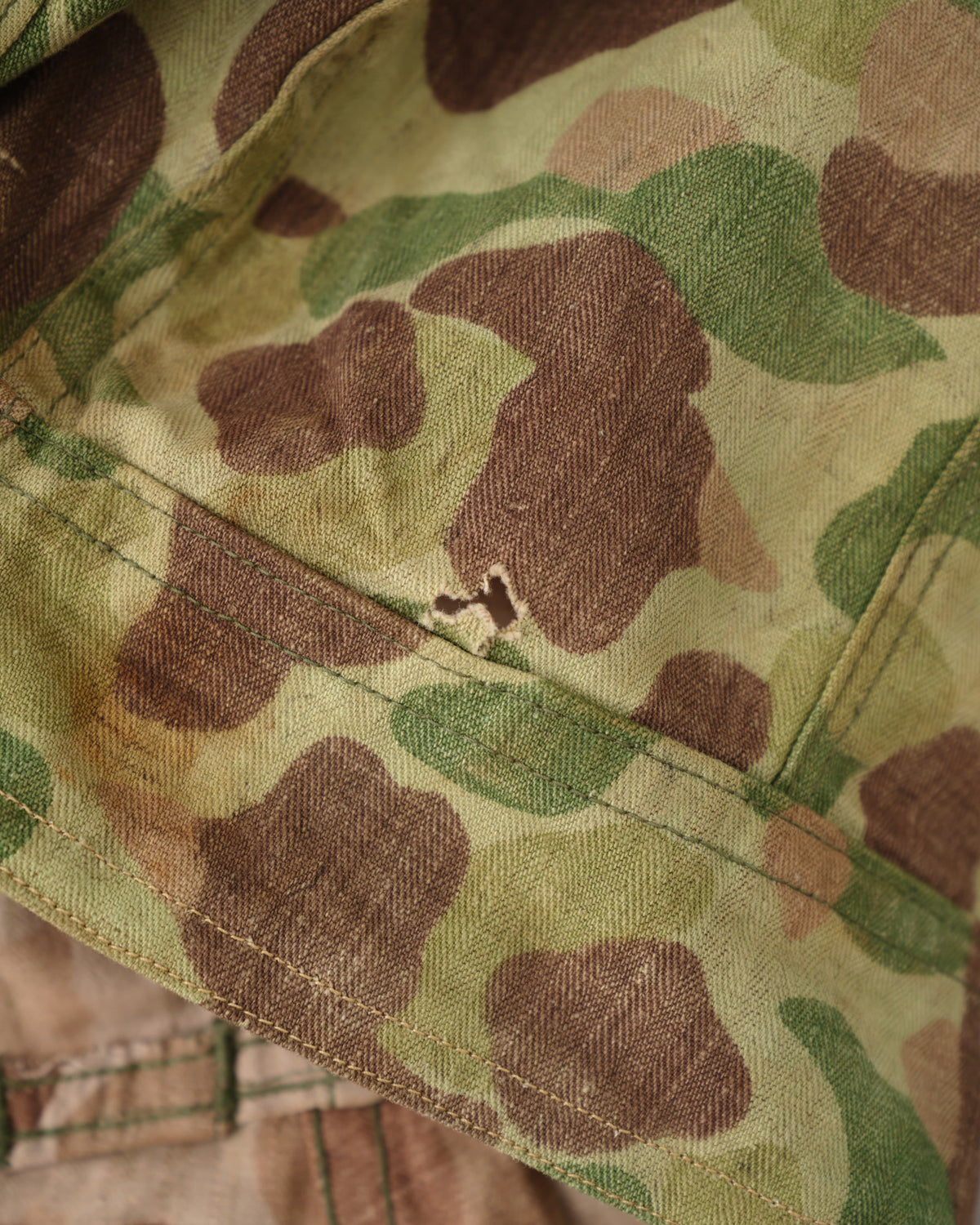
Look closely and the ridges of that chevron emerge clearly from beneath the printed camouflage.
Eighty years have made it thoroughly soft, yet the cloth has not lost its own body even now.
HBT in 100% cotton grows a little softer with every wash, and the camouflage fades pale where it rubs.
This piece has already dried out well, but from here it will dry out again in another way entirely.
The colour is a frogskin camouflage based on olive and brown.
Compared with modern camouflage, the saturation is low and the number of colours restrained.
Precisely for that reason it does not stand out in town; if anything it gives a settled impression.
Some may brace themselves at the word "military", but with this pattern there is no need for concern.
Worn with black slacks or a charcoal bottom, it should settle in very smartly indeed as a patterned outer layer.
The length is short and the hem left raw, so layering with a longer piece beneath, peeking out from the hem, would be interesting too.
The size marking reads "44 L".
Roughly equivalent to a Japanese "M", I should think.
As it began as coveralls, it is made very generously, on the assumption of clothing worn beneath.
The body and the armholes are both taken amply, so a heavy knit or a sweatshirt underneath should present no trouble at all.
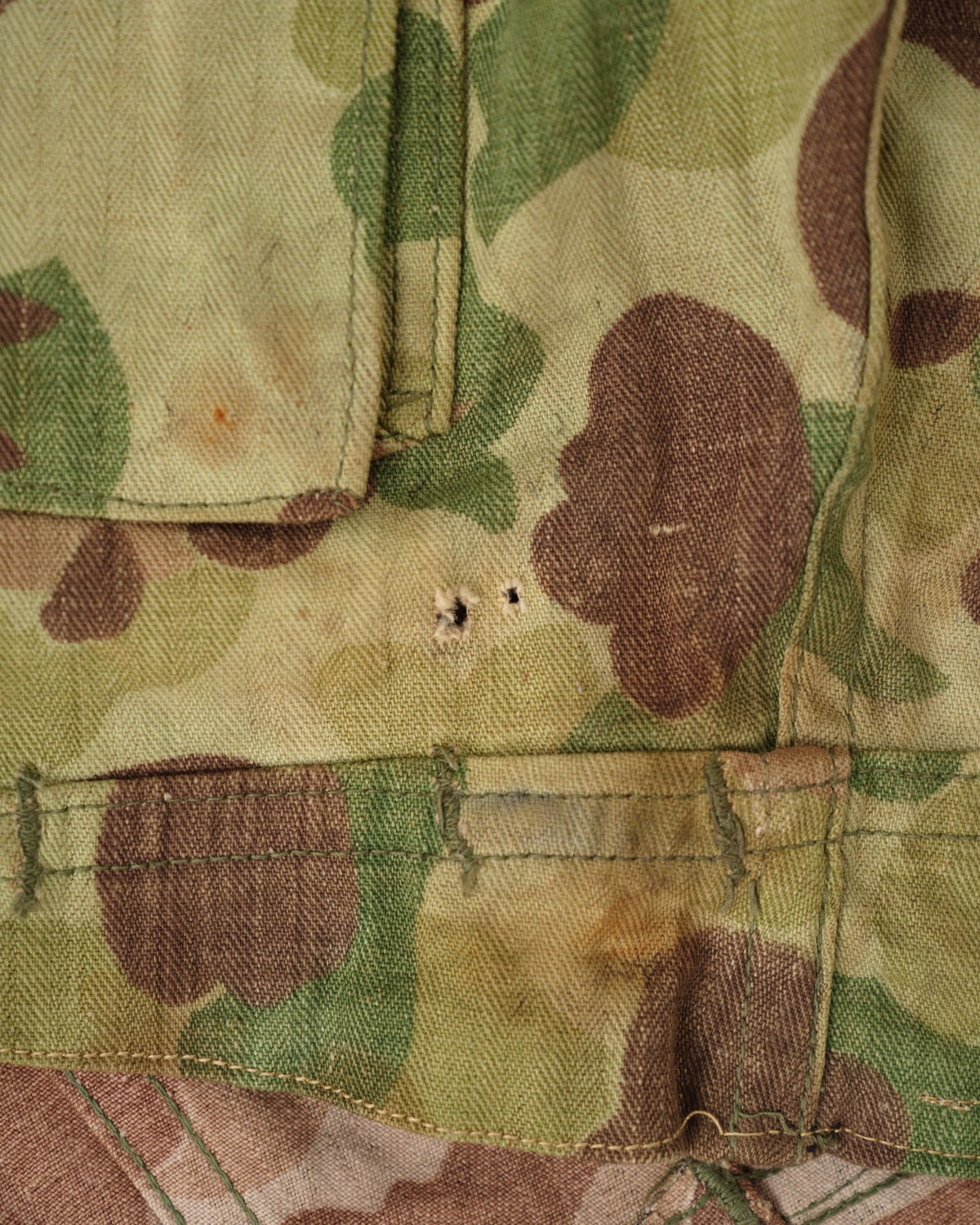
There are signs of use — soiling, abrasion, fraying, small holes and traces of repair — but no significant damage that would affect wear, so there is plenty of life left in it.
Some fraying is visible on part of the zip tape, so please handle it with a little care when opening and closing. As it stands, there is no problem with the action itself.
Please note that this piece is an original one-piece modified by a previous owner.
I should be grateful if you would take that point into account.
Making this cloth today would probably not be impossible.
But that it was worn somewhere in the Pacific eighty years ago, had scissors taken to it somewhere in America after the war, and then crossed the sea to be here in Japan —
that route alone can never be reproduced.
Within one garment, the decisions of owners from two different eras are inscribed.
I should like to entrust what comes next to its following keeper.
![[~40's] WWII U.S.ARMY/U.S.M.C Frogskin Camouflage Short Jacket Size.44L "Overalls Modified"](http://vieuxetnouveau-shop.com/cdn/shop/files/J01102-1_1535946f-f511-40d7-a685-c6bf6d8fec52.jpg?v=1788334831&width=2400)
![[~40's] WWII U.S.ARMY/U.S.M.C Frogskin Camouflage Short Jacket Size.44L "Overalls Modified"](http://vieuxetnouveau-shop.com/cdn/shop/files/J01102-2_f9d605d9-78bf-42f9-831a-53b752d1d5ec.jpg?v=1788334831&width=2400)
![[~40's] WWII U.S.ARMY/U.S.M.C Frogskin Camouflage Short Jacket Size.44L "Overalls Modified"](http://vieuxetnouveau-shop.com/cdn/shop/files/J01102-3_dc4bf535-2c02-47bf-b24d-1c83a8a3d080.jpg?v=1788334831&width=2400)
![[~40's] WWII U.S.ARMY/U.S.M.C Frogskin Camouflage Short Jacket Size.44L "Overalls Modified"](http://vieuxetnouveau-shop.com/cdn/shop/files/J01102-4_404ca439-89fc-415b-b05c-dcfc68cbeaea.jpg?v=1788334831&width=2400)
![[~40's] WWII U.S.ARMY/U.S.M.C Frogskin Camouflage Short Jacket Size.44L "Overalls Modified"](http://vieuxetnouveau-shop.com/cdn/shop/files/J01102-5_69d5463f-b217-4679-b860-356a5c28cda7.jpg?v=1788334831&width=2400)
![[~40's] WWII U.S.ARMY/U.S.M.C Frogskin Camouflage Short Jacket Size.44L "Overalls Modified"](http://vieuxetnouveau-shop.com/cdn/shop/files/J01102-6_82baecc1-211b-45b2-b5b0-5f51e2995e53.jpg?v=1788334831&width=2400)
![[~40's] WWII U.S.ARMY/U.S.M.C Frogskin Camouflage Short Jacket Size.44L "Overalls Modified"](http://vieuxetnouveau-shop.com/cdn/shop/files/J01102-7_4225739a-0c16-4700-843a-d4233a53610e.jpg?v=1788334831&width=2400)
![[~40's] WWII U.S.ARMY/U.S.M.C Frogskin Camouflage Short Jacket Size.44L "Overalls Modified"](http://vieuxetnouveau-shop.com/cdn/shop/files/J01102-8_82885ce2-daeb-43fe-a014-e01dba61c1c5.jpg?v=1788334831&width=2400)
![[~40's] WWII U.S.ARMY/U.S.M.C Frogskin Camouflage Short Jacket Size.44L "Overalls Modified"](http://vieuxetnouveau-shop.com/cdn/shop/files/J01102-9_4105b245-695b-4072-a8e0-40edef71dede.jpg?v=1788334831&width=2400)
![[~40's] WWII U.S.ARMY/U.S.M.C Frogskin Camouflage Short Jacket Size.44L "Overalls Modified"](http://vieuxetnouveau-shop.com/cdn/shop/files/J01102-10_c327bc4e-2b9b-4050-86a5-a19eefd3b988.jpg?v=1788334831&width=2400)
![[~40's] WWII U.S.ARMY/U.S.M.C Frogskin Camouflage Short Jacket Size.44L "Overalls Modified"](http://vieuxetnouveau-shop.com/cdn/shop/files/J01102-11_720739d0-e3e8-4045-b739-a8c090b3ffb2.jpg?v=1788334831&width=2400)
![[~40's] WWII U.S.ARMY/U.S.M.C Frogskin Camouflage Short Jacket Size.44L "Overalls Modified"](http://vieuxetnouveau-shop.com/cdn/shop/files/J01102-12_a29c0b15-82a8-4f6c-8024-661182a961d1.jpg?v=1788334831&width=2400)
![[~40's] WWII U.S.ARMY/U.S.M.C Frogskin Camouflage Short Jacket Size.44L "Overalls Modified"](http://vieuxetnouveau-shop.com/cdn/shop/files/J01102-13_d5737113-8efb-440b-adcb-0512382a94d2.jpg?v=1788334831&width=2400)
![[~40's] WWII U.S.ARMY/U.S.M.C Frogskin Camouflage Short Jacket Size.44L "Overalls Modified"](http://vieuxetnouveau-shop.com/cdn/shop/files/J01102-14_1d817aea-46cf-4a5e-9a1c-5209bf0ee089.jpg?v=1788334831&width=2400)
![[~40's] WWII U.S.ARMY/U.S.M.C Frogskin Camouflage Short Jacket Size.44L "Overalls Modified"](http://vieuxetnouveau-shop.com/cdn/shop/files/J01102-15_ff7e87a8-ecd9-41d9-ba4c-d9313b279c15.jpg?v=1788334831&width=2400)
![[~40's] WWII U.S.ARMY/U.S.M.C Frogskin Camouflage Short Jacket Size.44L "Overalls Modified"](http://vieuxetnouveau-shop.com/cdn/shop/files/J01102-16_20861f04-eb84-42ad-be71-5baf82b951c4.jpg?v=1788334831&width=2400)
![[~40's] WWII U.S.ARMY/U.S.M.C Frogskin Camouflage Short Jacket Size.44L "Overalls Modified"](http://vieuxetnouveau-shop.com/cdn/shop/files/J01102-17_ced2e23f-7864-4f4e-80c8-8148ec9493c5.jpg?v=1788334831&width=2400)
![[~40's] WWII U.S.ARMY/U.S.M.C Frogskin Camouflage Short Jacket Size.44L "Overalls Modified"](http://vieuxetnouveau-shop.com/cdn/shop/files/J01102-18_1b764594-85fc-4f1e-8dc9-caded84f15ed.jpg?v=1788334831&width=2400)
![[~40's] WWII U.S.ARMY/U.S.M.C Frogskin Camouflage Short Jacket Size.44L "Overalls Modified"](http://vieuxetnouveau-shop.com/cdn/shop/files/J01102-19_1ae3bce8-780d-4be7-a72e-c7468eb91b4e.jpg?v=1788334831&width=2400)
![[~40's] WWII U.S.ARMY/U.S.M.C Frogskin Camouflage Short Jacket Size.44L "Overalls Modified"](http://vieuxetnouveau-shop.com/cdn/shop/files/J01102-20_a4d514a2-dc73-4391-a550-af664bd376ca.jpg?v=1788334831&width=2400)
![[~40's] WWII U.S.ARMY/U.S.M.C Frogskin Camouflage Short Jacket Size.44L "Overalls Modified"](http://vieuxetnouveau-shop.com/cdn/shop/files/J01102-21_c087b7fb-68e5-4c9e-bb9e-b3164d58aeb1.jpg?v=1788334831&width=2400)
![[~40's] WWII U.S.ARMY/U.S.M.C Frogskin Camouflage Short Jacket Size.44L "Overalls Modified"](http://vieuxetnouveau-shop.com/cdn/shop/files/J01102-22_8121f20b-010e-4670-a540-013a90b673d6.jpg?v=1788334831&width=2400)
![[~40's] WWII U.S.ARMY/U.S.M.C Frogskin Camouflage Short Jacket Size.44L "Overalls Modified"](http://vieuxetnouveau-shop.com/cdn/shop/files/J01102-23_4bf9b9fc-dadf-4eed-a63c-0a778f8286ff.jpg?v=1788334831&width=2400)
![[~40's] WWII U.S.ARMY/U.S.M.C Frogskin Camouflage Short Jacket Size.44L "Overalls Modified"](http://vieuxetnouveau-shop.com/cdn/shop/files/J01102-24_9d65abf8-a759-4b38-9243-8858744802ed.jpg?v=1788334831&width=2400)
![[~40's] WWII U.S.ARMY/U.S.M.C Frogskin Camouflage Short Jacket Size.44L "Overalls Modified"](http://vieuxetnouveau-shop.com/cdn/shop/files/J01102-25_75af5317-4dd9-4dbc-a8ab-0e67eb801d68.jpg?v=1788334831&width=2400)
![[~40's] WWII U.S.ARMY/U.S.M.C Frogskin Camouflage Short Jacket Size.44L "Overalls Modified"](http://vieuxetnouveau-shop.com/cdn/shop/files/J01102-26_47ec5284-acb8-4ab9-bcfe-d1946c8a2b43.jpg?v=1788334831&width=2400)