A ‘Camouflage Retailored Windproof Jacket’ of the French Army, estimated to date from around the 1950s.
A super special item has come in.
First and above all, this condition. It has survived in a state one would not believe of military wear seventy years old.
This is the jacket that pairs with the trousers we presented previously.
We have had the lower half in before, but the upper half is a first for our shop.
The base is the "Windproof Pattern" cloth adopted by the British forces.
Used as an offshoot of the Denison smock, its camouflage is marked by a bold pattern that looks as though it were laid on with a brush.
Called brushstroke, its character lies not in blotches cut from a stencil but in overlapping tones that really do look painted on, coat upon coat.
So why is a piece made up in British cloth an item of the French Army?
This is the most interesting thing about it, and it touches on a most particular set of circumstances within the French Army during the Algerian War.
In the French Army of the day there was a custom whereby a man would take his issued uniform to a tailor in town and have it remade to his own build and taste.
For duty, for walking out, and at times for ceremony. And astonishingly, these altered garments are said to have been worn on actual operations as well.
Records remain of a well-known tailor in Algiers altering military clothing in quantity, on order from the units.
Adjusting the waist, adding belt loops, adding pockets, slimming the silhouette.
The scope of the alterations was genuinely wide.
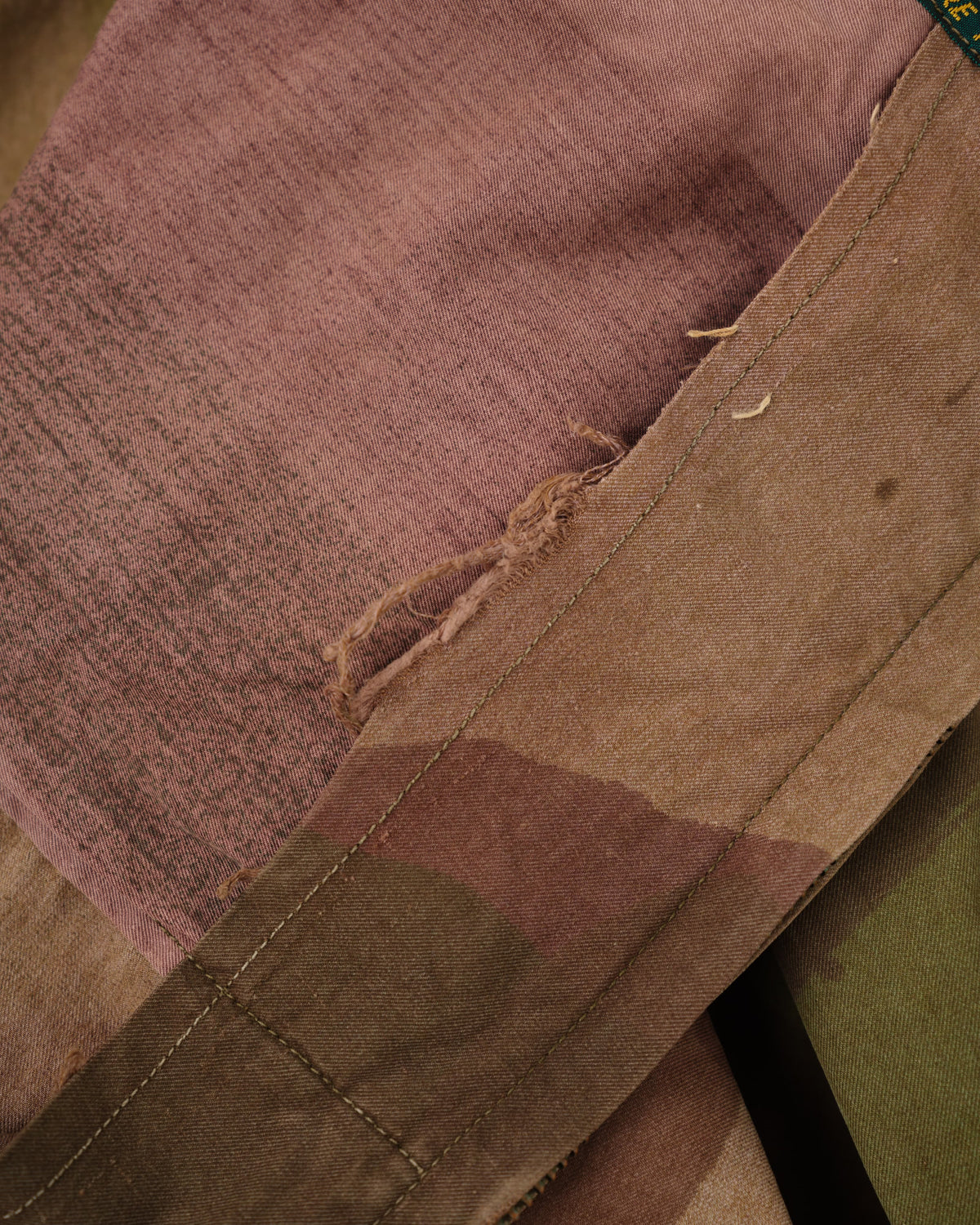
And inside this piece, a label embroidered in gold thread on a green ground has been stitched in.
‘SADOWY / MAITRE TAILLEUR’
"MAITRE TAILLEUR" means "master tailor" in French.
Which is to say, this is a garment sent out into the world by a craftsman who inscribed his own name upon it.
Ready-made issue from the army never carries a label like this.
British cloth, remade by a craftsman in Algiers, for a French soldier to wear.
Three lands crossing within one garment.
Is there another piece of clothing like this?
Let us look, in turn, at the details that define the model.
The collar is a small, composed point collar.
It has a refinement unlike military dress, and by that one detail the whole impression becomes considerably gentler.
Both shoulders carry epaulettes.
Originally these held rank insignia, or kept the belts of equipment from slipping off the shoulder.
On this piece, that vestige works beautifully as a design element.
The front is a zip closure.
The slider is stamped "ECLAIR", and the brass, grown amber with the years, has a genuinely lovely quality.
Éclair is the old fastener maker that represents France, and that this stamp is present is itself the surest proof that this piece was tailored in France.
Both sides of the chest carry buttoned flap pockets.
Pleats stand in place of gussets, so the pockets swell out just enough when something is put in.
And what I should particularly like you to note is the vertical zip pocket set on the left front alone.
There is nothing corresponding to it on the right.
The hem is elasticated with shirring.
Being drawn in, roundness arises in the upper body, creating the light silhouette of a blouson. The cuffs button at the wrist, and close it up properly as well.
The cloth is a light, smooth cotton twill.
True to the name windproof, it is designed to keep the wind out by weaving the threads close.
No thickness, and yet it stops the wind. This functionality was the answer the British forces of the day arrived at.
To the touch it is dry and smooth, with the body that comes of its high density.
Being light, it serves through spring and autumn of course, and as something to throw on during summer evenings as well.
High-density cotton of this kind grows softer the more it is worn, and the outlines of the camouflage grow a little paler by degrees.
This piece being in good condition, plenty of room to raise it remains — a happy thing, I should think.
The colour is a brushstroke camouflage of brown, olive and pink-beige.
Unlike camouflage of ranged blotches, this is a pattern of large planes overlapping gently, so from a distance it can look like an abstract painting.
The number of colours being restrained, it is camouflage with a genuinely settled bearing.
Brown being the main note, it is surprisingly easy to combine, which is part of its appeal.
Beige chinos or black slacks — it quarrels with neither.
Short in length and compactly composed, it looks best of all worn on its own, I think.
The pattern will take the leading role, so keeping everything else simple is what I would recommend.
There is no size marking, but judging from the measurements I should think it corresponds to a Japanese "S ~ M".
As it was remade to its wearer's build to begin with, the measurements are considerably neater than one expects of military dress.
The armholes are narrow as well, so it is a piece I would particularly recommend to those of slighter build.
There are signs of use such as fraying and small holes, but no significant damage that would affect wear, so there is plenty of life left in it.
To repeat myself: for a piece from the Algerian War of seventy years ago, the condition is little short of astonishing.
The British mill that wove this cloth and the tailor in Algiers who made it up no longer exist.
And above all, the very culture of taking army issue to a craftsman in town to have it altered to one's own taste has disappeared.
One could make the same thing, but a garment with the same history will never be born again.
British cloth, a French soldier. And the name of a craftsman in Algiers.
A piece that is at once documentary and practical — one you can literally talk about.
The chances of one appearing on the market at all are extremely limited, so if you have been looking, please do not let this opportunity pass.
![[~50's] French Army Camouflage Retailored Windproof Jacket "Algerian War"](http://vieuxetnouveau-shop.com/cdn/shop/files/J01104-1_4871c7fa-8c90-457e-b579-2244e3b55363.jpg?v=1788335178&width=2400)
![[~50's] French Army Camouflage Retailored Windproof Jacket "Algerian War"](http://vieuxetnouveau-shop.com/cdn/shop/files/J01104-2_afdf1a93-87be-4543-b936-dc11214e4fa3.jpg?v=1788335178&width=2400)
![[~50's] French Army Camouflage Retailored Windproof Jacket "Algerian War"](http://vieuxetnouveau-shop.com/cdn/shop/files/J01104-3_c3b7af6e-c21a-425f-bf56-aeb3f1c0ef90.jpg?v=1788335178&width=2400)
![[~50's] French Army Camouflage Retailored Windproof Jacket "Algerian War"](http://vieuxetnouveau-shop.com/cdn/shop/files/J01104-4_6266a45f-6097-4616-9fad-9a19daec9549.jpg?v=1788335178&width=2400)
![[~50's] French Army Camouflage Retailored Windproof Jacket "Algerian War"](http://vieuxetnouveau-shop.com/cdn/shop/files/J01104-5_ed83df1e-3584-4af1-ac0f-ec46f74d900f.jpg?v=1788335178&width=2400)
![[~50's] French Army Camouflage Retailored Windproof Jacket "Algerian War"](http://vieuxetnouveau-shop.com/cdn/shop/files/J01104-6_cf85ac54-cae3-48d3-932a-ea15fb2ba40f.jpg?v=1788335178&width=2400)
![[~50's] French Army Camouflage Retailored Windproof Jacket "Algerian War"](http://vieuxetnouveau-shop.com/cdn/shop/files/J01104-7_30e60713-1228-4e43-a234-7c0483ae2f6e.jpg?v=1788335178&width=2400)
![[~50's] French Army Camouflage Retailored Windproof Jacket "Algerian War"](http://vieuxetnouveau-shop.com/cdn/shop/files/J01104-8_bacb6a57-f2e8-4d7b-95eb-5511a28df160.jpg?v=1788335178&width=2400)
![[~50's] French Army Camouflage Retailored Windproof Jacket "Algerian War"](http://vieuxetnouveau-shop.com/cdn/shop/files/J01104-9_c8122e53-9d72-4fb1-98c3-e3cc8734d42d.jpg?v=1788335178&width=2400)
![[~50's] French Army Camouflage Retailored Windproof Jacket "Algerian War"](http://vieuxetnouveau-shop.com/cdn/shop/files/J01104-10_493634c6-c684-4439-a583-f19aef0894db.jpg?v=1788335178&width=2400)
![[~50's] French Army Camouflage Retailored Windproof Jacket "Algerian War"](http://vieuxetnouveau-shop.com/cdn/shop/files/J01104-11_6616916c-54ae-4f29-ab10-672656069d35.jpg?v=1788335178&width=2400)
![[~50's] French Army Camouflage Retailored Windproof Jacket "Algerian War"](http://vieuxetnouveau-shop.com/cdn/shop/files/J01104-12_64b97484-39ca-44e0-befa-5987d9e80bad.jpg?v=1788335178&width=2400)
![[~50's] French Army Camouflage Retailored Windproof Jacket "Algerian War"](http://vieuxetnouveau-shop.com/cdn/shop/files/J01104-13_33854111-69fb-40e1-aa88-8d4e927aff04.jpg?v=1788335178&width=2400)
![[~50's] French Army Camouflage Retailored Windproof Jacket "Algerian War"](http://vieuxetnouveau-shop.com/cdn/shop/files/J01104-14_ac9bd32d-4a3e-41e3-92c3-1238bd9d78a6.jpg?v=1788335178&width=2400)
![[~50's] French Army Camouflage Retailored Windproof Jacket "Algerian War"](http://vieuxetnouveau-shop.com/cdn/shop/files/J01104-15_872a5b55-d493-4992-83e8-3cb3b005bb3d.jpg?v=1788335178&width=2400)
![[~50's] French Army Camouflage Retailored Windproof Jacket "Algerian War"](http://vieuxetnouveau-shop.com/cdn/shop/files/J01104-16_f49cecb2-78a4-4aaf-88ad-55a52944d32a.jpg?v=1788335178&width=2400)
![[~50's] French Army Camouflage Retailored Windproof Jacket "Algerian War"](http://vieuxetnouveau-shop.com/cdn/shop/files/J01104-17_8d20202f-dc1e-4bef-9d2e-403e896f6530.jpg?v=1788335178&width=2400)
![[~50's] French Army Camouflage Retailored Windproof Jacket "Algerian War"](http://vieuxetnouveau-shop.com/cdn/shop/files/J01104-18_662e203d-6e46-49a0-95c3-cfa9cbb52ea8.jpg?v=1788335178&width=2400)
![[~50's] French Army Camouflage Retailored Windproof Jacket "Algerian War"](http://vieuxetnouveau-shop.com/cdn/shop/files/J01104-19_c2f1cc8d-0ad6-4ae3-9d34-53bb0f4b4c4d.jpg?v=1788335178&width=2400)
![[~50's] French Army Camouflage Retailored Windproof Jacket "Algerian War"](http://vieuxetnouveau-shop.com/cdn/shop/files/J01104-20_cbd0ded1-1da6-4ad6-ab5a-6b0fa1e40e67.jpg?v=1788335178&width=2400)
![[~50's] French Army Camouflage Retailored Windproof Jacket "Algerian War"](http://vieuxetnouveau-shop.com/cdn/shop/files/J01104-21_f66e0748-1b20-4075-b4cc-3dfd6a703107.jpg?v=1788335178&width=2400)
![[~50's] French Army Camouflage Retailored Windproof Jacket "Algerian War"](http://vieuxetnouveau-shop.com/cdn/shop/files/J01104-22_3ba51e6a-54d4-4d80-9c52-ebc7672ea27b.jpg?v=1788335178&width=2400)
![[~50's] French Army Camouflage Retailored Windproof Jacket "Algerian War"](http://vieuxetnouveau-shop.com/cdn/shop/files/J01104-23_e460683d-d762-48bb-9172-4f49f854e3f4.jpg?v=1788335178&width=2400)
![[~50's] French Army Camouflage Retailored Windproof Jacket "Algerian War"](http://vieuxetnouveau-shop.com/cdn/shop/files/J01104-24_34d774c7-766d-49e4-8883-54941ca072d0.jpg?v=1788335178&width=2400)
![[~50's] French Army Camouflage Retailored Windproof Jacket "Algerian War"](http://vieuxetnouveau-shop.com/cdn/shop/files/J01104-25_9ace0dd8-b386-4fbb-8640-2460a3bd9caa.jpg?v=1788335178&width=2400)
![[~50's] French Army Camouflage Retailored Windproof Jacket "Algerian War"](http://vieuxetnouveau-shop.com/cdn/shop/files/J01104-26_57668158-dc14-4b36-bf47-308d3fe023cc.jpg?v=1788335178&width=2400)
![[~50's] French Army Camouflage Retailored Windproof Jacket "Algerian War"](http://vieuxetnouveau-shop.com/cdn/shop/files/J01104-27_dd1d2483-d6fd-4120-b4c7-ea9e3e65ba2c.jpg?v=1788335178&width=2400)
![[~50's] French Army Camouflage Retailored Windproof Jacket "Algerian War"](http://vieuxetnouveau-shop.com/cdn/shop/files/J01104-28_8246376b-c25e-48bd-b0e0-2b0a5b5ca575.jpg?v=1788335178&width=2400)
![[~50's] French Army Camouflage Retailored Windproof Jacket "Algerian War"](http://vieuxetnouveau-shop.com/cdn/shop/files/J01104-29_d9a9cd6c-798a-4628-a4e2-7658d9b16932.jpg?v=1788335178&width=2400)
![[~50's] French Army Camouflage Retailored Windproof Jacket "Algerian War"](http://vieuxetnouveau-shop.com/cdn/shop/files/J01104-30_8b129b64-eb02-43e7-8f58-a1b3c0eaa073.jpg?v=1788335178&width=2400)
![[~50's] French Army Camouflage Retailored Windproof Jacket "Algerian War"](http://vieuxetnouveau-shop.com/cdn/shop/files/J01104-31_2cbc9140-1db0-46d3-b840-b56de13522bb.jpg?v=1788335178&width=2400)
![[~50's] French Army Camouflage Retailored Windproof Jacket "Algerian War"](http://vieuxetnouveau-shop.com/cdn/shop/files/J01104-32_ea0a05b5-92b2-4291-b81d-7878c3fc9993.jpg?v=1788335178&width=2400)
![[~50's] French Army Camouflage Retailored Windproof Jacket "Algerian War"](http://vieuxetnouveau-shop.com/cdn/shop/files/J01104-33_7b2e4d9a-b879-4e89-aa3b-b436f4ca259a.jpg?v=1788335178&width=2400)
![[~50's] French Army Camouflage Retailored Windproof Jacket "Algerian War"](http://vieuxetnouveau-shop.com/cdn/shop/files/J01104-34_054be7ca-3fb0-47b4-b0c7-082f54c87df6.jpg?v=1788335178&width=2400)