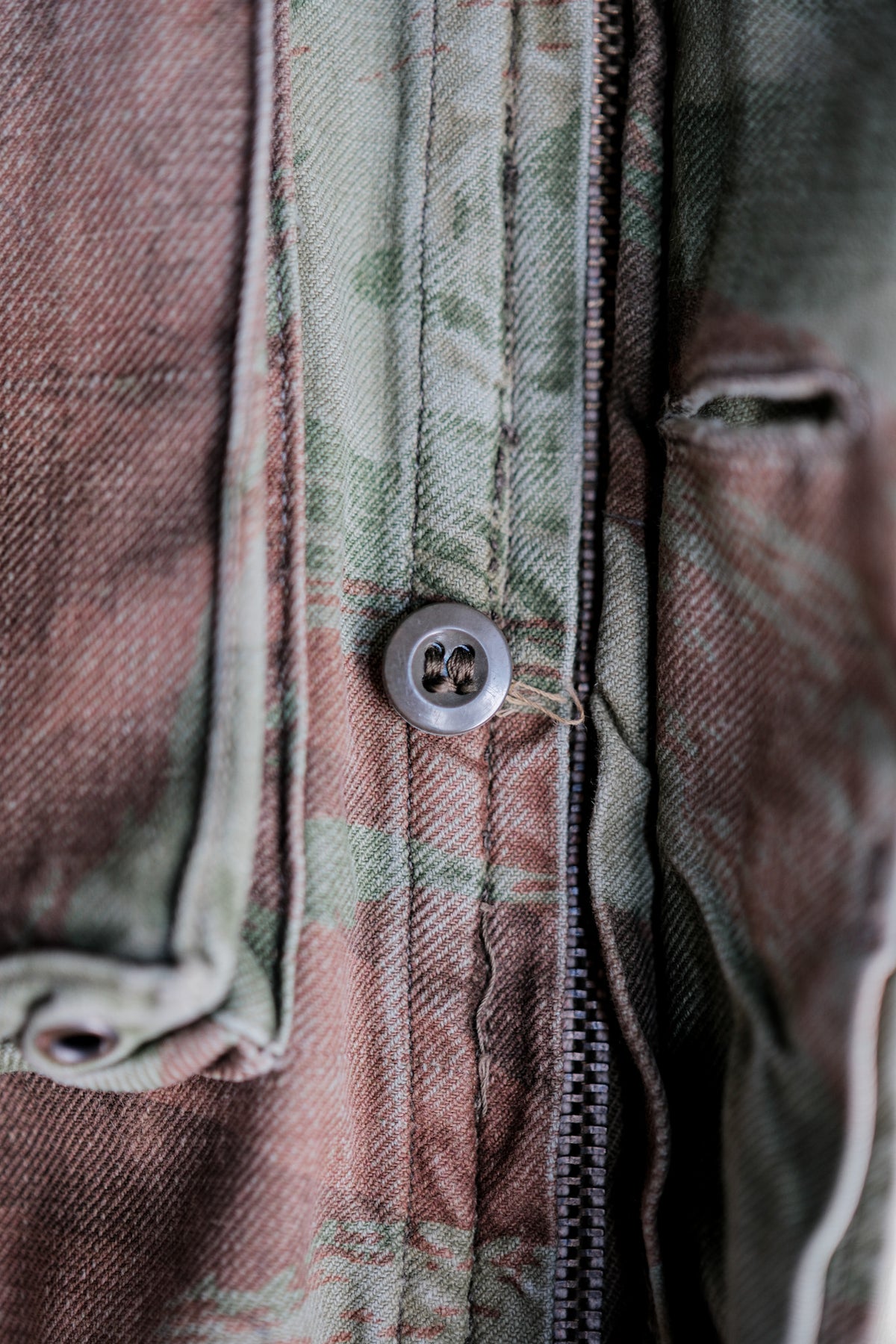
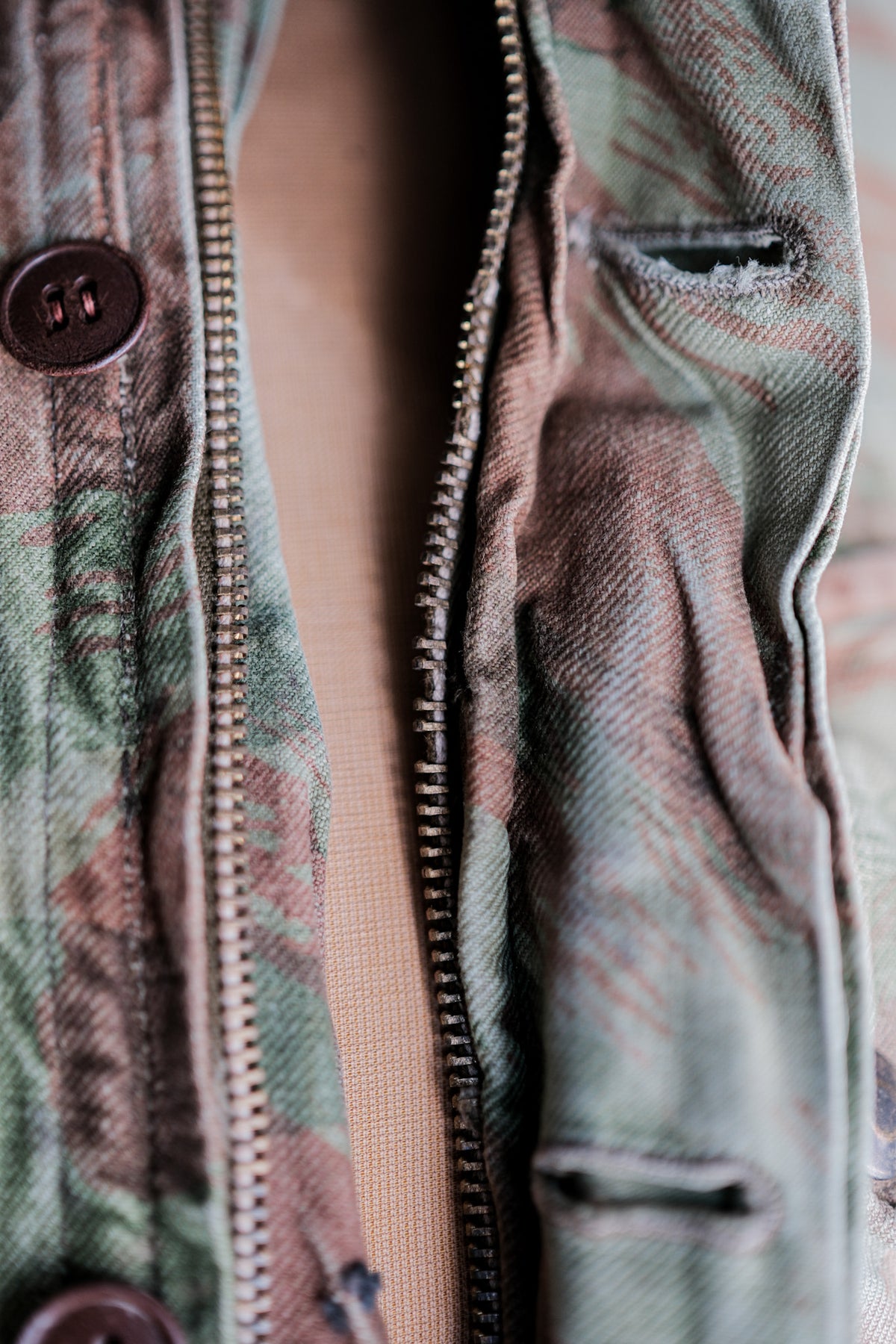
Estimated 1950s, French Army TAP47/53 Lizard Camouflage Paratrooper Jacket.
The arrival of a superb piece.
One of the finest examples from French Army operations. Many encountering this piece for the first time will understand immediately why it is rarely seen.
A parachute jacket first issued to French Army airborne units in 1947. Known also as the TAP47, the details and camouflage patterns evolved gradually with each iteration.
Two variants existed: camouflage and olive drab. While the olive pattern is conventionally regarded as rarer, the early camouflage variant—such as this example—is equally elusive in the market.
Where the TAP47 represents the initial release, this TAP47/53 was refined in 1953. The TAP47, along with the TAP47/51, TAP47/52, and TAP47/53, occupy the highest tier of rarity within French Army acquisitions. Collectors pursue these pieces with dedication, and their scarcity commands significant prices wherever they appear.
The more commonly circulated TAP47/56 employs HBT cotton fabric. This TAP47/53, however, features the coarser cotton twill characteristic of early M47 construction.
The TAP47/53 is distinguished by distinctive detailing: large flapped pockets with three metal buttons positioned diagonally on each side; angled flap pockets at the hem on either flank; a collar cut with generous height; a beaver tail at the back; and adjustable belts at the hem. Later variants abandoned these features entirely.
The lizard camouflage pattern evolved with each revision, yielding a colorway not seen in subsequent years.
The TAP47/56 introduced significant simplifications: diagonal hem pockets converted to parallel placement, collar height substantially reduced, and the beaver tail omitted altogether. With each model generation, the design grew progressively refined.
For those drawn to these particular details, examples preceding the TAP47/56 are earnestly recommended.
Size marked as "46".
In Japanese sizing, this corresponds to approximately "L to XL".
The actual measurements confirm a generous cut—those of larger build will find it accommodating. In military tradition, wearing it generously oversized carries considerable presence.
Designed originally as an overgarment meant to drape above layers, these pieces are universally proportioned for ample fit. The armholes and body width provide room across varied frames.
Fading, repair marks, and button replacements are evident from use.
The zipper slider shows partial wear, with approximately two-thirds of the mechanism functional.
The front buttons remain complete, so wear remains entirely feasible. Should the zipper operation trouble you, replacement is recommended.
Inside, faint French Army stamps remain discernible.
Such a piece exists beyond the reach of mere expenditure. Future acquisition cannot be assured.
Whether as wardrobe or collection, as archive or design reference, it bears uncompromising merit.
Rarely sighted domestically or abroad, and equally scarce in our inventory, this piece will not return easily. Those who have sought it, or who value the uncommon, would be wise not to let this moment pass.