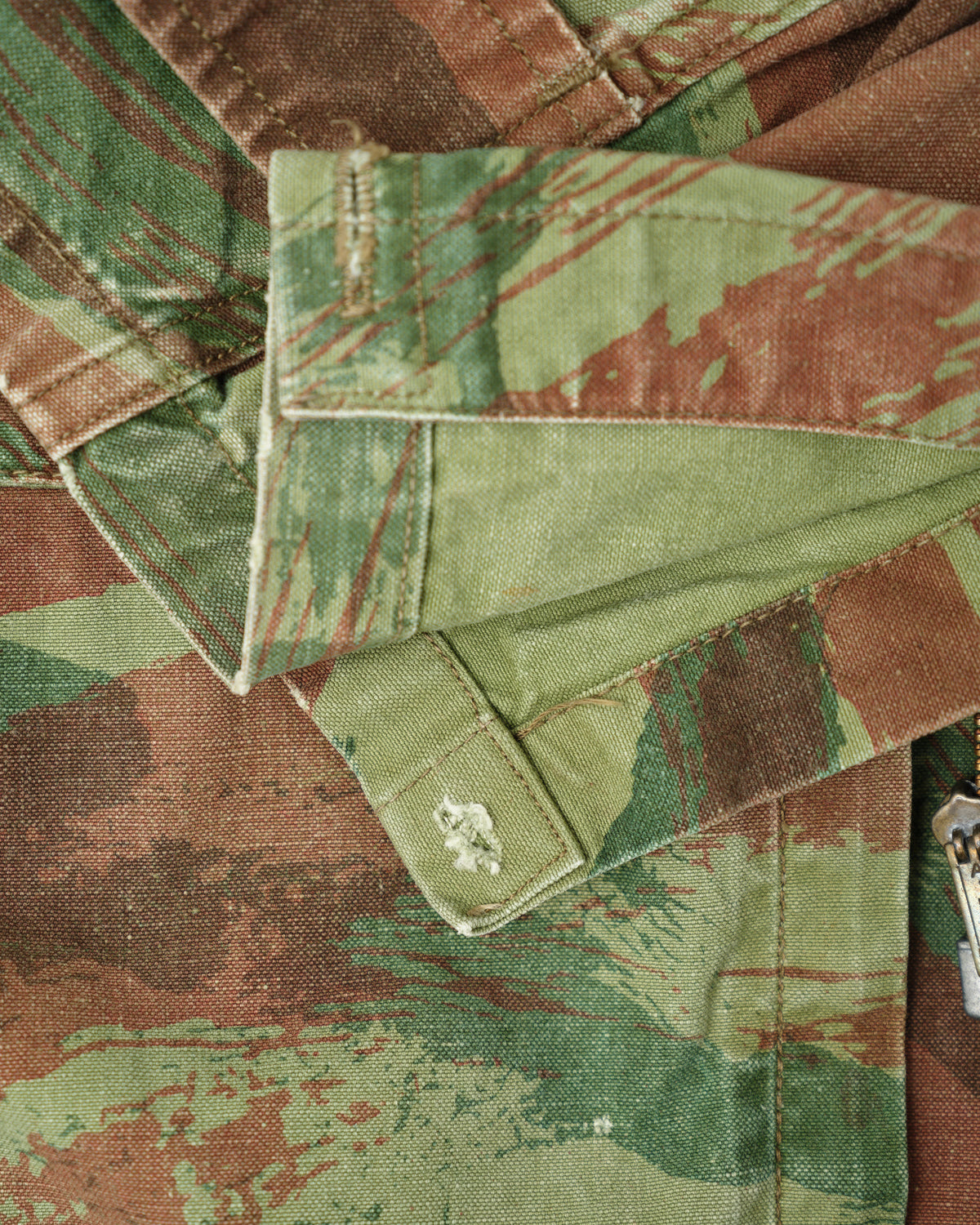
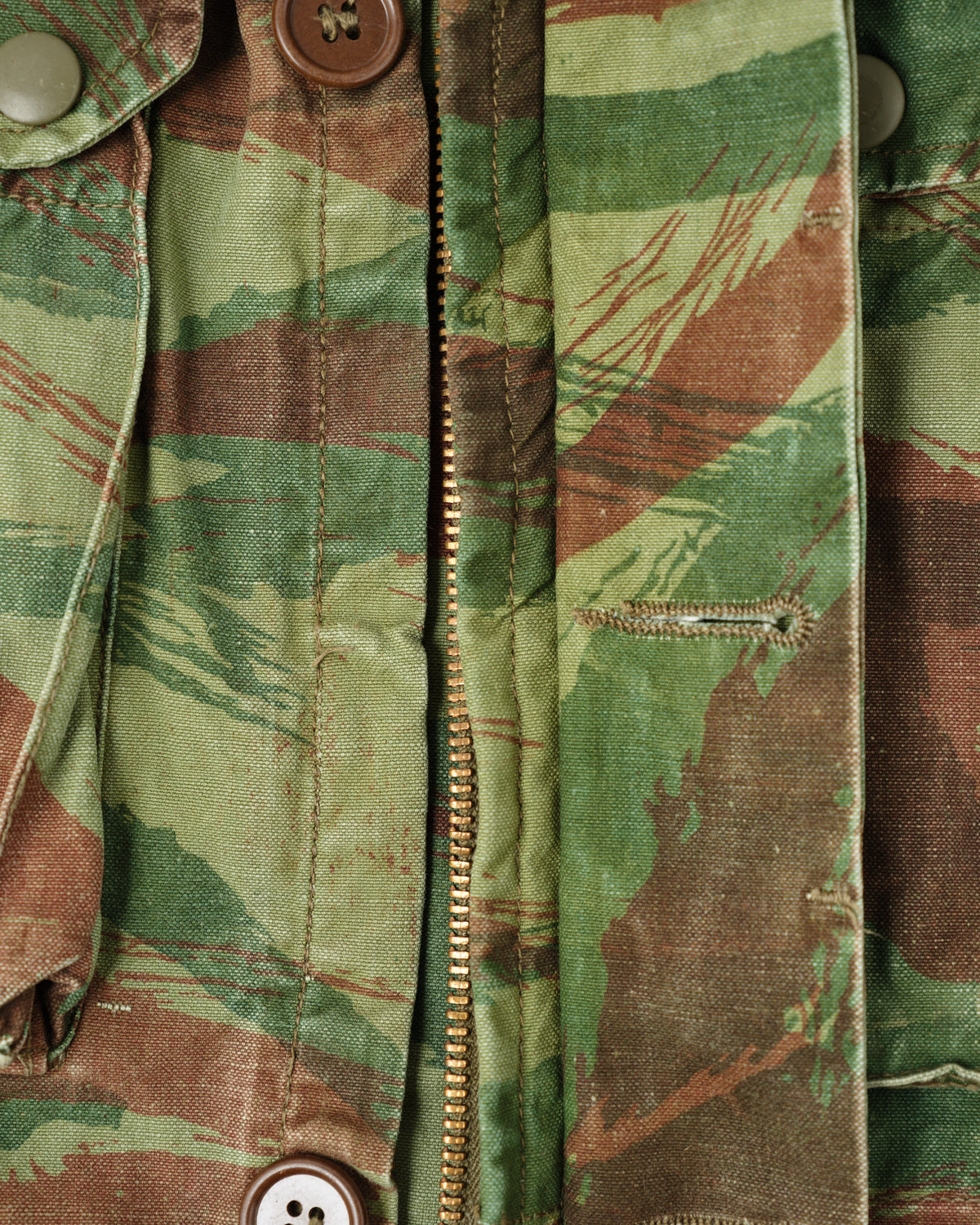
A French military TAP47/54 Lizard Camouflage Paratrooper Jacket, estimated from the 1950s.
A special arrival.
The TAP Paratrooper Jacket—emblematic of French airborne forces.
Beginning with the so-called TAP47, first issued in 1947, this series underwent continuous refinement through field deployment and operational feedback. The details evolved across iterations, and French military pieces from this lineage are particularly known for their density as products.
The example presented here corresponds to the TAP47/54—the 1954 revision.
Precisely speaking, production and distribution occurred only between 1954 and 1956—a mere two-year window. It represents the final iteration before the more commonly circulated TAP47/56, a positioning that lends considerable appeal when considered alongside its historical context.
Among significant changes from the TAP47/53, the removal of the beaver tail—that distinctive panel designed to wrap beneath the crotch, characteristic of parachute jackets—stands out notably.
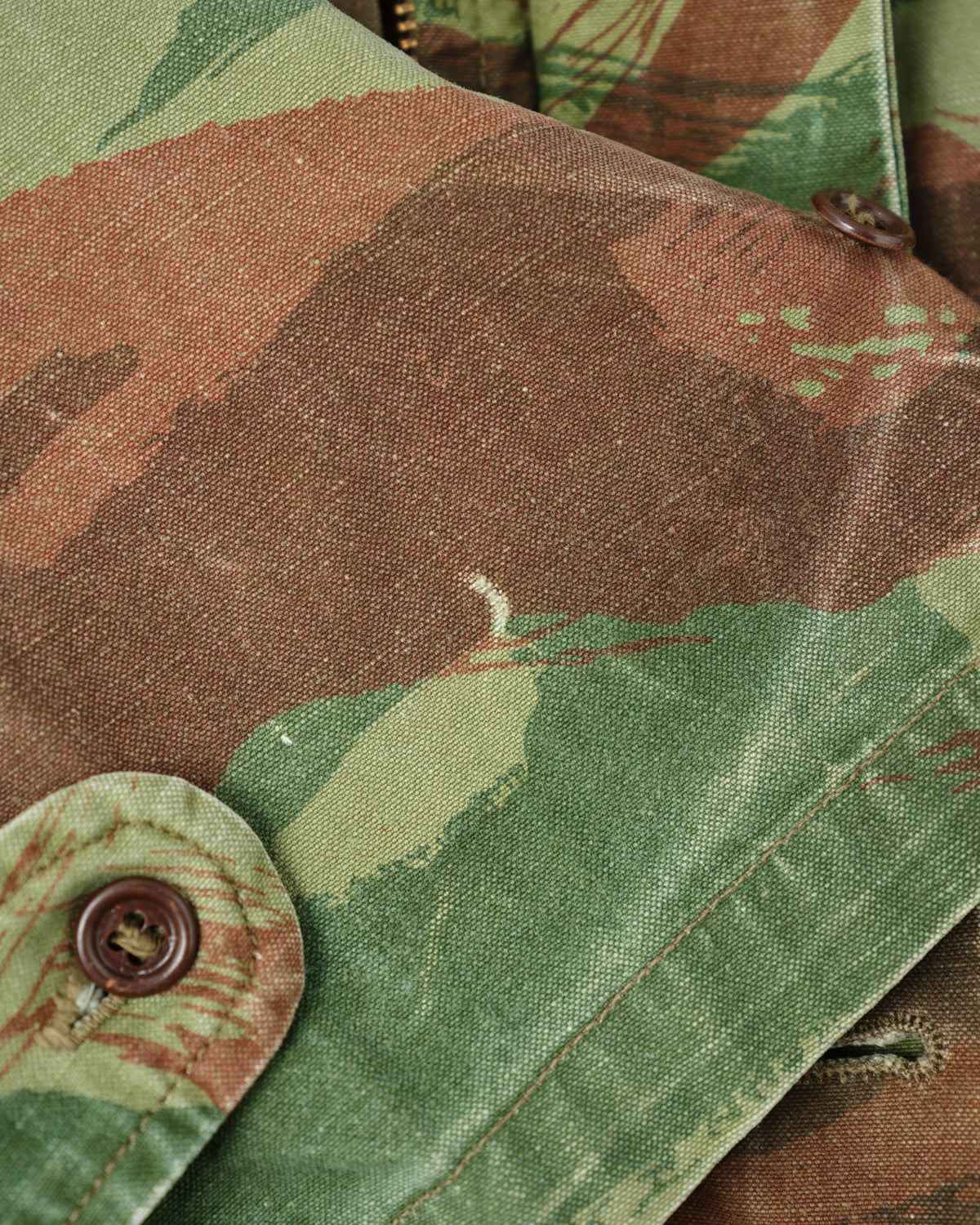
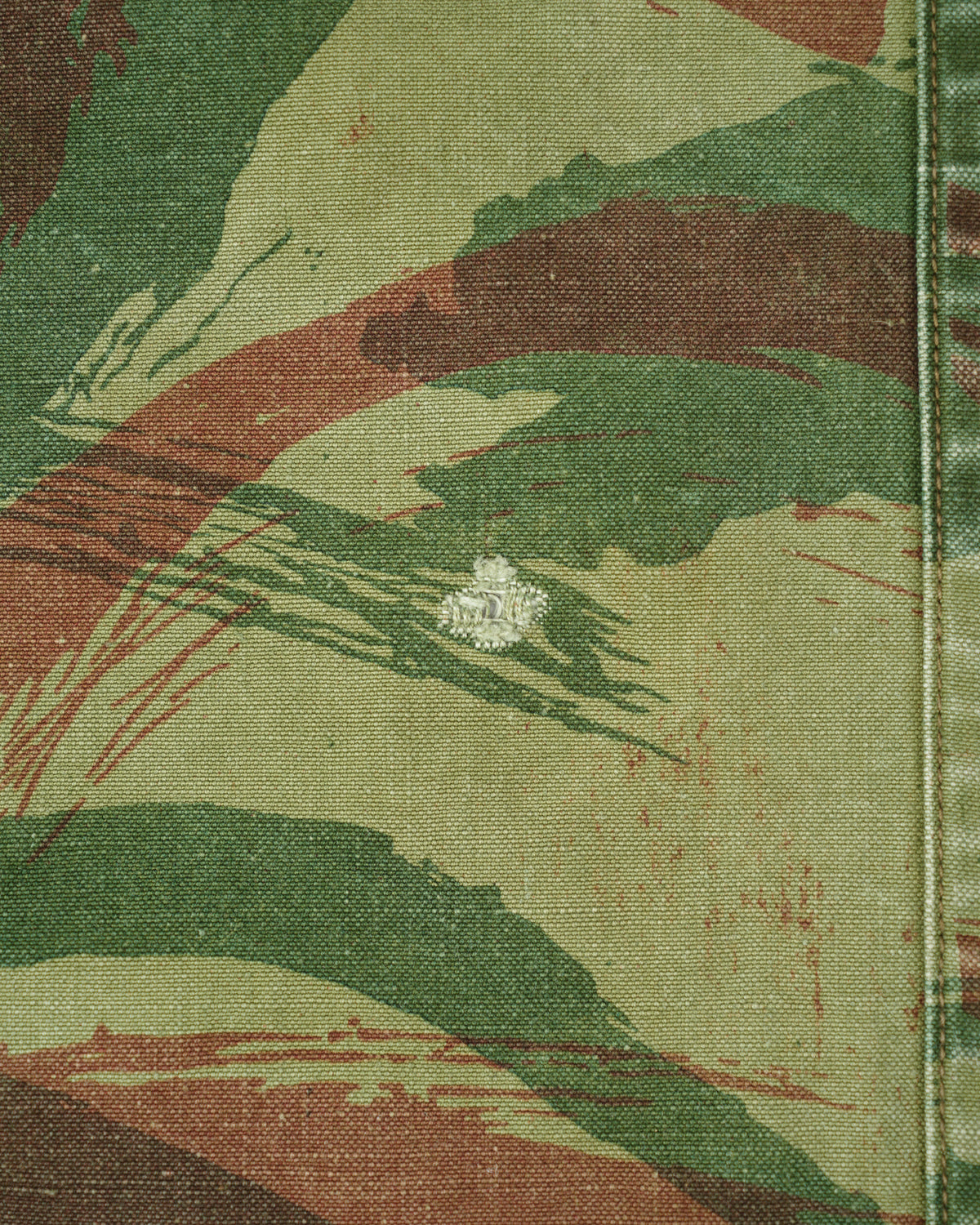
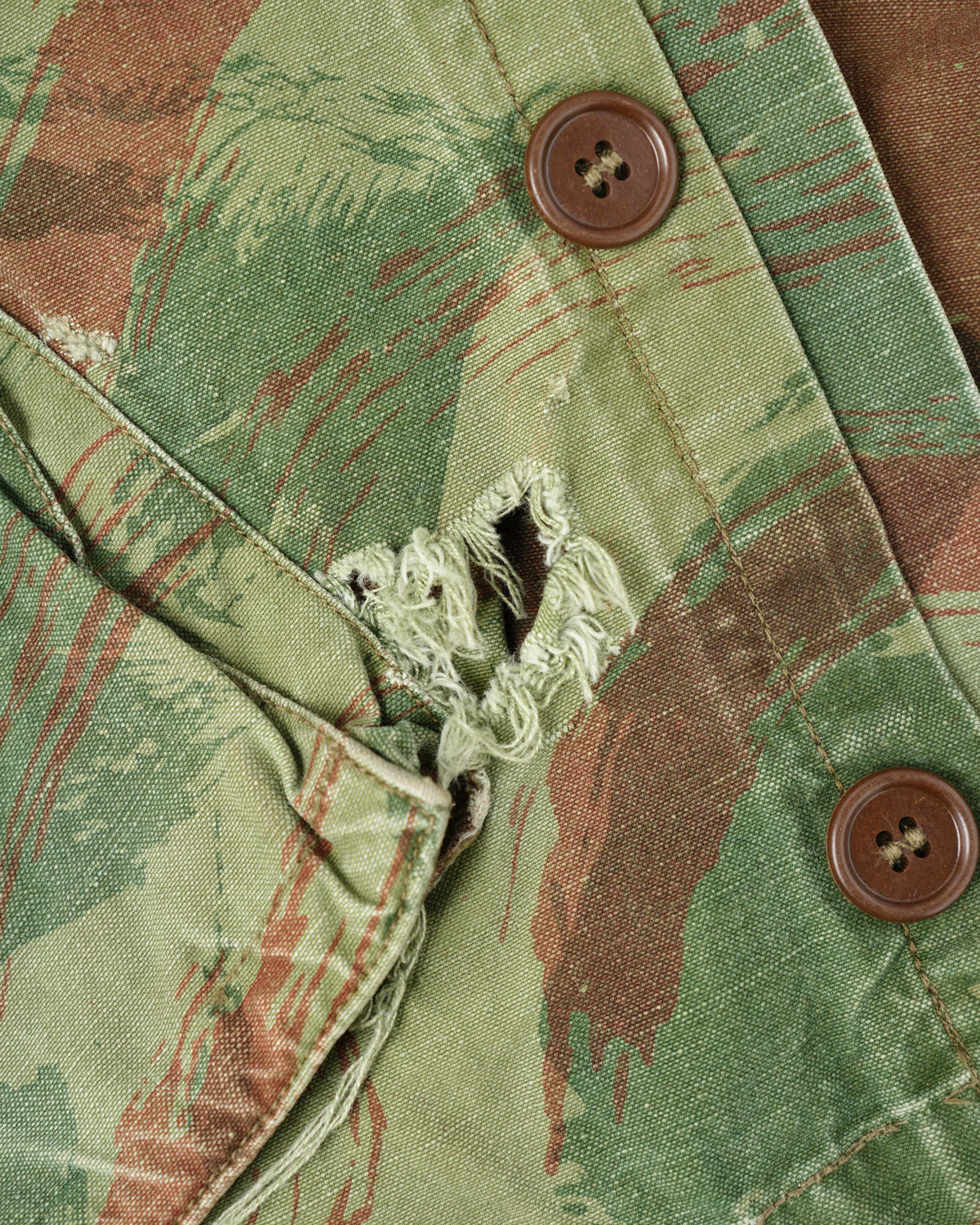
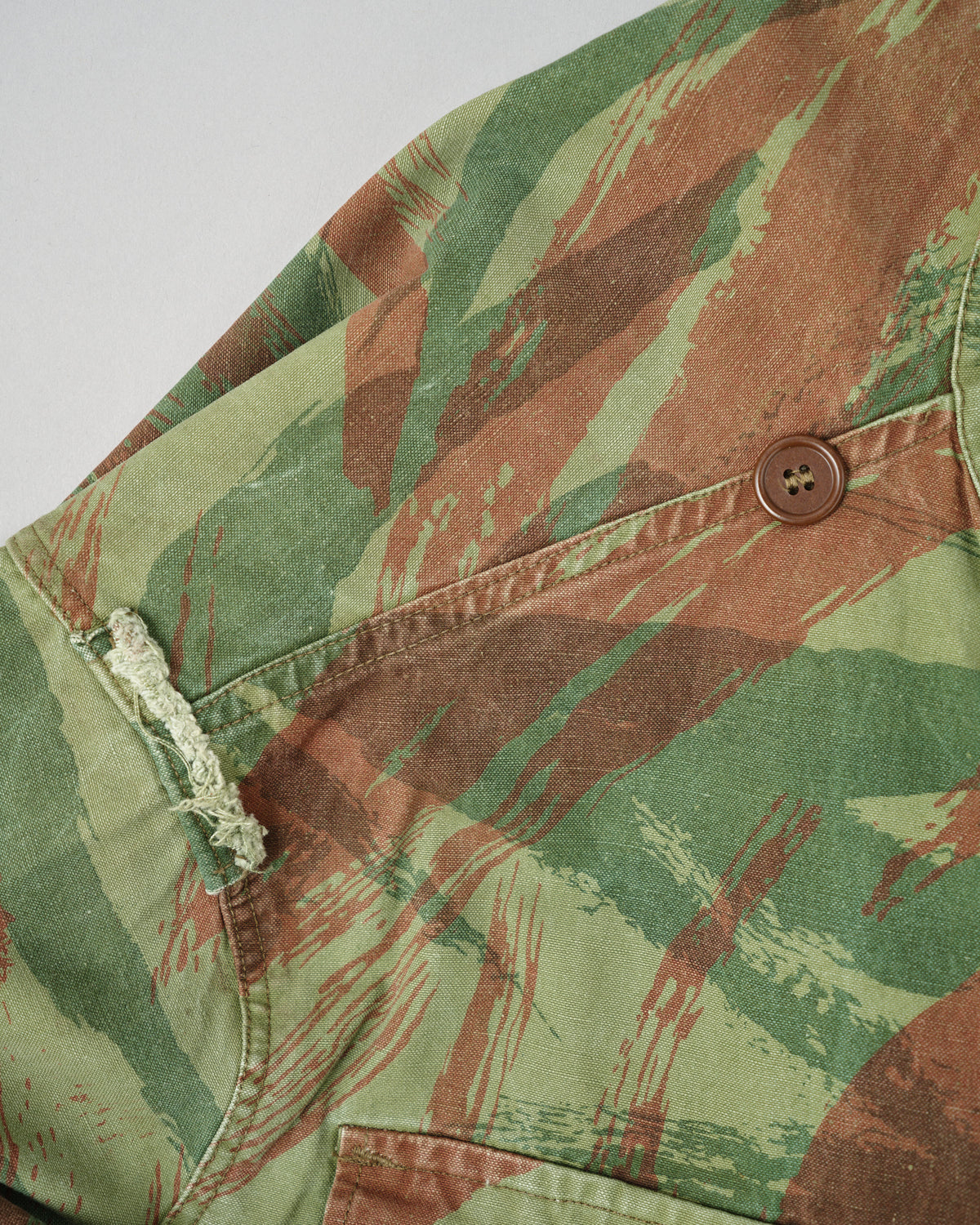
And the dominant signature: the Lizard Camouflage unique to French forces.
International sources establish this brushstroke-like pattern as evolving in the post-war period—early 1950s onward—where it became particularly associated with airborne troops during the Algerian War.
The nomenclature itself reveals cultural inflection: English-speaking collectors call it Lizard, while French documentation primarily employed Leopard—camouflage de léopard or tenue de léopard. This linguistic distinction has persisted through the decades.
The lineage traces back to the British airborne Denison Smock. Through successive overprinting of green and brown, the pattern achieves something beyond mere surface decoration—a genuine spatial fracturing, a depth of field.
Further still, this heritage passed through experimental iterations during the Indochina campaign, eventually becoming recognized as one of the conceptual ancestors of Tiger Stripe—a lineage that justifies its continuing significance in vintage discourse.
Details reveal the pronounced TAP47 sensibility—a distinctly equipped aesthetic.
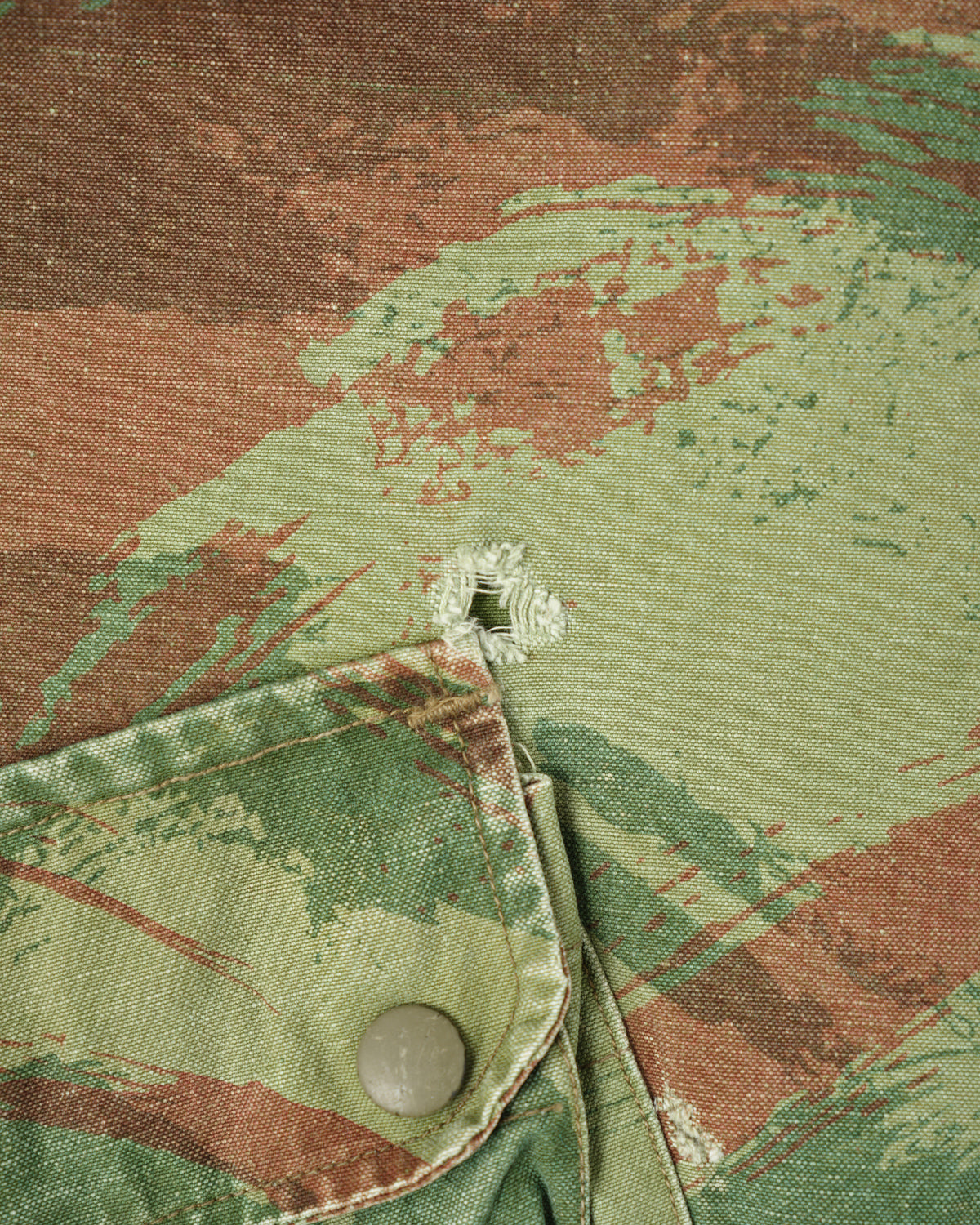
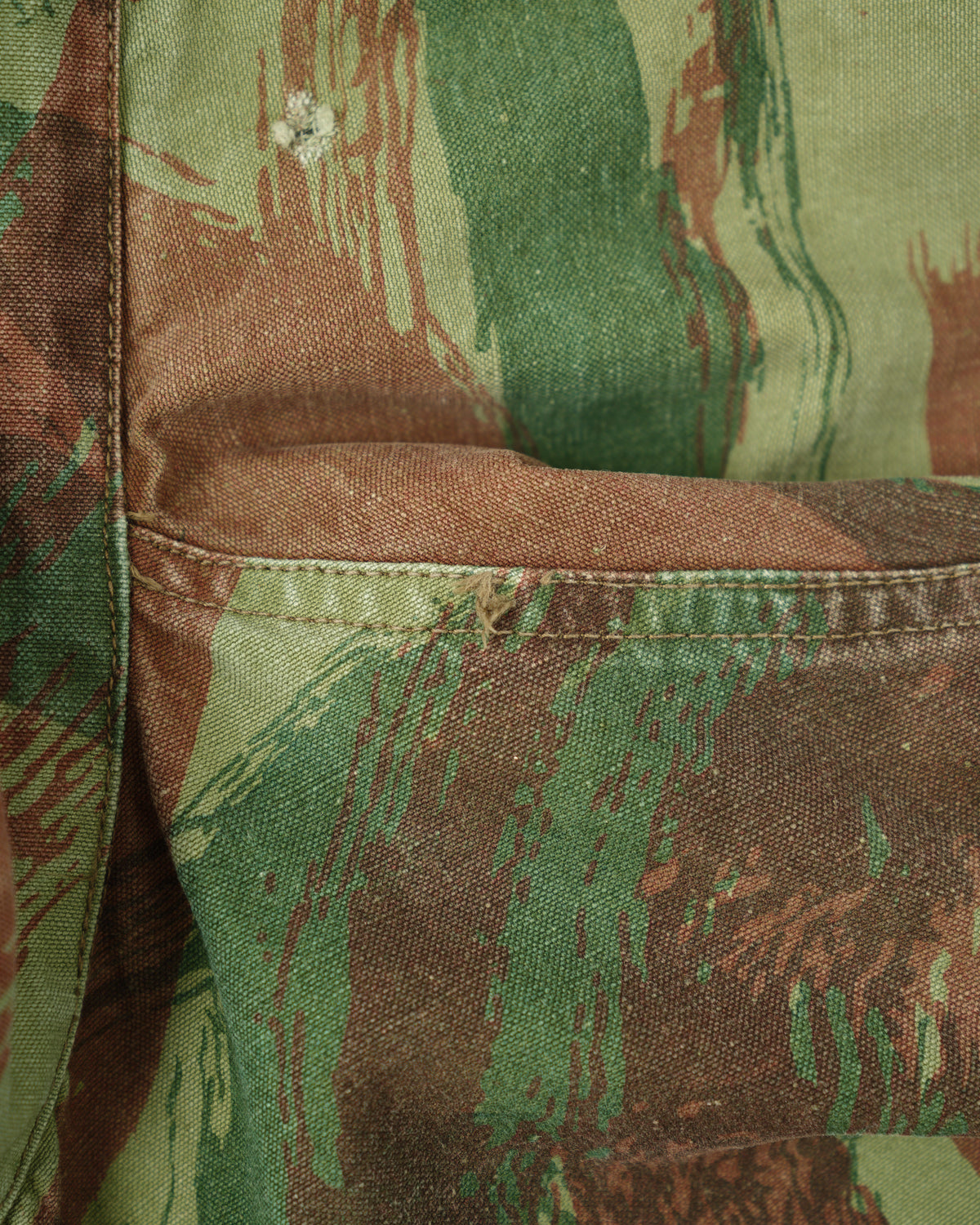
The chest features two substantial flap pockets, each fitted with three snap buttons.
Visually, the information density increases considerably, and the chest volume prevents the silhouette from appearing flat when worn.
The hem on both sides carries angled flap pockets—details that would be simplified in later TAP47/56 variants. The idiosyncratic character of the older design persists unmistakably.
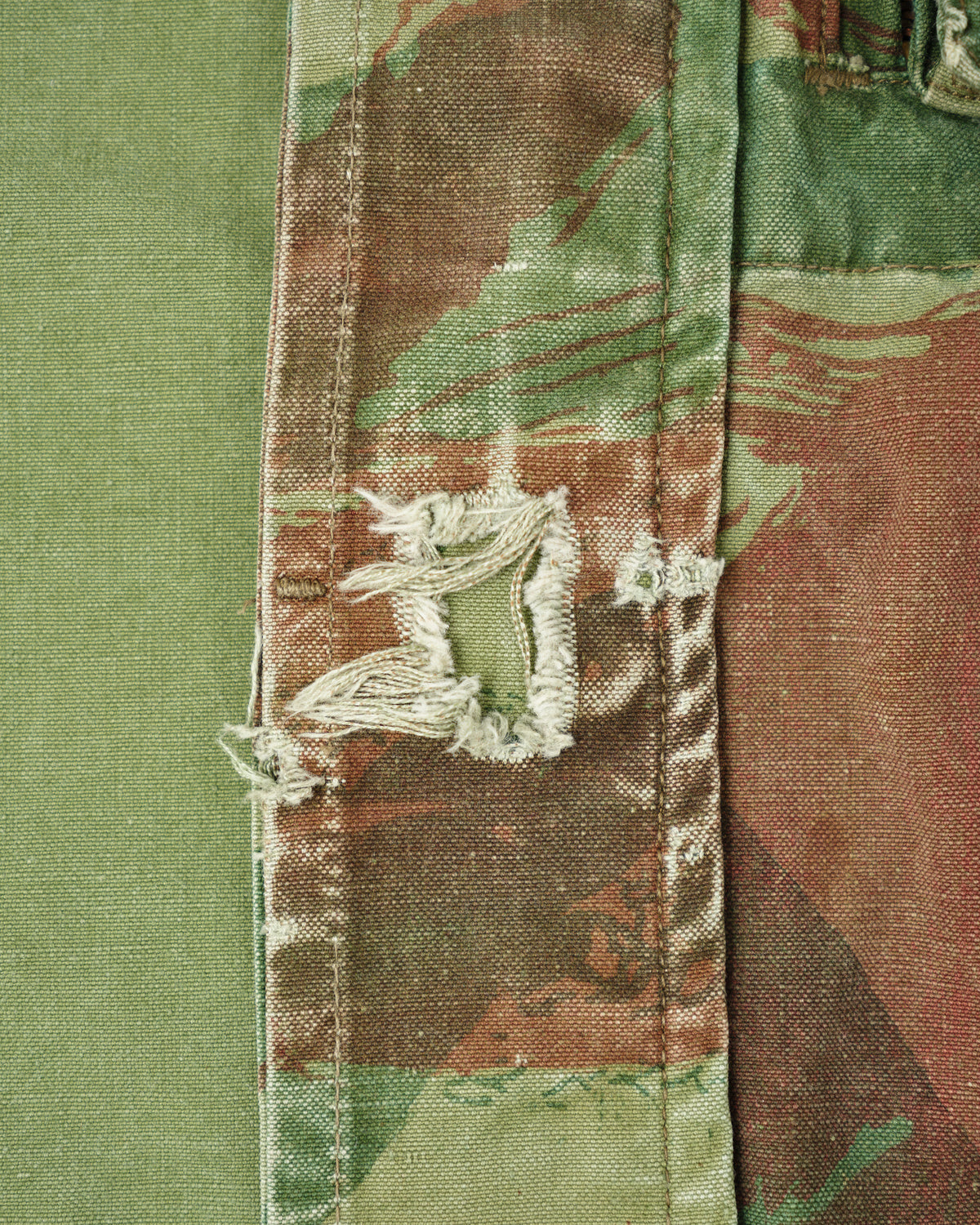
Both hems are fitted with side adjuster belts, allowing waistline adjustment. Combined with the relatively compact body, this construction generates considerable three-dimensionality when cinched.
The front closure employs a dual-layer system: zipper and button fastening together.
Inside, faint military stamps remain visible—subtle yet deliberate assertions of its provenance as issued equipment.
By actual measurements, this reads as a golden size for Japanese proportions, accommodating a broad range of builds.
By design, this functions as an overgarment—conceived to be worn atop other clothing. Most examples carry proportionally generous sizing.
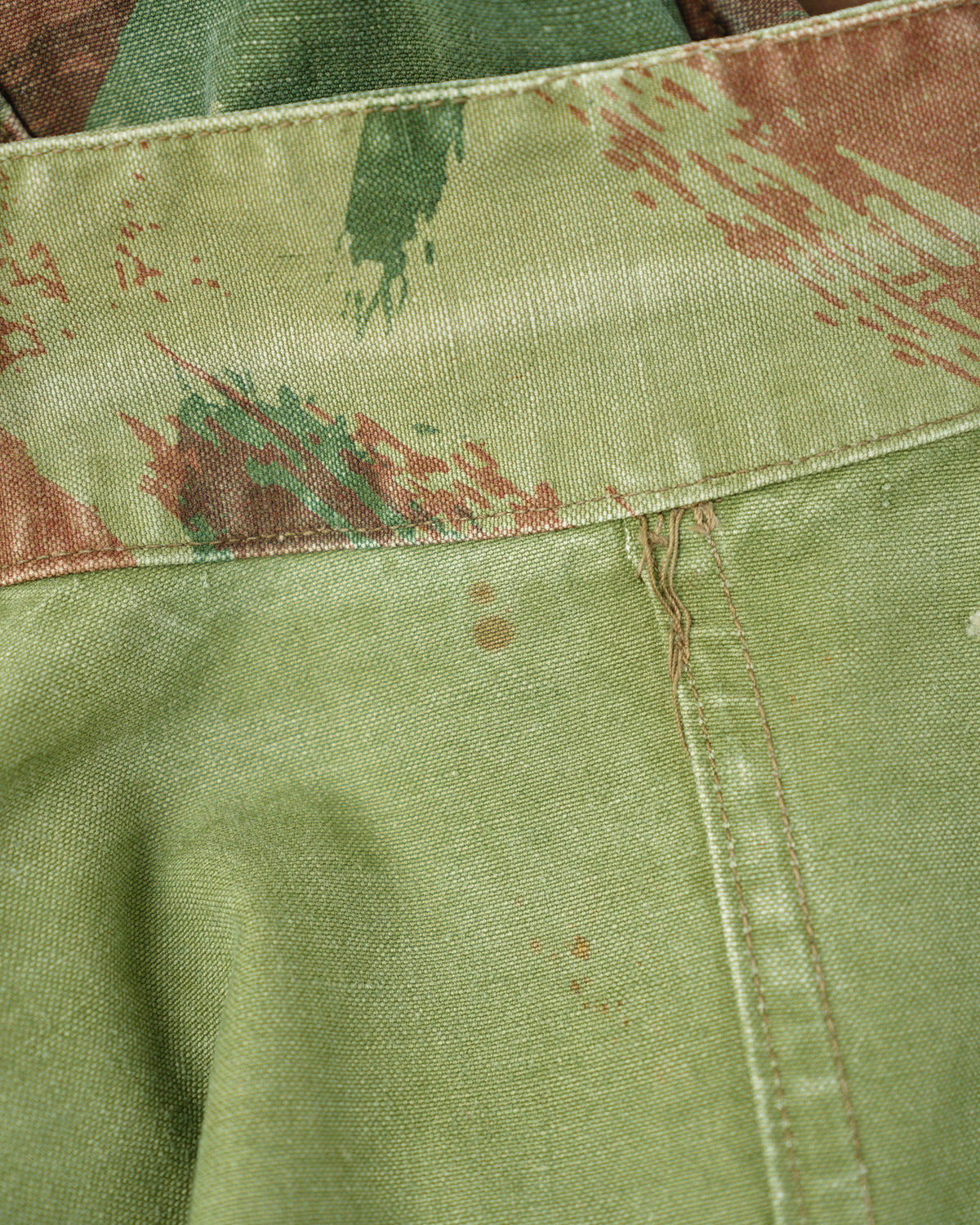
The fabric displays wear inherent to its history—surface marks, soil, minor punctures, tears, missing buttons, absent epaulettes.
The TAP Paratrooper Jacket, refined through successive cycles of field feedback, transcends mere camouflage uniform. It is equipment whose functional necessity converts directly into visual authority.
Among these, the TAP47/54 stands apart: adopted during that narrow 1954–1956 window, positioned as the final iteration before the more prevalent TAP47/56. Its historical positioning grants it considerable appeal.
Equally suited to active wardrobe or considered collection, this represents an exemplary piece.
ADD TO CART