A Deep Blue Metis work jacket, French made, estimated from the 1950s.
The work jacket—an essential presence in French vintage style.
Despite bearing the name "Work," this was in reality a supremely practical garment for manual labour, distributed to and worn by the working classes across France from the late 19th through mid-20th century. Coal miners, factory workers, railway workers, farm labourers—the work jacket served them all, indispensable to the daily rigours of their trades.
As France advanced through industrialisation and urbanisation, countless labourers found themselves in hands-on roles. The work jacket became essential—a companion to their work, shaped by genuine need.
Its character lies in the deliberately engineered details: the hidden button front, deep patch pockets, a box silhouette that allows freedom of movement—all conceived for the demands of arduous labour. This practicality-first approach ensured broad adoption across trades and professions.
The fabrics employed were equally varied—cotton twill, moleskin, cotton pique, corduroy, wool, linen—each chosen according to environment, region, and season. Among these, moleskin particularly distinguished itself for its durability and warmth, earning particular esteem among those engaged in heavy work. It remains one of the most coveted specifications in the vintage market today.
Distribution during this era typically occurred through corporate, governmental, and municipal systems, with company names, manufacturers' marks, and issue numbers stamped inside the collar. Many such examples survive.
Though mass-produced, the work jacket's details reveal marked variation by place and era, rendering it a vivid mirror of French labour culture and historical context. It is valued today for precisely this quality.
Few garments deserve the phrase "functional beauty" as entirely as the work jacket. It stands as the symbol of French workwear—an honest, powerful presence that speaks to us still.
The front closure is the classic five-button configuration with a softly rounded collar, and a single patch pocket positioned at the left chest—the fundamental grammar of the work jacket, faithfully observed.
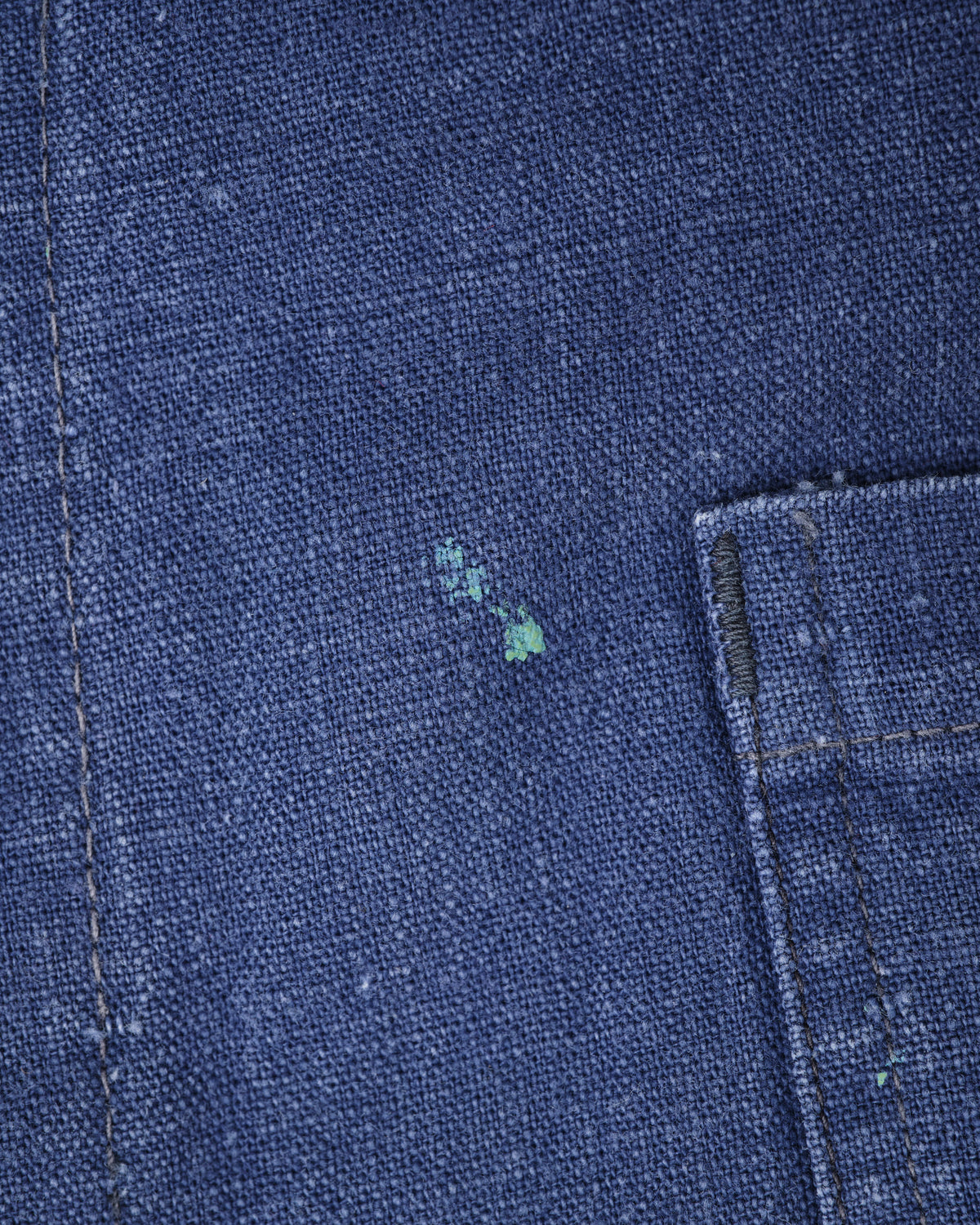
The left chest pocket itself shows period-correct thinking: its opening runs slightly on the diagonal, and the base is cut into a trapezoid—a small gesture toward practical efficiency.
The sleeves are cut with a subtle forward pitch, slightly more pronounced than on comparable coveralls, allowing uncompromised range of motion during work.
Equally noteworthy is the interior construction.
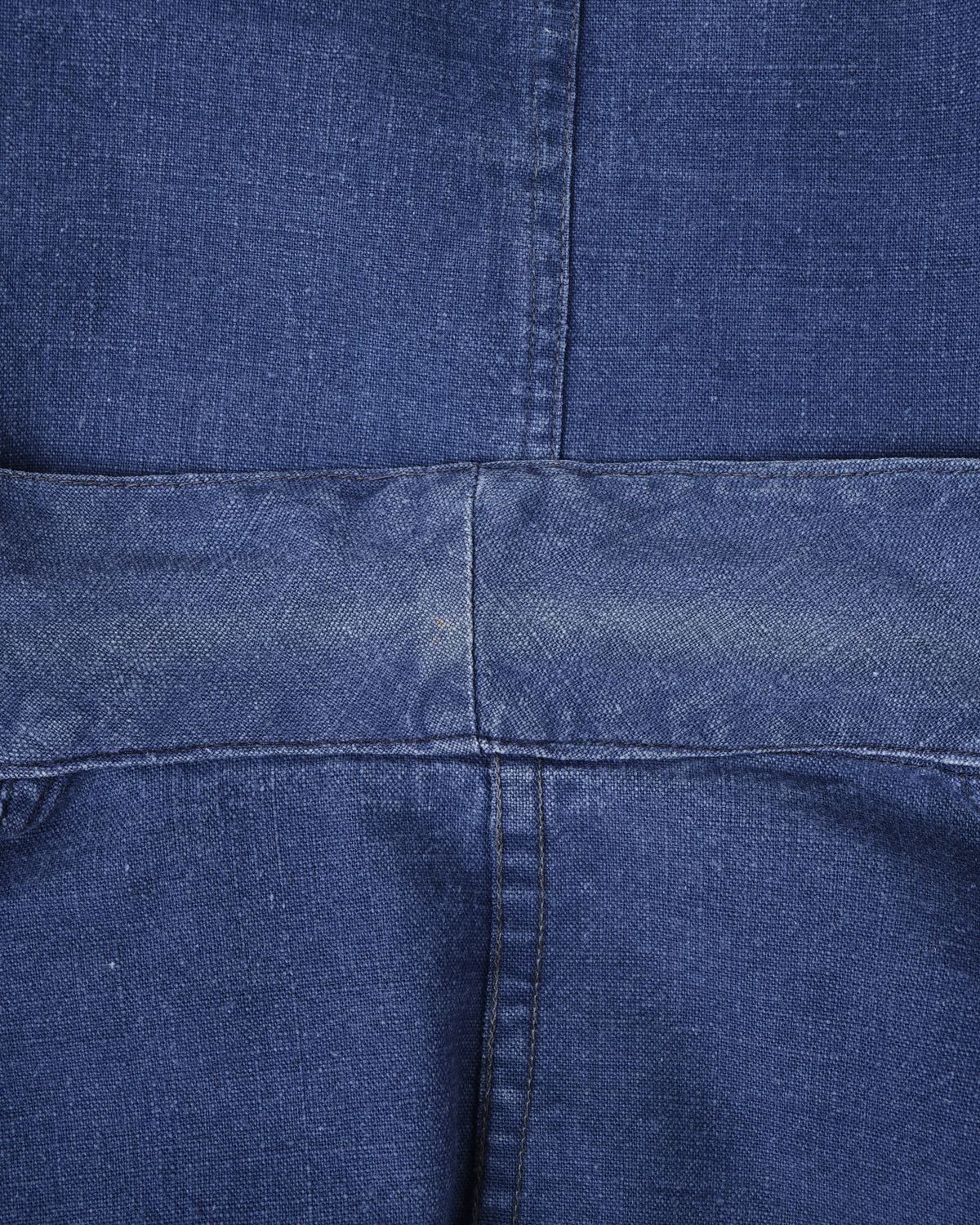
A substantial internal pocket sits within, finished with an indigo Metis cloth of distinctly different tone from the body. This subtle colour differentiation—vintage pragmatism at its finest—serves both utility and quiet visual interest.
The fabric itself is Metis in a plain weave—cotton and linen in balanced proportion, approximately 60 per cent linen to 40 per cent cotton by the hand.
Work jackets typically employ diagonal weave cotton twill or moleskin. This piece stands apart, fashioned from a superior plain-weave Metis—an uncommon and distinguishing choice.
To hold it is to encounter the characteristic texture of linen: a subtle crisp hand and an inherent breathability, paired with a quiet, unpretentious surface. Fine nubs and weaving irregularities catch the light—the hallmark of French vintage refinement.
Cotton adds its own qualities: a softness and gentle elasticity that balance the linen's austerity. The fabric moves with the body, breathing as one might, responsive and accommodating to the wearer's gestures.
The colour is a deep blue, evocative of indigo itself.
More than simple blue—this holds depth and subtle variance. The warp and weft carry a complexity: a deep blue that speaks at once of clarity and quiet strength, distinct and present.
When austere work-wear detailing meets the restraint of deep blue, something emerges: straightforwardness and refinement in unexpected balance.
As light passes through the fine weave of the Metis, the colour shifts with viewing angle and source of illumination, revealing a quiet gradient within what appears at first glance to be a single tone.
No size marking is visible, though the piece appears to correspond to a Japanese size M.
Among French workwear, Metis holds a singular place through its material poetry and distinctive colour. This deep blue piece, quietly detailed with its indigo interior cloth, deserves to be experienced in hand.
ADD TO CART

![[~50’s]French Vintage Deep Blue Metis Work Jacket](http://vieuxetnouveau-shop.com/cdn/shop/files/202505030968.jpg?v=1756736437&width=2400)
![[~50’s]French Vintage Deep Blue Metis Work Jacket](http://vieuxetnouveau-shop.com/cdn/shop/files/202505030970.jpg?v=1756736437&width=2400)
![[~50’s]French Vintage Deep Blue Metis Work Jacket](http://vieuxetnouveau-shop.com/cdn/shop/files/202505030975.jpg?v=1756736437&width=2400)
![[~50’s]French Vintage Deep Blue Metis Work Jacket](http://vieuxetnouveau-shop.com/cdn/shop/files/DSCF8160_9785845b-bea7-4dd9-a475-7e0cd831d0f7.jpg?v=1756736445&width=2400)
![[~50’s]French Vintage Deep Blue Metis Work Jacket](http://vieuxetnouveau-shop.com/cdn/shop/files/DSCF8161_b345d947-a52c-40af-8198-3fae943efb9e.jpg?v=1756736446&width=2400)
![[~50’s]French Vintage Deep Blue Metis Work Jacket](http://vieuxetnouveau-shop.com/cdn/shop/files/DSCF8162_661b637b-191a-46a0-9dfc-6e2582607ee7.jpg?v=1756736446&width=2400)
![[~50’s]French Vintage Deep Blue Metis Work Jacket](http://vieuxetnouveau-shop.com/cdn/shop/files/DSCF8163_c09e0ae4-c3db-42f5-a389-8d12047f74f7.jpg?v=1756736446&width=2400)
![[~50’s]French Vintage Deep Blue Metis Work Jacket](http://vieuxetnouveau-shop.com/cdn/shop/files/DSCF8164_dfa285d4-80e3-4904-8ed0-948d3ee18825.jpg?v=1756736448&width=2400)
![[~50’s]French Vintage Deep Blue Metis Work Jacket](http://vieuxetnouveau-shop.com/cdn/shop/files/DSCF8165_a46fcf0c-fe17-44d9-9050-ec6368719213.jpg?v=1756736446&width=2400)
![[~50’s]French Vintage Deep Blue Metis Work Jacket](http://vieuxetnouveau-shop.com/cdn/shop/files/DSCF8166_8dfb674a-0806-4292-adf1-e6dc29c8d471.jpg?v=1756736446&width=2400)
![[~50’s]French Vintage Deep Blue Metis Work Jacket](http://vieuxetnouveau-shop.com/cdn/shop/files/DSCF8167_8175a47a-f596-4db2-8a02-ac20609a1cf3.jpg?v=1756736446&width=2400)
![[~50’s]French Vintage Deep Blue Metis Work Jacket](http://vieuxetnouveau-shop.com/cdn/shop/files/DSCF8169_92a5125e-37ce-42d0-9938-e422649e6519.jpg?v=1756736447&width=2400)
![[~50’s]French Vintage Deep Blue Metis Work Jacket](http://vieuxetnouveau-shop.com/cdn/shop/files/DSCF8173_ab4e5cb1-55a5-4ec5-aefb-2a2ff7fbf17a.jpg?v=1756736446&width=2400)
![[~50’s]French Vintage Deep Blue Metis Work Jacket](http://vieuxetnouveau-shop.com/cdn/shop/files/DSCF8350_89130e65-6c17-4936-aac1-f024e77f5fcb.jpg?v=1756801199&width=2400)
![[~50’s]French Vintage Deep Blue Metis Work Jacket](http://vieuxetnouveau-shop.com/cdn/shop/files/DSCF8351_59c6a2b2-31f2-4c19-8c39-ac4cc929456a.jpg?v=1756801199&width=2400)
![[~50’s]French Vintage Deep Blue Metis Work Jacket](http://vieuxetnouveau-shop.com/cdn/shop/files/DSCF8352_e7172a7c-86cc-4599-93c3-2a1e1a64bab1.jpg?v=1756801199&width=2400)
![[~50’s]French Vintage Deep Blue Metis Work Jacket](http://vieuxetnouveau-shop.com/cdn/shop/files/DSCF8353_73e2562c-4797-45af-88c9-f93d5c33844e.jpg?v=1756801199&width=2400)
![[~50’s]French Vintage Deep Blue Metis Work Jacket](http://vieuxetnouveau-shop.com/cdn/shop/files/DSCF8349_1e480005-a2a6-42fb-90ce-c4bae168843d.jpg?v=1756801199&width=2400)
![[~50’s]French Vintage Deep Blue Metis Work Jacket](http://vieuxetnouveau-shop.com/cdn/shop/files/DSCF8346_dd394dc5-221b-47dd-8ce9-2b99c17fa7ae.jpg?v=1756801199&width=2400)
![[~50’s]French Vintage Deep Blue Metis Work Jacket](http://vieuxetnouveau-shop.com/cdn/shop/files/DSCF8347_6c05f797-36ec-4419-9a95-ba1a9265ebe1.jpg?v=1756801199&width=2400)
![[~50’s]French Vintage Deep Blue Metis Work Jacket](http://vieuxetnouveau-shop.com/cdn/shop/files/DSCF8348_b364b408-47fc-4c75-aa3f-80ff2e69213e.jpg?v=1756801199&width=2400)
![[~50’s]French Vintage Deep Blue Metis Work Jacket](http://vieuxetnouveau-shop.com/cdn/shop/files/DSCF8358_2b455b8b-5ca4-4142-9a12-9b0478121390.jpg?v=1756801199&width=2400)
![[~50’s]French Vintage Deep Blue Metis Work Jacket](http://vieuxetnouveau-shop.com/cdn/shop/files/DSCF8355_5cd8e446-24e9-446c-bd00-ace7cf5471f9.jpg?v=1756801199&width=2400)
![[~50’s]French Vintage Deep Blue Metis Work Jacket](http://vieuxetnouveau-shop.com/cdn/shop/files/DSCF8356_67e0751a-6a7f-4113-ab40-240b50656c5f.jpg?v=1756801199&width=2400)
![[~50’s]French Vintage Deep Blue Metis Work Jacket](http://vieuxetnouveau-shop.com/cdn/shop/files/DSCF8357_c2886f61-15f2-48eb-9e6f-73d40e524a6f.jpg?v=1756801199&width=2400)