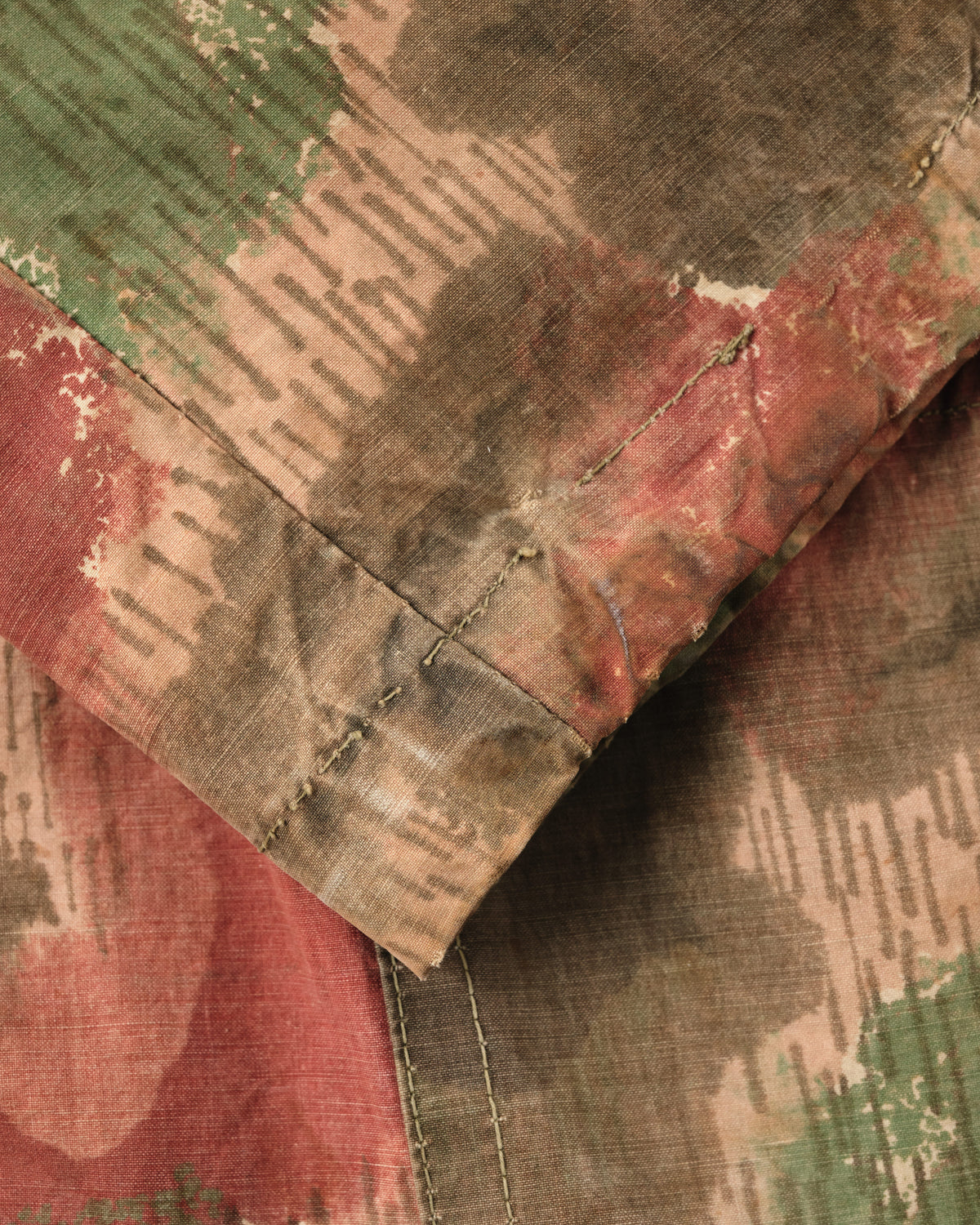
Circa 1960s: a Czechoslovak People's Army Sumpfmuster Pattern Camouflage Raglan Sleeve Zip-up Hooded Jacket.
A special acquisition.
Today divided into the Czech Republic and Slovak Republic, these territories once formed the Czechoslovak Socialist Republic from 1918 to 1992 (initially as the Czechoslovak Republic until 1960). This piece originates from that era.
Worn by the Československá Lidová Armáda (CSLA—the Czechoslovak People's Army)—a period and context few pieces carry forward today.
CSLA = "Československá Lidová Armáda."
What arrests the eye is the distinctly characteristic Sumpfmuster Pattern Camouflage, singular to Czechoslovak military forces.
This pattern draws from Wehrmacht wetland camouflage of World War II and was first introduced in 1948. By the 1950s, it saw limited adoption within select CSLA units—primarily airborne and reconnaissance divisions.
Uniform adoption remained sparse. The pattern was predominantly used for what the Wehrmacht called the "Zeltbahn"—an isosceles triangle shelter tent for individual use.
Historical records show similar restraint with British Denison smock–type parachute smocks, suggesting even these had narrow distribution.
Among all camouflage patterns, the Sumpfmuster ranks among the rarest. Its global scarcity means many encounter it for the first time here. Within Japan, pieces in circulation number but a handful.
This example represents what is called "Localmade"—not factory mass-production of the pattern, but rather an individual construction: fabric, pattern, and tailoring procured and assembled by hand. Lockstitch detailing and construction suggest a piece made circa 1960s.
Though the camouflage reads bold at first glance, the detailing remains restrained.
Patch pockets at the hem quietly anchor the silhouette without competing with the pattern—a studied balance between function and form.
The hooded design offers practical shelter from wind at the neck while serving as a stylistic counterpoint to the camouflage's boldness.
Shirring at the waist prevents bulk, creating dimension without heaviness.
The closure employs a full-length zipper, fitted with KIN-branded hardware.
The zip construction allows easy layering—ideal as a middle layer beneath heavier outerwear or worn open over lighter pieces.
No factory size marking remains, though the piece aligns with Japanese sizing M to L—a proportional fit for most frames.
Measurements suggest a golden size for the Japanese physique. The piece wears well oversized, in keeping with military tradition.
Wear is evident: fabric-specific surface aging, light marks, minor loose threads, and repair marks—none of which compromise function. The piece remains entirely wearable.
Among European military pieces, this represents a specialized chapter in camouflage history.
Beyond its rarity, it reads beautifully as a fashion object—something worth wearing, not merely shelving.
This is not something money alone secures. Future availability cannot be assured.
Whether as a working garment, a collection piece, or a design reference, it warrants consideration.
Domestically and internationally, such examples surface rarely. If you have searched for this or favor the uncommon, this warrants attention.