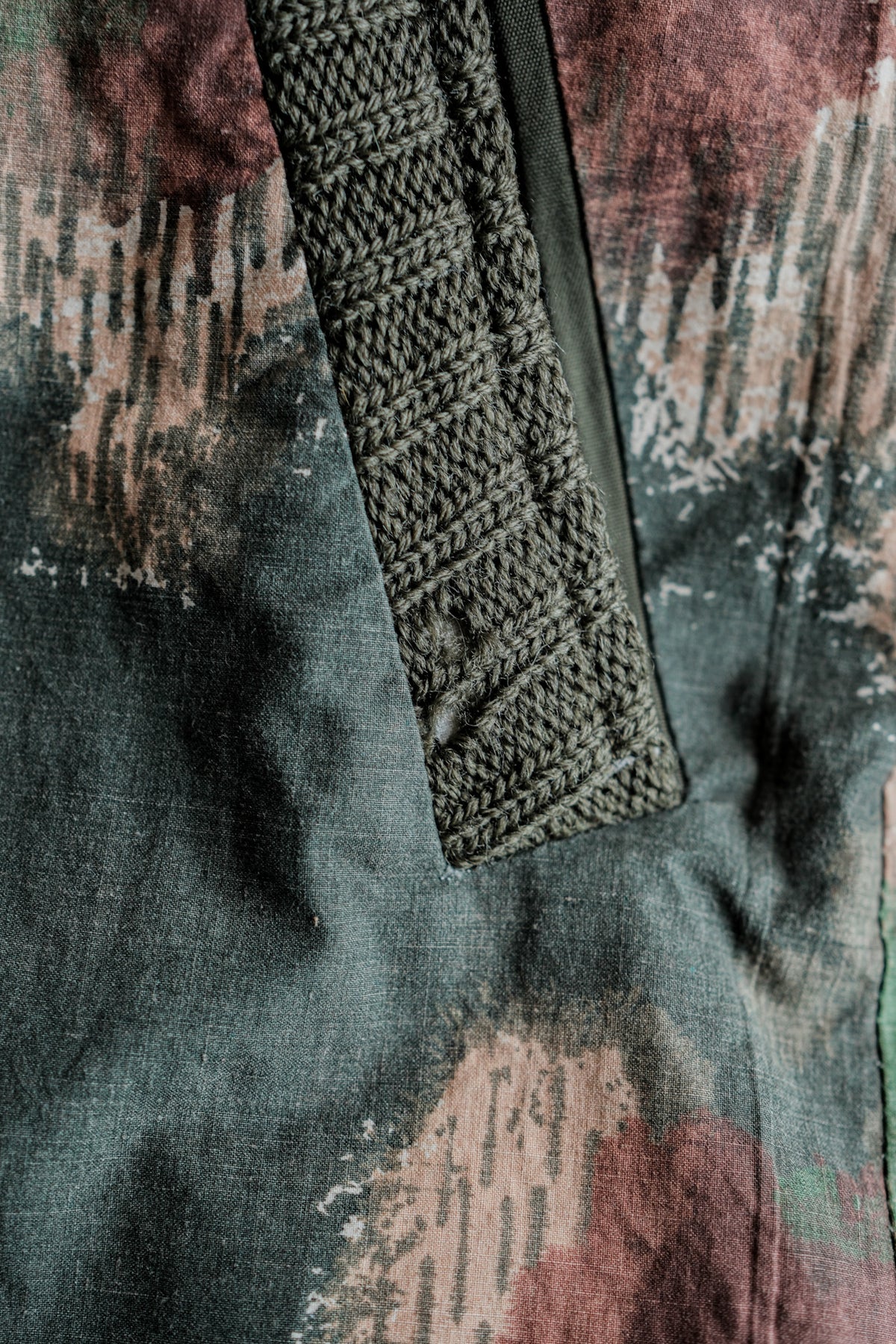
Estimated circa 1960s, this is a Československé Lidové Letectvo (Czechoslovak People's Air Force) Sumpfmuster Pattern Camouflage Paratrooper Jacket.
A truly exceptional arrival.
Today divided into the Czech Republic and Slovak Republic as separate nations, the Czechoslovak Socialist Republic existed from 1918 to 1992 (as the Czechoslovak Republic from 1918 to 1960). This piece is believed to have been worn by personnel of the Československé Lidové Letectvo (CSLL) during that socialist era.
CSLL = "Československé Lidové Letectvo."
The Sumpfmuster Pattern Camouflage—a distinctly characteristic pattern unique to Czechoslovak People's Army forces—commands immediate attention. This camouflage pattern, derived from German Wehrmacht swamp camouflage designs of the Second World War, was first introduced in 1948.
By the 1950s, it saw adoption within select units of the Czechoslovak People's Army, primarily among airborne and reconnaissance forces.
Official uniform adoption was rare; the pattern was predominantly employed as the Zeltbahn—an isosceles triangle personal shelter tent. Documentation in our collection shows similar limited adoption with Denison smock-pattern parachute smocks in British forces.
Among camouflage patterns, the Sumpfmuster stands among the rarest. Given how few examples survive globally, many will encounter this pattern for the first time.
Within Japan specifically, circulation has been minimal—countable on one hand.
This particular example represents what is known as "localmade" production—not mass-manufactured from a single factory run, but rather individually constructed: the fabric, pattern, and tailoring all sourced and executed by hand. Based on the zipper type and stitching methods employed, this piece likely dates to approximately the 1960s.
The design features typical of military wear: shawl collar, epaulettes, dual-snap flap pockets positioned at both chest, vertical hand pockets at the hem, and ribbed cuffs to resist wind intrusion. The interplay between the bold camouflage shell and the contrasting material panels throughout proves remarkably elegant and purposeful in execution.
Closure is achieved via zipper. The slider carries an unmarked pull.
No size marking is present, though it appears to correspond to a Japanese S to M.
Given the compact proportions, those of slighter build will find it accommodating. It suits both a fitted and relaxed wear equally well.
Small punctures and wear are evident, but no damage that would impede wearing remains.
Among European military pieces, this occupies the realm of exceptional camouflage. Beyond its rarity, considered simply as a garment, it is genuinely compelling—meant to be worn, not merely preserved.
This is not something money alone can procure, nor can future availability be assured.
Whether as working wardrobe, collector's piece, or reference for design, it stands without compromise. Rarely encountered domestically, this is worth pursuing should you have sought such a thing or hold affection for the genuinely uncommon.