An estimated 1960s L'ESQUIMAU Printed Moleskin Lapel Hunting Jacket.
The brand has become increasingly visible domestically in recent years.
A French-founded outdoor brand that has primarily focused on hunting jackets and fishing jackets.
This particular piece carries a double nameplate with MEFFRE, another French manufacturer.
Items from this brand tend to be marked by thoughtful design and refined aesthetics.
The piece presented here exemplifies that character—a distinctive and refined specimen.
Restrained lapels, hand warmer pockets positioned at the chest, generous flap pockets at the hem, and a water-resistant game pocket at the back—a collection of well-considered details that excel functionally while remaining compelling as a fashion object.
Action pleats are sewn into the shoulders, a design choice prioritising ease of movement.
This reduces strain when moving the arms, resulting in comfortable wear.
The front closure employs a hidden button placket.
Beyond the visual refinement this affords, the double-layer construction provides practical benefits—it prevents wind penetration and protects the buttons from external elements.
The defining characteristic of this piece is its generous use of Printed Moleskin—a fabric known as rare even among French workwear of the same era.
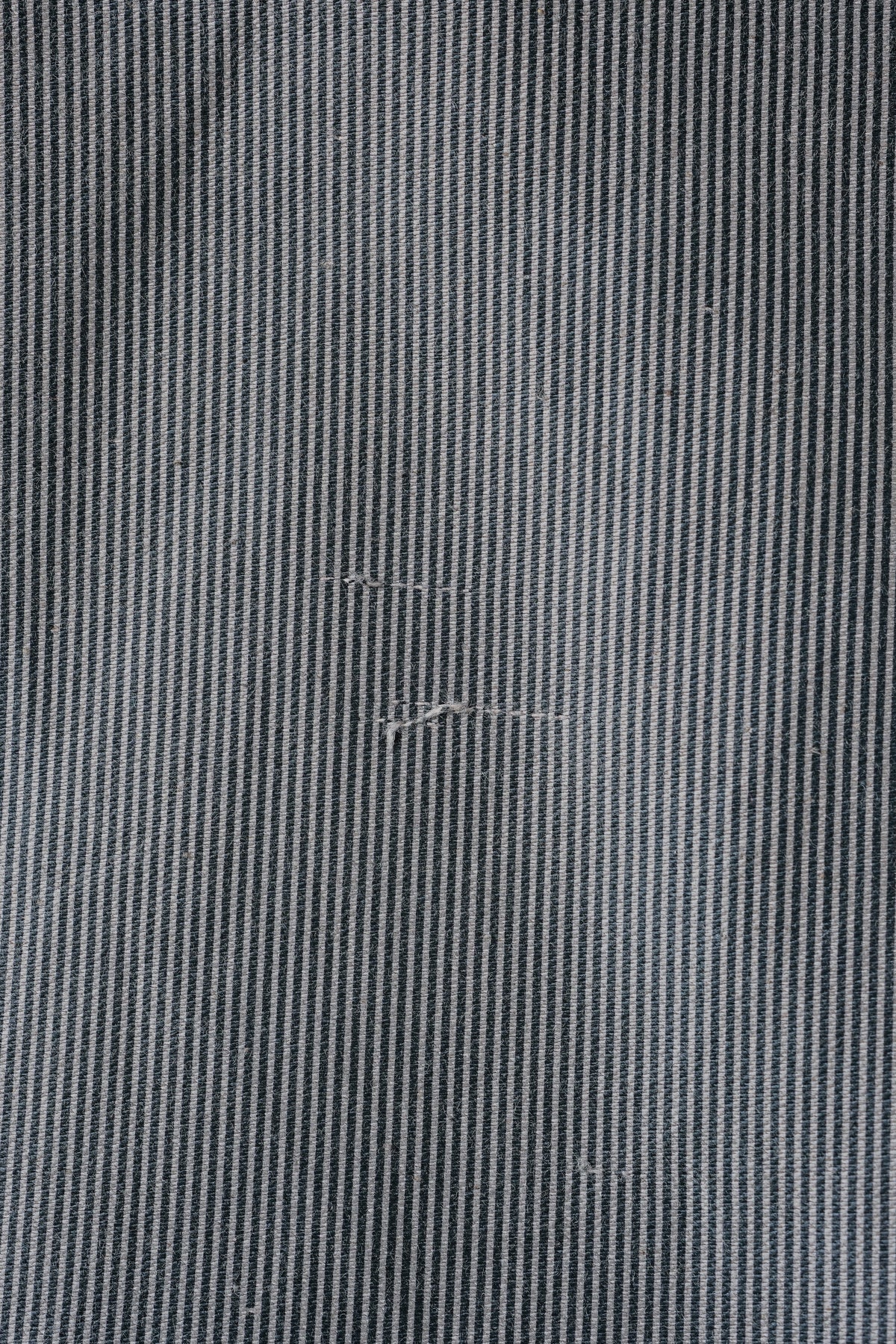
Printed Moleskin is precisely what its name suggests: a Moleskin fabric, named for its resemblance to mole skin, printed with a fine-pitch stripe pattern.
Even across Belgium and France during this period, such fabric was adopted only sparingly, making it highly sought after by those aware of its rarity.
The hand and weight of Printed Moleskin mirror standard Moleskin—a smoothness and substance that belies its cotton composition.
The secret lies in the weaving method.
Moleskin is constructed using a satin weave—one of the three fundamental fabric structures.
Satin weave is characterised by warp and weft threads numbering at least five, creating a structure where floats are minimal and only one direction appears on the surface.
High density, substantial weight, flexibility, smoothness, and pronounced lustre are its hallmarks.
It is precisely because of this dense weave—its substance and flexibility—that Moleskin became the fabric of choice for workwear in demanding environments.
Its dark tonality works equally well with richly saturated colours or in monochromatic layering, both approaches resolving into a cohesive whole.
The sleeves are cut with dimensional construction, lending the jacket an understated refinement despite its hunting jacket origins.
While no size marking is visible, the piece appears to correspond to a Japanese size L.
The measurements indicate a generous fit, accommodating larger frames without issue.
It works equally well worn close or oversized.
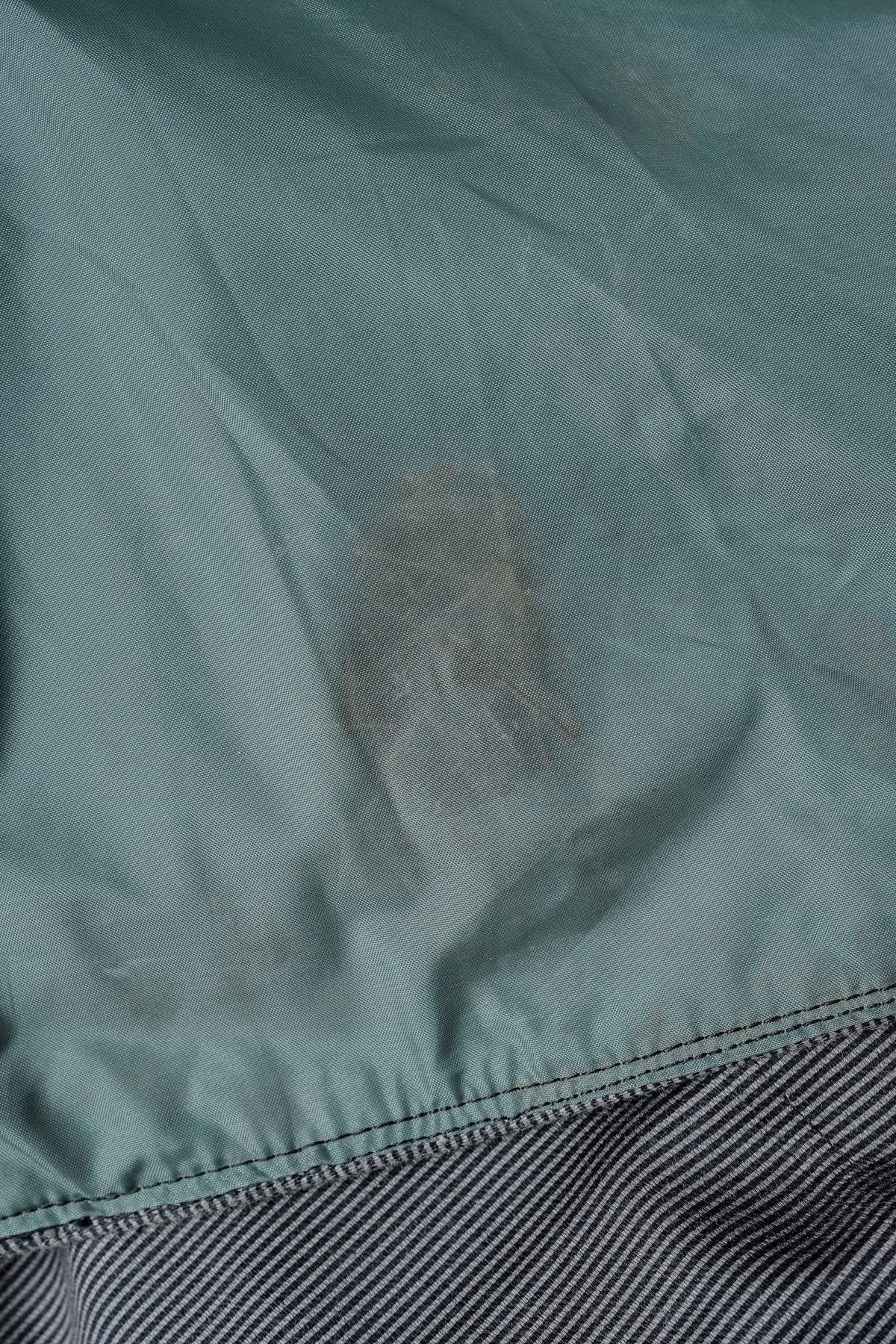
Surface wear—scuffing and small pulls—is present,though no significant damage compromises wearability. This remains a viable garment.
L'ESQUIMAU consistently demonstrates thoughtful detailing and design.
A piece bearing authentic hunting jacket and fishing jacket details—born from genuine purpose—reads with a naturalness that aligns remarkably well with contemporary sensibilities. It is, in the best sense, current.
Items of this calibre arrive infrequently. If you have been searching, this would be the time to act.