A ‘Denim Jacket’ by CLOSED by Marithé François Girbaud, estimated to date from around the 1980s.
A piece that seems to have stitched a tailored jacket and a riders jacket together in denim.
Put into words it sounds a little violent, but seeing the garment itself should convince you.
Marithé + François Girbaud is the brand of the French designer couple "Marithé Bachellerie" and "François Girbaud".
What the two, who met in 1960s Paris, set themselves to was work the fashion world of the day would not so much as glance at.
How to "treat" denim.
Washed jeans are taken for granted now, but at the time denim was nothing but stiff, navy work clothing.
To wash it, abrade it, strip the colour, and produce from the outset the expression of a garment already worn in — François Girbaud is said to be among the very first to put this thinking into practice.
Stone washing, in which stones are tumbled in with the wash, is one of the techniques that spread from their experiments.
Trace back the pale-coloured jeans lining shops the world over today and one arrives at this couple's work. Quite something, don't you think?
And the brand the two founded in 1978 is the one recorded on this piece's label: "CLOSED".
Begun in partnership with an Italian sewing factory, the brand was a place where the experimental spirit of Paris crossed with the tailoring skill of Italy.
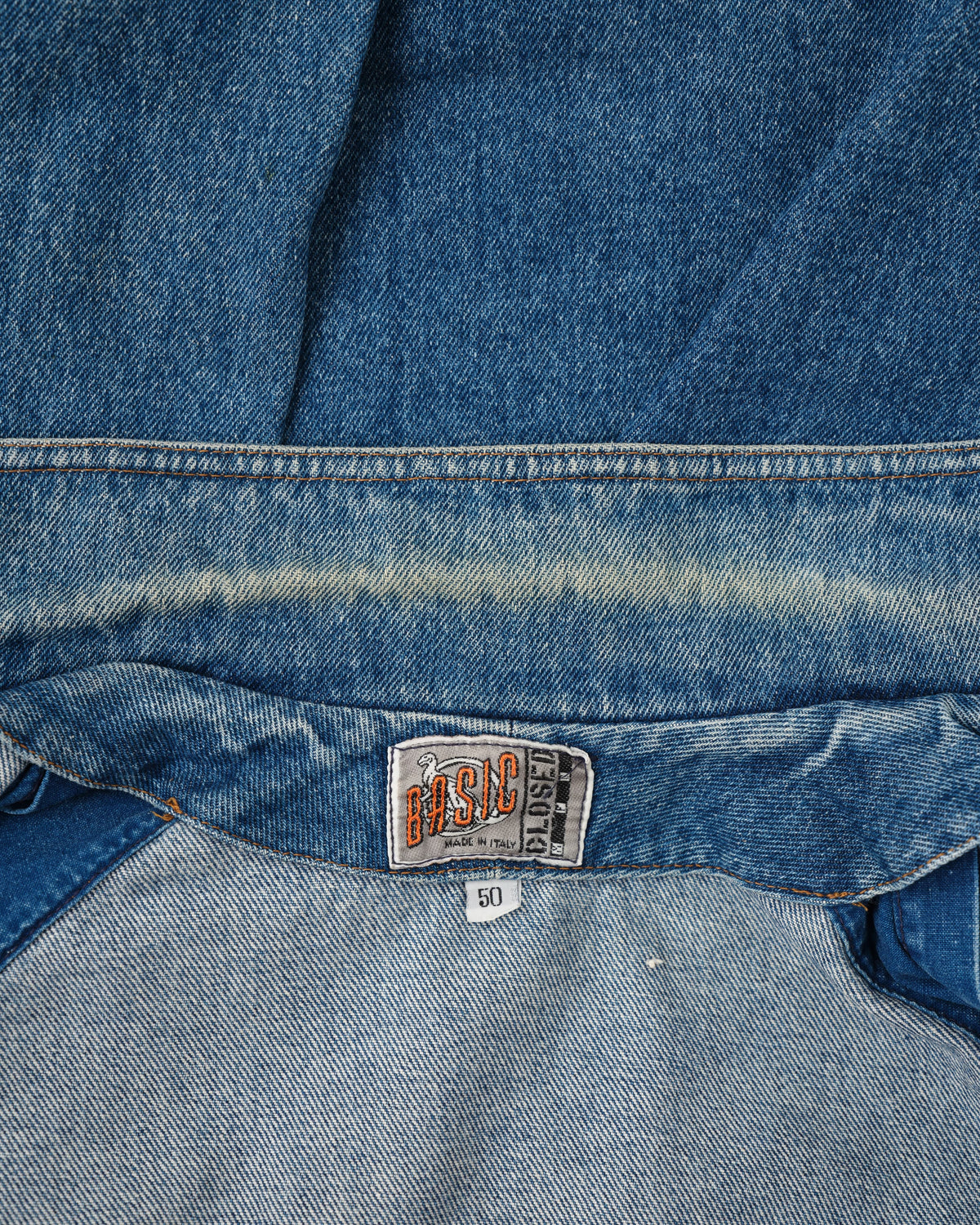
The label at the neck carries "BASIC" in orange lettering, the "CLOSED" logo, and a single line reading "MADE IN ITALY".
The sight of those three set together seems to carry the air of the period all by itself.
Now, the piece introduced here is a genuinely unusual thing.
First, the collar is tailored.
A proper notched lapel, with a lower collar, made up in denim cloth.
The standard for a denim jacket is a small collar on a stand, and here that has deliberately been replaced with the collar of a suit jacket.
By that one move alone, denim that ought to be rough suddenly begins to look refined — curious, isn't it.
The front closes with two buttons.
This too is interesting: the upper button catches on a denim loop while the lower one has an ordinary buttonhole — not asymmetric left to right, but asymmetric top to bottom.
And then the pockets. This, I think, is the greatest point of interest on the piece.
At the waist, both sides carry large patch pockets with their corners rounded off — but what is laid over them differs from side to side.
On one side, a welted slit pocket.
A welt is a technique in which the pocket mouth is bound with a narrow strip of cloth, properly belonging to the breast pocket of a tailored jacket and the like.
And on the other, a small flap pocket closed with a snap button.
This is plainly a device drawn from the riders jacket, and the snap is stamped "CLOSED".
Which is to say, within a single garment, gentleman's tailoring and the motorcyclist's coat live side by side, divided left and right.
Ordinarily the thing would fall apart, and that it holds together is where one feels the true strength of this couple.
From the shoulder across the chest runs a diagonal seam.
Thanks to that single line, dimensional shadow arises across a denim front body that tends otherwise to read flat.
The cloth is a denim of solid thickness.
And yet it has already come to sufficient softness, so it follows the body from the moment it is put on.
The thread is unified in orange stitching, and white wear has risen along the seam allowances.
Denim is a cloth that records its wearer's habits exactly as they are.
At the elbows, at the cuffs, and at the edges of the pockets, the way you use it from here will be cut straight into it.
This piece has not yet run dry, so a good deal of room to raise it remains.
The colour is an indigo fade, the colour drawn out to a moderate degree.
Settled between deep navy and pale blue, one might call it the most usable depth of all.
With a tailored collar attached, this lightness of tone works towards a certain ease.
Thrown over a white shirt, with grey slacks below.
It is denim, yet the collar is that of a jacket, so this alone should compose a well-ordered impression.
Of course one may break it down with a T-shirt beneath, and pairing it with denim of a similar shade for a unified look would be interesting as well.
It is a piece with a quirk, and yet once on it settles in with surprising ordinariness. That kind of garment.
The size marking reads "50".
Roughly equivalent to a Japanese "L ~ XL", I should think.
Dropped shoulders, with generous room through the body and the armholes: a relaxed silhouette in the manner of the eighties.
The front body is cut longer than the back, so worn open the vertical line is emphasised and it falls beautifully.
There are signs of use, including the wear marks peculiar to the cloth and some fading, but no significant damage that would affect wear, so there is plenty of life left in it.
The brand itself continues today, but a piece of this period — and this experimental — is no longer made.
A design that houses tailoring and the riders jacket in one garment, with neither profit nor saleability taken into account, was a game permitted only by the Europe of that time, I think.
There are any number of denim jackets in the world, but one will scarcely find this same shape.
To anyone looking for a piece with a quirk, I should be glad to hand the next chapter over.
![[~80's] Old Marithé François Girbaud Closed Denim Jacket Size.50](http://vieuxetnouveau-shop.com/cdn/shop/files/J01099-1_e7db71d0-0955-47f2-bff3-56233e11dc73.jpg?v=1788334594&width=2400)
![[~80's] Old Marithé François Girbaud Closed Denim Jacket Size.50](http://vieuxetnouveau-shop.com/cdn/shop/files/J01099-2_845bf909-a5f5-47d9-b879-c7f30be4aabe.jpg?v=1788334594&width=2400)
![[~80's] Old Marithé François Girbaud Closed Denim Jacket Size.50](http://vieuxetnouveau-shop.com/cdn/shop/files/J01099-3_d0b1efa8-e05e-44c3-aba2-9209962d741c.jpg?v=1788334594&width=2400)
![[~80's] Old Marithé François Girbaud Closed Denim Jacket Size.50](http://vieuxetnouveau-shop.com/cdn/shop/files/J01099-4_79064675-eeae-49cd-b245-fb7c812ab5f8.jpg?v=1788334594&width=2400)
![[~80's] Old Marithé François Girbaud Closed Denim Jacket Size.50](http://vieuxetnouveau-shop.com/cdn/shop/files/J01099-5_b00e1742-2f28-42c7-8eda-03f5a41ed20f.jpg?v=1788334594&width=2400)
![[~80's] Old Marithé François Girbaud Closed Denim Jacket Size.50](http://vieuxetnouveau-shop.com/cdn/shop/files/J01099-6_0faf7f24-17cf-496d-b4a6-ff1b1766faa7.jpg?v=1788334594&width=2400)
![[~80's] Old Marithé François Girbaud Closed Denim Jacket Size.50](http://vieuxetnouveau-shop.com/cdn/shop/files/J01099-7_108d6b30-1b25-4718-810a-a9dee4e8b5e6.jpg?v=1788334594&width=2400)
![[~80's] Old Marithé François Girbaud Closed Denim Jacket Size.50](http://vieuxetnouveau-shop.com/cdn/shop/files/J01099-8_bfb22fda-5034-4f87-9ef5-0f586716b572.jpg?v=1788334594&width=2400)
![[~80's] Old Marithé François Girbaud Closed Denim Jacket Size.50](http://vieuxetnouveau-shop.com/cdn/shop/files/J01099-9_937022cb-d5e6-427d-bdd7-a25c886d1863.jpg?v=1788334594&width=2400)
![[~80's] Old Marithé François Girbaud Closed Denim Jacket Size.50](http://vieuxetnouveau-shop.com/cdn/shop/files/J01099-10_785bc160-5e2f-4217-ac6a-177da6c95f9d.jpg?v=1788334594&width=2400)
![[~80's] Old Marithé François Girbaud Closed Denim Jacket Size.50](http://vieuxetnouveau-shop.com/cdn/shop/files/J01099-11_ca165d0b-d1af-49e3-9eea-0a7b2f5bbfaa.jpg?v=1788334594&width=2400)
![[~80's] Old Marithé François Girbaud Closed Denim Jacket Size.50](http://vieuxetnouveau-shop.com/cdn/shop/files/J01099-12_77c22d14-08c1-4ca6-9ff5-5473174e0eb6.jpg?v=1788334595&width=2400)
![[~80's] Old Marithé François Girbaud Closed Denim Jacket Size.50](http://vieuxetnouveau-shop.com/cdn/shop/files/J01099-13_6d479b1a-aa11-40ac-b222-12685679edb0.jpg?v=1788334595&width=2400)
![[~80's] Old Marithé François Girbaud Closed Denim Jacket Size.50](http://vieuxetnouveau-shop.com/cdn/shop/files/J01099-14_d494b09c-0eb2-4bc7-9156-396900cf5ac4.jpg?v=1788334595&width=2400)
![[~80's] Old Marithé François Girbaud Closed Denim Jacket Size.50](http://vieuxetnouveau-shop.com/cdn/shop/files/J01099-15_e20b21cd-d1f6-41e4-ba04-5d0d5ab16ee8.jpg?v=1788334595&width=2400)
![[~80's] Old Marithé François Girbaud Closed Denim Jacket Size.50](http://vieuxetnouveau-shop.com/cdn/shop/files/J01099-16_7a864aee-2e21-47e6-a94a-e56f0aa40988.jpg?v=1788334595&width=2400)
![[~80's] Old Marithé François Girbaud Closed Denim Jacket Size.50](http://vieuxetnouveau-shop.com/cdn/shop/files/J01099-17_9e82f119-3427-47b9-a8ed-1f51473f1d39.jpg?v=1788334595&width=2400)
![[~80's] Old Marithé François Girbaud Closed Denim Jacket Size.50](http://vieuxetnouveau-shop.com/cdn/shop/files/J01099-18_1b191f10-5d80-4601-ac05-d105cd91f824.jpg?v=1788334595&width=2400)
![[~80's] Old Marithé François Girbaud Closed Denim Jacket Size.50](http://vieuxetnouveau-shop.com/cdn/shop/files/J01099-19_265182f7-8a07-411b-be45-8e8c50ec41fb.jpg?v=1788334595&width=2400)
![[~80's] Old Marithé François Girbaud Closed Denim Jacket Size.50](http://vieuxetnouveau-shop.com/cdn/shop/files/J01099-20_b8a67964-e43e-47eb-91e1-f9c70109bb39.jpg?v=1788334595&width=2400)
![[~80's] Old Marithé François Girbaud Closed Denim Jacket Size.50](http://vieuxetnouveau-shop.com/cdn/shop/files/J01099-21_275fe107-2633-415a-bf6e-04eaa7e6ce77.jpg?v=1788334595&width=2400)
![[~80's] Old Marithé François Girbaud Closed Denim Jacket Size.50](http://vieuxetnouveau-shop.com/cdn/shop/files/J01099-22_aa938c3d-7f51-4d3e-9581-c29f73676554.jpg?v=1788334595&width=2400)
![[~80's] Old Marithé François Girbaud Closed Denim Jacket Size.50](http://vieuxetnouveau-shop.com/cdn/shop/files/J01099-23_6297bb20-fdae-41a2-90a1-13723ebf84ec.jpg?v=1788334595&width=2400)
![[~80's] Old Marithé François Girbaud Closed Denim Jacket Size.50](http://vieuxetnouveau-shop.com/cdn/shop/files/J01099-24_ab43ff7b-7e27-4cee-bd21-47e61dc1e99b.jpg?v=1788334595&width=2400)
![[~80's] Old Marithé François Girbaud Closed Denim Jacket Size.50](http://vieuxetnouveau-shop.com/cdn/shop/files/J01099-25_7f0ad415-6031-4d82-a149-eca01fe51fa8.jpg?v=1788334595&width=2400)
![[~80's] Old Marithé François Girbaud Closed Denim Jacket Size.50](http://vieuxetnouveau-shop.com/cdn/shop/files/J01099-26_ef71b8a0-1a25-4621-8282-f937cc851e09.jpg?v=1788334595&width=2400)
![[~80's] Old Marithé François Girbaud Closed Denim Jacket Size.50](http://vieuxetnouveau-shop.com/cdn/shop/files/J01099-27_bae29524-705c-4dcc-b3ba-e615310a16d1.jpg?v=1788334595&width=2400)