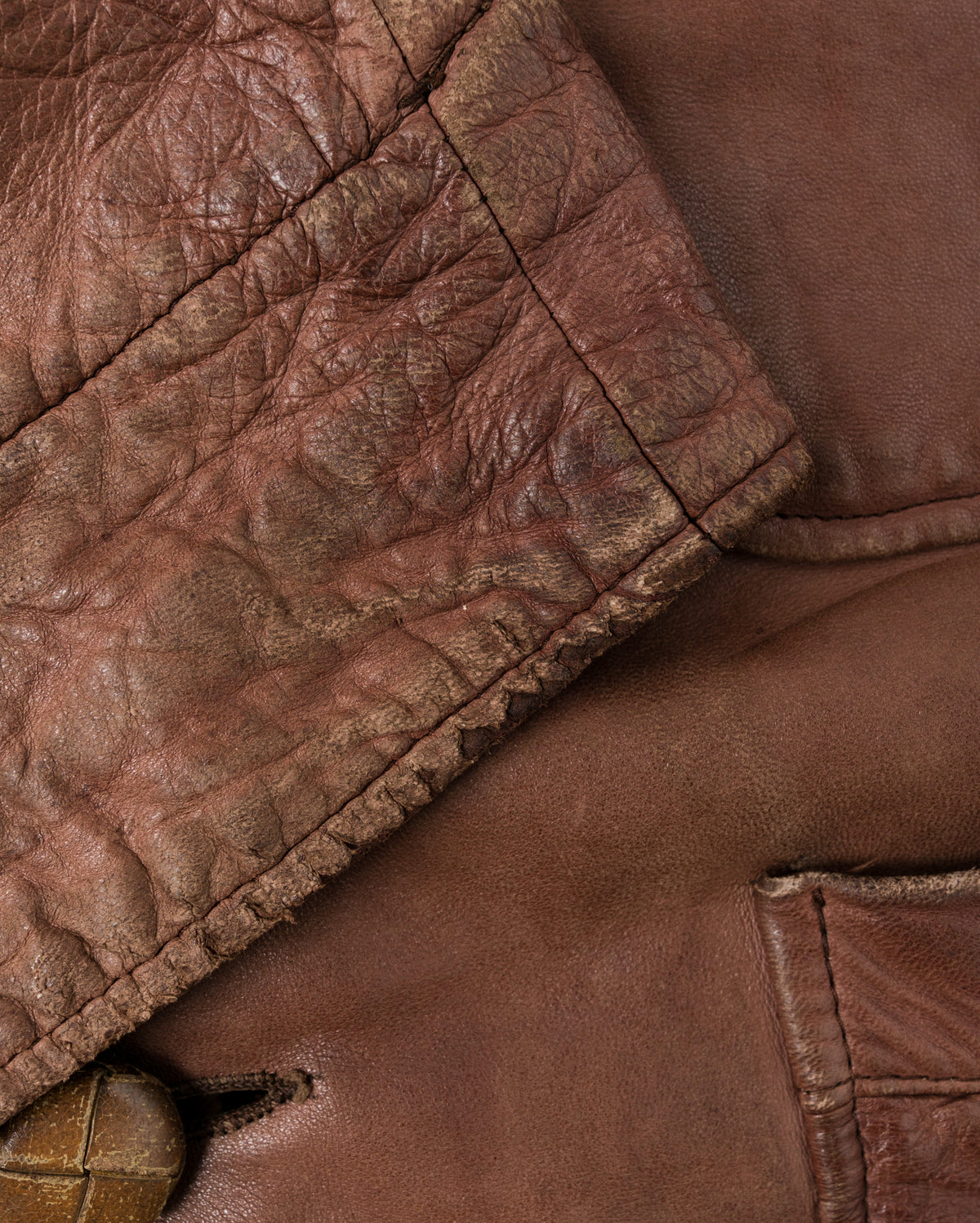
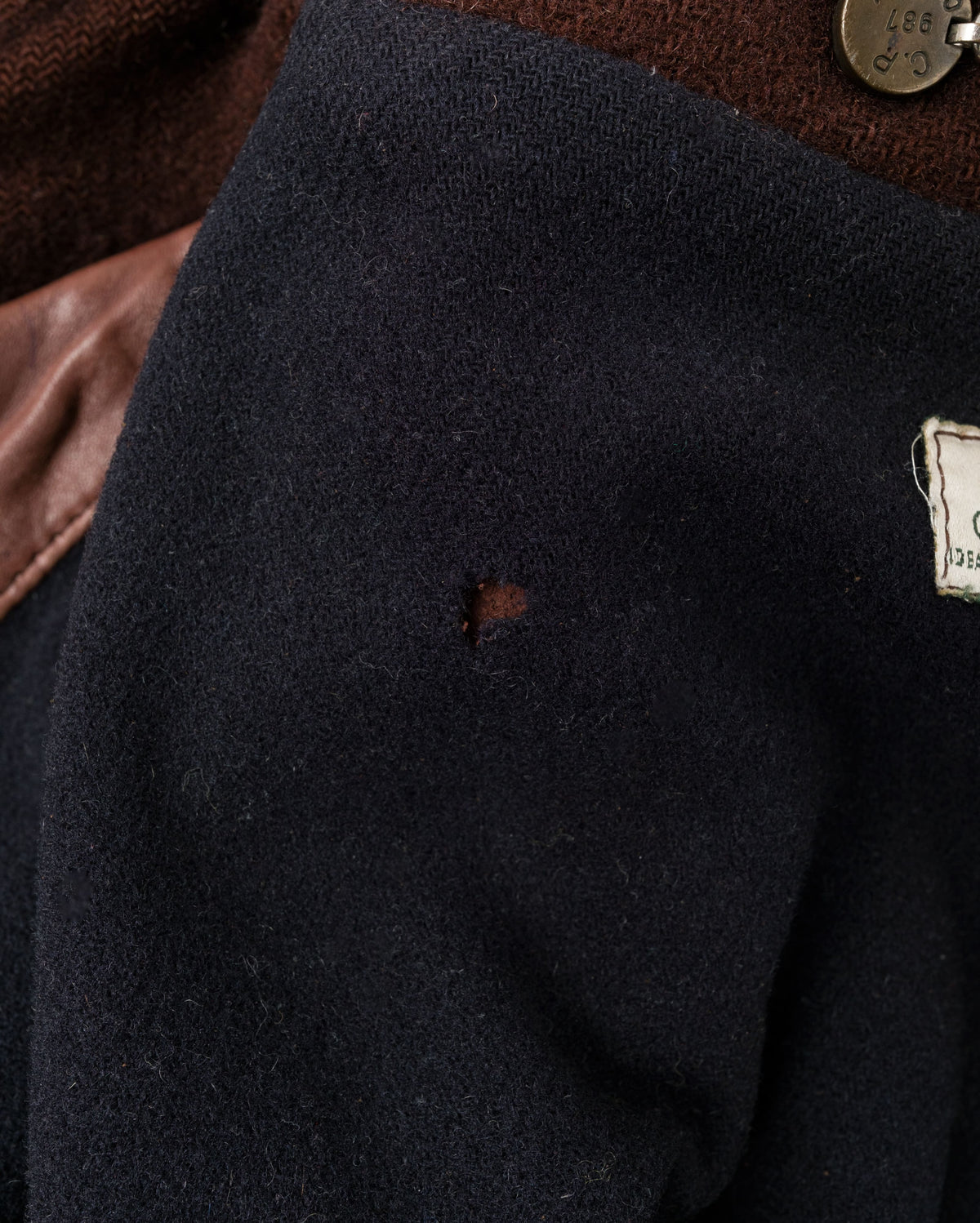
1987 Autumn/Winter, a brown leather four-pocket jacket by C.P.Company.
A special arrival.
C.P.Company was founded in 1971 in Bologna, Italy by Massimo Osti. Originally established under the name Chester Perry, the brand was renamed to C.P.Company in 1978.
The "C.P." in C.P.Company stands for "Color of Passion," a foundational concept of the house. The brand is also recognized as a pioneer of Italian casual wear.
Items conceived through C.P.Company's unique interpretation unite exceptional functionality with refined design sensibility. They quickly gained acclaim among Italian fashionistas and artists, becoming a benchmark of the era.
To achieve a lived-in aesthetic and distinctive colorways, the house pioneered the world's first "Garment Dye" process.
Garment Dye is the name given to a dyeing technique first developed in the early 1970s by Massimo Osti and his colleagues at C.P.Company. Unlike conventional methods where fabric is dyed before construction, this process uses undyed or raw cloth, with dyeing applied only after the garment is fully constructed.
Developed through years of research, the resulting palette encompasses some 60,000 possible colorways—a technical achievement unmatched by other houses.
The technique further employs "Double Dye in a Single Bath," allowing different fiber compositions to be dyed simultaneously with separate chemical approaches, resulting in distinctive tone-on-tone effects. This innovation became a signature of Massimo Osti's work and drew considerable recognition.
Other notable brands under Osti's direction include STONE ISLAND, Boneville, and Left Hand.
This piece exemplifies C.P.Company's 1987 Autumn/Winter collection.
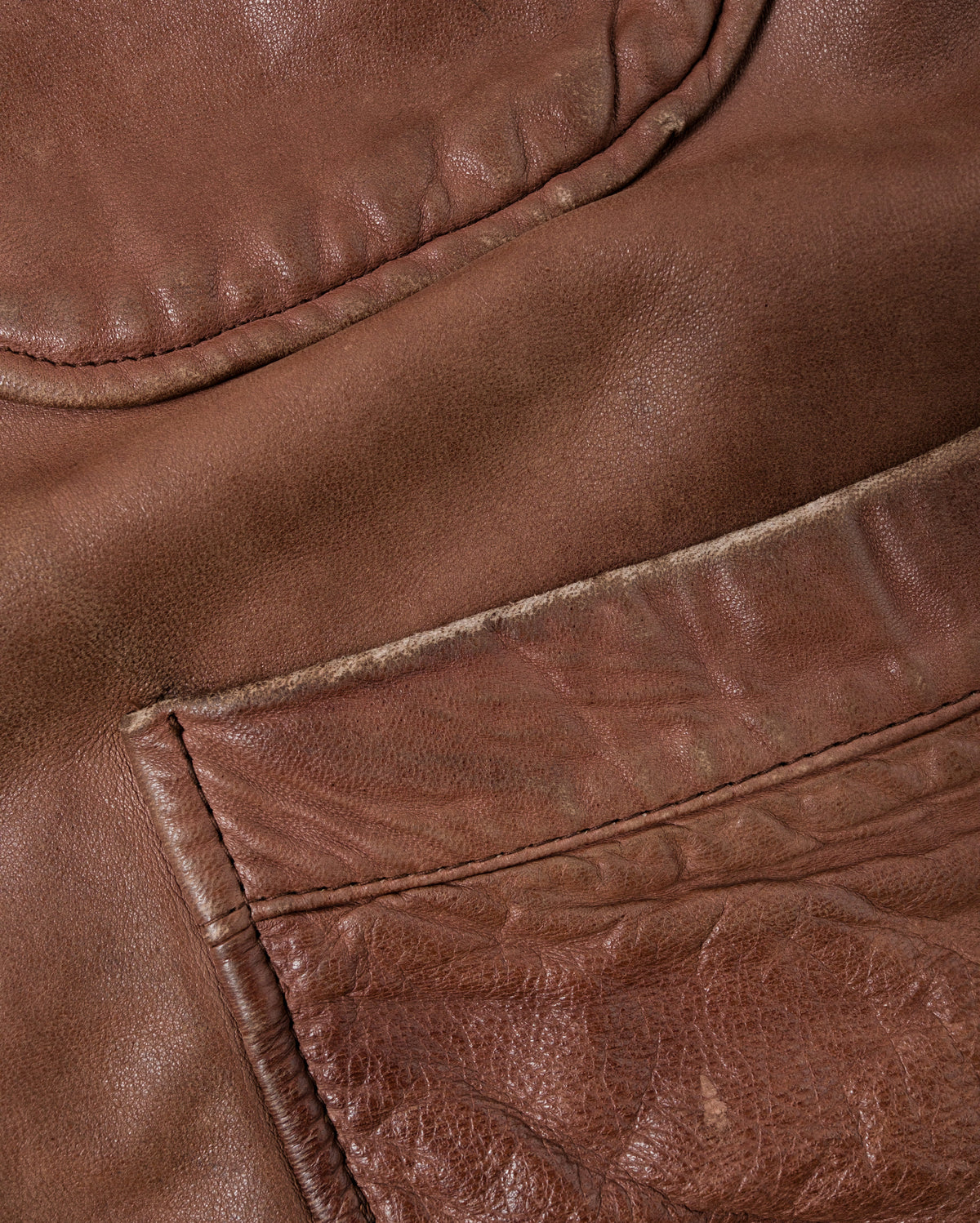
Its defining feature is an asymmetrical four-pocket configuration, apparently sampled from American workwear tradition. The piece merges workwear masculinity with Italian elegance—a rare convergence.
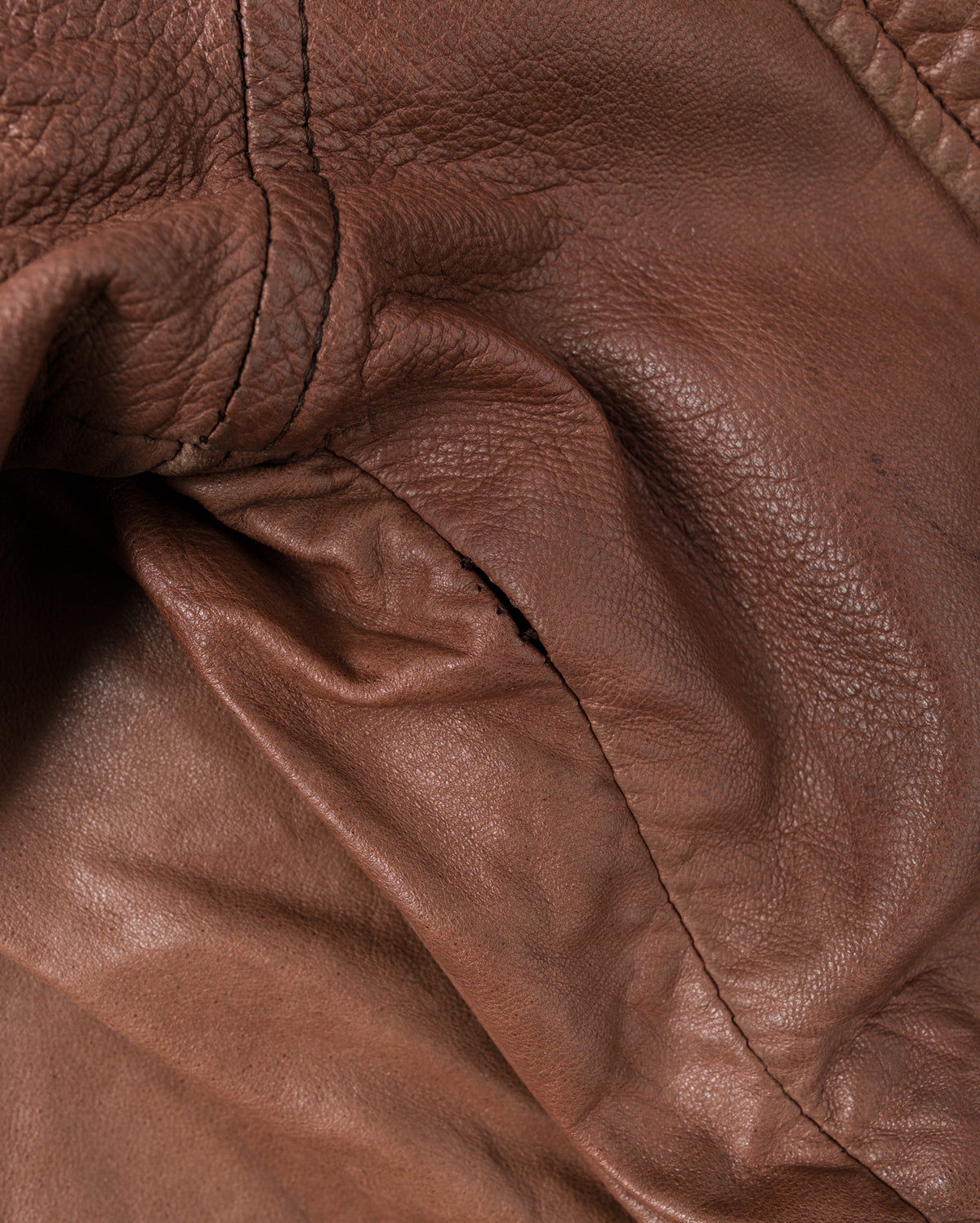
The garment also features side vents, common to tailored jackets, which open and close via zippered slits. This allows the wearer to adapt the jacket's character depending on occasion—practical movement or dressed refinement.
The front closure operates through button fastening.
The interior neckline bears a brand label bearing the inscription "IDEAS FROM MASSIMO OSTI," characteristic of the era. The care label is marked "c.p.company."
This example is made in Italy—a detail of significance, as later production was relocated. For those with a preference for Italian manufacturing, this provenance carries weight.
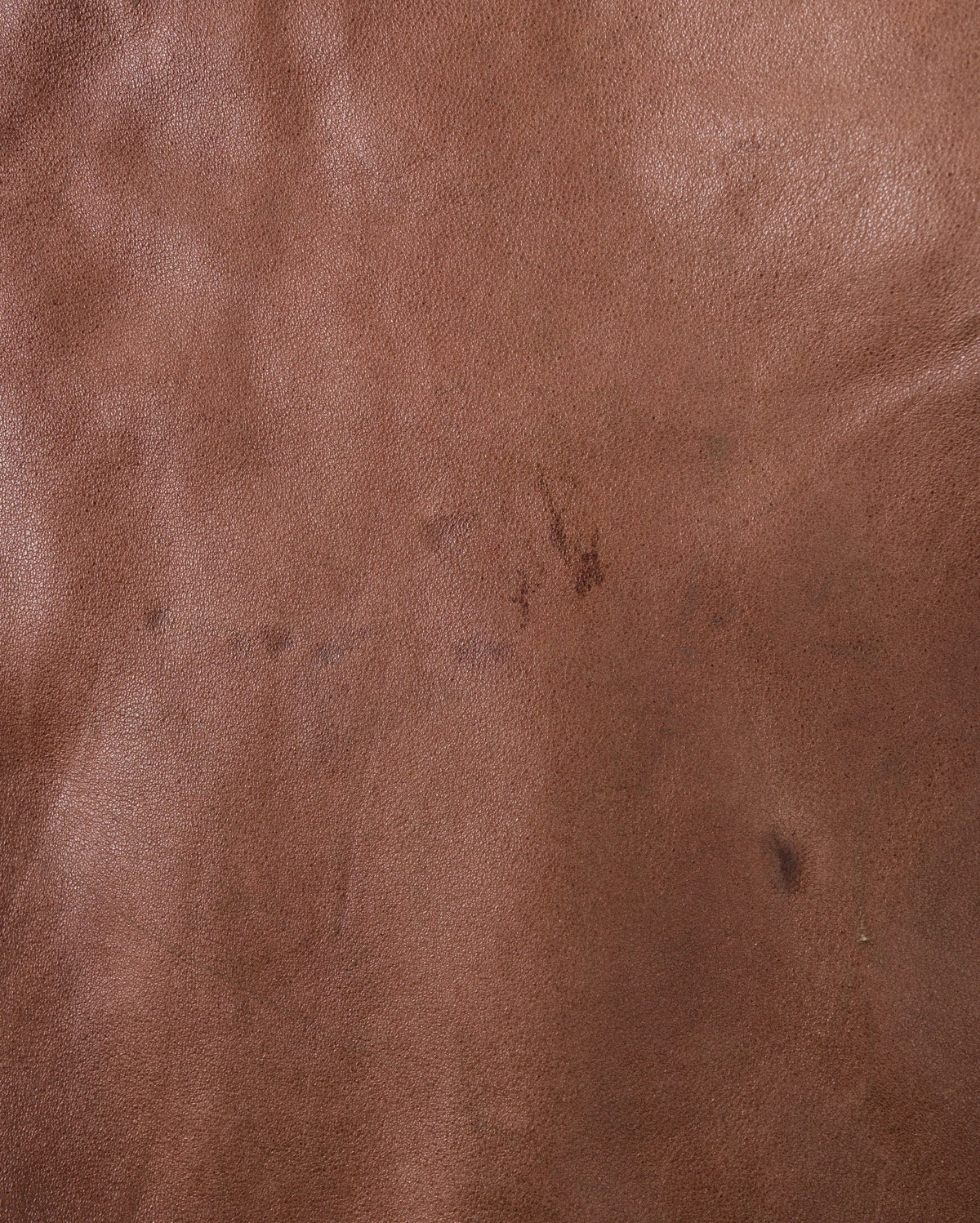
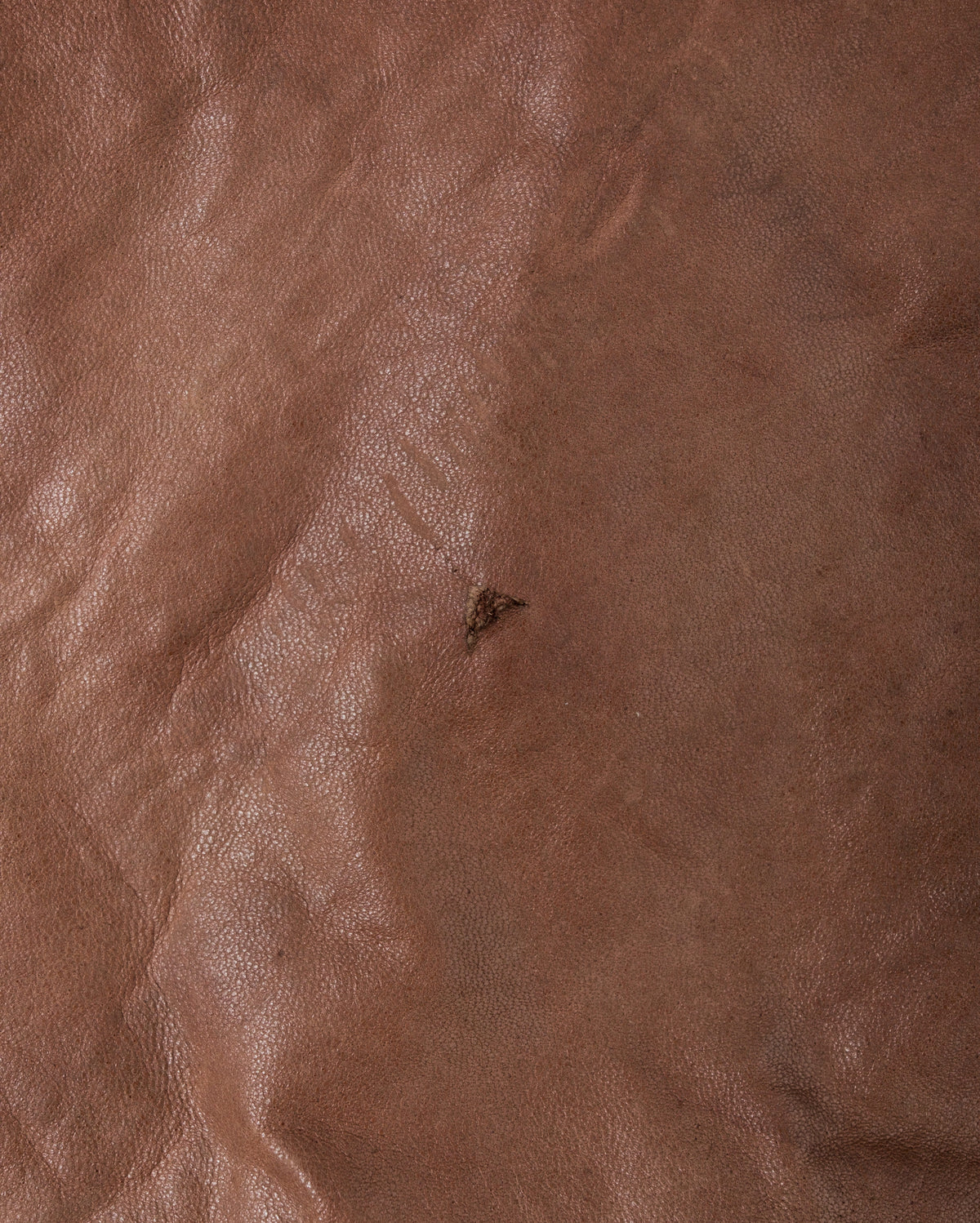
The outer fabric is, in all likelihood, Lambskin.
Lambskin is leather from sheep less than one year of age. While less durable than bovine leather, it possesses a distinctive tactile quality—fine-grained, supple, and exceptionally soft.
The material conveys a lightness and malleability that seems to contradict leather's typical character. It delivers a remarkably effortless wearing experience. Many avoid leather jackets due to their rigidity, but this example transcends such concerns entirely.
The lining is a wool-blend fabric, offering substantial warmth. This makes the jacket suitable well into autumn and winter months when layered appropriately.
The colorway is a brick brown—warm and layered in depth.
It suggests terracotta, a soft brown infused with subtle red undertones. This tonal complexity conveys classical mood and character. The color possesses restraint while radiating warmth, bringing natural, earthy sophistication to any wardrobe.
The relaxed, unstructured leather amplifies this effect. Age and wear manifest as deepening sheen and expressive creasing—the signature presence of vintage leather.
Size is marked 48, approximating M to L in Japanese sizing.
The actual measurements suggest a proportionate golden size for many frames. It accommodates both fitted and oversized approaches with equal grace.
Evidence of wear is present—minor soiling, scuffing, some loose stitching, small abrasions, and button replacement. No significant damage impairs function; the jacket remains entirely wearable.
Early C.P.Company is increasingly sought after, with prices reflecting this recognition. Pieces from Osti's tenure remain singular—unreplicable by other houses.
This jacket merits a place both as daily wear and as a collection piece. For those devoted to C.P.Company, it represents the sort of example that warrants serious consideration.
ADD TO CART

![[87AW]Old C.P.Company Brown Leather 4 Pockets Jacket Size.48](http://vieuxetnouveau-shop.com/cdn/shop/files/DSCF2311_b28ae27f-aa2f-4d43-b635-dd57d836d872.jpg?v=1743481767&width=2400)
![[87AW]Old C.P.Company Brown Leather 4 Pockets Jacket Size.48](http://vieuxetnouveau-shop.com/cdn/shop/files/DSCF2327_f96cb506-518e-4b72-9002-16f9b2c0dd67.jpg?v=1743481767&width=2400)
![[87AW]Old C.P.Company Brown Leather 4 Pockets Jacket Size.48](http://vieuxetnouveau-shop.com/cdn/shop/files/DSCF2312.jpg?v=1743481767&width=2400)
![[87AW]Old C.P.Company Brown Leather 4 Pockets Jacket Size.48](http://vieuxetnouveau-shop.com/cdn/shop/files/DSCF2314_574261ca-4600-4c49-b677-96484a003b2c.jpg?v=1743481767&width=2400)
![[87AW]Old C.P.Company Brown Leather 4 Pockets Jacket Size.48](http://vieuxetnouveau-shop.com/cdn/shop/files/DSCF2313_a83f7c65-b7ed-4ab3-91bc-beac79cace03.jpg?v=1743481767&width=2400)
![[87AW]Old C.P.Company Brown Leather 4 Pockets Jacket Size.48](http://vieuxetnouveau-shop.com/cdn/shop/files/DSCF2307_7ae740ee-96b0-4c57-b829-21271bd0ff14.jpg?v=1743481767&width=2400)
![[87AW]Old C.P.Company Brown Leather 4 Pockets Jacket Size.48](http://vieuxetnouveau-shop.com/cdn/shop/files/DSCF2315_19ccd64e-4e93-41a2-99a1-f4067facb78b.jpg?v=1743481767&width=2400)
![[87AW]Old C.P.Company Brown Leather 4 Pockets Jacket Size.48](http://vieuxetnouveau-shop.com/cdn/shop/files/DSCF2316_f804fb7d-e9bc-4dde-bee0-aab82ff58654.jpg?v=1743481767&width=2400)
![[87AW]Old C.P.Company Brown Leather 4 Pockets Jacket Size.48](http://vieuxetnouveau-shop.com/cdn/shop/files/DSCF2338_61f964c8-8485-4b67-b5ac-559c5f00d961.jpg?v=1743481767&width=2400)
![[87AW]Old C.P.Company Brown Leather 4 Pockets Jacket Size.48](http://vieuxetnouveau-shop.com/cdn/shop/files/DSCF2317_7f937612-a6cd-4c3f-a472-086740ddfb07.jpg?v=1743491543&width=2400)
![[87AW]Old C.P.Company Brown Leather 4 Pockets Jacket Size.48](http://vieuxetnouveau-shop.com/cdn/shop/files/DSCF2319_4a8285d1-1d53-4488-b6c0-811a3cec072c.jpg?v=1743491543&width=2400)
![[87AW]Old C.P.Company Brown Leather 4 Pockets Jacket Size.48](http://vieuxetnouveau-shop.com/cdn/shop/files/DSCF2320_739e15d3-59f8-40b1-b1be-95992f2653a2.jpg?v=1743491543&width=2400)
![[87AW]Old C.P.Company Brown Leather 4 Pockets Jacket Size.48](http://vieuxetnouveau-shop.com/cdn/shop/files/DSCF2321_0076edd9-dd12-4d76-8e09-4ace2bd02860.jpg?v=1743491543&width=2400)
![[87AW]Old C.P.Company Brown Leather 4 Pockets Jacket Size.48](http://vieuxetnouveau-shop.com/cdn/shop/files/DSCF2328_a64d33b7-b2e6-48d3-a340-967c03fc83bd.jpg?v=1743491543&width=2400)
![[87AW]Old C.P.Company Brown Leather 4 Pockets Jacket Size.48](http://vieuxetnouveau-shop.com/cdn/shop/files/DSCF2329_5b7a053a-ee0c-4b28-8cd5-abb089d73bb4.jpg?v=1743491543&width=2400)
![[87AW]Old C.P.Company Brown Leather 4 Pockets Jacket Size.48](http://vieuxetnouveau-shop.com/cdn/shop/files/DSCF2322_8e6c56b8-3463-414b-b9f2-8bd3d23a110f.jpg?v=1743491543&width=2400)
![[87AW]Old C.P.Company Brown Leather 4 Pockets Jacket Size.48](http://vieuxetnouveau-shop.com/cdn/shop/files/DSCF2323_41d2aa34-9f8c-41d3-922c-989082e00071.jpg?v=1743491543&width=2400)
![[87AW]Old C.P.Company Brown Leather 4 Pockets Jacket Size.48](http://vieuxetnouveau-shop.com/cdn/shop/files/DSCF2335_3d026035-e651-49e6-9fc5-d7fe5e84a770.jpg?v=1743481767&width=2400)
![[87AW]Old C.P.Company Brown Leather 4 Pockets Jacket Size.48](http://vieuxetnouveau-shop.com/cdn/shop/files/DSCF2336.jpg?v=1743481767&width=2400)
![[87AW]Old C.P.Company Brown Leather 4 Pockets Jacket Size.48](http://vieuxetnouveau-shop.com/cdn/shop/files/DSCF2334.jpg?v=1743481767&width=2400)
![[87AW]Old C.P.Company Brown Leather 4 Pockets Jacket Size.48](http://vieuxetnouveau-shop.com/cdn/shop/files/DSCF2333.jpg?v=1743481873&width=2400)
![[87AW]Old C.P.Company Brown Leather 4 Pockets Jacket Size.48](http://vieuxetnouveau-shop.com/cdn/shop/files/DSCF2339_1ac800a2-87df-4a32-8ded-511dc92d97ad.jpg?v=1743481873&width=2400)
![[87AW]Old C.P.Company Brown Leather 4 Pockets Jacket Size.48](http://vieuxetnouveau-shop.com/cdn/shop/files/DSCF2644_66ee53b8-8ff8-4f35-88f1-65530dde19e2.jpg?v=1743606822&width=2400)
![[87AW]Old C.P.Company Brown Leather 4 Pockets Jacket Size.48](http://vieuxetnouveau-shop.com/cdn/shop/files/DSCF2645_8fe18b39-8a88-42bd-96b7-5fdeb117c5f3.jpg?v=1743606822&width=2400)
![[87AW]Old C.P.Company Brown Leather 4 Pockets Jacket Size.48](http://vieuxetnouveau-shop.com/cdn/shop/files/DSCF2646_dd698095-fc0e-4f91-8add-ee0d22bfdb74.jpg?v=1743606822&width=2400)
![[87AW]Old C.P.Company Brown Leather 4 Pockets Jacket Size.48](http://vieuxetnouveau-shop.com/cdn/shop/files/DSCF2647_9a3db493-13c3-4f78-93d1-77f2d631ab3d.jpg?v=1743606822&width=2400)
![[87AW]Old C.P.Company Brown Leather 4 Pockets Jacket Size.48](http://vieuxetnouveau-shop.com/cdn/shop/files/DSCF2649_3bb12ce3-90d6-4afd-adb0-9453376e4c02.jpg?v=1743606822&width=2400)
![[87AW]Old C.P.Company Brown Leather 4 Pockets Jacket Size.48](http://vieuxetnouveau-shop.com/cdn/shop/files/DSCF2648_4b347767-02e3-41a8-98bd-6a906a6a3f55.jpg?v=1743606822&width=2400)
![[87AW]Old C.P.Company Brown Leather 4 Pockets Jacket Size.48](http://vieuxetnouveau-shop.com/cdn/shop/files/DSCF2643_ff2b8ff9-c41f-4a9d-ae06-6df4e8ef446b.jpg?v=1743606822&width=2400)
![[87AW]Old C.P.Company Brown Leather 4 Pockets Jacket Size.48](http://vieuxetnouveau-shop.com/cdn/shop/files/DSCF2640_47a104b4-7195-46b6-8c2e-1fb3ef7848d5.jpg?v=1743606822&width=2400)
![[87AW]Old C.P.Company Brown Leather 4 Pockets Jacket Size.48](http://vieuxetnouveau-shop.com/cdn/shop/files/DSCF2641_812661a4-42e3-420f-8617-65fd46924ece.jpg?v=1743606822&width=2400)
![[87AW]Old C.P.Company Brown Leather 4 Pockets Jacket Size.48](http://vieuxetnouveau-shop.com/cdn/shop/files/DSCF2642_c7e9be0e-9700-452b-888b-d6d00d240df3.jpg?v=1743606822&width=2400)
![[87AW]Old C.P.Company Brown Leather 4 Pockets Jacket Size.48](http://vieuxetnouveau-shop.com/cdn/shop/files/DSCF2653_5fea516a-2b15-4297-885a-b6cd90f9eee4.jpg?v=1743606822&width=2400)
![[87AW]Old C.P.Company Brown Leather 4 Pockets Jacket Size.48](http://vieuxetnouveau-shop.com/cdn/shop/files/DSCF2650_7d313c2e-8c35-4bb5-b84d-394c8d07c363.jpg?v=1743606822&width=2400)
![[87AW]Old C.P.Company Brown Leather 4 Pockets Jacket Size.48](http://vieuxetnouveau-shop.com/cdn/shop/files/DSCF2651_067468a6-ecba-405b-b6e9-c53cdb0dc6a6.jpg?v=1743606822&width=2400)
![[87AW]Old C.P.Company Brown Leather 4 Pockets Jacket Size.48](http://vieuxetnouveau-shop.com/cdn/shop/files/DSCF2652_bab15a4c-8054-4238-9dd7-dd1e70ef4af6.jpg?v=1743606822&width=2400)