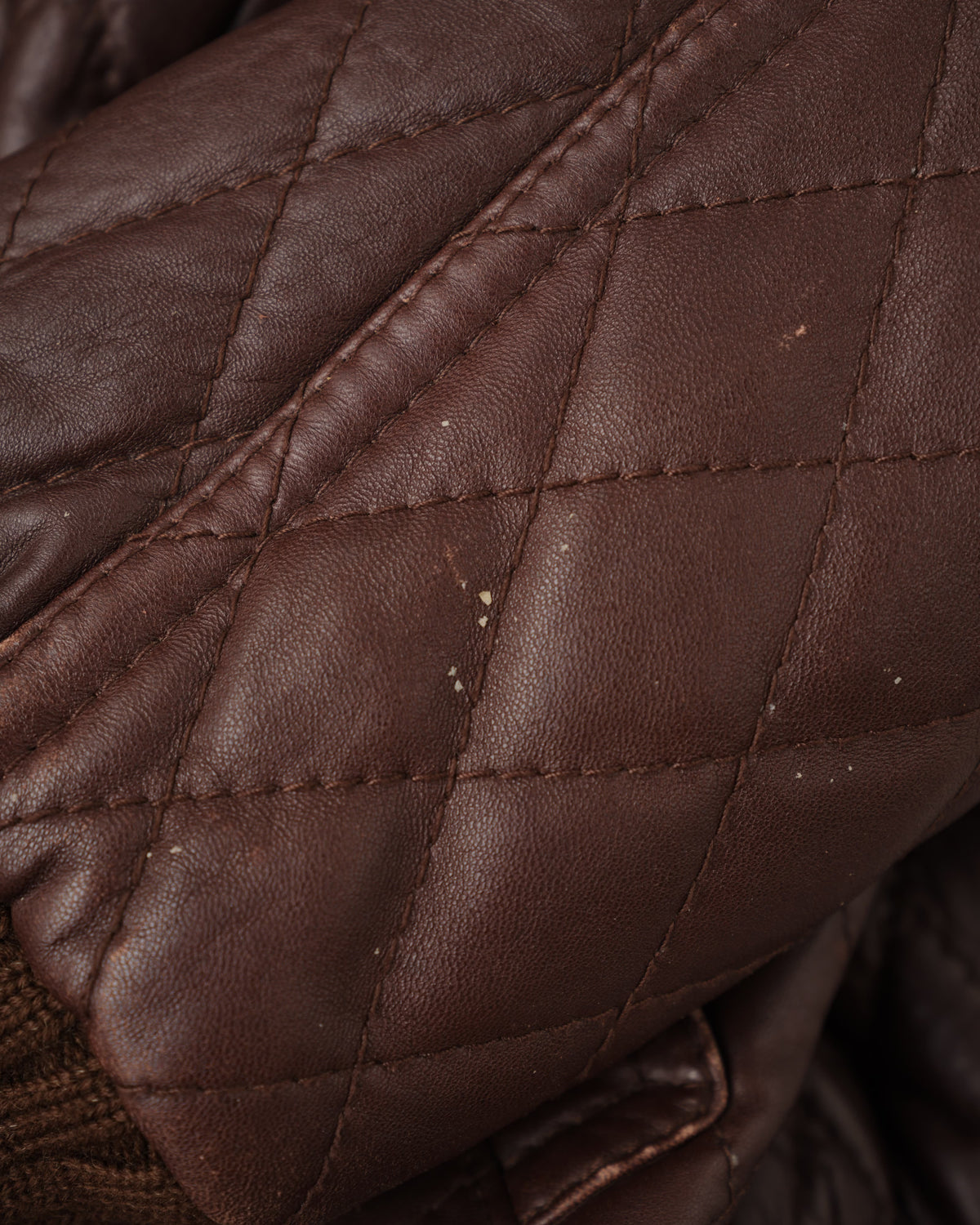
A VALENTINO quilted leather belted cardigan jacket, thought to date from around the 1990s.
A special piece has come in.
A cardigan made in leather — and belted, at that.
I have no recollection of ever having seen such a combination before.
VALENTINO is one of Italy's defining couture houses, founded in Rome in 1960.
Its founder, "Valentino Garavani", was born in 1932 in Voghera, a small town in northern Italy.
He crossed to Paris in his teens and, after serving his apprenticeship at houses including Jean Dessès and Guy Laroche, opened an atelier on Via Condotti, Rome's most exclusive street, in 1960.
That he met "Giancarlo Giammetti", who would accompany him for the rest of his life, at this moment is equally indispensable to any account of the house.
Valentino devoted to the design, Giammetti to the business.
This partnership carried a single Roman atelier up to the standing of a house of world renown.
The turning point came in 1962, with a presentation at the Palazzo Pitti in Florence.
International attention gathered all at once, and from then on the house built an unshakeable position as a Roman maison.
Then in 1968 came the collection carried out entirely in white, known as the "White Collection".
That same year, Jacqueline Kennedy chose a Valentino dress for her wedding to Mr Onassis, and with that the name belonged completely to the world.
Yet the colour that most symbolises this house is not white but red.
What is called "Rosso Valentino": a pure deep crimson in which neither yellow nor blue can be felt.
Said to derive from something he saw in Spain in his youth, this red has remained the house's standard for more than half a century.
The founder himself stepped back from the front line in 2008, though the house continues in Rome to this day.
Now, this piece has reached us from that house, and it is genuinely an unusual thing.
The form is entirely that of a cardigan.
A collarless V-neck, with the front band, the cuffs and the hem all worked in brown rib.
The heavy ridges of the fisherman's rib show a softness that is knitwear through and through.
And yet the body within it is leather throughout.
What is more, diamond quilting runs across the whole of it, each lozenge rising plump and three-dimensional.
The structure of a knit and the material of leather.
Two things that ought never to meet, connected here with the most matter-of-fact expression imaginable.
The front fastens with five buttons, lustrous and tortoiseshell in appearance.
Slash pockets cut on the diagonal wait at either side of the waist, and serve as hand-warmers besides.
And then the leather belt carried around the hem.
Fastening the eyeleted belt through its buckle lets you draw the waist in wherever you prefer.
With the rib and the belt working in concert, the range over which the silhouette can be adjusted is remarkably wide.
Put it on, and the inside reveals itself.
The lining is a red that wakes the eye.
An acetate and viscose blend, worked in the same diamond quilting as the outside, with wadding between.
A zipped pocket was fitted inside the left breast as well.
This red is that Rosso Valentino.
The outside thoroughly restrained in dark brown; the crimson glimpsed only in the moment of taking it off.
The way that gap has been set up strikes me as play of a thoroughly maison-like kind.
The leather used is a lambskin, supple and soft to the touch.
Not the sort of hide that intimidates by its stiffness, but a fine, luxurious quality that follows the body from the moment the arm goes in.
Because the quilting divides the leather into small compartments, each lozenge settles individually as the jacket is worn, and the whole comes to remember the shape of the body.
The point some years from now, when only the lozenges at the elbow and shoulder have softened and given way, will be this jacket at its very best.
The colour is a dark brown with red within it.
The brown of the rib leans slightly yellow while the leather is pitched a little more towards red, so that although they belong to the same family, the two materials remain properly distinguishable.
As for what to wear with it, I would keep things below from asserting themselves too far.
Grey trousers, or denim in a settled colour.
The top half says quite enough on its own, so leaving the rest quiet pulls the whole together.
And picking up the red in what you wear underneath creates an answering call with the lining, which is a good deal more stylish.
From the deepening of autumn to the threshold of midwinter, the wadding should keep it in service for a long stretch.
The size is marked "52".
In Japanese sizing this corresponds roughly to "L ~ XL".
The shoulder line drops considerably: a construction with the volume of its period.
The length is set on the shorter side, so drawing the hem belt in lightly raises the centre of gravity and makes the overall balance easy to hold.
There is wear — soiling, chafing, scratches, and the cracking and lifting particular to the material — but no significant damage that would affect wearing it, so there is a great deal of life in it yet.
In particular, the surface finish has lifted finely with age in places, remaining as small white speckled marks.
The leather itself has not weakened, but if this concerns you, please look carefully at the photographs of the condition.
The house continues in Rome to this day, but it will surely never return to the notion of running a belt around a leather cardigan.
Leather wearing the face of a knit; a garment scarlet only on the inside.
To make something that cannot be explained by reason, and to make it this boldly — is that not exhilarating?