A ‘Houndstooth Sports Jacket’ made in Britain, estimated to date from around the 1940s.
Well, this really is an elegant thing.
Some may take the name ‘sports jacket’ to mean a garment for athletics.
Less formal than the coat of a suit, and yet keeping up a gentleman's appearance.
In time, after the war, it settled into place as a casual coat that could be worn in town as well.
The clue to its period lies in the front zip.
The slider is stamped "LIGHTNING", from the old fastener maker based in Birmingham.
It differs from later mass-produced zips in the very way the metal catches the light, and the weight under the finger when drawn is something else entirely.
That the buttonholes at the cuffs have been worked by hand is proof of the same period.
Let us look, in turn, at the details that define the model.
What first draws the eye is the arched seam crossing the chest.
It is a design possible only in a coat intended to be worn outdoors, yet the mere presence of that curve brings dimension to the chest and tightens the whole bearing considerably.
At either side of the waist sit hand-warmer pockets cut vertically.
The cuffs fasten with shell-effect buttons.
And what took hold of me most in this jacket is the lining.
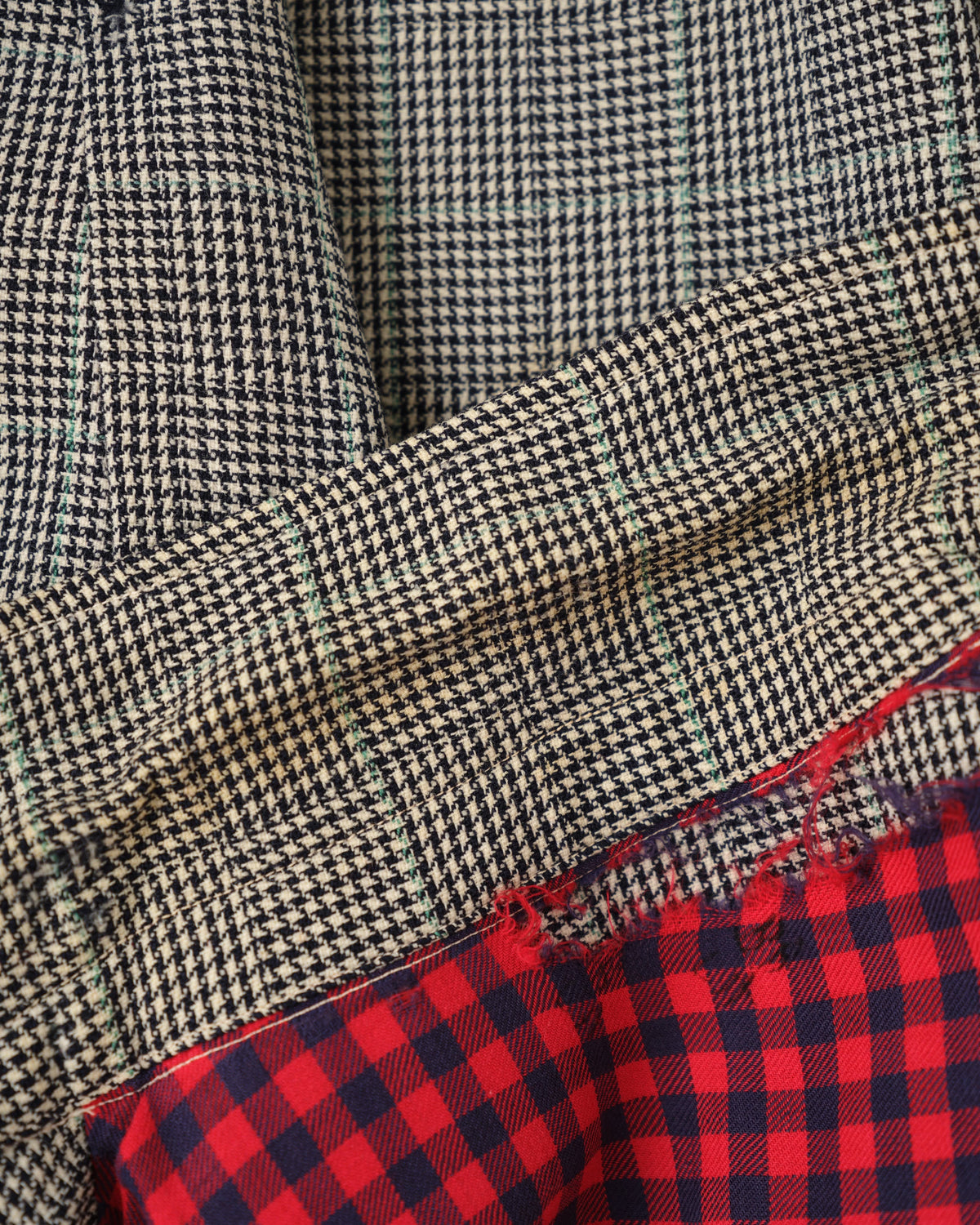
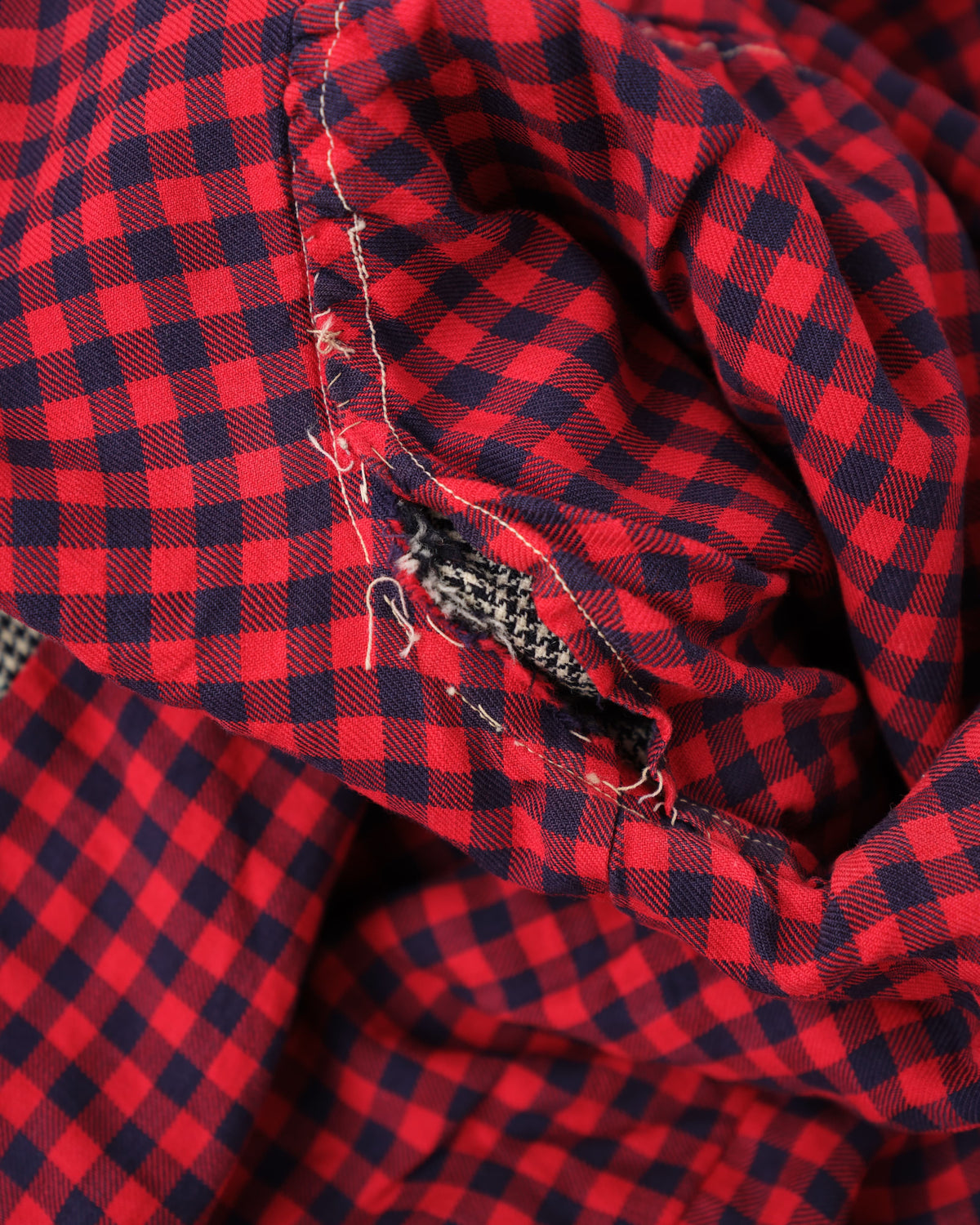
Against a composed black-and-white houndstooth outside, the inside is a buffalo check in "red × navy".
Worn open, a glimpse of red shows at the turn of the lapel.
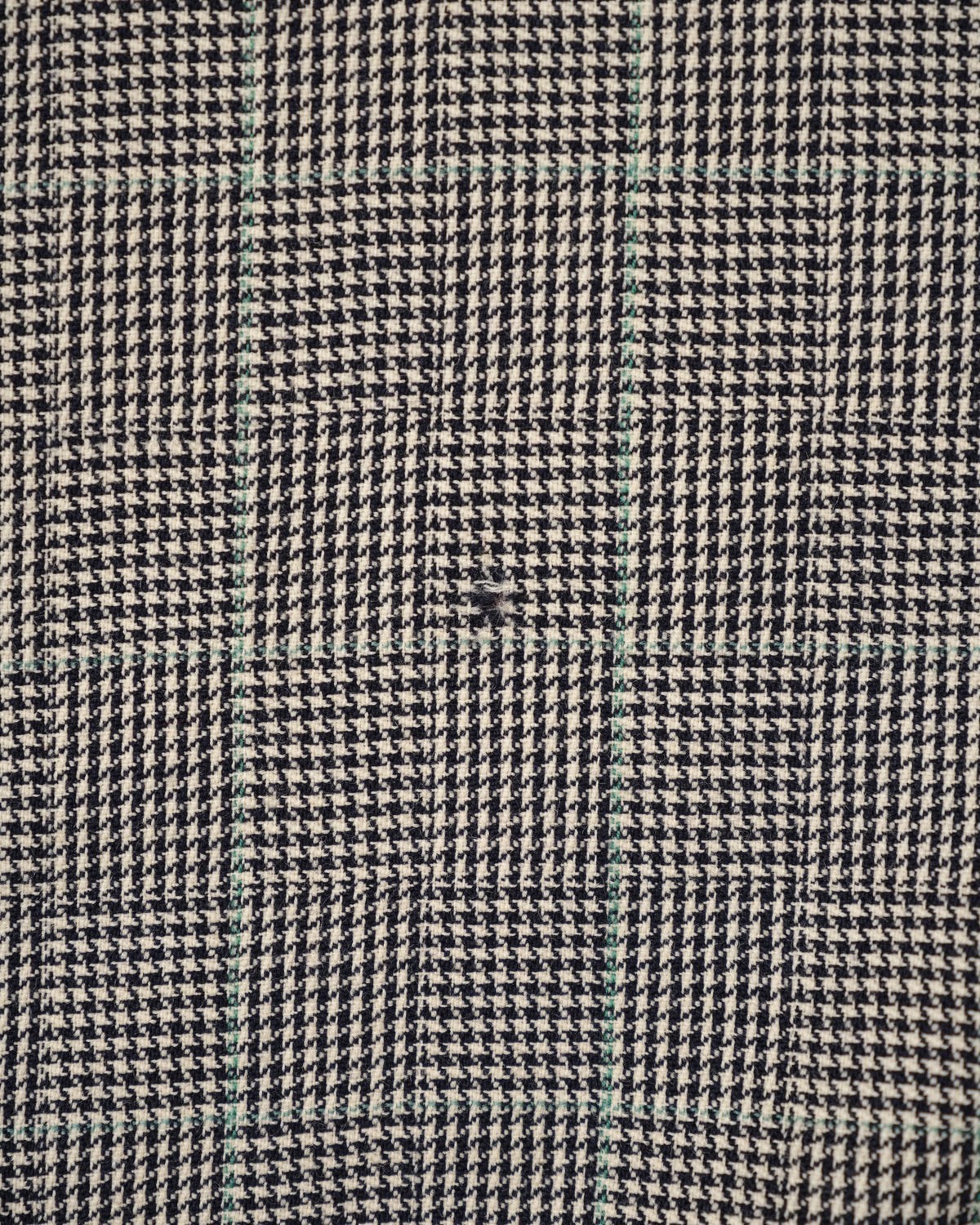
There is no composition label, so I cannot state it with certainty, but I take it to be a wool cloth with rayon blended in.
The colour is a small-scale houndstooth woven in black and white.
Over it is laid a windowpane check, and looking closely one finds a pale green drawn into those lines.
The base being monotone, it is a patterned piece that nonetheless refuses no colour.
Take it monotone throughout with a black roll-neck, or break it down casually over denim.
There is no size marking, but judging from the measurements I should think it corresponds to a Japanese "S ~ M".
Short in length and compactly composed — the balance of its day.
There are signs of use — soiling, abrasion, fraying, small holes and tears — but no significant damage that would affect wear, so there is plenty of life left in it.
This cloth could perhaps still be woven today.
A jacket someone in Britain slipped on for their day off, eighty years ago.
Thrown over a shirt on a slightly cold autumn morning, on the way out.
ADD TO CART

![[~40’s] British Vintage Houndstooth Sports Jacket](http://vieuxetnouveau-shop.com/cdn/shop/files/J01096-1_925b4d69-4380-4acb-af39-8f8dc6026986.jpg?v=1788334394&width=2400)
![[~40’s] British Vintage Houndstooth Sports Jacket](http://vieuxetnouveau-shop.com/cdn/shop/files/J01096-2_a09e5d89-e20e-4afb-8af5-e080dd55299f.jpg?v=1788334394&width=2400)
![[~40’s] British Vintage Houndstooth Sports Jacket](http://vieuxetnouveau-shop.com/cdn/shop/files/J01096-3_87684989-9bbb-4de1-81d9-dd9517ace7ee.jpg?v=1788334394&width=2400)
![[~40’s] British Vintage Houndstooth Sports Jacket](http://vieuxetnouveau-shop.com/cdn/shop/files/J01096-4_98f9b018-dcb1-4995-a135-84c512af0997.jpg?v=1788334394&width=2400)
![[~40’s] British Vintage Houndstooth Sports Jacket](http://vieuxetnouveau-shop.com/cdn/shop/files/J01096-5_4a24a2da-06ae-4293-895b-f3c8bab4cb92.jpg?v=1788334394&width=2400)
![[~40’s] British Vintage Houndstooth Sports Jacket](http://vieuxetnouveau-shop.com/cdn/shop/files/J01096-6_2101751f-4f18-4402-80d6-001febe8913d.jpg?v=1788334394&width=2400)
![[~40’s] British Vintage Houndstooth Sports Jacket](http://vieuxetnouveau-shop.com/cdn/shop/files/J01096-7_60d73d1a-7ed3-4a75-97a4-c1ee1ba3aec5.jpg?v=1788334394&width=2400)
![[~40’s] British Vintage Houndstooth Sports Jacket](http://vieuxetnouveau-shop.com/cdn/shop/files/J01096-8_63e2012e-a52d-4ac1-91ed-c51542819bde.jpg?v=1788334394&width=2400)
![[~40’s] British Vintage Houndstooth Sports Jacket](http://vieuxetnouveau-shop.com/cdn/shop/files/J01096-9_bdd1a8aa-b7e7-4ec7-b126-b8fc679d6697.jpg?v=1788334394&width=2400)
![[~40’s] British Vintage Houndstooth Sports Jacket](http://vieuxetnouveau-shop.com/cdn/shop/files/J01096-10_e716a5bc-123b-4bb1-a7bd-63c68343fd13.jpg?v=1788334394&width=2400)
![[~40’s] British Vintage Houndstooth Sports Jacket](http://vieuxetnouveau-shop.com/cdn/shop/files/J01096-11_423f5d70-d4cd-4025-b794-0e04b6fac87a.jpg?v=1788334394&width=2400)
![[~40’s] British Vintage Houndstooth Sports Jacket](http://vieuxetnouveau-shop.com/cdn/shop/files/J01096-12_5316b6c7-b40a-47da-b70c-273958e3f677.jpg?v=1788334394&width=2400)
![[~40’s] British Vintage Houndstooth Sports Jacket](http://vieuxetnouveau-shop.com/cdn/shop/files/J01096-13_61d62937-a45f-4b3d-bac9-0e206ff70cd2.jpg?v=1788334394&width=2400)
![[~40’s] British Vintage Houndstooth Sports Jacket](http://vieuxetnouveau-shop.com/cdn/shop/files/J01096-14_2b19f434-b8f8-4813-9a69-3ea78b1a5df9.jpg?v=1788334394&width=2400)
![[~40’s] British Vintage Houndstooth Sports Jacket](http://vieuxetnouveau-shop.com/cdn/shop/files/J01096-15_8e5e2476-5023-4524-b84e-c68ac58111d4.jpg?v=1788334394&width=2400)
![[~40’s] British Vintage Houndstooth Sports Jacket](http://vieuxetnouveau-shop.com/cdn/shop/files/J01096-16_aa308c52-eb6d-4147-b8af-f4033b79494e.jpg?v=1788334394&width=2400)
![[~40’s] British Vintage Houndstooth Sports Jacket](http://vieuxetnouveau-shop.com/cdn/shop/files/J01096-17_88a31833-cff2-47c9-b99e-de373886176f.jpg?v=1788334394&width=2400)
![[~40’s] British Vintage Houndstooth Sports Jacket](http://vieuxetnouveau-shop.com/cdn/shop/files/J01096-18_1144bcd7-0c08-4cff-a2b6-aad1e27456ad.jpg?v=1788334394&width=2400)
![[~40’s] British Vintage Houndstooth Sports Jacket](http://vieuxetnouveau-shop.com/cdn/shop/files/J01096-19_bb344fce-ec99-4981-9a74-6836f93e26d1.jpg?v=1788334394&width=2400)
![[~40’s] British Vintage Houndstooth Sports Jacket](http://vieuxetnouveau-shop.com/cdn/shop/files/J01096-20_93a7b5fe-5e04-43c9-90aa-e36db15f70b7.jpg?v=1788334394&width=2400)
![[~40’s] British Vintage Houndstooth Sports Jacket](http://vieuxetnouveau-shop.com/cdn/shop/files/J01096-21_6f20fbf8-ef70-4dcb-9882-97d93e6fd341.jpg?v=1788334394&width=2400)
![[~40’s] British Vintage Houndstooth Sports Jacket](http://vieuxetnouveau-shop.com/cdn/shop/files/J01096-22_327dab6b-cd80-4e6c-9524-ced1fab36284.jpg?v=1788334394&width=2400)
![[~40’s] British Vintage Houndstooth Sports Jacket](http://vieuxetnouveau-shop.com/cdn/shop/files/J01096-23_c02791d3-32ae-432f-a0a4-e3fbccfcc91e.jpg?v=1788334394&width=2400)
![[~40’s] British Vintage Houndstooth Sports Jacket](http://vieuxetnouveau-shop.com/cdn/shop/files/J01096-24_96985369-8c19-4628-8133-eb6dac00fc65.jpg?v=1788334394&width=2400)
![[~40’s] British Vintage Houndstooth Sports Jacket](http://vieuxetnouveau-shop.com/cdn/shop/files/J01096-25_59802e13-858e-4b79-b2d5-84ffd68d1488.jpg?v=1788334394&width=2400)
![[~40’s] British Vintage Houndstooth Sports Jacket](http://vieuxetnouveau-shop.com/cdn/shop/files/J01096-26_8056a288-00c6-48ac-a103-45808301d2bf.jpg?v=1788334394&width=2400)
![[~40’s] British Vintage Houndstooth Sports Jacket](http://vieuxetnouveau-shop.com/cdn/shop/files/J01096-27_b2ae37ae-00f9-4e3e-8cf4-2601f7c50752.jpg?v=1788334394&width=2400)