A métis black chambray work coat, made in France, which we date to around the 1940s.
A special piece has come in.
Speak of French work coats in salt-and-pepper or chambray and what comes to mind first is the atelier coat — that neat working garment with its lapels.
This piece stands close to that in bearing, but it does not fit within the category.
A small collar that describes an arc as it wraps the neck. No corners — and that alone changes the impression entirely.
The clue to the period lies in the sewing.
Cotton thread is used.
And single stitching — a finish handled with one line of stitches alone, from before the spread of twin-needle mass production.
Now, let us look at the details.
Look closely at the collar and a pale beige cotton thread runs along its edge.
The front has five buttons.
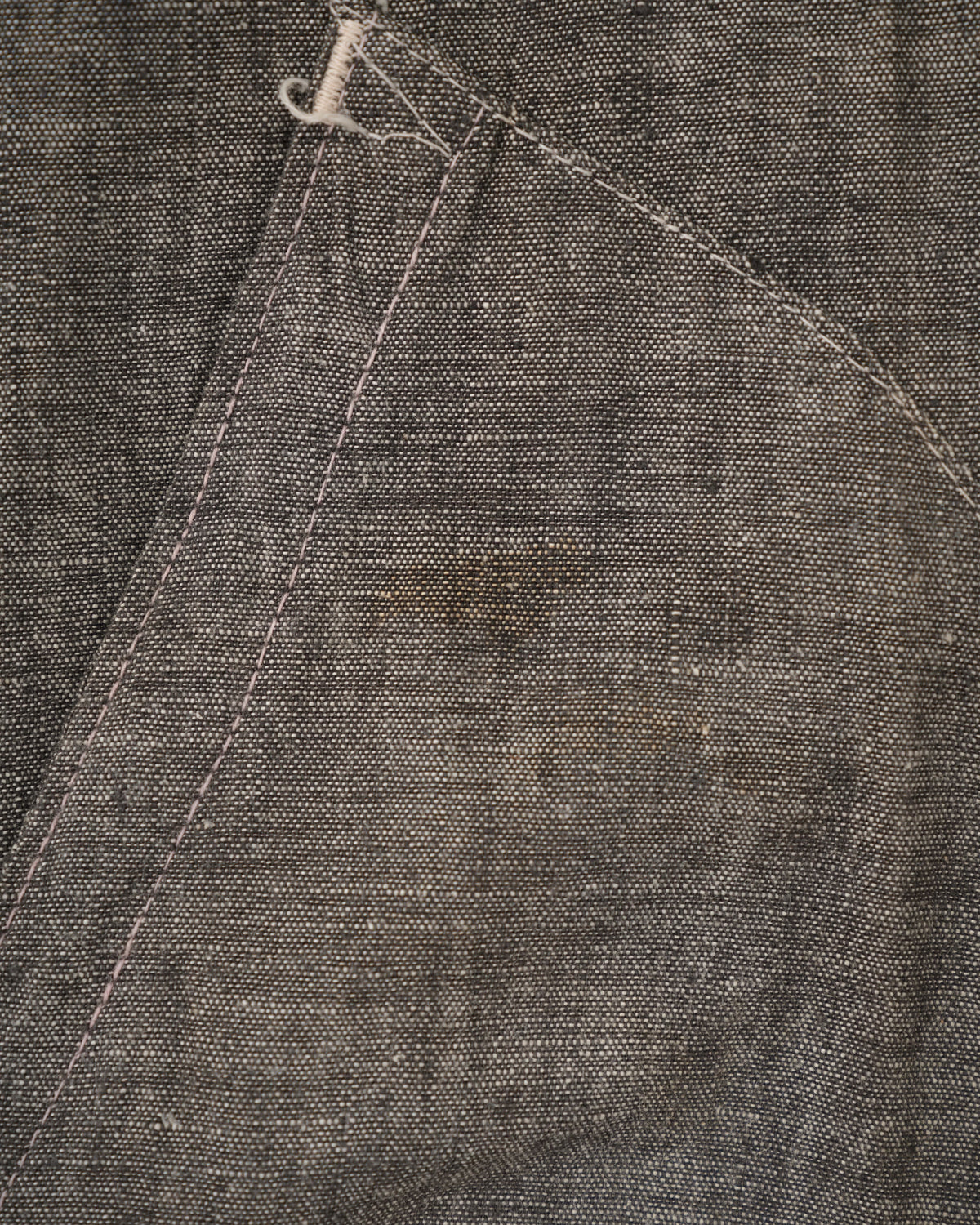
At the left breast is a patch pocket, cut very slightly on the diagonal.
At both hips, large patch pockets.
The cuffs have button tabs.
The silhouette is an A-line opening towards the hem.
The material is métis, a cloth woven from cotton and linen together.
Meaning "mixed" in French, this cloth was once widely used for sheets, tablecloths and working garments.
To the senses it feels about seven parts linen to three of cotton.
The weave is chambray.
Add the irregular slubs of the linen to that, and an expression arises as though countless particles were suspended within a single cloth.
This cloth grows softer still the more you put your arms through it.
The colour is "charcoal grey".
A grey holding moisture, like cobblestones after rain, or charcoal dusted with ash.
Thanks to the round collar, this coat never turns severe, for all that it is workwear.
Beneath it, a white shirt will look best. White showing at a round collar makes the whole outfit read a degree cleaner. A striped cut-and-sew or a simple knit will do equally well.
It is a pattern that looks right simply thrown on, so I would recommend wearing it with the front open.
There is no size marking, but I should say it corresponds to roughly a Japanese "S".
The make is compact throughout, so we would recommend it to women, or to slighter gentlemen.
The armholes call for particular attention. They are cut narrow, so anyone with volume around the arms may find them tight.
There are marks of use, including soiling and fraying, but no damage that would affect wearing, so there is plenty of life in it yet.
An unusual work coat — that is my honest impression.
It has the bearing of an atelier coat and yet is not one. Where a lapel ought to be, a round collar sits.
Métis, moreover, is scarcely woven any more.
Eighty years ago, somebody wore this and worked in it. That person's arms must have sat exactly within these armholes.
ADD TO CART

![[~40’s] French Vintage Metis Black Chambray Work Coat](http://vieuxetnouveau-shop.com/cdn/shop/files/C0185-1_5b454114-4b03-473b-b96b-5ad37250adb6.jpg?v=1786431853&width=2400)
![[~40’s] French Vintage Metis Black Chambray Work Coat](http://vieuxetnouveau-shop.com/cdn/shop/files/C0185-2_4f063b00-ec9d-4d3d-a618-78eafec6a567.jpg?v=1786431853&width=2400)
![[~40’s] French Vintage Metis Black Chambray Work Coat](http://vieuxetnouveau-shop.com/cdn/shop/files/C0185-3_0c2c62de-06ed-49da-af04-d412e93c5f0e.jpg?v=1786431853&width=2400)
![[~40’s] French Vintage Metis Black Chambray Work Coat](http://vieuxetnouveau-shop.com/cdn/shop/files/C0185-4_23e36c4f-1076-4259-b0f6-4e0e3fa64187.jpg?v=1786431854&width=2400)
![[~40’s] French Vintage Metis Black Chambray Work Coat](http://vieuxetnouveau-shop.com/cdn/shop/files/C0185-5_94ab0497-2dd0-46ac-9140-2bc126d19647.jpg?v=1786431854&width=2400)
![[~40’s] French Vintage Metis Black Chambray Work Coat](http://vieuxetnouveau-shop.com/cdn/shop/files/C0185-6_3839b04e-01cc-4764-b657-ec5bcdf8e1f4.jpg?v=1786431854&width=2400)
![[~40’s] French Vintage Metis Black Chambray Work Coat](http://vieuxetnouveau-shop.com/cdn/shop/files/C0185-7_91a13e90-3c08-4172-850f-48eb3ec47f78.jpg?v=1786431854&width=2400)
![[~40’s] French Vintage Metis Black Chambray Work Coat](http://vieuxetnouveau-shop.com/cdn/shop/files/C0185-8_77cf5fc0-9952-4d2e-864d-db691c894cbc.jpg?v=1786431854&width=2400)
![[~40’s] French Vintage Metis Black Chambray Work Coat](http://vieuxetnouveau-shop.com/cdn/shop/files/C0185-9_e8584fbc-aea6-49b2-bccc-45b77a182212.jpg?v=1786431854&width=2400)
![[~40’s] French Vintage Metis Black Chambray Work Coat](http://vieuxetnouveau-shop.com/cdn/shop/files/C0185-10_e60b47ab-c17d-4285-aaa6-9589e85eacb8.jpg?v=1786431854&width=2400)
![[~40’s] French Vintage Metis Black Chambray Work Coat](http://vieuxetnouveau-shop.com/cdn/shop/files/C0185-11_d0134f2b-8830-4f64-ab25-5bfd19718ca3.jpg?v=1786431854&width=2400)
![[~40’s] French Vintage Metis Black Chambray Work Coat](http://vieuxetnouveau-shop.com/cdn/shop/files/C0185-12_36269dd1-86f3-4735-b3a5-3cb81194dcfa.jpg?v=1786431854&width=2400)
![[~40’s] French Vintage Metis Black Chambray Work Coat](http://vieuxetnouveau-shop.com/cdn/shop/files/C0185-13_178fbd6d-4868-4502-b9a6-0cbc7b45aac4.jpg?v=1786431854&width=2400)
![[~40’s] French Vintage Metis Black Chambray Work Coat](http://vieuxetnouveau-shop.com/cdn/shop/files/C0185-14_f691bad8-e5fe-42e4-95ef-e78823986c44.jpg?v=1786431854&width=2400)
![[~40’s] French Vintage Metis Black Chambray Work Coat](http://vieuxetnouveau-shop.com/cdn/shop/files/C0185-15_39546c32-f059-4e37-b081-b0c124b5f0ab.jpg?v=1786431854&width=2400)
![[~40’s] French Vintage Metis Black Chambray Work Coat](http://vieuxetnouveau-shop.com/cdn/shop/files/C0185-16_bed42697-38ec-45ba-9fd5-fa41f0b44192.jpg?v=1786431854&width=2400)
![[~40’s] French Vintage Metis Black Chambray Work Coat](http://vieuxetnouveau-shop.com/cdn/shop/files/C0185-17_d8174aba-755e-4b19-8dba-f8e7b1b8a374.jpg?v=1786431854&width=2400)
![[~40’s] French Vintage Metis Black Chambray Work Coat](http://vieuxetnouveau-shop.com/cdn/shop/files/C0185-18_0b7316a0-905e-403f-b059-5c8127b93755.jpg?v=1786431854&width=2400)
![[~40’s] French Vintage Metis Black Chambray Work Coat](http://vieuxetnouveau-shop.com/cdn/shop/files/C0185-19_b087410a-fb84-4d4b-884e-17e12c8cabaf.jpg?v=1786431854&width=2400)
![[~40’s] French Vintage Metis Black Chambray Work Coat](http://vieuxetnouveau-shop.com/cdn/shop/files/C0185-20_fdbf8f4e-239b-4ff8-a708-86c5b8a12582.jpg?v=1786431854&width=2400)
![[~40’s] French Vintage Metis Black Chambray Work Coat](http://vieuxetnouveau-shop.com/cdn/shop/files/C0185-21_303fca2d-7195-42b5-9a60-32b625fc9124.jpg?v=1786431854&width=2400)
![[~40’s] French Vintage Metis Black Chambray Work Coat](http://vieuxetnouveau-shop.com/cdn/shop/files/C0185-22_0cad7d22-2a31-43de-b9a6-fbf1406b0d37.jpg?v=1786431854&width=2400)
![[~40’s] French Vintage Metis Black Chambray Work Coat](http://vieuxetnouveau-shop.com/cdn/shop/files/C0185-23_08462469-0f52-4a07-a0a5-ec28ab9eec50.jpg?v=1786431854&width=2400)
![[~40’s] French Vintage Metis Black Chambray Work Coat](http://vieuxetnouveau-shop.com/cdn/shop/files/C0185-24_d67c2d5f-c3e3-4056-89f5-8b363f836737.jpg?v=1786431854&width=2400)
![[~40’s] French Vintage Metis Black Chambray Work Coat](http://vieuxetnouveau-shop.com/cdn/shop/files/C0185-25_1b9c9657-0d16-414b-a8a6-cebecff4619e.jpg?v=1786431854&width=2400)
![[~40’s] French Vintage Metis Black Chambray Work Coat](http://vieuxetnouveau-shop.com/cdn/shop/files/C0185-26_55c3c8c2-6879-4c51-989f-2fd2a9185b1d.jpg?v=1786431854&width=2400)