A pair of indigo hemp linen cross-belt work trousers, made in France, which we date to around the 1940s.
A special piece has come in.
"So such a thing exists" — that was my first reaction.
I have seen French vintage trousers beyond counting, but I must admit I have never before come across a pair with a cross belt at the waist.
The dealer we bought from stated it was French-made. But the specification is so seldom seen that it may have been born in some tailor's workshop, or from somebody's own hands.
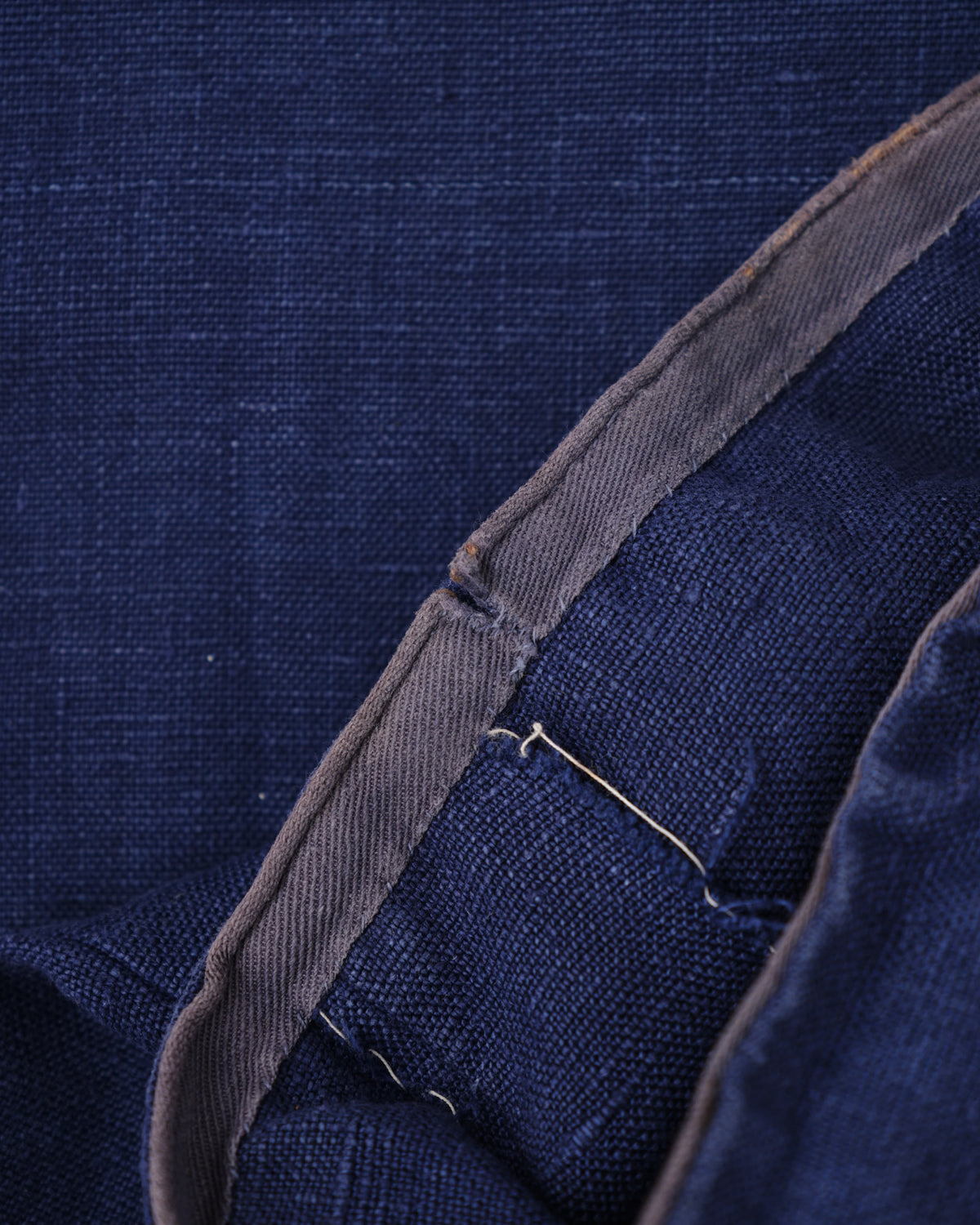
There are neither belt loops nor brace buttons, and the front is a button fly.
Now, let us look at the details.
The waist takes two pleats.
For trousers of this period, two pleats is a considerably lavish way of building them.
And then the cross belt at the heart of it.
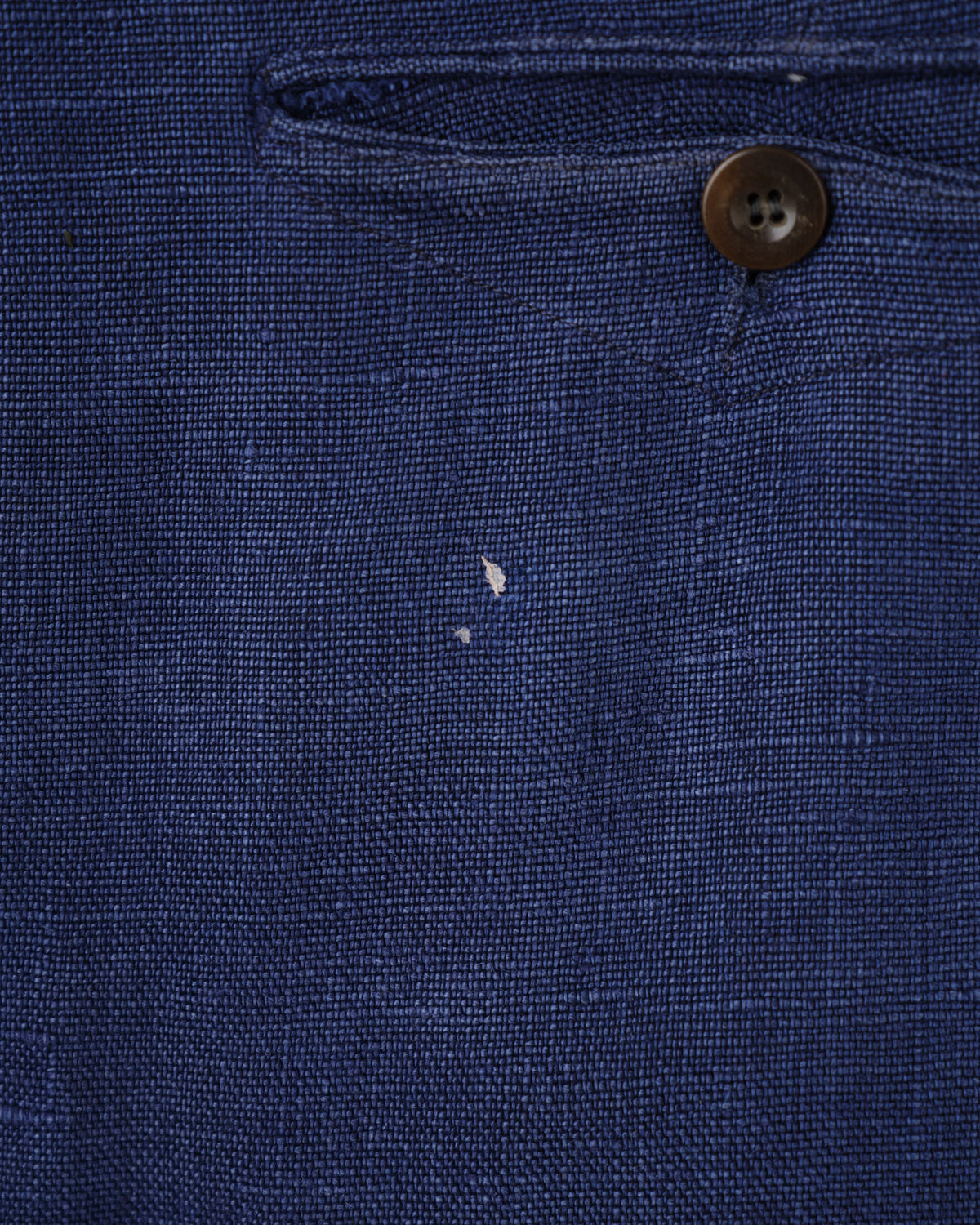
A small coin pocket sits at the right of the waist.
The hems are turned up.
The material is hemp linen.
Look closely and the yarn is not uniform in thickness. Slubs rise here and there, and irregular shadows form within the weave.
And the hand. There is that distinctive drape peculiar to French linen, which seems to quiver as it moves.
Against the skin it is cool, and you can see at once that this was a cloth made on the assumption of being worn in summer.
Linen is a material that grows softer the more it is worn.
The colour is "indigo".
Not merely navy.
Indigo as a dye has the property of remaining on the surface rather than penetrating to the core of the fibre.
Indigo-dyed pieces are few in French vintage to begin with, and this is a pair we can only rarely secure.
The silhouette is a straight cut, not overly wide.
With this colour and this material, white or unbleached above will look best. A linen shirt, a cotton T-shirt, a loosely knitted jumper. Build the outfit on the affinity between materials and it will come together.
At the feet, sandals or leather shoes alike.
Whether or not there is one pair of deep indigo linen in a summer wardrobe.
There is no size marking, but I should say they correspond to roughly a Japanese "S to M".
Being a cross-belt specification with neither belt loops nor brace buttons, there is almost no scope for adjusting the waist.
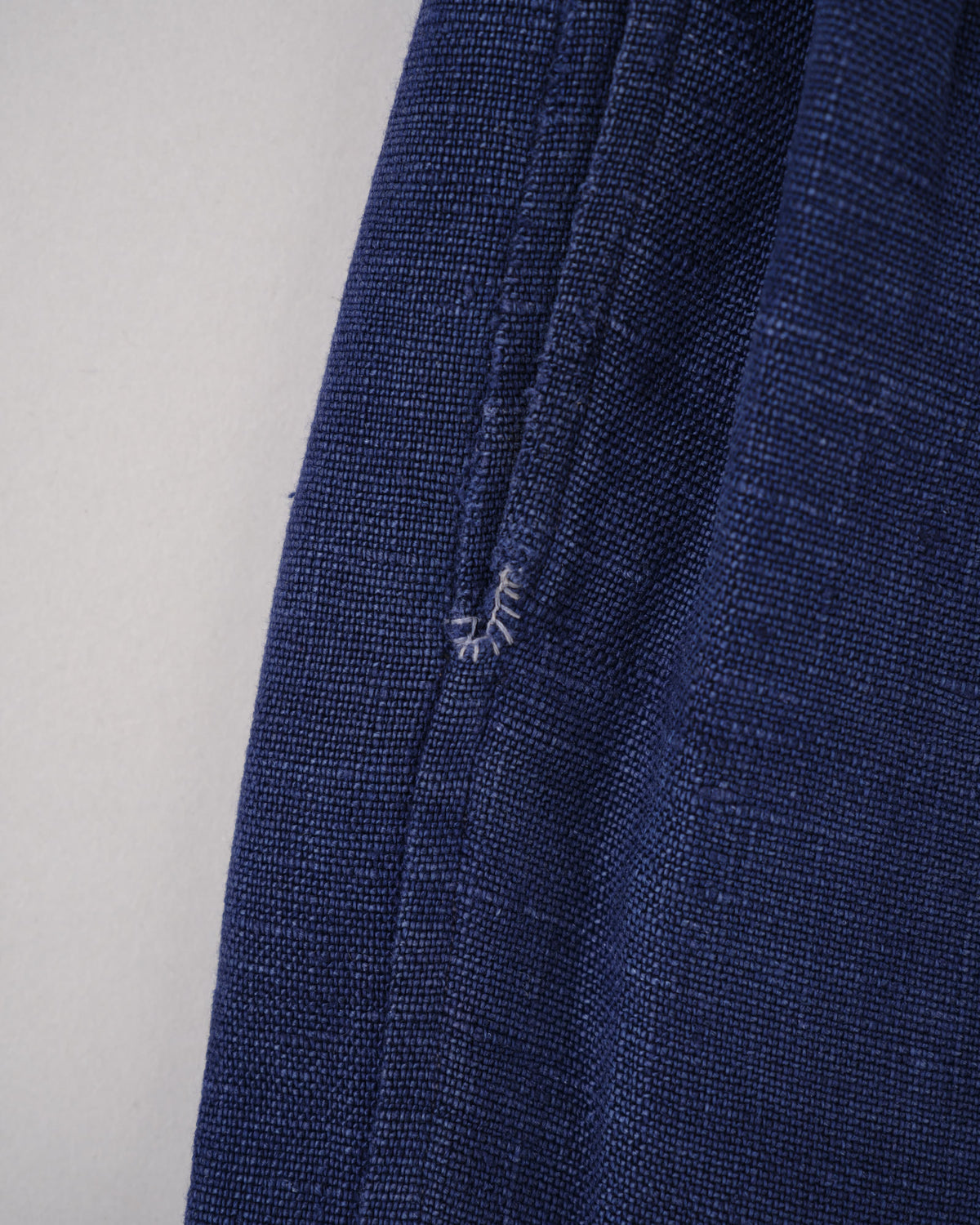
There are marks of use — soiling, fraying, tears, traces of repair — but no major damage that would impede wearing, so there is plenty of life in them yet.
All of these marks are equally proof that this pair actually worked, was mended, and worked again.
Having nothing to compare against is something that happens from time to time in this trade.
By whom, and where, this pair was made, and why the choice of a cross belt was arrived at — there is most likely no longer anyone holding the answer.
Yet looking at the two straps crossing at the waist, one comes to feel that there was certainly a moment when whoever made them thought, "this way works better".
Someone's ingenuity reaches us across time.
ADD TO CART

![[~40's] French Vintage Indigo Hemp Linen Cross Belt Work Pants](http://vieuxetnouveau-shop.com/cdn/shop/files/B0350-1_6cf0820e-e71c-4926-8b06-67943a08b577.jpg?v=1786431818&width=2400)
![[~40's] French Vintage Indigo Hemp Linen Cross Belt Work Pants](http://vieuxetnouveau-shop.com/cdn/shop/files/B0350-2_d21f7272-c0bf-4763-a945-d69ff2c56252.jpg?v=1786431818&width=2400)
![[~40's] French Vintage Indigo Hemp Linen Cross Belt Work Pants](http://vieuxetnouveau-shop.com/cdn/shop/files/B0350-3_95b632c3-9071-4581-9beb-3496967a9529.jpg?v=1786431818&width=2400)
![[~40's] French Vintage Indigo Hemp Linen Cross Belt Work Pants](http://vieuxetnouveau-shop.com/cdn/shop/files/B0350-4_509aad1f-f496-48c9-9ab9-db782bc6108a.jpg?v=1786431818&width=2400)
![[~40's] French Vintage Indigo Hemp Linen Cross Belt Work Pants](http://vieuxetnouveau-shop.com/cdn/shop/files/B0350-5_9cdc51fb-1d81-4997-95dc-917ece376b36.jpg?v=1786431818&width=2400)
![[~40's] French Vintage Indigo Hemp Linen Cross Belt Work Pants](http://vieuxetnouveau-shop.com/cdn/shop/files/B0350-6_b4bd2a73-8cc7-4ea0-a4d2-6050ce80c19e.jpg?v=1786431818&width=2400)
![[~40's] French Vintage Indigo Hemp Linen Cross Belt Work Pants](http://vieuxetnouveau-shop.com/cdn/shop/files/B0350-7_9f85af46-b8b3-4b7e-a3e3-5e6faed01573.jpg?v=1786431818&width=2400)
![[~40's] French Vintage Indigo Hemp Linen Cross Belt Work Pants](http://vieuxetnouveau-shop.com/cdn/shop/files/B0350-8_df280f62-2d13-440f-ae21-cc8f8d0166fa.jpg?v=1786431818&width=2400)
![[~40's] French Vintage Indigo Hemp Linen Cross Belt Work Pants](http://vieuxetnouveau-shop.com/cdn/shop/files/B0350-9_611f0eff-f610-4d4d-8553-2880e6f3acf8.jpg?v=1786431818&width=2400)
![[~40's] French Vintage Indigo Hemp Linen Cross Belt Work Pants](http://vieuxetnouveau-shop.com/cdn/shop/files/B0350-10_e251d466-db08-43d4-b1d9-117160f4205f.jpg?v=1786431818&width=2400)
![[~40's] French Vintage Indigo Hemp Linen Cross Belt Work Pants](http://vieuxetnouveau-shop.com/cdn/shop/files/B0350-11_743753bb-be6a-4227-a106-94667bdf15df.jpg?v=1786431818&width=2400)
![[~40's] French Vintage Indigo Hemp Linen Cross Belt Work Pants](http://vieuxetnouveau-shop.com/cdn/shop/files/B0350-12_9c62d4b6-35b7-4ed3-9b21-c8be3be0b8c9.jpg?v=1786431818&width=2400)
![[~40's] French Vintage Indigo Hemp Linen Cross Belt Work Pants](http://vieuxetnouveau-shop.com/cdn/shop/files/B0350-13_9115e4a6-ac1c-40e7-b42d-6e791d4f75bf.jpg?v=1786431818&width=2400)
![[~40's] French Vintage Indigo Hemp Linen Cross Belt Work Pants](http://vieuxetnouveau-shop.com/cdn/shop/files/B0350-14_0b6388fe-cd1e-48f1-a63d-7382650a9def.jpg?v=1786431818&width=2400)
![[~40's] French Vintage Indigo Hemp Linen Cross Belt Work Pants](http://vieuxetnouveau-shop.com/cdn/shop/files/B0350-15_3b960f5f-06be-4c41-ac7b-d89464eefb1a.jpg?v=1786431818&width=2400)
![[~40's] French Vintage Indigo Hemp Linen Cross Belt Work Pants](http://vieuxetnouveau-shop.com/cdn/shop/files/B0350-16_c233de19-0adc-40c8-b578-db7eaa704432.jpg?v=1786431818&width=2400)
![[~40's] French Vintage Indigo Hemp Linen Cross Belt Work Pants](http://vieuxetnouveau-shop.com/cdn/shop/files/B0350-17_22611b67-ac1c-41d0-a05d-00afb79ae6e4.jpg?v=1786431818&width=2400)
![[~40's] French Vintage Indigo Hemp Linen Cross Belt Work Pants](http://vieuxetnouveau-shop.com/cdn/shop/files/B0350-18_cdf24ad2-345b-4b35-a04e-9380f09d185c.jpg?v=1786431818&width=2400)
![[~40's] French Vintage Indigo Hemp Linen Cross Belt Work Pants](http://vieuxetnouveau-shop.com/cdn/shop/files/B0350-19_0b9d7e33-fc32-4c5a-8947-3961b8a2c578.jpg?v=1786431819&width=2400)
![[~40's] French Vintage Indigo Hemp Linen Cross Belt Work Pants](http://vieuxetnouveau-shop.com/cdn/shop/files/B0350-20_6b1475fe-f413-4243-9f7a-1e18b3295097.jpg?v=1786431819&width=2400)
![[~40's] French Vintage Indigo Hemp Linen Cross Belt Work Pants](http://vieuxetnouveau-shop.com/cdn/shop/files/B0350-21_fe0401b4-d3de-465c-a9cd-05a822f9ee26.jpg?v=1786431819&width=2400)
![[~40's] French Vintage Indigo Hemp Linen Cross Belt Work Pants](http://vieuxetnouveau-shop.com/cdn/shop/files/B0350-22_503ebb46-59f5-4e28-a05c-dbee7a3821e0.jpg?v=1786431819&width=2400)
![[~40's] French Vintage Indigo Hemp Linen Cross Belt Work Pants](http://vieuxetnouveau-shop.com/cdn/shop/files/B0350-23_6719e80c-ec9e-4417-8532-cac77367b51c.jpg?v=1786431819&width=2400)
![[~40's] French Vintage Indigo Hemp Linen Cross Belt Work Pants](http://vieuxetnouveau-shop.com/cdn/shop/files/B0350-24_a15f19bb-d59a-4f30-a167-cff03de7eda0.jpg?v=1786431819&width=2400)
![[~40's] French Vintage Indigo Hemp Linen Cross Belt Work Pants](http://vieuxetnouveau-shop.com/cdn/shop/files/B0350-25_9898c00f-8268-4998-bcbe-aab8f26af0ab.jpg?v=1786431819&width=2400)