A raglan-sleeve Harrington jacket by GRENFELL, which we date to around the 1960s.
And this one was made to the special order of "Pozzi & Co.", the long-established Milanese outfitter — a piece one does not often meet.
Speak of Grenfell and most of what appears on the market is the Golfer jacket.
The story begins in the 1920s, at a mill in Burnley, Lancashire, in the north-west of England.
Walter, at the head of "Haythornthwaite & Sons", wove extra-fine Egyptian cotton at the frankly unreasonable density of some 600 threads to the square inch.
This was the birth of the cloth later known as Grenfell Cloth.
The cloth took its name from "Sir Wilfred Grenfell", the missionary doctor who gave his life to the medical care of fishing communities in the far northern Labrador.
In time the cloth clothed the backs of Everest expeditions, was spoken of alongside the records of polar exploration, and came to receive a Royal Warrant.
Sewn into this piece is the woven label known as the "Mountain Tag".
Above sits the royal arms and a single line: "MANUFACTURERS OF GRENFELL CLOTH".
And directly below it.
A label on a cherry-pink ground, laid over with red crowns and crests, into which "Pozzi & Co." is woven in flowing script.
The British crown, and the Italian crown.
And yet a piece with such a lineage is, of all things, a Harrington.
The collar first. It is a turn-down collar worked in knitted rib, in a marled greige carrying slightly more red than the body cloth.
The front zip is by "AERO".
Flap pockets sit at either hip.
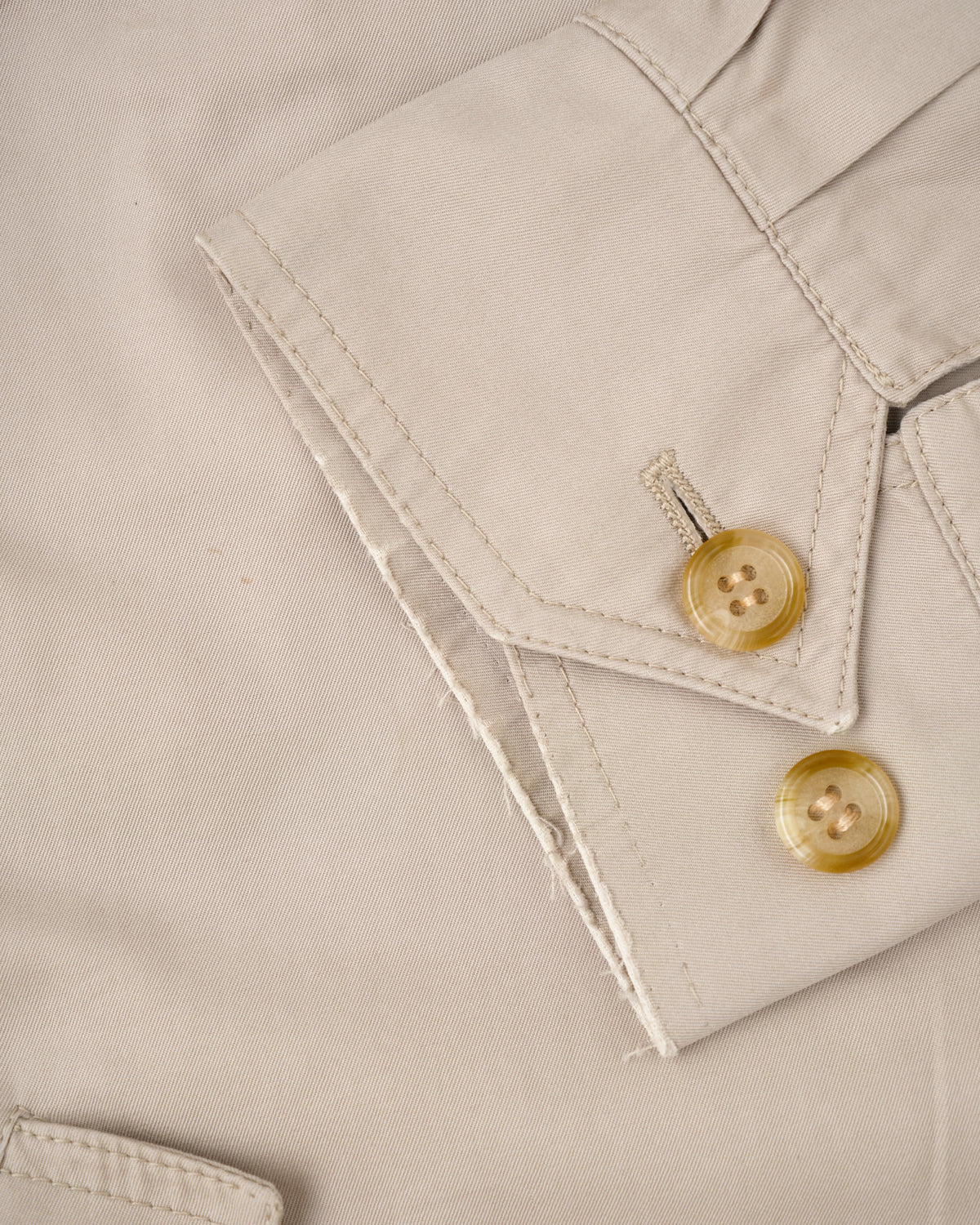
The cuffs follow the same idea: tab cuffs, with two buttons set vertically on a pointed placket.
And the hem, which is irregular again.
The sleeves are raglan, so no seam runs across the top of the shoulder.
The material is Grenfell Cloth, 100% cotton.
Look closely and you will see fine twill lines running regularly up to the right. What is striking is how tightly closed that weave is.
This cloth softens as the fibres settle with wear.
The colour is a "beige" like dry sand.
A mid tone that commits neither to yellow nor to grey, faded very slightly with age, now carrying a warmth close to milk tea.
Into that come the reddish greige of the rib, the amber buttons, the smoked brass of the zip.
Beige is a colour that reduces the number of moves the wearer must make.
A white shirt, grey trousers, loafers below. That alone is quite enough.
Conversely, it is an interesting piece worn with a black roll-neck or a charcoal knit, deliberately raising the contrast.
There is no size marking, but I should say it corresponds to roughly a Japanese "M to L".
The measurements too show a balance that settles nicely over a shirt or a knit.
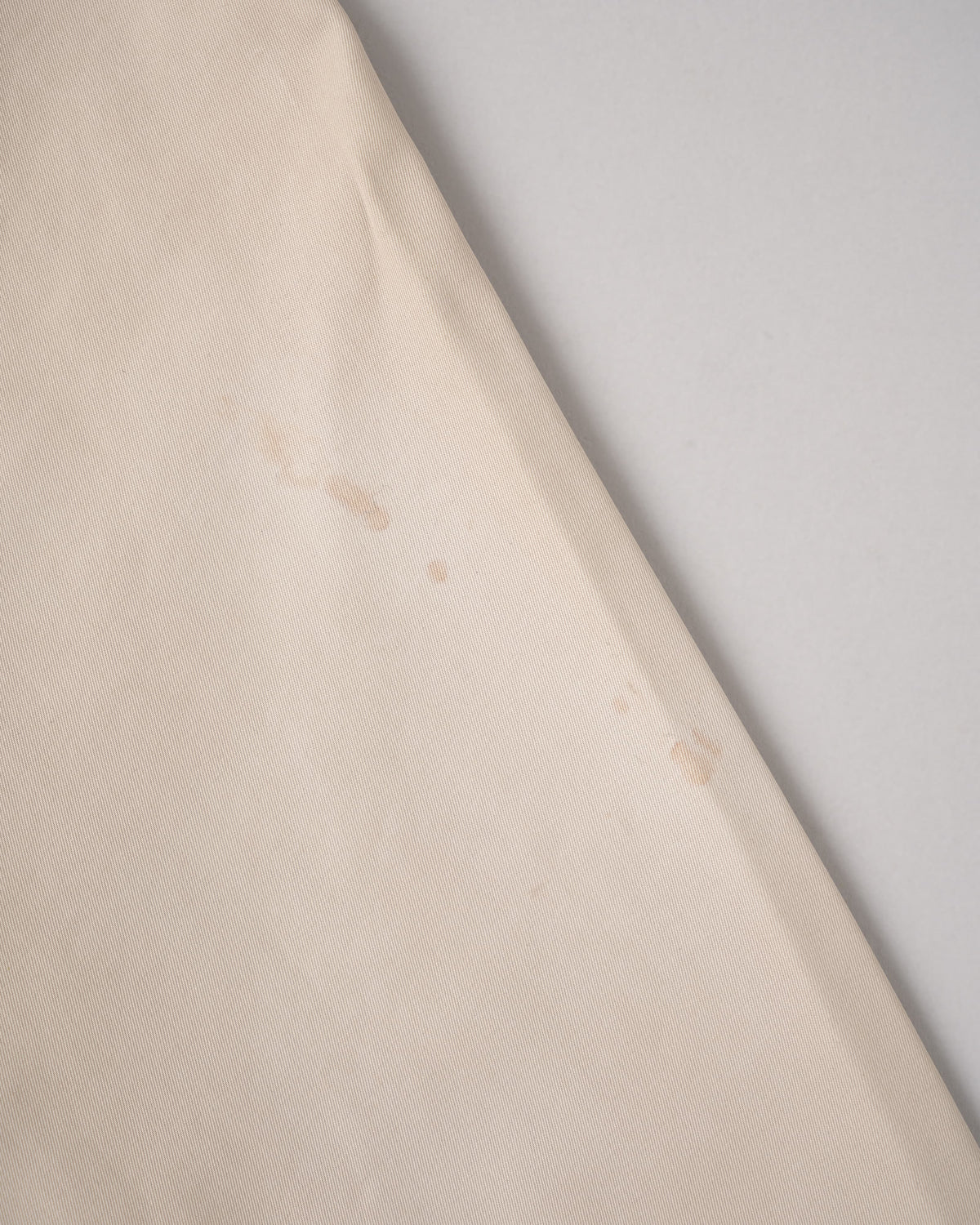
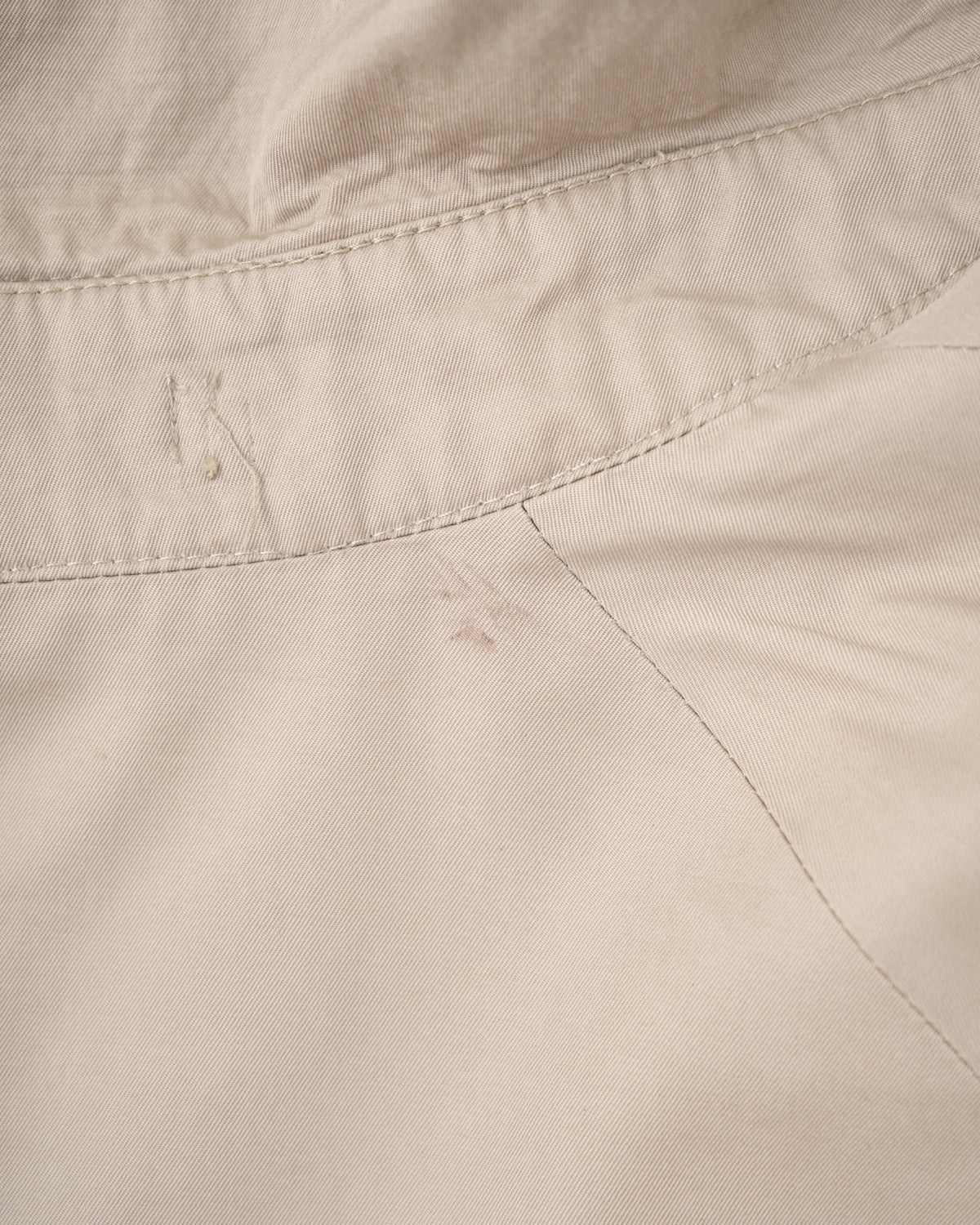
There are marks of use — soiling, rubbing, small holes — but no damage that would affect wearing, so there is plenty of life in it yet.
One last point of interest.
Italy abolished the monarchy by referendum in 1946.
Grenfell is still with us, but cloth from the Mountain Tag era, made moreover to the special order of a Milanese royal warrant holder, and cut as a Harrington besides.
Cloth approved by one crown, sold by a shop approved by another.
ADD TO CART

![[~60’s] Vintage Grenfell Raglan Sleeve Harrington Jacket "Mountain Tag" "POZZI&Co. 別注"](http://vieuxetnouveau-shop.com/cdn/shop/files/J01080-1_51c11131-dd9d-4d19-a1e2-3d1232771e9a.jpg?v=1786431588&width=2400)
![[~60’s] Vintage Grenfell Raglan Sleeve Harrington Jacket "Mountain Tag" "POZZI&Co. 別注"](http://vieuxetnouveau-shop.com/cdn/shop/files/J01080-2_8e863b41-84ce-4cd9-b0d3-9779ee4dee80.jpg?v=1786431588&width=2400)
![[~60’s] Vintage Grenfell Raglan Sleeve Harrington Jacket "Mountain Tag" "POZZI&Co. 別注"](http://vieuxetnouveau-shop.com/cdn/shop/files/J01080-3_3a626aa4-1b3f-4d72-81c0-3d479d92e48e.jpg?v=1786431588&width=2400)
![[~60’s] Vintage Grenfell Raglan Sleeve Harrington Jacket "Mountain Tag" "POZZI&Co. 別注"](http://vieuxetnouveau-shop.com/cdn/shop/files/J01080-4_722f32d3-ed5f-4a55-9255-ac82e4d46b1e.jpg?v=1786431588&width=2400)
![[~60’s] Vintage Grenfell Raglan Sleeve Harrington Jacket "Mountain Tag" "POZZI&Co. 別注"](http://vieuxetnouveau-shop.com/cdn/shop/files/J01080-5_c9b1ec74-b7e6-4f6d-81c5-f487fb12a389.jpg?v=1786431588&width=2400)
![[~60’s] Vintage Grenfell Raglan Sleeve Harrington Jacket "Mountain Tag" "POZZI&Co. 別注"](http://vieuxetnouveau-shop.com/cdn/shop/files/J01080-6_2971809a-4550-462a-8912-897afaea4804.jpg?v=1786431588&width=2400)
![[~60’s] Vintage Grenfell Raglan Sleeve Harrington Jacket "Mountain Tag" "POZZI&Co. 別注"](http://vieuxetnouveau-shop.com/cdn/shop/files/J01080-7_202a8714-19ea-4e9e-b515-cfdc6ecda285.jpg?v=1786431588&width=2400)
![[~60’s] Vintage Grenfell Raglan Sleeve Harrington Jacket "Mountain Tag" "POZZI&Co. 別注"](http://vieuxetnouveau-shop.com/cdn/shop/files/J01080-8_1a42a0bc-6ae1-4e9e-8d16-bf8470c64463.jpg?v=1786431589&width=2400)
![[~60’s] Vintage Grenfell Raglan Sleeve Harrington Jacket "Mountain Tag" "POZZI&Co. 別注"](http://vieuxetnouveau-shop.com/cdn/shop/files/J01080-9_06c1467e-2eef-4059-8fca-d0aa89fc7dc4.jpg?v=1786431589&width=2400)
![[~60’s] Vintage Grenfell Raglan Sleeve Harrington Jacket "Mountain Tag" "POZZI&Co. 別注"](http://vieuxetnouveau-shop.com/cdn/shop/files/J01080-10_d85434b1-30ee-4dbe-95f6-36466157a31e.jpg?v=1786431589&width=2400)
![[~60’s] Vintage Grenfell Raglan Sleeve Harrington Jacket "Mountain Tag" "POZZI&Co. 別注"](http://vieuxetnouveau-shop.com/cdn/shop/files/J01080-11_7cfba3fc-3269-4cc6-ad38-ea5da530b6fa.jpg?v=1786431589&width=2400)
![[~60’s] Vintage Grenfell Raglan Sleeve Harrington Jacket "Mountain Tag" "POZZI&Co. 別注"](http://vieuxetnouveau-shop.com/cdn/shop/files/J01080-12_8dafca68-2481-43b1-a720-9cf50a1e2161.jpg?v=1786431589&width=2400)
![[~60’s] Vintage Grenfell Raglan Sleeve Harrington Jacket "Mountain Tag" "POZZI&Co. 別注"](http://vieuxetnouveau-shop.com/cdn/shop/files/J01080-13_fb3bd9df-e4da-4ff1-8e0b-b266d60ecd12.jpg?v=1786431589&width=2400)
![[~60’s] Vintage Grenfell Raglan Sleeve Harrington Jacket "Mountain Tag" "POZZI&Co. 別注"](http://vieuxetnouveau-shop.com/cdn/shop/files/J01080-14_fd204656-bc6e-4cfc-8782-896682abf50e.jpg?v=1786431589&width=2400)
![[~60’s] Vintage Grenfell Raglan Sleeve Harrington Jacket "Mountain Tag" "POZZI&Co. 別注"](http://vieuxetnouveau-shop.com/cdn/shop/files/J01080-15_c1e58b52-acc9-441c-ac77-4270a1bd1a2f.jpg?v=1786431589&width=2400)
![[~60’s] Vintage Grenfell Raglan Sleeve Harrington Jacket "Mountain Tag" "POZZI&Co. 別注"](http://vieuxetnouveau-shop.com/cdn/shop/files/J01080-16_acc2255a-ff3d-4355-bd0d-bfed27812959.jpg?v=1786431589&width=2400)
![[~60’s] Vintage Grenfell Raglan Sleeve Harrington Jacket "Mountain Tag" "POZZI&Co. 別注"](http://vieuxetnouveau-shop.com/cdn/shop/files/J01080-17_aef4f2d8-2ea6-4597-857f-5d34f8c78f1d.jpg?v=1786431589&width=2400)
![[~60’s] Vintage Grenfell Raglan Sleeve Harrington Jacket "Mountain Tag" "POZZI&Co. 別注"](http://vieuxetnouveau-shop.com/cdn/shop/files/J01080-18_4c36a4a7-540e-4ca8-bc24-8812f46fcb96.jpg?v=1786431589&width=2400)
![[~60’s] Vintage Grenfell Raglan Sleeve Harrington Jacket "Mountain Tag" "POZZI&Co. 別注"](http://vieuxetnouveau-shop.com/cdn/shop/files/J01080-19_ed6fb740-5e9a-4f7d-9844-01f02e897f8f.jpg?v=1786431589&width=2400)
![[~60’s] Vintage Grenfell Raglan Sleeve Harrington Jacket "Mountain Tag" "POZZI&Co. 別注"](http://vieuxetnouveau-shop.com/cdn/shop/files/J01080-20_7da1e8f2-2322-445d-acfc-5a3abc6d2d71.jpg?v=1786431589&width=2400)
![[~60’s] Vintage Grenfell Raglan Sleeve Harrington Jacket "Mountain Tag" "POZZI&Co. 別注"](http://vieuxetnouveau-shop.com/cdn/shop/files/J01080-21_c3226766-5655-492e-b618-0e1adbf6e538.jpg?v=1786431589&width=2400)
![[~60’s] Vintage Grenfell Raglan Sleeve Harrington Jacket "Mountain Tag" "POZZI&Co. 別注"](http://vieuxetnouveau-shop.com/cdn/shop/files/J01080-22_ed489e34-38be-4eb9-ad10-eca64cef0e28.jpg?v=1786431589&width=2400)
![[~60’s] Vintage Grenfell Raglan Sleeve Harrington Jacket "Mountain Tag" "POZZI&Co. 別注"](http://vieuxetnouveau-shop.com/cdn/shop/files/J01080-23_15ad35c9-d654-4f5d-86bc-1eec1b068567.jpg?v=1786431589&width=2400)
![[~60’s] Vintage Grenfell Raglan Sleeve Harrington Jacket "Mountain Tag" "POZZI&Co. 別注"](http://vieuxetnouveau-shop.com/cdn/shop/files/J01080-24_e3027ccb-d721-4850-a335-899a0c0340e8.jpg?v=1786431589&width=2400)
![[~60’s] Vintage Grenfell Raglan Sleeve Harrington Jacket "Mountain Tag" "POZZI&Co. 別注"](http://vieuxetnouveau-shop.com/cdn/shop/files/J01080-25_17dc6916-fc0d-4183-bc6f-2000030d8db7.jpg?v=1786431589&width=2400)