A lambskin shawl-collar coat by GUCCI, which we date to around the 1970s.
The moment I touched it, my hand stopped.
We have offered a great many leather products over the years, but to be won over this completely by the quality of the leather itself does not happen often.
The story begins at the Savoy Hotel in London.
Guccio Gucci, born in Florence in 1881, worked there as a bellboy in his youth.
He returned to Florence and, in 1921, opened a small leather goods shop on Via della Vigna Nuova.
Working with skilled Tuscan artisans, he carried the techniques of saddlery over into bags and shoes.
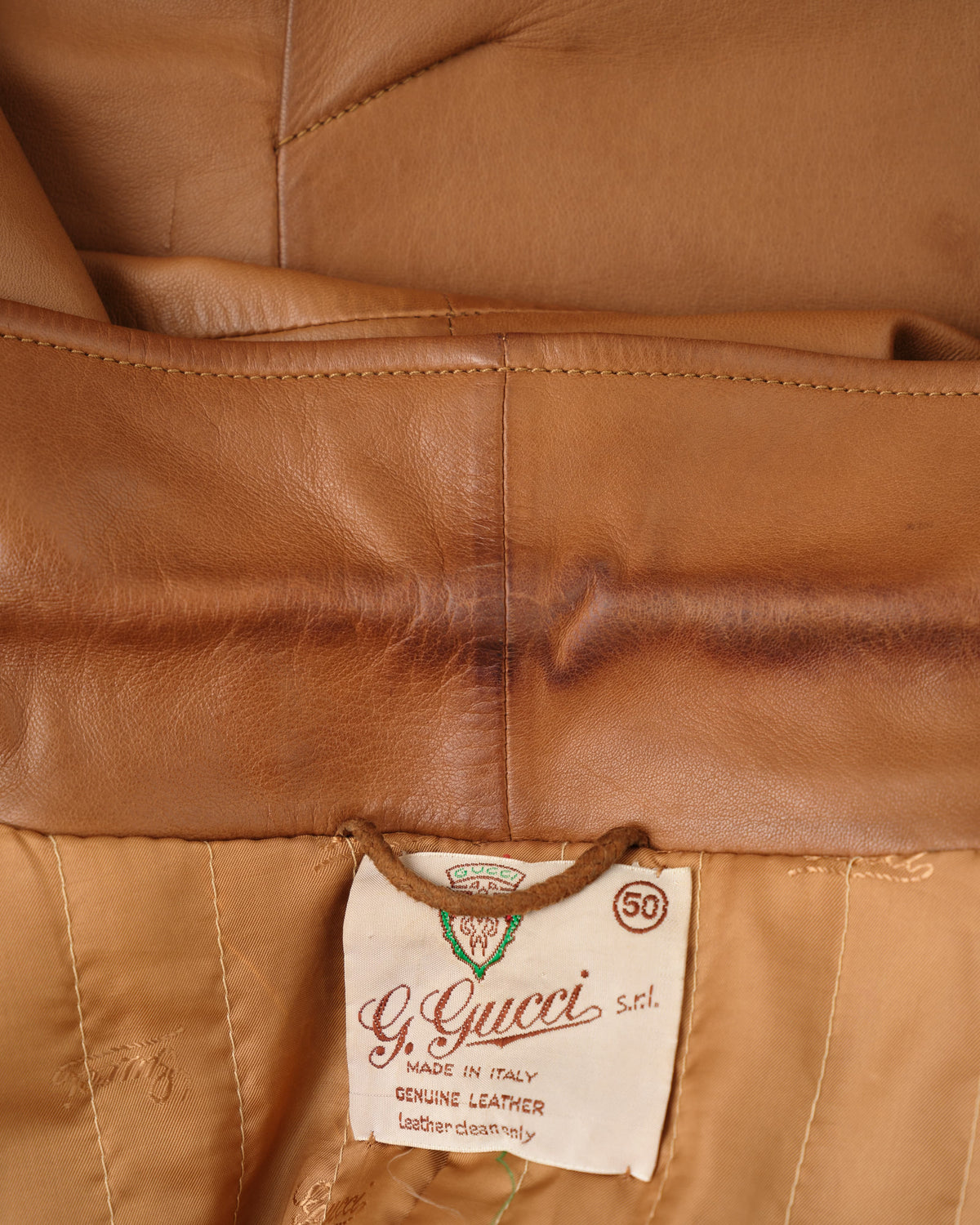
Sewn inside this piece is the script logo "G. Gucci s.r.l.", woven in brown on an unbleached ground.
Is this not a label that quietly tells us Gucci of this period was still a leather workshop?
Now, let us look at the details that define this model.
First, what settles the character of this piece is the shawl collar.
Speak of a leather coat and the usual idea is to turn the collar up and wear it wild; this pattern goes precisely the other way.
The construction follows that of a tailored jacket.
A pocket at the left breast. Flap pockets at both hips.
A change pocket is for coins, and adding one to the right side alone is a classical practice deriving from British tailoring.
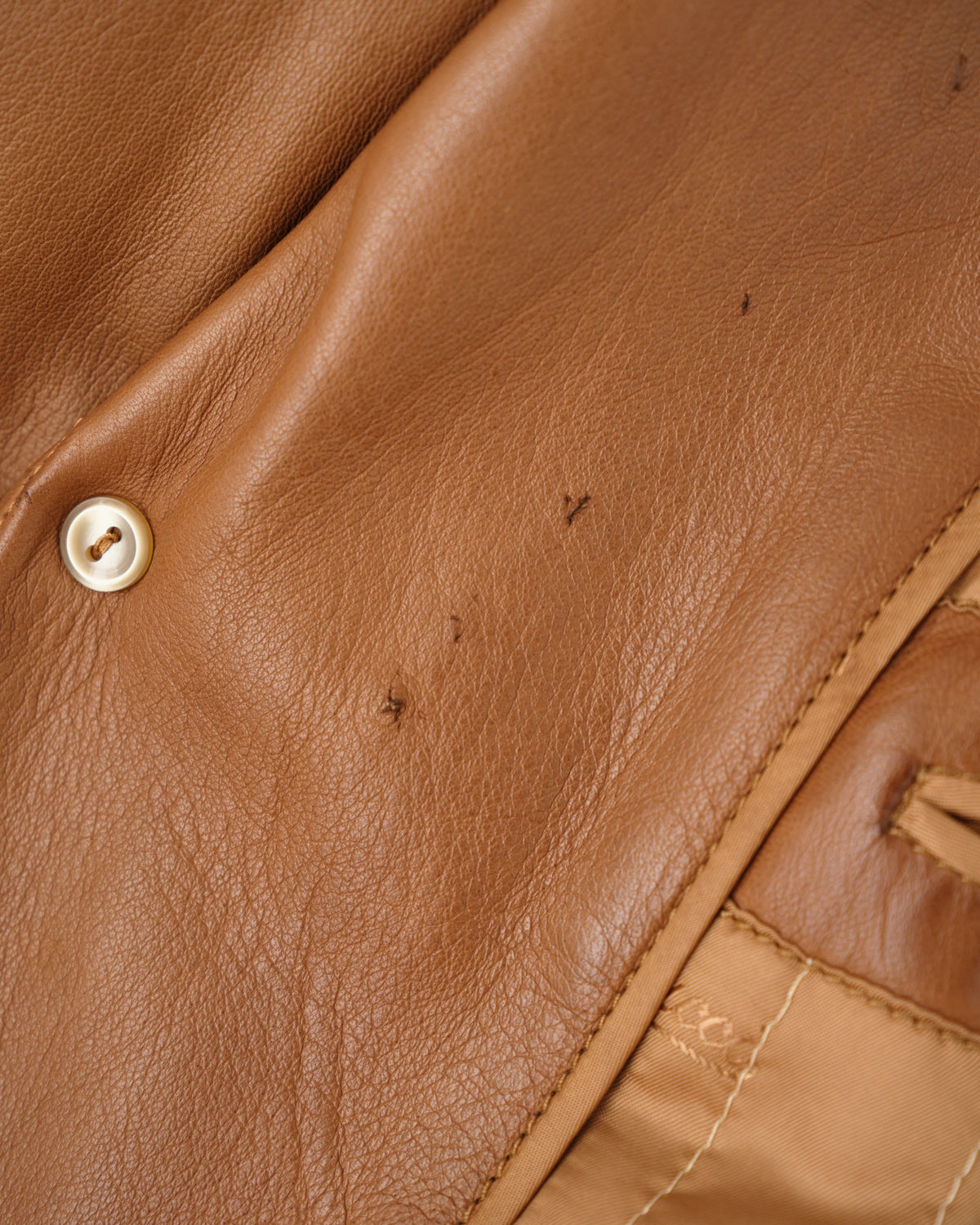
The front has three buttons.
The lining is likely rayon.
The material is lambskin.
There is no sense of weight whatsoever. The instant you put it on, the feeling of wearing a coat simply disappears.
Look closely and an extremely fine grain runs uniformly across it.
To reconcile this softness with this evenness, no compromise is possible at any stage, from the selection of the hides to the tanning.
And lambskin is a leather that grows with the wearer's warmth and movement.
The colour is "camel brown".
A dry, caramel-like brown, holding back both red and black.
Brown in leather turns frivolous when lightened and heavy when darkened. This strikes precisely the mid depth, the most difficult of all.
Including the apricot of the lining, the whole is unified in warm tones. Amid the heavy dress of winter, this colour will certainly hold body heat.
For styling, I think the correct answer is to take it towards the refined.
A knit, wool trousers, loafers or Chelsea boots below. The roundness of the shawl collar gathers the whole into something elegant.
Taking it down to denim and letting the quality of the leather do all the work is interesting too. Where the material is good, dress grows stronger the more you strip away.
The size marking is "50".
The measurements too show enough room to go over a jacket.
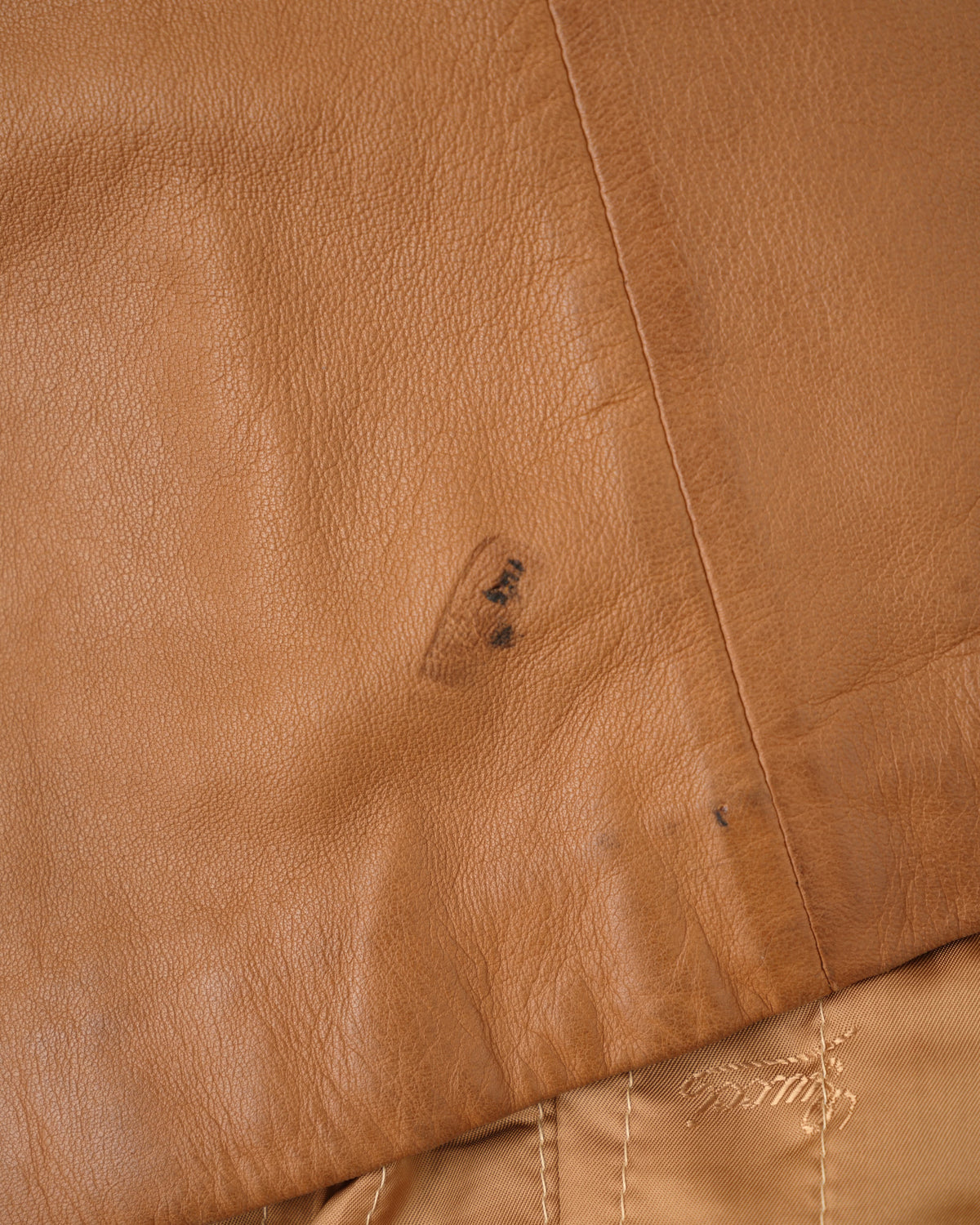
There are marks of use — soiling, scratches, replaced buttons — but no damage that would affect wearing, so there is plenty of life in it yet.
The front buttons have been replaced, but two spare buttons come attached inside, so anyone troubled by this can change them over at home.
We once handled a tailored jacket in the same colour and the same texture.
Gucci as a brand is still very much with us worldwide, but products standing in the direct line of the Florentine workshop, from the days when it called itself "G. Gucci s.r.l.", are of course no longer made.
Softness can be produced by technique. But to produce this softness with this evenness, the quality of the raw hide itself is required.
The bags a hotel bellboy once looked up at.
ADD TO CART

![[~70’s] Old GUCCI Lambskin Leather Shawl Collar Coat Size.50](http://vieuxetnouveau-shop.com/cdn/shop/files/C0184-1_1a8db550-ec48-4f7a-928f-e6111ad8dff3.jpg?v=1786431726&width=2400)
![[~70’s] Old GUCCI Lambskin Leather Shawl Collar Coat Size.50](http://vieuxetnouveau-shop.com/cdn/shop/files/C0184-2_1c92c4f1-4f1c-4d07-adf0-f253f761daef.jpg?v=1786431726&width=2400)
![[~70’s] Old GUCCI Lambskin Leather Shawl Collar Coat Size.50](http://vieuxetnouveau-shop.com/cdn/shop/files/C0184-3_f2fccfc7-f772-44fa-9d3e-72d5266b3a09.jpg?v=1786431726&width=2400)
![[~70’s] Old GUCCI Lambskin Leather Shawl Collar Coat Size.50](http://vieuxetnouveau-shop.com/cdn/shop/files/C0184-4_f9f8bf9f-ff9c-41cf-b995-9847e57946a3.jpg?v=1786431726&width=2400)
![[~70’s] Old GUCCI Lambskin Leather Shawl Collar Coat Size.50](http://vieuxetnouveau-shop.com/cdn/shop/files/C0184-5_16d87944-1f32-40c8-a428-f2ffdec20bad.jpg?v=1786431726&width=2400)
![[~70’s] Old GUCCI Lambskin Leather Shawl Collar Coat Size.50](http://vieuxetnouveau-shop.com/cdn/shop/files/C0184-6_cd630331-750b-418a-938c-61c684c19fc0.jpg?v=1786431726&width=2400)
![[~70’s] Old GUCCI Lambskin Leather Shawl Collar Coat Size.50](http://vieuxetnouveau-shop.com/cdn/shop/files/C0184-7_4fd662cb-6170-4d37-a0af-f1974d6b76ee.jpg?v=1786431726&width=2400)
![[~70’s] Old GUCCI Lambskin Leather Shawl Collar Coat Size.50](http://vieuxetnouveau-shop.com/cdn/shop/files/C0184-8_f5c57298-e2b1-4d02-bcca-3abbb0e890f9.jpg?v=1786431726&width=2400)
![[~70’s] Old GUCCI Lambskin Leather Shawl Collar Coat Size.50](http://vieuxetnouveau-shop.com/cdn/shop/files/C0184-9_228b23ee-499b-4c40-a315-0ee5e2fb0207.jpg?v=1786431726&width=2400)
![[~70’s] Old GUCCI Lambskin Leather Shawl Collar Coat Size.50](http://vieuxetnouveau-shop.com/cdn/shop/files/C0184-10_272b8864-ad9d-45ec-a904-d94ed835b0c0.jpg?v=1786431726&width=2400)
![[~70’s] Old GUCCI Lambskin Leather Shawl Collar Coat Size.50](http://vieuxetnouveau-shop.com/cdn/shop/files/C0184-11_5c07c01a-f393-4129-b2ab-f3dde4792c9f.jpg?v=1786431726&width=2400)
![[~70’s] Old GUCCI Lambskin Leather Shawl Collar Coat Size.50](http://vieuxetnouveau-shop.com/cdn/shop/files/C0184-12_56b6637a-b61e-4e68-81d1-9efd5f72321c.jpg?v=1786431726&width=2400)
![[~70’s] Old GUCCI Lambskin Leather Shawl Collar Coat Size.50](http://vieuxetnouveau-shop.com/cdn/shop/files/C0184-13_95fe9b59-0e63-4c20-afce-0e822dabb7cc.jpg?v=1786431726&width=2400)
![[~70’s] Old GUCCI Lambskin Leather Shawl Collar Coat Size.50](http://vieuxetnouveau-shop.com/cdn/shop/files/C0184-14_4fac7e52-279a-49f9-894a-262a157fc0c2.jpg?v=1786431726&width=2400)
![[~70’s] Old GUCCI Lambskin Leather Shawl Collar Coat Size.50](http://vieuxetnouveau-shop.com/cdn/shop/files/C0184-15_e982f9e7-31ce-4cc4-a09a-cacc279acd97.jpg?v=1786431726&width=2400)
![[~70’s] Old GUCCI Lambskin Leather Shawl Collar Coat Size.50](http://vieuxetnouveau-shop.com/cdn/shop/files/C0184-16_3228eaaa-2b5f-46fb-a361-ac1d79392175.jpg?v=1786431726&width=2400)
![[~70’s] Old GUCCI Lambskin Leather Shawl Collar Coat Size.50](http://vieuxetnouveau-shop.com/cdn/shop/files/C0184-17_1d764893-9994-43d8-9eb8-168cca5ab2f3.jpg?v=1786431726&width=2400)
![[~70’s] Old GUCCI Lambskin Leather Shawl Collar Coat Size.50](http://vieuxetnouveau-shop.com/cdn/shop/files/C0184-18_2094022b-fedc-41a1-ba81-fec425e75e35.jpg?v=1786431726&width=2400)
![[~70’s] Old GUCCI Lambskin Leather Shawl Collar Coat Size.50](http://vieuxetnouveau-shop.com/cdn/shop/files/C0184-19_10a2b12e-d21b-4e0b-bd15-7fcd6b56a84f.jpg?v=1786431726&width=2400)
![[~70’s] Old GUCCI Lambskin Leather Shawl Collar Coat Size.50](http://vieuxetnouveau-shop.com/cdn/shop/files/C0184-20_865e5cc7-ed27-4802-a793-6978986db2a7.jpg?v=1786431726&width=2400)
![[~70’s] Old GUCCI Lambskin Leather Shawl Collar Coat Size.50](http://vieuxetnouveau-shop.com/cdn/shop/files/C0184-21_b2b1fd27-5bed-4a80-afd1-ca8fe4e3ea1f.jpg?v=1786431726&width=2400)
![[~70’s] Old GUCCI Lambskin Leather Shawl Collar Coat Size.50](http://vieuxetnouveau-shop.com/cdn/shop/files/C0184-22_ebf4429a-7f96-4c60-9e43-326599152395.jpg?v=1786431726&width=2400)
![[~70’s] Old GUCCI Lambskin Leather Shawl Collar Coat Size.50](http://vieuxetnouveau-shop.com/cdn/shop/files/C0184-23_d99e42ff-a765-4d17-ab63-1efb8fa8654d.jpg?v=1786431726&width=2400)
![[~70’s] Old GUCCI Lambskin Leather Shawl Collar Coat Size.50](http://vieuxetnouveau-shop.com/cdn/shop/files/C0184-24_8e136b21-7e23-4870-aea7-cf55b6bee9b5.jpg?v=1786431726&width=2400)
![[~70’s] Old GUCCI Lambskin Leather Shawl Collar Coat Size.50](http://vieuxetnouveau-shop.com/cdn/shop/files/C0184-25_c3d89c01-e183-4512-8991-63123c543b8a.jpg?v=1786431726&width=2400)
![[~70’s] Old GUCCI Lambskin Leather Shawl Collar Coat Size.50](http://vieuxetnouveau-shop.com/cdn/shop/files/C0184-26_bb6fa5bf-b266-4acf-81b3-d89866b7b8dd.jpg?v=1786431726&width=2400)
![[~70’s] Old GUCCI Lambskin Leather Shawl Collar Coat Size.50](http://vieuxetnouveau-shop.com/cdn/shop/files/C0184-27_39d34e6e-16a7-48f9-8931-493724e4d68b.jpg?v=1786431726&width=2400)